
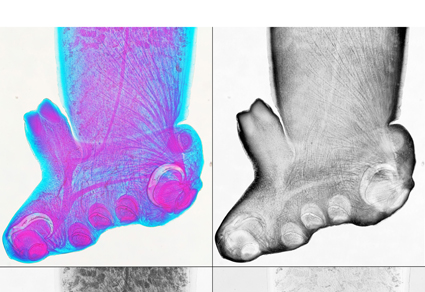

Abstract
Herein, detailed supplementary descriptions and novel nucleotide sequences are provided for Heteronchocotyle leucas Hargis and Erpocotyle carcharhini Watson & Thorson (Monogenea: Hexabothriidae). This is the first report of a hexabothriid from an Australian carcharhinid (Elasmobranchii: Carcharhiniformes: Carcharhinidae) and the first record of these hexabothriid species from Australia, constituting new host records. Heteronchocotyle leucas is reported from Carcharhinus leucas (Valenciennes), C. amboinensis (Müller & Henle) and Negaprion acutidens (Rüppell), whereas E. carcharhini is reported from C. leucas and C. amboinensis, all from off the Capricorn coastline, Queensland. Heteronchocotyle leucas demonstrated significant size range differences in multiple measurement variables in populations from different hosts suggesting that worms could adapt in size to the different gill microhabitat architecture of different hosts species. A strong statistical positive correlation (p < 0.05) in the size of most sclerite variables of sclerite pairs 1A, 1B and 2B with the growth of H. leucas was demonstrated, indicating that sucker sclerites grow as the worm grows but that the functional shape of these sclerites is conserved. The three smallest sclerites of H. leucas, 2A, 3A and 3B demonstrate less correlation with growth, especially with the sclerite hook, which develops first. This suggests that these three sclerite pairs develop functionality early in the ontogeny of the worm post host-invasion but become increasingly redundant with increased growth, as the main sclerites develop. This is also supported by the haptoral musculature, which is minimal in these smallest sclerites but considerable in the others. Details of the reproductive system of H. leucas are provided that were incorrectly interpreted in the type-description. Heteronchocotyle leucas and E. carcharhini 28S molecular sequences are provided for the first time. The phylogenetic position of H. leucas and E. carcharhini within the Hexabothriidae, based on 28S sequences, is explored and briefly discussed.
References
- Agrawal, N., Chisholm, L.A. & Whittington, I.D. (1996) Pseudohexabothrium taeniurae n. sp. (Monogenea: Hexabothriidae) from the gills of Taeniura lymma (Dasyatididae) from the Great Barrier Reef, Australia. Journal of Parasitology, 82 (1), 131–136. https://doi.org/10.2307/3284128
- Badets, M., Whittington, I., Lalubin, F., Allienne, J.-F., Maspimby, J.-L., Betz, S., Du Preez, L.H., Barton, D., Hasegawa, H., Tandon, V., Imkongwapang, R., Ohler, A., Combes, C. & Verneau, O. (2011) Correlating early evolution of parasitic platyhelminths to Gondwana breakup. Systematic Parasitology, 60 (6), 762–781. https://doi.org/10.1093/sysbio/syr078
- Beverley-Burton, M. & Chisholm, L.A. (1990) Callorhynchocotyle hydrolagi n. sp. (Monogenea: Hexabothriidae) from Hydrolagus ogilbyi (Chimaeriformes: Chimaeridae) in the South Pacific. Systematic Parasitology, 16, 241–246. https://doi.org/10.1007/BF00009151
- Boeger, W.A. & Kritsky, D.C. (1989) Phylogeny, coevolution, and revision of the Hexabothriidae Price, 1942 (Monogenea). International Journal for Parasitology, 19, 425–440. https://doi.org/10.1016/0020-7519(89)90099-4
- Brinkmann, A. (1952) Fish trematodes from Norwegian waters. I. The history of fish trematode investigations in Norway and the Norwegian species of the order Monogenea. Årbok for Universitetet i Bergen, Naturvitenskapelig rekke, 1, 1–134.
- Brooks, G.L. (1934) Some new ectoparasitic trematodes (Onchocotylinae) from the gills of American sharks. Parasitology, 26 (2), 259–267. https://doi.org/10.1017/S0031182000023544
- Cerfontaine, P. (1899) Contribution à l’étude des Octocotylidés. V. Onchocotylinae (Planches XVIII a XXI). Archives de Biologie, Liège, 16, 345–478.
- Chero, J.D., Cruces, C.L., Sáez, G., Camargo, A.C.A., Portes Santos, C. & Luque, J.L. (2018) Hypanocotyle bullardi n. gen. n. sp. (Monogenea: Hexabothriidae) from gill of the diamond stingray Hypanus dipterurus (Jordan et Gilbert) (Myliobatiformes: Dasyatidae) in the Southeastern Pacific Ocean off Peru. Parasitology International, 67, 425–430. https://doi.org/10.1016/j.parint.2018.03.010
- Chero, J.D., Cruces, C.L., Sáez, G., Camargo, A.C.A., Portes Santos, C. & Luque, J.L. (2019) Redescription and first nucleotide sequences of Rhinobatonchocotyle pacifica Oliva & Luque, 1995 (Monogenea: Hexabothriidae), a parasite of Pseudobatos planiceps (Garman, 1880) (Rhinopristiformes: Rhinobatidae) from Peru. Acta Parasitologica, 64, 797–806. https://doi.org/10.2478/S11686-019-00101-4
- Chisholm, L.A., Morgan, J.A.T., Adlard, R.D. & Whittington, I.D. (2001a) Phylogenetic analysis of the Monocotylidae (Monogenea) inferred from 28S rDNA sequences. International Journal for Parasitology, 31, 1537–1547. https://doi.org/10.1016/S0020-7519(01)00313-7
- Chisholm, L.A., Whittington, I.D., Morgan, J.A.T. & Adlard, R.D. (2001b) The Calicotyle conundrum: Do molecules reveal more than morphology? Systematic Parasitology, 49, 81–87. https://doi.org/10.1023/A:1010629022955
- Dalrymple, K.M., de Buron, I., Hill-Spanik, K.K., Galloway, A.S., Barker, A., Portnoy, D.S., Frazier, B.S. & Boeger, W.A. (2022) Hexabothriidae and Monocotylidae (Monogenoidea) from the gills of neonate hammerhead sharks (Sphyrnidae) Sphyrna gilberti, Sphyrna lewini and their hybrids from the western North Atlantic Ocean. Parasitology, 149, 1910–1927. https://doi.org/10.1017/S0031182022001007
- Dalrymple, K.M., Razzolini, E.L. & Boeger, W.A. (2025) Total-evidence phylogenetic hypothesis of Hexabothriidae Price, 1942. Parasitology International, 109, 103107. https://doi.org/10.1016/j.parint.2025.103107
- Domingues, M.V., Pancera, N.C.M. & Marques, F.P.L. (2007) Monogenoidean parasites of freshwater stingrays (Rajiformes: Potamotrygonidae) from the Negro River, Amazon, Brazil: species of Potamotrygonocotyle (Monocotylidae) and Paraheteronchocotyle (Hexabothriidae). Folia Parasitologica, 54, 177–190. https://doi.org/10.14411/fp.2007.025
- El Mouna Ayadi, Z., Gey, D., Justine, J-L. & Tazerouti, F. (2017) A new species of Microcotyle (Monogenea: Microcotylidae) from Scorpaena notata (Teleostei: Scorpaenidae) in the Mediterranean Sea. Parasitology International, 66 (2), 37–42. https://doi.org/10.1016/j.parint.2016.11.004
- Euzet, L. & Maillard, C. (1967) Parasites de Poissons de mer ouest-africains récoltés par J. Cadenat. VI. Monogènes de Sélaciens. Bulletin de L’Institut français d’Afrique noire, Série A, 29 (4), 1435–1493.
- Fankoua, S-O., Bitja Nyom, A.R., Bahanak, D.n.d., Bilong Bilong, C.F. & Pariselle, A. (2017) Influence of preservative and mounting media on the size and shape of monogenean sclerites. Parasitology Research, 116, 2277–2281. https://doi.org/10.1007/s00436-017-5534-7
- Glennon, V., Chisholm, L.A. & Whittington, I.D. (2005) Branchotenthes octohamatus sp. n. (Monogenea: Hexabothriidae) from the gills of the southern fiddler ray, Trygonorrhina fasciata (Rhinobatidae) in South Australia: Description of adult and larva. Folia Parasitologica, 52 (3), 223–230. https://doi.org/10.14411/fp.2005.030
- Glennon, V., Chisholm, L.A. & Whittington, I.D. (2007) Experimental infections, using a fluorescent marker, of two elasmobranch species by unciliated larvae of Branchotenthes octohamatus (Monogenea: Hexabothriidae): invasion route, host specificity and post-larval development. Parasitology, 134, 1243–1252. https://doi.org/10.1017/S0031182007002545
- Hargis, W.T. Jr. (1955) Monogenetic trematodes of Gulf of Mexico fishes. Part VI. The superfamilies Polystomatoidea Price, 1936 and Diclidophoroidea Price, 1936. Transactions of the American Microscopical Society, 74 (4), 361–377. https://doi.org/10.2307/3224172
- Hoang, D.T., Chernomor, O., von Haeseler, A., Minh, B.Q. & Vinh, L.S. (2017) UFBoot2: Improving the ultrafast bootstrap approximation. Molecular Biology and Evolution, 35 (2), 518–522. https://doi.org/10.1093/molbev/msx281
- Huelsenbeck, J.P. & Ronquist, F. (2001) MRBAYES: Bayesian inference of phylogenetic trees. Bioinformatics, 17, 754–755. https://doi.org/10.1093/bioinformatics/17.8.754
- Iwata, K. (1991) Ectoparasitic trematodes from marine fishes of Kyusyu, Japan II. The family Hexabothriidae and Diclidophoridae (Monogenea). Medical Bulletin of Fukuoka University, 18, 107–115.
- Justine, J-L. (2005) Species of Pseudorhabdosynochus Yamaguti, 1958 (Monogenea: Diplectanidae) from Epinephelus fasciatus and E. merra (Perciformes: Serranidae) off New Caledonia and other parts of the Indo-Pacific Ocean, with a comparison of measurements of specimens prepared using different methods, and a description of P. caledonicus n. sp. Systematic Parasitology, 62, 1–37. https://doi.org/10.1007/s11230-005-5480-0
- Justine, J-L. (2009) A redescription of Pseudorhabdosynochus epinepheli (Yamaguti, 1938), the type-species of Pseudorhabdosynochus Yamaguti, 1958 (Monogenea: Diplectanidae), and the description of P. satyui n. sp. from Epinephelus akaara off Japan. Systematic Parasitology, 72, 27–55. https://doi.org/10.1007/s11230-008-9171-5
- Katoh, K., Rozewicki, J. & Yamada, K.D. (2019) MAFFT online service: multiple sequence alignment, interactive sequence choice and visualization. Briefings in Bioinformatics, 20 (4), 1160–1166. https://doi.org/10.1093/bib/bbx108
- Kritsky, D.C. & Chisholm, L.A. (2020) Monocotylids (Monogenoidea) infecting elasmobranchs in Moreton Bay, Queensland, Australia, with descriptions of Calicotyle cutmorei n. sp. (Calicotylinae) and Dendromonocotyle raiae n. sp. (Monocotylinae). Systematic Parasitology, 97 (6), 569–589. https://doi.org/10.1007/s11230-020-09946-0
- Last, P.R & Stevens, J.D. (2009) Sharks and rays of Australia 2nd Edition. CSIRO Publishing, Victoria, 644 pp.
- Lemoine, F., Correia, D., Lefort, V., Doppelt-Azeroual, O., Mareuil, F., Cohen-Boulakia, S. & Gascuel, O. (2019) NGPhylogeny.fr: new generation phylogenetic services for non-specialists. Nucleic Acids Research, 47, W260–W265. https://doi.org/10.1093/nar/gkz303
- Lopez-Verdejo, A., Palomba, M., Crocetta, F. & Santoro, M. (2024) Integrative taxonomy of metazoan parasites of the bluntnose sixgill shark Hexanchus griseus (Bonnaterre, 1788) in the Mediterranean Sea, with the resurrection of Grillotia acanthoscolex Rees, 1944 (Cestoda: Trypanorhyncha). Journal of Fish Biology, 104, 1754–1763. https://doi.org/10.1111/jfb.15703
- Maillard, C. (1970) Trois nouvelles espèces d’Hexabothriidae (Monogenea) Parasites de golfe du Lion. Annales de Parasitologie, Paris, 45 (5), 563–576. https://doi.org/10.1051/parasite/1970455563
- Neifar, L., Euzet, L. & Ben Hassine, O.K. (2001) Heteronchocotyle gymnurae sp. n. (Monogenea: Hexabothriidae), a gill parasite of Gymnura altavela (Elasmobranchii: Gymnuridae) from the Mediterranean Sea. Comparative Parasitology, 68, 91–96.
- Ogawa, K. (1991) Ectoparasites of sawfish, Pristis microdon, caught in freshwaters of Australia and Papua New Guinea. In: Shimizu, M. & Taniuchi, T. (Eds.), Studies on Elasmobranchs Collected from Seven River Systems in Northern Australia and Papua New Guinea. University Museum, University of Tokyo, pp. 91–102.
- Olson, P.D. & Littlewood, D.T.J. (2002) Phylogenetics of the Monogenea – evidence from a medley of molecules. International Journal for Parasitology, 32 (3), 233–244. https://doi.org/10.1016/S0020-7519(01)00328-9
- Patella, R. & Bullard, S.A. (2013) Hexabothriids of devil rays (Mobulidae): new genus and species from gill of Mobula hypostoma in the northern Gulf of Mexico and redescription of a congener from Mobula rochebrunei in the eastern Atlantic Ocean. Journal of Parasitology, 99 (5), 856–867. https://doi.org/10.1645/12-153.1
- Price, E.W. (1942) North American monogenetic trematodes. V. The family Hexabothriidae, n. n. (Polystomatoidea). Proceedings of the Helminthological Society of Washington, 9, 39–56.
- R Core Team (2025) R: A language and environment for statistical computing. R Foundation for Statistical Computing, Vienna, Austria. Available from: https://www.R-project.org/
- Reiczigel, J., Marozzi, M., Fábián, I. & Rózsa, L. (2019) Biostatistics for parasitologists – a primer to quantitative parasitology. Trends in Parasitology, 35, 277–281. https://doi.org/10.1016/j.pt.2019.01.003
- Roberts, J.R., Halanych, K.M., Arias, C.R., Curran, S.S. & Bullard, S.A. (2018) A new species of Spirorchis MacCallum, 1918 (Digenea: Schistosomatoidea) and Spirorchis scripta Stunkard, 1923, infecting river cooter, Pseudemys concinna (Le Conte, 1830) (Testudines: Emydidae) in the Pascagoula River, Mississippi, USA, including an updated phylogeny for Spirorchis spp. Comparative Parasitology, 85, 120–132. https://doi.org/10.1654/1525-2647-85.2.120
- Rózsa, L., Reiczigel, J. & Majoros, G. (2000) Quantifying parasites in samples of hosts. Journal of Parasitology, 86 (2), 228–232. https://doi.org/10.1645/0022-3395(2000)086[0228:QPISOH]2.0.CO;2
- Santoro, M., Bellisario, B., Fernández-Álvarez, F.A., Crocetta, F. & Palomba, M. (2023) Parasites and prey of the nursehound shark Scyliorhinus stellaris (Linnaeus, 1758): Insights into hidden trophic web interactions in the Mediterranean Sea. Journal of Fish Biology, 102 (1), 271–280. https://doi.org/10.1111/jfb.15259
- Schindelin, J., Arganda-Carreras, I., Frise, E., Kaynig, V., Longair, M., Pietzsch, T., Preibisch, S., Rueden, C., Saalfeld, S., Schmid, B., Tinevez, J.Y., White, D.J., Hartenstein, V., Eliceiri, K., Tomancak, P. & Cardona, A (2012) Fiji: An open-source platform for biological-image analysis. Nature Methods, 9, 676–682. https://doi.org/10.1038/nmeth.2019
- Sproston, N.G. (1946) A synopsis of the monogenetic trematodes. Transcripts of the Zoological Society of London, 25, 185–600. https://doi.org/10.1111/j.1096-3642.1946.tb00218.x
- Suriano, D.M. & Labriola, J.B. (1998) Erpocotyle Van Beneden et Hesse, 1863 (Monogenea, Hexabothriidae), parasite of carcharhiniform fishes from the Southwestern Atlantic Ocean, with the description of E. schmitti sp. n. Acta Parasitologica, 43 (1), 4–10.
- Tendeiro, J. & Valdez, V. (1955) Helmintologia Ictiológica. Sobre os helmintes de alguns peixes da costa Portuguesa. Boletim Cultural da Guiné Portuguesa, 10, 81–128.
- Torres-Carerra, G., Ruiz-Escobar, F., García-Prieto, L. & Oceguera-Figueroa, A. (2020) Narcinecotyle longifilamentus n. gen., n. sp. (Monogenea: Hexabothriidae), gill parasite of the numbfish Narcine entemedor (Torpediniformes: Narcinidae) from the Mexican Pacific coast. Parasitology International, 76, 102095. https://doi.org/10.1016/j.parint.2020.102095
- Vaughan, D. & Christison, K. (2012) Towards addressing the current state of confusion within the Hexabothriidae Price, 1942 (1908): Callorhynchocotyle Suriano & Incorvaia, 1982 (Monogenea: Hexabothriidae) re-visited, with the preliminary evaluation of novel parameters for measuring haptoral armature of hexabothriids. Zootaxa, 3229 (1), 1–34. https://doi.org/10.11646/zootaxa.3229.1.1
- Vaughan, D.B., Christison, K.W., Hansen, H. & Bullard, S.A. (2023a) Species of Hexabothriidae (Monogenea) may have extensive distribution ranges reflecting multiple host species: evidence from three new South African records. Zootaxa, 5254 (2), 151–180. https://doi.org/10.11646/zootaxa.5254.2.1
- Vaughan, D.B., Christison, K.W. & Hansen, H. (2023b) Rajonchocotyle Cerfontaine, 1899 (Monogenea: Hexabothriidae) species from South Africa, with discussion of the literary accounts of R. emarginata (Olsson, 1876). Journal of Parasitology, 109 (3), 148–168. https://doi.org/10.1645/22-125
- Vaughan, D.B., Trujillo-González, A., Flint, N. & Chisholm, L. (2025) A rare discovery: a new Loimos species (Monocotylidae: Loimoinae) from the gills of Rhizoprionodon taylori (Carcharhinidae) off the southern Great Barrier Reef, Australia. Journal of Helminthology, 99 (e69), 1–11. https://doi.org/10.1017/S0022149X25100370
- Watson, D.E. & Thorson, T.B. (1976) Helminths from elasmobranchs in Central American fresh waters. In: Thorson, T.B. (Ed.), Investigations of the Ichthyofauna of Nicaraguan lakes. No. 52. School of Life Sciences. University of Nebraska, Lincoln, pp. 629–640.
- Yamaguti, S. (1958) Studies on the Helminth fauna of Japan - Part 53. Trematodes of fishes, XII. Publications of the Seto Marine Biological Laboratory, 7 (1), 53–88. https://doi.org/10.5134/174599
- Yamaguti, S. (1963) Systema Helminthum. Vol. IV. Monogenea and Aspidocotylea. Interscience Publishers, New York, New York, 699 pp.