

Abstract
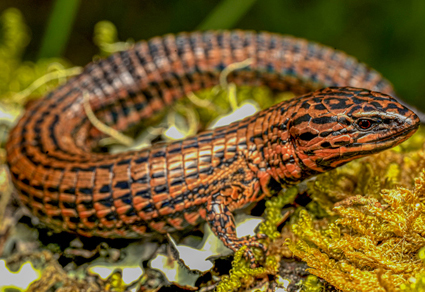
Nearly two decades ago, the gymnophthalmid lizard Petracola ventrimaculata was hypothesized to be a species complex based on dorsal and ventral color pattern differences among populations within a wide and disjunct geographical area in the northern Peruvian Andes. Here, we address this proposal using both molecular and morphological evidence. We analyzed a molecular matrix of Cercosaurinae, including 22 specimens and 78 DNA sequences of P. ventrimaculata sensu lato to study the phylogenetic relationships among its populations. We also conducted a detailed examination of the external morphology of 236 P. ventrimaculata specimens from several populations. Based on our analyses, we describe five new Petracola species, two of them previously assigned to P. ventrimaculata, from Cordillera Occidental and Cordillera Central in northern Peru. P. ventrimaculata sensu stricto is distributed across several localities in Cajamarca department in the northern part of the Cordillera Occidental in northwestern Peru. We hypothesize that the distribution patterns within the Petracola ventrimaculata species complex could be related to vicariant processes driven by the complex orogeny of the Huancabamba Depression and the Marañón River valley. Given its distinctive morphological traits and disjunct distribution, we recommend treating P. labioocularis as incertae sedis within Cercosaurinae, pending molecular data to resolve its phylogenetic placement. We present recommendations for future descriptions of new species of Petracola.
References
- Aguilar, C., Wood, P.L., Jr., Cusi, J.C., Guzman, A., Huari, F., Lundberg, M., Mortensen, E., Ramirez, C., Robles, D., Suarez, J., Ticona, A., Vargas, V.J., Venegas, P.J. & Sites, J.W., Jr. (2013) Integrative taxonomy and preliminary assessment of species limits in the Liolaemus walkeri complex (Squamata, Liolaemidae) with descriptions of three new species from Peru. Zookeys, 364, 47–91. https://doi.org/10.3897/zookeys.364.6109
- Altamirano, M.A., Zaher, H., Lobo, L., Grazziotin, F.G., sales Nunes, P.M. & Trefaut Rodrigues, M. (2013) A new species of lizard genus Potamites from Ecuador (Squamata, Gymnophthalmidae). Zootaxa, 3717 (3), 345–358. https://doi.org/10.11646/zootaxa.3717.3.4
- Amézquita, A., Mazariegos-H, L.A., Cañaveral, S., Orejuela, C., Barragán-Contreras, L.A. & Daza, J.M. (2023) Species richness under a vertebral stripe: integrative taxonomy uncovers three additional species of Pholidobolus lizards (Sauria, Squamata, Gymnophthalmidae) from the north-western Colombian Andes. Zookeys, 1141, 119–148. https://doi.org/10.3897/zookeys.1141.94774
- Angulo, A. (2002) Anfibios y paradojas: perspectivas sobre la diversidad y las poblaciones de anfibios. Ecología Aplicada, 1, 105–109. https://doi.org/10.21704/rea.v1i1-2.237
- Angulo, A. & Icochea, J. (2010) Cryptic species complexes, widespread species and conservation: lessons from Amazonian frogs of the Leptodactylus marmoratus group (Anura: Leptodactylidae). Systematics and Biodiversity, 8 (3), 357–370. https://doi.org/10.1080/14772000.2010.507264
- Bachman, S., Moat, J., Hill, A., de la Torre, J. & Scott, B. (2011) Supporting Red List threat assessments with GeoCAT: geospatial conservation assessment tool. ZooKeys 150: 117–126. https://doi.org/10.3897/zookeys.150.2109
- Bickford, D., Lohman, D.J., Sodhi, N.S., Ng, P.K., Meier, R., Winker, K., Ingram, K.K. & Das, I. (2007) Cryptic species as a window on diversity and conservation. Trends in Ecology & Evolution, 22 (3), 148–155. https://doi.org/10.1016/j.tree.2006.11.004
- Cadle, J.E. (1991) Systematics of lizards of the genus Stenocercus (Iguania: Tropiduridae) from northern Perú: New species and comments on relationships and distribution patterns. Proceedings of the Academy of Natural Sciences of Philadelphia, 143, 1–96.
- Chávez, G., Malqui, J. & Catenazzi, A. (2021) A new riparian Andean Potamites (Reptilia, Squamata, Gymnophtalmidae) from El Sira Mountains, central Peru, with comments on P. ecpleopus Cope 1875, and on the taxonomy and biogeography of Potamites. European Journal of Taxonomy, 760, 136–159. https://doi.org/10.5852/ejt.2021.760.1445
- Chernomor, O., Von Haeseler, A. & Minh, B.Q. (2016) Terrace aware data structure for phylogenomic inference from supermatrices. Systematic Biology, 65, 997–1008. https://doi.org/10.1093/sysbio/syw037
- de Oliveira, D.P., de Carvalho, V.T. & Hrbek, T. (2016) Cryptic diversity in the lizard genus Plica (Squamata): phylogenetic diversity and Amazonian biogeography. Zoologica Scripta, 45, 630–641. https://doi.org/10.1111/zsc.12172
- de Queiroz, K. (1998) The general lineage concept of species, species criteria, and the process of speciation. In: Howard, D.J. & Berlocher, S.H. (Eds.), Endless forms: species and speciation. Oxford University Press, New York, Oxford, pp. 57–75. https://doi.org/10.1093/oso/9780195109009.003.0005
- Doan, T.M. (2003) A south‐to‐north biogeographic hypothesis for Andean speciation: evidence from the lizard genus Proctoporus (Reptilia, Gymnophthalmidae). Journal of Biogeography, 30, 361–374. https://doi.org/10.1046/j.1365-2699.2003.00833.x
- Doan, T.M. & Castoe, T.A. (2005) Phylogenetic taxonomy of the Cercosaurini (Squamata: Gymnophthalmidae), with new genera for species of Neusticurus and Proctoporus. Zoological Journal of the Linnean Society, 143, 405–416. https://doi.org/10.1111/j.1096-3642.2005.00145.x
- Duellman, W.E. (1979) The South American Herpetofauna: Its Origin, Evolution, and Dispersal. Monograph of the Museum of Natural History, University of Kansas. No. 7. Museum of Natural History, University of Kansas, Lawrence, Kansas, 485 pp. https://doi.org/10.5962/bhl.title.3207
- Duellman, W.E. & Pramuk, J.B. (1999) Frogs of the genus Eleutherodactylus (Anura: Leptodactylidae) in the Andes of Northern Peru. Museum of Natural History, the University of Kansas, 13, 1–78. https://doi.org/10.5962/bhl.title.16169
- Echevarría, L.Y. & Venegas, P.J. (2013) Petracola ventrimaculatus (spotted lightbulb lizard) cannibalism. Herpetological Review, 44, 678–679.
- Echevarría, L.Y. & Venegas, P.J. (2015) A new elusive species of Petracola (Squamata: Gymnophthalmidae) from the Utcubamba basin in the Andes of northern Peru. Amphibian & Reptile Conservation, 9 (1), 26–33.
- Ely, C.V., de Loreto Bordignon, S.A., Trevisan, R. & Boldrini, I.I. (2017) Implications of poor taxonomy in conservation. Journal for Nature Conservation, 36, 10–13. https://doi.org/10.1016/j.jnc.2017.01.003
- Funk, W.C., Caminer, M. & Ron, S.R. (2011) High levels of cryptic species diversity uncovered in Amazonian frogs. Proceedings of the Royal Society B, Biological Sciences, 279, 1806–1814. https://doi.org/10.1098/rspb.2011.1653
- Guindon, S., Dufayard, J.-F., Lefort, V., Anisimova, M., Hordijk, W. & Gascuel, O. (2010) New algorithms and methods to estimate maximum-likelihood phylogenies: assessing the performance of PhyML 3.0. Systematic Biology, 59, 307–321. https://doi.org/10.1093/sysbio/syq010
- Hazzi, N.A., Moreno, J.S., Ortiz-Movliav, C. & Palacio, R.D. (2018) Biogeographic regions and events of isolation and diversification of the endemic biota of the tropical Andes. Proceedings of the Academy of Natural Sciences, 115 (3), 7985–7990. https://doi.org/10.1073/pnas.1803908115
- Hending, D. (2025) Cryptic species conservation: a review. Biological Reviews, 100, 258–274. https://doi.org/10.1111/brv.13139
- Hoang, D.T., Chernomor, O., von Haeseler, A., Minh, B.Q. & Vinh, L.S. (2018) UFBoot2: Improving the Ultrafast Bootstrap Approximation. Molecular Biology and Evolution, 35, 518–522. https://doi.org/10.1093/molbev/msx281
- IUCN (2024) Guidelines for Using the IUCN Red List Categories and Criteria. Version 16. IUCN Standards and Petitions Committee, Gland, Switzerland. [https://www.iucnredlist.org/documents/RedListGuidelines.pdf]
- Kalyaanamoorthy, S., Minh, B.Q., Wong, T.K.F., Von Haeseler, A. & Jermiin, L.S. (2017) ModelFinder: fast model selection for accurate phylogenetic estimates. Nature methods, 14, 587–589. https://doi.org/10.1038/nmeth.4285
- Katoh, K., Rozewicki, J. & Yamada, K.D. (2019) MAFFT online service: multiple sequence alignment, interactive sequence choice and visualization. Briefings in Bioinformatics, 20, 1160–1166. https://doi.org/10.1093/bib/bbx108
- Kizirian, D., Bayefsky-Anand, S., Eriksson, A., Le, M. & Donnelly, M.A. (2008) A new Petracola and re-description of P. ventrimaculatus (Squamata: Gymnophthalmidae). Zootaxa, 1700 (1), 53–62. https://doi.org/10.11646/zootaxa.1700.1.4
- Kizirian, D.A. (1996) A review of Ecuatorian Proctoporus (Squamata: Gymnophthalmidae) with description of nine new species. Herpetological monographs, 1996, 85–155. https://doi.org/10.2307/1466981
- Köhler, G. & Lehr, E. (2004) Comments on Euspondylus and Proctoporus (Squamata: Gymnophthalmidae) from Peru, with the Description of Three New Species and a Key to the Peruvian Species. Herpetologica, 60 (4), 501–518. https://doi.org/10.1655/03-93
- Kok, P.J.R., Fouquet, A., Torres Carvajal, O., Means, D.B. & Rodrigues, M.T. (2025) New insights into the molecular phylogenetic relationships of lizards in the Neotropical genus Arthrosaura (Reptilia: Gymnophthalmidae) reveal rampant ‘cryptic’ speciation in the Guiana Shield. Zoological Journal of the Linnean Society, 204, zlaf045. https://doi.org/10.1093/zoolinnean/zlaf045
- Kuraku, S., Zmasek, C.M., Nishimura, O. & Katoh, K. (2013) aLeaves facilitates on-demand exploration of metazoan gene family trees on MAFFT sequence alignment server with enhanced interactivity. Nucleic Acids Research, 41, W22–W28. https://doi.org/10.1093/nar/gkt389
- Mace, G.M. (2004) The role of taxonomy in species conservation. Philosophical Transactions of the Royal Society of London. Series B: Biological Sciences, 359, 711–719. https://doi.org/10.1098/rstb.2003.1454
- Mamani, L., Vargas, V.J., Chaparro, J.C. & Catenazzi, A. (2023) Two new species of gymnophthalmid lizards of the genus Petracola (Squamata: Cercosaurinae) from the Andes of northeastern Peru, and their phylogenetic relationships. Amphibian & Reptile Conservation, 17, 161–173.
- Melo‐Sampaio, P.R., Passos, P., Prudente, A.L.C., Venegas, P.J. & Torres‐Carvajal, O. (2021) Systematic review of the polychromatic ground snakes Atractus snethlageae complex reveals four new species from threatened environments. Journal of Zoological Systematics and Evolutionary Research, 59, 718–747. https://doi.org/10.1111/jzs.12453
- MINAGRI. (2014) D.S. 004-2014. Decreto Supremo que aprueba la actualización de la lista de clasificación y categorización de las especies amenazadas de fauna silvestre legalmente protegidas. El Peruano, Normas Legales, Martes, 8, 520497–520504.
- Minh, B.Q., Nguyen, M.A.T. & Von Haeseler, A. (2013) Ultrafast approximation for phylogenetic bootstrap. Molecular Biology and Evololution, 30, 1188–1195. https://doi.org/10.1093/molbev/mst024
- More, A., Sánchez, I., Piana, R.P., Vallejos, J., Appleton, R.D. & Vallejos, J. (2022) Registros notables de mamíferos en una cordillera aislada, amenazada y no protegida en la depresión de Huancabamba, norte de Perú. Revista de la Academia Colombiana de Ciencias Exactas, Físicas y Naturales, 46, 393–405. https://doi.org/10.18257/raccefyn.1624
- Murphy, J.C., Jowers, M.J., Lehtinen, R.M., Charles, S.P., Colli, G.R., Peres, A.K., Jr., Hendry, C.R. & Pyron, R.A. (2016) Cryptic, Sympatric Diversity in Tegu Lizards of the Tupinambis teguixin Group (Squamata, Sauria, Teiidae) and the Description of Three New Species. PLoS One, 11 (8), e0158542. https://doi.org/10.1371/journal.pone.0158542
- Nguyen, L.-T., Schmidt, H.A., von Haeseler, A. & Minh, B.Q. (2015) IQ-TREE: A fast and effective stochastic algorithm for estimating maximum-likelihood phylogenies. Molecular Biology and Evololution, 32 (1), 268–274. https://doi.org/10.1093/molbev/msu300
- Nunes, P.M.S., Fouquet, A., Curcio, F.F., Kok, P.J.R. & Rodrigues, M.T. (2012) Cryptic species in Iphisa elegans Gray, 1851 (Squamata: Gymnophthalmidae) revealed by hemipenial morphology and molecular data. Zoological Journal of the Linnean Society, 166, 361–376. https://doi.org/10.1111/j.1096-3642.2012.00846.x
- Olson, D.M., Dinerstein, E., Wikramanayake, E.D., Burgess, N.D., Powell, G.V.N., Underwood, E.C., D’Amico, J.A., Itoua, I., Strand, H.E., Morrison, J.C., Loucks, C.J., Allnutt, T.F., Ricketts, T.H., Kura, Y., Lamoreux, J.F., Wettengel, W.W., Hedao, P. & Kassem, K.R. (2001) Terrestrial ecoregions of the world: A new map of life on earth. BioScience, 51 (11), 933–938. https://doi.org/10.1641/0006-3568(2001)051[0933:TEOTWA]2.0.CO;2
- Parra, V., Nunes, P.M.S. & Torres-Carvajal, O. (2020) Systematics of Pholidobolus lizards (Squamata, Gymnophthalmidae) from southern Ecuador, with descriptions of four new species. Zookeys, 954, 109–156. https://doi.org/10.3897/zookeys.954.50667
- Pfenninger, M. & Schwenk, K. (2007) Cryptic animal species are homogeneously distributed among taxa and biogeographical regions. BMC evolutionary biology, 7, 1–6. https://doi.org/10.1186/1471-2148-7-121
- Rodríguez, L.O. & Mamani, L. (2020) A new species of Petracola (Squamata: Gymnophthalmidae) from Río Abiseo National Park, San Martín, Peru. Amphibian & Reptile Conservation, 14 (1), 140–146.
- Simpson, G.G. (1951) The species concept. Evolution, 5, 285–298. https://doi.org/10.1111/j.1558-5646.1951.tb02788.x
- Tamura, K., Stecher, G. & Kumar, S. (2021) MEGA11: molecular evolutionary genetics analysis version 11. Molecular biology and evolution, 38, 3022–3027. https://doi.org/10.1093/molbev/msab120
- Torres-Carvajal, O. (2007) Phylogeny and biogeography of a large radiation of andean lizards (Iguania, Stenocercus). Zoologica Scripta, 36, 311–326. https://doi.org/10.1111/j.1463-6409.2006.00284.x
- Torres-Carvajal, O., Echevarría, L.Y., Lobos, S.E., Venegas, P.J. & Kok, P.J.R. (2019) Phylogeny, diversity and biogeography of Neotropical sipo snakes (Serpentes: Colubrinae: Chironius). Molecular Phylogenetics and Evolution, 130, 315–329. https://doi.org/10.1016/j.ympev.2018.10.022
- Torres-Carvajal, O. & Hinojosa, K.C. (2020) Hidden diversity in two widespread snake species (Serpentes: Xenodontini: Erythrolamprus) from South America. Molecular Phylogenetics and Evolution, 146, 106772. https://doi.org/10.1016/j.ympev.2020.106772
- Torres-Carvajal, O., Lobos, S.E., Venegas, P.J., Chavez, G., Aguirre-Penafiel, V., Zurita, D. & Echevarría, L.Y. (2016) Phylogeny and biogeography of the most diverse clade of South American gymnophthalmid lizards (Squamata, Gymnophthalmidae, Cercosaurinae). Molecular Phylogenetics and Evolution, 99, 63–75. https://doi.org/10.1016/j.ympev.2016.03.006
- Torres-Carvajal, O. & Mafla-Endara, P. (2013) Evolutionary history of Andean Pholidobolus and Macropholidus (Squamata: Gymnophthalmidae) lizards. Molecular Phylogenetics and Evolution, 68, 212–217. https://doi.org/10.1016/j.ympev.2013.03.013
- Torres-Carvajal, O. & Teran, C. (2021) Molecular phylogeny of Neotropical Parrot Snakes (Serpentes: Colubrinae: Leptophis) supports underestimated species richness. Molecular Phylogenetics and Evolution, 164, 107267. https://doi.org/10.1016/j.ympev.2021.107267
- Torres-Carvajal, O., Venegas, P.J. & Sales Nunes, P.M. (2020) Description and Phylogeny of a New Species of Andean Lizard (Gymnophthalmidae: Cercosaurinae) from the Huancabamba Depression. South American Journal of Herpetology, 18 (1), 13–23. https://doi.org/10.2994/SAJH-D-18-00069.1
- Trifinopoulos, J., Nguyen, L.T., Von Haeseler, A. & Minh, B.Q. (2016) W-IQ-TREE web server: fast and accurate phylogenetic trees under maximum likelihood. Nucleic Acids Res., 44, W232–W235. https://doi.org/10.1093/nar/gkw256
- Vaidya, G., Lohman, D.J. & Meier, R. (2011) SequenceMatrix: concatenation software for the fast assembly of multi-gene datasets with character set and codon information. Cladistics, 27, 171–180. https://doi.org/10.1111/j.1096-0031.2010.00329.x
- Venegas, P., Torres, C., Suárez, J., Lehr, E. & Perez, J. (2019) Petracola ventrimaculatus. The IUCN Red List of Threatened Species, 2019, e.T48282388A48282419.
- Weigend, M. (2004) Four new species of Nasa ser. Alatae (Loasaceae) in the Amotape-Huancabamba zone of Peru. Novon, 14 (1) 134–146.
- Weigend, M., Rodríguez, E.F. & Arana, C. (2005) The relict forests of northwest Peru and southwest Ecuador. Revista Peruana de Biología, 12, 185–194. https://doi.org/10.15381/rpb.v12i2.2390
- Weir, J.T. (2009) Implications of genetic differentiation in neotropical montane forest birds. Annals of the Missouri Botanical Garden, 96 (3), 410–433. https://doi.org/10.3417/2008011
- Wiley, E.O. (1978) The evolutionary species concept reconsidered. Systematic Biology, 27, 17–26. https://doi.org/10.2307/2412809
- Wiley, E.O. & Lieberman, B.S. (2011) Phylogenetics: theory and practice of phylogenetic systematics. 2nd Edition. John Wiley & Sons, Hoboken, New Jersey, 440 pp. https://doi.org/10.1002/9781118017883
- Winger, B.M. & Bates, J.M. (2015) The tempo of trait divergence in geographic isolation: Avian speciation across the Marañon Valley of Peru. Evolution, 69, 772–787. https://doi.org/10.1111/evo.12607
- Yánez-Muñoz, M.H., Torres-Carvajal, O., Reyes-Puig, J.P., Urgiles-Merchán, M.A. & Koch, C. (2021) A new and very spiny lizard (Gymnophthalmidae: Echinosaura) from the Andes in northwestern Ecuador. PeerJ, 9, e12523. https://doi.org/10.7717/peerj.12523