
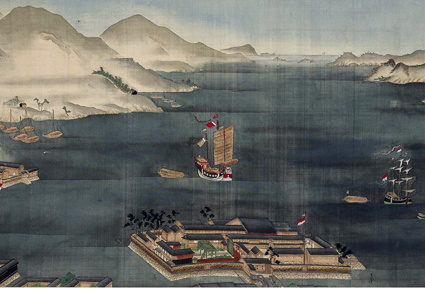

Abstract
The nomenclatural status of Bufo praetextatus Boie, 1826, described based on specimens collected by Jan Cock Blomhoff, has long been uncertain. Although this binomen has priority over the widely used B. japonicus Temminck & Schlegel, 1838, its application has been hindered by lost type material and misinterpretation of its original description. Through a detailed textual analysis of Boie’s work and corroboration from historical sources, we demonstrate that terms previously interpreted as type localities (“Vitikairu, Fikikojeru et Nakfudo”) are in fact phonetic transcriptions of vernacular Japanese names for toads. Furthermore, Boie’s description lists a broad distribution across Japan, not one restricted to Nagasaki. With Blomhoff’s collections including regions now known to be inhabited by three distinct, hybridizing species of Japanese Bufo (B. japonicus, B. formosus, B. torrenticola), it is impossible to determine which species Boie’s specimens represented. We therefore conclude that Bufo praetextatus Boie, 1826 must be considered a nomen dubium and that the prevailing use of B. japonicus should be maintained to ensure nomenclatural stability and accuracy.
References
- AmphibiaWeb (2026) AmphibiaWeb. University of California, Berkeley, California. Available from: https://amphibiaweb.org (accessed 8 February 2026)
- Böhme, W., Denzer, W. & Wüster, W. (2025) Noli tangere nomina probata! Taxonomists must prioritise stability and protection of well‐established scientific names in herpetology. Salamandra, 61 (4), 395–406.
- Boie, H. (1826) Merkmale einiger japanischer Lurche. Isis von Oken, 1826 (2), 205–215.
- Boie, H. (1827) Kenteekenen van eenige Japansche Amphibiën. Bijdragen tot de Natuurkundige Wetenschappen te Amsterdam, 2 (1), 243–272. https://doi.org/10.5962/bhl.title.46817
- Camerano, L. (1879) Di alcune specie di anfibii anuri esistenti nelle collezioni del R. Museo Zoologico di Torino. Atti della Reale Accademia delle Scienze di Torino, 14, 866–898.
- Camerano, L. (1900) Ricerche intorno alla variazione del Bufo vulgaris Laur. Memorie Della Reale Accademia delle Scienze di Torino, Serie Seconda, 50, 81–141.
- Chang, C.B. (2019) Phonetic drift. In: Schmid, M.S. & Köpke, B. (Eds.), The Oxford Handbook of Language Attrition. Oxford Academic Press, Oxford, pp. 191–203. https://doi.org/10.1093/oxfordhb/9780198793595.013.16
- Cheng, S.J., Gaynor, K.M., Moore, A.C., Darragh, K., Estien, C.O., Hammond, J.W., Lawrence, C., Mills, K.L., Baiz, M.D., Ignace, D. & Khadempour, L. (2023) Championing inclusive terminology in ecology and evolution. Trends in Ecology & Evolution, 38 (5), 381–384. https://doi.org/10.1016/j.tree.2022.12.011
- Compton, J.A. & Thijsse, G. (2013) The remarkable PFB von Siebold, his life in Europe and Japan. Curtis’s Botanical Magazine, 30 (3), 275–314. https://doi.org/10.1111/curt.12047
- Cullen, L.M. (2018) Knowledge and use of Japanese by the Dutch on Dejima Island, Nagasaki. In: Latham, A.J.H. & Kawakatsu, H. (Eds.), Asia and the History of the International Economy. Essays in Memory of Peter Mathias. Routledge, Abingdon-on-Thames, Oxfordshire, pp. 72–94. https://doi.org/10.4324/9781315098548-7
- Dubois, A. (2011) The International Code of Zoological Nomenclature must be drastically improved before it is too late. Bionomina, 2, 1–104. https://doi.org/10.11646/bionomina.2.1.1
- Dufresnes, C. & Litvinchuk, S.N. (2022) Diversity, distribution and molecular species delimitation in frogs and toads from the Eastern Palaearctic. Zoological Journal of the Linnean Society, 195, 695–760. https://doi.org/10.1093/zoolinnean/zlab083
- Fonseca, O.V., Vieira, O., da Silva, H.R., Frazão, A., Sobral, G., Lourenço, A.C.C., Capdevile, T.G., Bockmann, F.A., Stopiglia, R., Selvatti, A.P. & Kirwan, G.M. (2026) Why is it so hard to discuss changing offensive names with zoologists? A Black perspective. Zoological Journal of the Linnean Society, 206 (1), zlaf196. https://doi.org/10.1093/zoolinnean/zlaf196
- Frost, D.R. (2026) Amphibian Species of the World: an Online Reference. American Museum of Natural History, New York, USA. Available from: https://amphibiansoftheworld.amnh.org/index.php (accessed 8 February 2026) https://doi.org/10.5531/db.vz.0001
- Fukutani, K., Matsui, M. & Nishikawa, K. (2022) Population genetic structure and hybrid zone analyses for species delimitation in the Japanese toad (Bufo japonicus). PeerJ, 11, e16302. https://doi.org/10.7717/peerj.16302
- Gillman, L.N. & Wright, S.D. (2020) Restoring indigenous names in taxonomy. Communications Biology, 3, 609. https://doi.org/10.1038/s42003-020-01344-y
- Guedes, P., Alves-Martins, F., Arribas, J.M., Chatterjee, S., Santos, A.M., Lewin, A., Bako, L., Webala, P.W., Correia, R.A., Rocha, R. & Ladle, R.J. (2023) Eponyms have no place in 21st-century biological nomenclature. Nature Ecology & Evolution, 7, 1157–1160. https://doi.org/10.1038/s41559-023-02022-y
- Hammer, T.A. & Thiele, K.R. (2021) (119–122) Proposals to amend Articles 51 and 56 and Division III, to allow the rejection of culturally offensive and inappropriate names. Taxon, 70 (6), 1392–1394. https://doi.org/10.1002/tax.12620
- Herpetological Society of Japan (2025) Standard Japanese Names of Amphibians and Reptiles of Japan. Version 28 April 2025. Herpetological Society of Japan, Kyoto. Available from: https://herpetology.jp/wamei (accessed 28 August 2025) [in Japanese]
- Hillis, D.M. (2019) Species delimitation in herpetology. Journal of Herpetology, 53 (1), 3–12. https://doi.org/10.1670/18-123
- ICZN [International Commission on Zoological Nomenclature] (1999) International Code of Zoological Nomenclature. 4th Edition. The International Trust for Zoological Nomenclature, London, xxix + 306 pp. https://doi.org/10.1046/j.1365-3113.2000.252107.x
- Iwao, S., Sakamoto, T., Hōgetsu, K., Yoshikawa, I., Kobayashi, T., Vié, M., Bonmarchand, G. & Kanazawa, S. (Eds.), (1970) Blomhoff, Jan Cock (1779–1853). In: Dictionnaire Historique du Japon. Vol. B. Kinokuniya, Tokyo, pp. 39–40.
- Kaiser, H., Mecke, S., Kaiser, C.M. & O’Shea, M. (2021) Three’s Company: discovery of a third syntype of Stegonotus lividus, a species of colubrid snake from Pulau Semau, Lesser Sunda Islands, Indonesia, with comments on an unpublished 19th Century manuscript by the naturalist Salomon Müller. Zootaxa, 5039 (1), 056–070. https://doi.org/10.11646/zootaxa.5039.1.2
- Kawamura, T., Nishioka, M. & Ueda, H. (1980) Inter- and intraspecific hybrids among Japanese, European and American toads. Scientific Report of the Laboratory for Amphibian Biology, Hiroshima University, 4, 1–125.
- Kraus, F., O’Shea, M. & Kaiser, H. (2023) Why Toxicocalamus longhagen Roberts, Iova & Austin, 2022 (Serpentes, Elapidae) is a taxonomic nomen dubium. Bionomina, 32, 41–51. https://doi.org/10.11646/bionomina.32.1.4
- Matsui, M. (1976) Experimental hybridization between toads from Kyoto and toads from Miyako Is. and France. Japanese Journal of Herpetology, 6, 80–92. [in Japanese] https://doi.org/10.5358/hsj1972.6.3_80
- Matsui, M. (1984) Morphometric variation analyses and revision of the Japanese toads (Genus Bufo, Bufonidae). Contributions from the Biological Laboratory, Kyoto University, 26 (3–4), 209–428.
- Matsui, Y. (2018) Japanese-Dutch relations in the Tokugawa Period. Transactions of the Japan Academy, 72 (Special Issue), 139–154. https://doi.org/10.2183/tja.72.special_issue_139
- McNabb, D.E. (2016) Tokugawa isolation, commerce, and industry, 1603–1868. In: McNabb, D.E. (Ed.), A Comparative History of Commerce and Industry. Vol. I. Four Paths to an Industrialized World. Palgrave Macmillan US, New York, New York, pp. 181–197. https://doi.org/10.1057/9781137503268_11
- Möbius, K.A. (1870) Friedrich Boie † Nekrolog. Journal für Ornithologie, 18 (3), 231–233.
- Narvaes, P. & Rodrigues, M.T. (2009) Taxonomic revision of Rhinella granulosa species group [sic] (Amphibia, Anura, Bufonidae), with a description of a new species. Arquivos de Zoologia, 40, 1–73. https://doi.org/10.11606/issn.2176-7793.v40i1p1-73
- Okada, Y. (1966) Fauna Japonica. Anura (Amphibia). Biogeographical Society of Japan, Tokyo, 246 pp., 24 pls. [in Japanese]
- Otani, S. & Duensser, E. (2020) English translation of the original description of Cynops pyrrhogaster Boie, 1826. Alytes, 37 (3–4), 22–24.
- Otani, S. & Duensser, E. (2024) English translation of the original descriptions of snakes described by Boie (1826). Taprobanica, 13 (2), 48–61. https://doi.org/10.47605/tapro.v13i2.330
- Pethiyagoda, R. (2023) Policing the scientific lexicon: the new colonialism? Megataxa, 10 (1), 20–25. https://doi.org/10.11646/megataxa.10.1.4
- Rösler, H., Ineich, I., Ávila-Pires, T.C.S., Hoogmoed, M.S. & Kaiser, H. (2025) Case 3798 – Gymnodactylus humeralis Guichenot, 1855 (currently Gonatodes humeralis; Reptilia, Sphaerodactylidae): proposed conservation of the specific name by suppression of Gymnodactylus timoriensis Duméril & Bibron, 1836. Bulletin of Zoological Nomenclature, 82, 14–30. https://doi.org/10.21805/bzn.v82.a007
- Savage, J.M., Sparreboom, M. & Pregill, G.K. (2025) The Dutch Indies Commission and the Herpetological Legacy of Heinrich Boie (1794–1827). Society for the Study of Amphibians and Reptiles and the International Society for the History and Bibliography of Herpetology, Villanova, Pennsylvania, 356 pp.
- Siebold, P.F. (1826) De Historiae Naturalis in Japonia Statu, nec non de Augmento Emolumentisque in Decursu Perscrutationum Exspectandis Dissertatio, cui Accedunt Spicilegia Faunae Japonicae. C.P. Bonitas, Wirceburgi [Würzburg], Bavaria, 20 pp.
- Stejneger, L. (1907) Herpetology of Japan and adjacent territory. Bulletin of the United States National Museum, 58, xx + 577. https://doi.org/10.5479/si.03629236.58.i
- Temminck, C.-J. (1820) Manuel d’Ornithologie ou Tableau Systématique des Oiseaux qui se Trouvent à Europe, Précédé d’une Analyse du Système Général d’Ornithologie, et suivi d’une Table Alphabétique des Espèces. Seconde Édition. H. Cousin, Paris, cxv + 439 pp. https://doi.org/10.5962/bhl.title.49424
- Temminck, C.-J. & Schlegel, H. (1838) Fauna Japonica sive Descriptio Animalium, quae in Itinere per Japonianum, Jussu et Auspiciis Superiorum, qui Summum in India Batava Imperium Tenent, Suscepto, Annis 1823–1830 Colleget, Notis Observationibus et Adumbrationibus Illustratis. Vol. 3. Chelonia, Ophidia, Sauria, Batrachia. J.G. Lalau, Leiden, xxi + 144 pp. https://doi.org/10.5962/bhl.title.124951
- Wüster, W., Böhme, W., Denzer, W. & Kaiser, H. (2025) Nomenclatural historians are kindly requested to respect the intent of the Code: “Nomenclatural parsimony” and the case of the Nose-horned Viper, Vipera ammodytes (Linnaeus, 1758). Zootaxa, 5696 (3), 385–397. https://doi.org/10.11646/zootaxa.5696.3.4
- Yamashita, N. (2015) A short introduction to the history of Dutch studies in Japan. Journal of the Center for Language Education and Research, Nagasaki University, 3, 57–77.