

Abstract
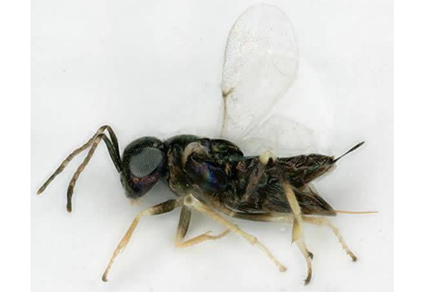
The first Iranian species of Copidosoma Ratzeburg, was described in 1970, followed by a second species in 2016. Both species are parasitoids of lepidopterous pests on Pistacia. This study expands the Iranian fauna of this genus through the discovery of a new species, Copidosoma haloxylonae Lotfalizadeh sp. nov., associated with the saxaul tree, Haloxylon ammodendron (C.A. Meyer). Additionally, we report the first record of Psyllaephagus ogazae Sugonjaev for Iran, reared from the same host plant. To contextualize these findings, we provide a comprehensive checklist of all six Iranian Copidosoma species with distribution and biological data, a dichotomous key for their identification, and a redescription of P. ogazae based on Iranian specimens. These results significantly contribute to the understanding of chalcidoid wasp diversity and host associations in arid ecosystems of Iran.
References
- Akhani, H. (2006) Biodiversity of halophytic and sabkha ecosystems in Iran. In: Tasks for Vegetation Science. Springer, Dordrecht, pp. 71–88. https://doi.org/10.1007/978-1-4020-5072-5_6
- Burks, R.A., Gibson, G.A.P. & Heraty, J.M. (2025) External morphology of adults Chalcidoidea. In: Heraty, J.M. & Woolly, J.B. (Eds.), Chalcidoidea of the World. CABI, Wallingford, pp. 69–110. https://doi.org/10.1079/9781800623545.0005
- Fallahzadeh, M. & Japoshvili, G. (2010) CWhecklist of Iranian encyrtids (Hymenoptera: Chalcidoidea) with descriptions of new species. Journal of Insect Science, 10 (1), 1–24. https://doi.org/10.1673/031.010.6801
- Fallahzadeh, M. & Japoshvili, G. (2017) An updated checklist of Iranian Encyrtidae (Hymenoptera, Chalcidoidea). Zootaxa, 4344 (1), 1–46. https://doi.org/10.11646/zootaxa.4344.1.1
- Guerrieri, E. & Noyes, J.S. (2005) Revision of the European species of Copidosoma Ratzeburg (Hymenoptera: Encyrtidae), parasitoids of caterpillars (Lepidoptera). Systematic Entomology, 30, 97–174. https://doi.org/10.1111/j.1365-3113.2005.00271.x
- Hain, F.B. & Wallner, W.E. (1973) The life history, biology, and parasites of the pine candle moth, Exoteleia nepheos (Lepidoptera: Gelechiidae), on Scotch pine in Michigan. Canadian Entomologists, 105, 157–164. https://doi.org/10.4039/Ent105157-1
- Harris, R.A. (1979) A glossary of surface sculpturing. Occasional Papers in Entomology of the California Department of Food and Agriculture, 28, 1–32. https://doi.org/10.5281/zenodo.26215
- Hoffer, A. (1970) Bemerkungen zu drei wenig bekannten Arten der Famile Encyrtidae (Hym., Chalcidoidea) und Beschreibungen der weiteren, für die Wissenschaft neuen Taxa. Studia Entomologica Forestalia, 1 (12), 191–193.
- Jafari, M. (2012) The Role of Haloxylon species in combating desertification in Iran. Journal of Desert Ecosystems, 5 (2), 12–25.
- Japoshvili, G., Hansen, L.O. & Guerrieri, E. (2013) The Norwegian species of Copidosoma Ratzeburg (Hymenoptera: Chalcidoidea: Encyrtidae). Zootaxa, 3619 (2), 145–153. https://doi.org/10.11646/zootaxa.3619.2.3
- Japoshvili, G. & Noyes, J.S. (2005) New data on Encyrtidae (Hymenoptera: Chalcidoidea) of the Transcaucasus and Turkey. Zoosystematica Rossica, 14, 135–145. https://doi.org/10.31610/zsr/2005.14.1.135
- Japoshvili, G., Rakhshani, H. & Khajehali, J. (2016) A new species of Copidosoma (Hymenoptera: Encyrtidae) from Iran. Zoology in the Middle East, 62 (3), 261–264. https://doi.org/10.1080/09397140.2016.1202909
- Lotfalizadeh, H. (2010) Some new data and corrections on Iranian encyrtid wasp (Hymenoptera: Chalcidoidea, Encyrtidae) fauna. Biharean Biologist, 4, 173–178.
- Lotfalizadeh, H. & Bab-Morad, M. (2014) Copidosoma bouchenum Ratzeburg (Hym.: Encyrtidae): new record from Iran. Turkish Journal of Zoology, 39, 185–187. https://doi.org/10.3906/zoo-1312-23
- Lotfalizadeh, H., Tavakoli-Korghond, G. & Mokhtari, A. (2019) On the parasitoid complex (Hymenoptera: Chalcidoidea) of Anophococcus abaii (Hemiptera: Eriococcidae), with description of Metaphycus anophococcusi Lotfalizadeh, n. sp.. Annales de la Société entomologique de France, Nouvelle Série, 55 (4), 317–326. https://doi.org/10.1080/00379271.2019.1621204
- Lotfalizadeh, H., Mirzaee, Z., Tavakoli-Korghond, G., Janšta, P. & Rasplus, J.-Y. (2024) Erimerinae, a prior name to Microdontomerinae (Hymenoptera, Torymidae) with the description of a new genus and three new species from Iran. Journal of Hymenoptera Research, 97, 85–103. https://doi.org/10.3897/jhr.97.115028
- Mifsud, D., Cocquempot, C., Streito, J.C. & Matile-Ferrero, D. (2010) Other Hemiptera Sternorrhyncha (Aleyrodidae, Phylloxeroidea, and Psylloidea) and Hemiptera Auchenorrhyncha. Chapter 9.3. BioRisk, 4 (1), 511–552. https://doi.org/10.3897/biorisk.4.63
- Noyes, J.S. (1988) Copidosoma truncatellum (Dalman) and C. floridanum (Ashmead) (Hymenoptera, Encyrtidae), two frequently misidentified polyembryonic parasitoids of caterpillars (Lepidoptera). Systematic Entomology, 13, 197–204. https://doi.org/10.1111/j.1365-3113.1988.tb00241.x
- Noyes, J.S. & Hanson, P. (1996) Encyrtidae (Hymenoptera: Chalcidoidea) of Costa Rica: the genera and species associated with jumping plant-lice (Homoptera: Psylloidea). Bulletin of the British Museum (Natural History), 65 (2), 105–164.
- Sugonjaev, E.S. (1968) New species of chalcids (Hymenoptera, Chalcidoidea) parasites of psyllids and scale insects (Homoptera, Psylloidea and Coccoidea), from deserts and semideserts of middle Asia and Kazakhstan. Entomologicheskoe Obozrenie, 47 (3), 589–604.
- Trjapitzin, V.A. (1989) Parasitic Hymenoptera of the Fam. Encyrtidae of Palaearctics. Opredeliteli po Faune SSSR, Zoologicheskim Institutom Akademii Nauk SSR, Leningrad, 158, 1–489.
- Trjapitzin, V.A. (2012) Characteristics of the genus Psyllaephagus Ashmead, 1900 with description of a new species from Moscow Province (Hymenoptera, Chalcidoidea: Encyrtidae). Entomological Review, 92 (8), 907–912. https://doi.org/10.1134/S001387381208009X
- UCD Community (2023) Universal Chalcidoidea Database Website. Available from: https://ucd.chalcid.org (accessed 18 Octobre 2024)
- Yu, F., Chen, F.-Q., Yen, S.-H., Tu, L.-H., Zhu, C.-D., Guerrieri, E. & Zhang, Y.-Z. (2014) Preliminary phylogeny of the genus Copidosoma (Hymenoptera, Encyrtidae), polyembryonic parasitoids of Lepidoptera. Systematic Entomology, 39 (2), 325–334. https://doi.org/10.1111/syen.12057
- Zou, B., Hu, H., Zhang, L. & Zhang, Y. (2023) A taxonomic study of Psyllaephagus Ashmead (Hymenoptera, Encyrtidae) from China. ZooKeys, 1184, 327–359. https://doi.org/10.3897/zookeys.1184.109476