
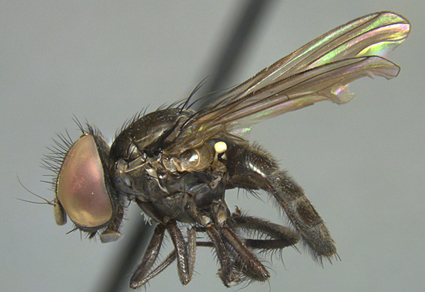

Abstract
The genus Fannia Robineau-Desvoidy, 1830 is found in all biogeographic regions and contains approximately 360 known species, including 24 recorded from Mexico. The larvae are generally saprophagous, feeding on decaying organic material, and some species are synanthropic being important from the medical, veterinary, forensic, and hygienic point of view. Several Fannia species are potentially useful in forensic studies, especially to estimate the minimum post-mortem interval (min. PMI) and as evidence of negligence of elderly individuals, children, or animals. There is a lack of information about the distribution and diversity of this genus in Mexico. Herein, we describe a new species of sarcosaprophagous Fannia from Mexico associated with a pig carcass, belonging to the Fannia pusio (Wiedemann, 1830) sub-group. We present an integrative taxonomic study of this new species, including the descriptions of the male, female, and third-instar larva; an identification key to the three species in the sub-group that occur in Mexico; a DNA barcode analysis; and information about the decomposition process stages at which the larvae occur, as well as the post-feeding larval dispersal behavior. The new species is forensically important considering that the larvae were found associated with the pig carcass from active decay until dry remains stages.
References
- Aballay, F.H., Domínguez, M.C. & Fernández Campón, F. (2012) Adult Fanniidae associated to pig carcasses during the winter season in a semiarid environment: initial examination of their potential as complementary PMI indicators. Forensic Science International, 219, 1–4. https://doi.org/10.1016/j.forsciint.2011.11.019
- Araújo, P.F. de & Couri, M.S. (1996) Duas novas espécies de Fannia Robineau-Desvoidy (Diptera, Fanniidae) do Rio de Janeiro, Brasil. Revista Brasileira de Zoologia, 13, 335–341. https://doi.org/10.1590/S0101-81751996000200005
- Bakmaz, D., Sonmez, S. & Korkmaz, E.M. (2025) Evaluating COI and ITS2 dual barcoding for molecular delimitation and taxonomic insights in Arenosetella Wilson, 1932 (Harpacticoida: Ectinosomatidae) along Turkish Coasts. PeerJ, 13, e19870. https://doi.org/10.7717/peerj.19870
- Benecke, M. & Lessig, R. (2001) Child neglect and forensic entomology. Forensic Science International, 120, 155–159. https://doi.org/10.1016/s0379-0738(01)00424-8
- Benecke, M., Josephi, E. & Zweihoff, R. (2004) Neglect of the elderly: Forensic entomology cases and considerations. Forensic Science International, 146, 195–199. https://doi.org/10.1016/j.forsciint.2004.09.061
- Carvalho, L.M.L., Thyssen, P.J., Linhares, A.X. & Palhares, F.A.B. (2000) A checklist of arthropods associated with pig carrion and human corpses in southeastern Brazil. Memórias do Instituto Oswaldo Cruz, 95, 135–138. https://doi.org/10.1590/S0074-02762000000100023
- Chillcott, J. (1961) A revision of the Nearctic species of Fanniinae (Diptera: Muscidae). Canadian Entomologist, 92, 1–295. https://doi.org/10.4039/entm9214fv
- Collin, J.E. (1939) On various new or little known British Diptera, including several species bred from the nests of birds and mammals. Entomologist’s Monthly Magazine, 75, 134–144.
- Collins, R.A. & Cruickshank, R.H. (2013) The seven deadly sins of DNA barcoding. Molecular Ecology Resources, 13, 969–975. https://doi.org/10.1111/1755-0998.12046
- Couri, M.S. & Araújo, P.F. de (1989) Uma nova espécie de Fannia Robineau-Desvoidy, 1830 do Brasil (Diptera, Fanniidae). Revista Brasileira de Zoologia, 6, 617–620. https://doi.org/10.1590/S0101-81751989000400007
- Couri, M.S. & Pamplona, D. (1991) Uma nova espécie de Fannia Robineau-Desvoidy, 1830 (Diptera, Fanniidae) de Manaus (Amazonas, Brasil). Boletim do Museu Paraense Emílio Goeldi, Série Zoologia, 6, 115–120.
- Couri, M.S. (2005) An illustrated key to adult males of Neotropical Fannia Robineau-Desvoidy belonging to pusio sub-group (Diptera, Fanniidae). Brazilian Journal of Biology, 65, 645–629. https://doi.org/10.1590/S1519-69842005000400009
- Cumming, J.M. & Wood, D.M. (2017) Adult morphology and terminology. In: Kirk-Spriggs, A.H. & Sinclair, B.J. (Eds.), Manual of Afrotropical Diptera. Vol. 1. Suricata 4. South African National Biodiversity Institute, Pretoria, pp. 89–133.
- de Carvalho, C.J.B., Moura, M.O. & Ribeiro, P.B. (2002) Chave para adultos de dípteros (Muscidae, Fanniidae, Anthomyiidae) associados ao ambiente humano no Brasil. Revista Brasileira de Entomologia, 46, 107–114. https://doi.org/10.1590/S0085-56262002000200001
- de Carvalho, C.J.B., Pont, A.C., Couri, M.S. & Pamplona, D. (2003) A catalogue of the Fanniidae (Diptera) of the Neotropical Region. Zootaxa, 219, 1–32. https://doi.org/10.11646/zootaxa.219.1.1
- Dentinger, B.T., Didukh, M.Y. & Moncalvo, J.M. (2011) Comparing COI and ITS as DNA barcode markers for mushrooms and allies (Agaricomycotina). PLoS ONE, 6, e25081. https://doi.org/10.1371/journal.pone.0025081
- Domínguez, M.C. & Aballay, F. (2008) A new species of the genus Fannia Robineau-Desvoidy (Diptera: Fanniidae) collected on pig carrion in Mendoza, Argentina. Annales Zoologici, 58, 819–824. https://doi.org/10.3161/000345408X396747
- Domínguez, M.C. & Pont, A.C. (2014) Fanniidae (Insecta: Diptera). Auckland. Fauna of New Zealand Series, 71, 1–91. https://doi.org/10.7931/J2/FNZ.71
- Durango, Y. & Ramírez-Mora, M. (2019) Fannia Robineau-Desvoidy (Diptera: Fanniidae) of Colombia: new species, identification key and updated checklist. Zootaxa, 4604 (2), 301–325. https://doi.org/10.11646/zootaxa.4604.2.4
- Durango-Manrique, Y., López-Rubio, A. & Gómez, G.F. (2024) Molecular differentiation analysis of ten putative species of Fannia (Diptera: Fanniidae) collected in carrion-baited traps from Colombia. Medical and Veterinary Entomology, 39, 1–11. https://doi.org/10.1111/mve.12732
- Failla, A.J., Vasquez, A.A., Hudson, P., Fujimoto, M. & Ram, J.L. (2015) Morphological identification and COI barcodes of adult flies help determine species identities of chironomid larvae (Diptera, Chironomidae). Bulletin of Entomological Research, 106, 34–46. https://doi.org/10.1017/S0007485315000486
- Folmer, O., Black, M., Hoeh, W., Lutz, R. & Vrijenhoek, R. (1994) DNA primers for amplification of mitochondrial cytochrome c oxidase subunit I from diverse metazoan invertebrates. Molecular Marine Biology and Biotechnology, 3, 298–299.
- Gomes, L., Godoy, W.A.C. & von Zuben, C.J. (2006) A review of postfeeding larval dispersal in blowflies: implications for forensic entomology. Naturwissenschaften, 93, 207–215. https://doi.org/10.1007/s00114-006-0082-5
- Gomes, L.R.P., Fratoni, R. de O., de la Torre, G.M., Freitas, F.F., Graciolli, G. & de Carvalho, C.J.B. (2021) Stilbometopa podopostyla (Speiser) (Diptera: Hippoboscidae): first larva description, new record in Paraná state (Brazil) and new host record. Studies on Neotropical Fauna and Environment, 56, 78–82. https://doi.org/10.1080/01650521.2020.1745516
- Gomes, L.R.P., Zawadneak, M.A.C., Costa-Ribeiro, M.C.V., Jarek, T.M. & de Carvalho, C.J.B. (2022) Integrating morphology and DNA barcodes for identification of Delia sanctijacobi (Diptera: Anthomyiidae): new host and new records in South America. Arthropod Systematics & Phylogeny, 80, 511–522. https://doi.org/10.3897/asp.80.e82831
- Gomes, L.R.P. & Pedraza-Lara, C. (2023) Fannia pretiosa-group (Diptera: Fanniidae) from Mexico: six new species from the Mexico Transition Zone and an identification key. Zootaxa, 5264 (2), 185–204. https://doi.org/10.11646/zootaxa.5264.2.2
- Grassberger, M. & Frank, C. (2004) Initial study of arthropod succession on pig carrion in central European urban habitat. Journal of Medical Entomology, 41, 511–523. https://doi.org/10.1603/0022-2585-41.3.511
- Greenberg, B. (1990) Behavior of postfeeding larvae of some Calliphoridae and a Muscid (Diptera). Annals of the Entomological Society of America, 83, 1210–1214. https://doi.org/10.1093/aesa/83.6.1210
- Grisales, D., Wolff, M. & de Carvalho, C.J.B. (2012) Neotropical Fanniidae (Insecta: Diptera): new species of Fannia from Colombia. Zootaxa, 3591 (1), 1–46. https://doi.org/10.11646/zootaxa.3591.1.1
- Grisales, D., Lecheta, M.C., Aballay, F.H. & de Carvalho, C.J.B. (2016) A key and checklist to the Neotropical forensically important “Little House Flies” (Diptera: Fanniidae). Zoologia, 33, e20160054. https://doi.org/10.1590/S1984-4689zool-20160054
- Grisales, D. & de Carvalho, C.J.B. (2019) Highland biodiversity of Fanniidae (Insecta, Diptera): fourteen new species from the Andes and Central America. Zootaxa, 4551 (3), 330–360. https://doi.org/10.11646/zootaxa.4551.3.4
- Grzywacz, A., Wyborska, D. & Piwczýnski, M. (2017) DNA barcoding allows identification of European Fanniidae (Diptera) of forensic interest. Forensic Science International, 278, 106–114. https://doi.org/10.1016/j.forsciint.2017.06.023
- Grzywacz, A., Jarmusz, M., Walczak, K., Skowronek, R., Johnston, N.P. & Szpila, K. (2021) DNA barcoding identifies unknown females and larvae of Fannia R.-D. (Diptera: Fanniidae) from carrion succession experiment and case report. Insects, 12, 381. https://doi.org/10.3390/insects12050381
- Grzywacz, A., Walczak, K., Niewiadomska, M. & Pape, T. (2022) Larval morphology and temperature-dependent development models of Fannia pusio (Wiedemann): A forensic indicator with expanding distribution. Acta Tropica, 233, 106546. https://doi.org/10.1016/j.actatropica.2022.106546
- Hernández, E.P. (2020) Riqueza de Dípteros de la familia Fanniidae de importancia forense, en la Reserva Ecológica del Pedregal de San Ángel. Bachelor dissertation, Universidad Nacional Autónoma de México, México, D.F., 84 pp.
- Holloway, B.A. (1984) Larvae of New Zealand Fanniidae (Diptera: Calyptrata). New Zealand Journal of Zoology, 11, 239–258. https://doi.org/10.1080/03014223.1984.10428238
- Horenstein, M.B., Linhares, A.X., de Ferradas, B.R. & García, D. (2010) Decomposition and dipteran succession in pig carrion in central Argentina: ecological aspects and their importance in forensic science. Medical and Veterinary Entomology, 24, 16–25. https://doi.org/10.1111/j.1365-2915.2009.00854.x
- Kumar, S., Stecher, G., Li, M., Knyaz, C. & Tamura, K. (2018) MEGA X: Molecular Evolutionary Genetics Analysis across computing platforms. Molecular Biology and Evolution, 35, 1547–1549. https://doi.org/10.1093/molbev/msy096
- Lot, A. (2007) Guía ilustrada de la Cantera Oriente. Caracterización ambiental e inventario biológico. Coordinación de la Investigación Científica, UNAM, México, D.F., 253 pp.
- Lyneborg, L. (1970) Taxonomy of European Fannia larvae (Diptera, Fanniidae). Stuttgarter Beiträge zur Naturkunde, 215, 1–28.
- Mai, M. & Amendt, J. (2012) Effect of different post-feeding intervals on the total time of development of the blowfly Lucilia sericata (Diptera: Calliphoridae). Forensic Science International, 221, 65–69. https://doi.org/10.1016/j.forsciint.2012.04.001
- Malloch, J.R. (1913) Notes on some American Diptera of the genus Fannia, with descriptions of new species. Proceedings of the United States National Museum, 44, 621–631. https://doi.org/10.5479/si.00963801.44-1972.621
- Meigen, J.W. (1826) Systematische Beschreibung der bekannten europäischen zweiflügeligen Insekten. Vol. 5. Schulzische Buchhandlung, Hamm, 412 pp.
- Miralles, A., Puillandre, N. & Vences, M. (2024) Chapter 4. DNA barcoding in species delimitation: From genetic distances to integrative taxonomy. In: DeSalle, R. (Ed.), DNA Barcoding. Methods in Molecular Biology. Vol. 2744. Humana Press, New York, New York, pp. 77–104. https://doi.org/10.1007/978-1-0716-3581-0_4
- Morrone, J.J., Escalante, T. & Rodríguez-Tapia, G. (2017) Mexican biogeographic provinces: Map and shapefiles. Zootaxa, 4277, 277–279. https://doi.org/10.11646/zootaxa.4277.2.8
- Nuorteva, P. (1977) Sarcosaprophagous insects as forensic indicators. In: Tedeschi, C.G. (Ed.), Forensic Medicine a Study in Trauma and Environmental Hazards. Saunders, Philadelphia, pp. 1072–1095.
- Ortloff, A., Peña, P. & Riquelme, M. (2012) Preliminary study of the succession pattern of necrobiont insects, colonizing species and larvae on pig carcasses in Temuco (Chile) for forensic applications. Forensic Science International, 222, e36–e41. https://doi.org/10.1016/j.forsciint.2012.04.022
- Pedraza-Lara, C., Garduño-Sánchez, M.A., Téllez-García, I., Rodríguez-González, S., Nuple-Juárez, E. & Guardado-Estrada, M. (2021) Species delimitation of scavenger flies in the Valley of Mexico. Journal of Medical Entomology, 58, 2206–2215. https://doi.org/10.1093/jme/tjab094
- Prado e Castro, C., Serrano, A., Martins da Silva, P. & García, M.D. (2012) Carrion flies of forensic interest: a study of seasonal community composition and succession in Lisbon, Portugal. Medical and Veterinary Entomology, 26, 417–431. https://doi.org/10.1111/j.1365-2915.2012.01031.x
- Quiroga, N.I. & Domínguez, M.C. (2010) A new species of the genus Fannia Robineau-Desvoidy (Diptera: Fanniidae) belonging to the canicularis species group, collected on pig carrion in the Yungas of the province of Jujuy, Argentina. Studies on Neotropical Fauna and Environment, 45, 95–100. https://doi.org/10.1080/01650521.2010.497994
- Roberts, R.A. (1934) Some insects collected in Mexico, mostly in association with man and animals or animal products. Journal of the New York Entomological Society, 43, 244–261.
- Robineau-Desvoidy, J.B. (1830) Essai sur les Myodaires. Mémoires Présentés par Divers Savants à l’Académie des Sciences de l’Institut de France, 2, 1–813.
- Robinson, L.A., Bryson, D., Bulling, M.T., Sparks, N. & Wellard, K.S. (2018) Post-feeding activity of Lucilia sericata (Diptera: Calliphoridae) on common domestic indoor surfaces and its effect on development. Forensic Science International, 286, 177–184. https://doi.org/10.1016/j.forsciint.2018.03.010
- Rondani, C. (1868) Diptera aliqua in America meridionali lecta a Prof. P. Strobel annis 1866–67 distincta et annotata, novis aliquibus descriptis. Annuario della Società di naturalisti di Modena, 3, 24–40.
- Rozkosný, R., Gregor, F. & Pont, A.C. (1997) The European Fanniidae (Diptera). Acta scientiarum Bohemicae Brno, 31, 1–80.
- Rzedowski, J. (1954) Vegetación del Pedregal de San Ángel, D. F. Anales de la Escuela Nacional de Ciencias Biológicas, México, IPN, 8, 59–129.
- Seago, J.M. (1954) The pusio group of the genus Fannia Robineau-Desvoidy, with descriptions of new species (Diptera, Muscidae). American Museum Novitates, 1699, 1–13.
- Sievert, C. (2020) Interactive Web-Based Data Visualization with R, plotly, and shiny. Chapman and Hall/CRC, Boca Raton, Florida, 281 pp. https://doi.org/10.1201/9780429447273
- Silva, A.Z. da, Hoffmeister, C.H., Anjos, V.A. dos, Ribeiro, P.B. & Krüger, R.F. (2014) Necrophagous Diptera associated with wild animal carcasses in southern Brazil. Revista Brasileira de Entomologia, 58, 337–342. https://doi.org/10.1590/S0085-56262014000400001
- Souza, A.M. & Linhares, A.X. (1997) Diptera and Coleoptera of potential forensic importance in southeastern Brazil: relative abundance and seasonality. Medical and Veterinary Entomology, 11, 8–12. https://doi.org/10.1111/j.1365-2915.1997.tb00284.x
- Stein, P. (1898) Nordamerikanische Anthomyiden. Beitrag zur Dipterenfauna der Vereinigten Staaten. Berliner entomologische Zeitschrift, 42, 161–288. [1897] https://doi.org/10.1002/mmnd.18970420306
- Stein, P. (1899) Euryomma, eine neue Gattung der Anthomyidengruppe. Entomologische Nachrichten, 25, 19–22.
- Stein, P. (1911) Die von Schnuse in Südamerika gefangenen Anthomyiden. Archiv für Naturgeschichte, 77, 61–189.
- Thompson, J.D., Higgins, D.G. & Gibson, T.J. (1994) CLUSTAL W: improving the sensitivity of progressive multiple sequence alignment through sequence weighting, position-specific gap penalties and weight matrix choice. Nucleic Acids Research, 22, 4673–4680. https://doi.org/10.1093/nar/22.22.4673
- Thümmel, L., Lutz, L., Geissenberger, J., Pittner, S., Heimer, J. & Amendt, J. (2023) Decomposition and insect succession of pig cadavers in tents versus outdoors - A preliminary study. Forensic Science International, 346, 111640. https://doi.org/10.1016/j.forsciint.2023.111640
- VanLaerhoven, S.L. & Anderson, G.S. (1999) Insect succession on buried carrion in two biogeoclimatic zones of British Columbia. Journal of Forensic Sciences, 44, 32–43. https://doi.org/10.1520/JFS14409J
- Vasconcelos, S.D., Costa, D.L. & Oliveira, D.L. (2017) Entomological evidence in a case of a suicide victim by hanging: first collaboration between entomologists and forensic police in north-eastern Brazil. Australian Journal of Forensic Sciences, 51, 231–239. https://doi.org/10.1080/00450618.2017.1356870
- Wiedemann, C.R.W. (1830) Aussereuropäische zweiflügelige Insekten. Part II. In der Schulzischen Buchhandlung, Hamm, 684 pp.