
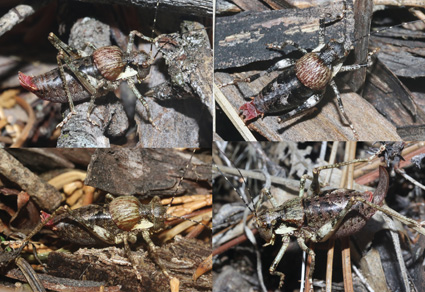

Abstract
Using morphology, bioacoustics, cytogenetics, and molecular phylogenetics, we tested whether a disjunct Phymonotus population from the highest peak in San Diego County, California, is distinct from the only known species, the San Jacinto Mountains endemic P. jacintotopos Lightfoot, Weissman, and Ueshima, 2011. The results prompt the description of P. glyphopyrenos sp. nov., a new extremophilic species with adult activity at high elevations during cold winter conditions. Morphologically, male genitalia and color pattern are generally diagnostic. Acoustically, P. glyphopyrenos have song energy spread out over a wider bandwidth than do P. jacintotopos (dominant frequency range 3.48±1.19 vs. 1.07±0.58 kHz; time entropy 0.88±0.11 vs. 0.70±0.09). The 2n♂=22 (20t+Xt+Yt) karyotype is distinct from 2n♂=24 (22t+Xt+Yt) described from P. jacintotopos. Bayesian consensus trees of the ITS2 barcode gene, both alone and concatenated with six other genes, clustered the two species into separate monophyletic lineages. We resurrect the subfamily Nedubinae for the monophyletic basal katydid lineage that includes Aglaothorax, Neduba, and Phymonotus. We contrast the habitats of both Phymonotus species, update the distribution of Phymonotus using community science observations, and hypothesize about the evolution of the peculiar dome-shaped male pronotum.
References
- Araya‐Salas, M. & Smith‐Vidaurre, G. (2017) warbleR: an R package to streamline analysis of animal acoustic signals Golding, N. (Ed). Methods in Ecology and Evolution, 8 (2), 184–191. https://doi.org/10.1111/2041-210X.12624
- Araya-Salas, M.., Smith, G., Chaverri, G., Brenes, J.C., Chirino, F., Elizondo, J. & Rico, A. (2023) ohun: An R package for diagnosing and optimizing automatic sound event detection. Methods in Ecology and Evolution, 14 (9), 2259–2271. https://doi.org/10.1111/2041-210X.14170
- Baker, E. & Chesmore, D. (2020) Standardisation of bioacoustic terminology for insects. Biodiversity Data Journal, 8, e54222. https://doi.org/10.3897/BDJ.8.e54222
- Berry, S.S. (1953) Two Californian mountain snails of the genus Helminthoglypta. A problem in the relationship of species. Transactions of the San Diego Society of Natural History, 11 (12), 329–344.
- Caudell, A.N. (1907) The Decticinae (a group of Orthoptera) of North America. Proceedings of the United States National Museum, 32, 285–410. https://doi.org/10.5479/si.00963801.32-1530.285
- Caudell, A.N. (1934) Notes on some Tettigoniidae of California with descriptions of new species. Pan-Pacific Entomologist, 10 (4), 151–158.
- Cole, J.A. (2010) Clinal variation explains taxonomic discrepancy in the calling songs of shield-back katydids (Orthoptera: Tettigoniidae: Tettigoniinae: Aglaothorax). Biological Journal of the Linnean Society, 101, 910–921. https://doi.org/10.1111/j.1095-8312.2010.01532.x
- Cole, J.A. (2016) Reinforcement and a cline in mating behaviour evolve in response to secondary contact and hybridization in shield-back katydids (Orthoptera: Tettigoniidae). Journal of Evolutionary Biology, 29 (9), 1652–1666. https://doi.org/10.1111/jeb.12900
- Cole, J.A. & Chiang, B.H. (2016) The Nearctic Nedubini: the most basal lineage of katydids is resolved among the paraphyletic ‘Tettigoniinae’ (Orthoptera: Tettigoniidae). Annals of the Entomological Society of America, 109 (4), 652–662. https://doi.org/10.1093/aesa/saw030
- Cole, J.A., Weissman, D.B., Lightfoot, D.C., Ueshima, N. & Warchałowska-Śliwa, E. (2025) A revision of the shield-backed katydid genus Aglaothorax (Orthoptera: Tettigoniidae: Tettigoniinae: Nedubini). Zootaxa, 5667 (1), 1–104. https://doi.org/10.11646/zootaxa.5667.1.1
- Cole, J.A., Weissman, D.B., Lightfoot, D.C., Ueshima, N., Warchałowska-Śliwa, E., Maryańska-Nadachowska, A. & Chatfield-Taylor, W. (2021) A revision of the shield-back katydid genus Neduba (Orthoptera: Tettigoniidae: Tettigoniinae: Nedubini). Zootaxa, 4910 (1), 1–92. https://doi.org/10.11646/zootaxa.4910.1.1
- Connors, M.G. (2024) A nomenclatural review of family-group names in the Tettigoniidae (Orthoptera: Ensifera). Zootaxa, 5468 (1), 1–51. https://doi.org/10.11646/zootaxa.5468.1.1
- Della Rocca, F., Repetto, E., De Caria, L. & Milanesi, P. (2025) Identifying ecological corridors of the bush cricket Saga pedo in fragmented landscapes. Insects, 16 (3), 279. https://doi.org/10.3390/insects16030279
- Gorochov, A.V. (1988) The classification and phylogeny of Tettigonioidea (Gryllida=Orthoptera, Tettigonioidea). In: The Cretaceous Biocoenotic Crisis and the Evolution of Insects. Nakua, Moscow, pp. 145–190.
- Greenfield, M.D. (2002) Signalers and Receivers: Mechanisms and Evolution of Arthropod Communication. Oxford University Press, New York, xii + 414 pp. https://doi.org/10.1093/oso/9780195134520.001.0001
- Harrison, S. (2013) Plant and animal endemism in California. University of California Press, Berkeley, California, 189 pp. https://doi.org/10.1525/california/9780520275546.001.0001
- Huelsenbeck, J.P. & Ronquist, F. (2001) MRBAYES: Bayesian inference of phylogeny. Bioinformatics, 17, 754–755. https://doi.org/10.1093/bioinformatics/17.8.754
- Ingrisch, S. (1998) Monograph of the Oriental Agraeciini (Insecta, Ensifera, Tettigoniidae): taxonomic revision, phylogeny, biogeography, stridulation and development. Courier Forschungsinstitut Senckenberg, 206, 1–391.
- Jonsson, T., Chivers, B.D., Brown, K.R., Sarria-S, F.A., Walker, M. & Montealegre-Z, F. (2017) Chamber music – An unusual Helmholtz resonator for song amplification in a Neotropical bush-cricket (Orthoptera, Tettigoniidae). Journal of Experimental Biology, 220 (16), 2900–2907. https://doi.org/10.1242/jeb.160234
- Kahle, D. & Wickham, H. (2013) ggmap: Spatial visulalization with ggplot2. The R Journal, 5 (1), 144–161. https://doi.org/10.32614/RJ-2013-014
- Lanfear, R., Calcott, B., Ho, S.Y.W. & Guindon, S. (2012) PartitionFinder: combined selection of partitioning schemes and substitution models for phylogenetic analyses. Molecular Biology and Evolution, 29 (6), 1695–1701. https://doi.org/10.1093/molbev/mss020
- Lanfear, R., Frandsen, P.B., Wright, A.M., Senfeld, T. & Calcott, B. (2016) PartitionFinder2: new methods for selecting partitioned models of evolution for molecular and morphological phylogenetic analysis. Molecular Biology and Evolution, 34 (3), 772–773. https://doi.org/10.1093/molbev/msw260
- Lightfoot, D.C., Weissman, D.B. & Ueshima, N. (2011) Phymonotus jacintotopos: A new genus and species of shield-backed katydid (Orthoptera: Tettigoniidae: Tettigoniinae: Nedubini) from the San Jacinto Mountains of California, USA. Zootaxa, 2937 (1), 49–65. https://doi.org/10.11646/zootaxa.2937.1.4
- Maddison, W.P. & Maddison, D.R. (2015) Mesquite: a modular system for evolutionary analysis. Version 3.04. Available from: http://mesquiteproject.org (accessed 31 March 2026)
- Martin, M. (2011) Cutadapt removes adapter sequences from high-throughput sequencing reads. EMBnet.journal, 17 (1), 10–12. https://doi.org/10.14806/ej.17.1.200
- Milanesi, P., Mori, E. & Menchetti, M. (2020) Observer‐oriented approach improves species distribution models from citizen science data. Ecology and Evolution, 10 (21), 12104–12114. https://doi.org/10.1002/ece3.6832
- Montealegre-Z, F. (2005) Biomechanics of Musical Stridulation in Katydids (Orthoptera: Ensifera: Tettigoniidae): An Evolutionary Approach. Ph.D. Thesis. University of Toronto, Toronto, Ontario, 228 pp.
- Rehn, J.A.G. & Hebard, M. (1920) Descriptions of new genera and species of North American Decticinae (Orthoptera; Tettigoniidae). Transactions of the American Entomological Society, 46 (3), 225–265.
- Rentz, D.C. (1973) The shield-backed katydids of the genus Idiostatus. Memoirs of the American Entomological Society, 29, 1–211.
- Rentz, D.C. (1979) Comments on the classification of the orthopteran family Tettigoniidae, with a key to subfamilies and description of two new subfamilies. Australian Journal of Zoology, 27 (6), 991–1013. https://doi.org/10.1071/ZO9790991
- Rentz, D.C. & Birchim, J.D. (1968) Revisionary studies in the Nearctic Decticinae. Memoirs of the Pacific Coast Entomological Society, 3, 1–173. https://doi.org/10.5962/bhl.title.150851
- Rentz, D.C. & Colless, D.H. (1990) A classification of the shield-backed katydids (Tettigoniinae) of the world. In: Bailey, W.J. & Rentz, D.C. (Eds.), The Tettigoniidae: Biology, Systematics and Evolution. Springer-Verlag, New York, New York, pp. 352–377. https://doi.org/10.1007/978-3-662-02592-5_17
- Riede, K. (2018) Acoustic profiling of Orthoptera: present state and future needs. Journal of Orthoptera Research, 27 (2), 203–215. https://doi.org/10.3897/jor.27.23700
- Ronquist, F. & Huelsenbeck, J.P. (2003) MRBAYES 3: Bayesian phylogenetic inference under mixed models. Bioinformatics, 19, 1572–1574. https://doi.org/10.1093/bioinformatics/btg180
- Ronquist, F., Teslenko, M., van der Mark, P., Ayres, D.L., Darling, A., Hohna, S., Larget, B., Liu, L., Suchard, M.A. & Huelsenbeck, J.P. (2012) MrBayes 3.2: efficient Bayesian phylogenetic inference and model choice across a large model space. Systematic Biology, 61 (3), 539–542. https://doi.org/10.1093/sysbio/sys029
- Sahlin, K., Lim, M.C.W. & Prost, S. (2021) NGSpeciesID: DNA barcode and amplicon consensus generation from long‐read sequencing data. Ecology and Evolution, 11 (3), 1392–1398. https://doi.org/10.1002/ece3.7146
- Sarria-Sarria, F.A., Morris, G.K. & Montealegre-Z, F. (2024) A new genus of Andean katydid with unusual pronotal structure for enhancing resonances. Biology, 13 (12), 1071. https://doi.org/10.3390/biology13121071
- Scudder, S.H. (1899) Two genera of North American Decticinae. Proceedings of the American Academy of Arts and Sciences, 35, 81–93. https://doi.org/10.2307/25129903
- Smeds, E.A. & Chatfield-Taylor, W. (2025) A new species of Okanagana native to a unique serpentine ecosystem in Northern California (Hemiptera: Auchenorrhyncha: Cicadidae). Zootaxa, 5636 (3), 487–498. https://doi.org/10.11646/zootaxa.5636.3.4
- Srivathsan, A. (2021) ONTbarcoder and MinION barcodes aid biodiversity discovery and identification by everyone, for everyone. BMC Biology, 19 (217), 1–21. https://doi.org/10.1186/s12915-021-01141-x
- Sueur, J., Aubin, T. & Simonis, C. (2008) Seewave, a free modular tool for sound analysis and synthesis. Bioacoustics, 18 (2), 213–226. https://doi.org/10.1080/09524622.2008.9753600
- Tinkham, E.R. (1944) Biological, taxonomic and faunistic studies on the shield-back katydids of the North American deserts. American Midland Naturalist, 31, 257–328. https://doi.org/10.2307/2421073
- Woo, B. (2024) A new species of Meadow Katydid (Orthoptera: Tettigoniidae: Conocephalini) from the Apalachicola River Basin of Florida, USA. Zootaxa, 5523 (1), 100–112. https://doi.org/10.11646/zootaxa.5523.1.6