

Abstract
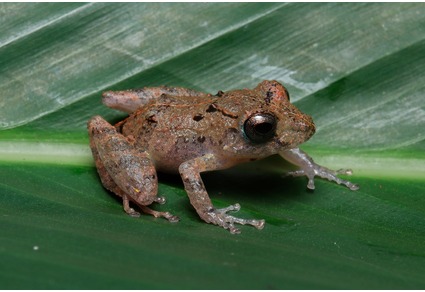
In the present study, we describe a new species of Pristimantis inhabiting open ombrophilous forests of Southwestern Amazonia. We describe this new species combining mitochondrial (16S and COI) and nuclear (RAG1) loci, external morphology, bioacoustic and natural history data. The new species is phylogenetically related to other Southwestern Amazonian lowland species of the P. unistrigatus species group (P. croceoinguinis, P. lirellus, P. okmoi and P. carvalhoi). It differs from its closest relatives mainly by its body size (male SVL of 17.7–20.4 mm, n = 29; female SVL of 24.6–26.5 mm, n = 2) and the presence of tympanum, extensive tuberculation (i.e., scapular, ulnar, heels, tarsal and eyelid tubercles), tarsal folds and dentigerous processes of vomers. Moreover, the new species differentiates from its relatives by presenting a yellow groin and gray iris, and by its two types of advertisement calls, consisting of either by a single-note call with duration of 130–254 ms, with three well-defined harmonics, or in three-note call with duration of 421–459 ms, with a single harmonic. The new species is very inconspicuous in its natural habitat due to its small body size, dull coloration, low intensity call, short call activity at dusk (lasting about 20 minutes) and shy behavior. Although open ombrophilous forests of Southwestern Amazonia are still poorly studied, recent studies have revealed a great number of undescribed anuran species under their canopy. Concerningly, the region is the main western route for the expansion of the Amazonian arc of deforestation, which strongly threatens endemic amphibians.
References
- Aguirre, P.D., Apunte, K. & Ron, S.R. (2025) Systematics of the Dendropsophus leucophyllatus species group (Anura, Hylidae) from the Chocó region of Ecuador, with description of a new species. Evolutionary Systematics, 9, 7–31. https://doi.org/10.3897/evolsyst.9.135431
- Albert, J.S., Val, P. & Hoorn, C. (2018) The changing course of the Amazon River in the Neogene: center stage for Neotropical diversification. Neotropical Ichthyology, 16 (03), e180033. https://doi.org/10.1590/1982-0224-20180033
- Altschul, S.F., Madden, T.L., Schäffer, A.A., Zhang, J., Zhang, Z., Miller, W. & Lipman, D.J. (1997) Gapped BLAST and PSI-BLAST: a new generation of protein database search programs. Nucleic Acids Research, 25, 3389–3402. https://doi.org/10.1093/nar/25.17.3389
- Bernarde, P.S., Albuquerque, S.D., Miranda, D.B.D. & Turci, L.C.B. (2013) Herpetofauna da floresta do baixo rio Moa em Cruzeiro do Sul, Acre-Brasil. Biota Neotropica, 13 (1), 220–244. https://doi.org/10.1590/S1676-06032013000100023
- Bernarde, P.S., Machado, R.A. & Turci, L.C.B. (2011) Herpetofauna da área do Igarapé Esperança na Reserva Extrativista Riozinho da Liberdade, Acre-Brasil. Biota Neotropica, 11(3), 117–144. https://doi.org/10.1590/S1676-06032011000300010
- Bioacoustics Research Program (2014) Raven Pro: interactive sound analysis software. Version 1.5. The Cornell Lab of Ornithology, Ithaca, New York. Available from: www.ravensoundsoftware.com/software/raven-pro (accessed 4 January 2025)
- Boulenger, G.A. (1903) Descriptions of new batrachians in the British Museum. Annals and Magazine of Natural History, Series 7, 12 (71), 552–557. https://doi.org/10.1080/00222930308678892
- Caldwell, J.P., Lima, A.P. & Keller, C. (2002) Redescription of Colostethus marchesianus (Melin, 1941) from its type locality. Copeia, 2002, 157–165. https://doi.org/10.1643/0045-8511(2002)002[0157:ROCMMF]2.0.CO;2
- Carphio, E.C., Cisneros-Heredia, D. F., Caicedo, A. & Cárdenas, P.A. (2021) Urbanization and altitude impact on gut microbiome of an Andean frog (Pristimantis unistrigatus). bioRxiv, 2021, 1–11. https://doi.org/10.1101/2021.11.10.468176
- Catenazzi, A. & Lehr, E. (2018) Pristimantis antisuyu sp. n. and Pristimantis erythroinguinis sp. n., two new species of terrestrial-breeding frogs (Anura, Strabomantidae) from the eastern slopes of the Andes in Manu National Park, Peru. Zootaxa, 13 (2), 185–206. https://doi.org/10.11646/zootaxa.4394.2.2
- Chávez, G., García Ayachi, L.A. & Catenazzi, A. (2021) Beauty is in the eye of the beholder: Cruciform eye reveals new species of direct-developing frog (Strabomantidae, Pristimantis) in the Amazonian Andes. Evolutionary Systematics, 5, 81–92. https://doi.org/10.3897/evolsyst.5.63674
- Che, J., Chen, H.M., Yang, J.X., Jin, J.Q., Jiang, K., Yuan, Z.Y., Murphy, R.W. & Zhang, Y.P. (2012) Universal COI primers for DNA barcoding amphibians. Molecular Ecology Resources, 12, 247–258. https://doi.org/10.1111/j.1755-0998.2011.03090.x
- Cheng, H., Sinha, A., Cruz, F.W., Wang, X., Edwards, R. L., d’Horta, F.M., Ribas, C.C., Vuille, M., Stott, L.D. & Auler, A.S. (2013) Climate change patterns in Amazonia and biodiversity. Nature communications, 4 (1), 1411. https://doi.org/10.1038/ncomms2415
- Courtois, E.A., Michel, E., Martinez, Q., Pineau, K., Dewynter, M., Ficetola, G.F. & Fouquet, A. (2016) Taking the lead on climate change: modelling and monitoring the fate of an Amazonian frog. Oryx, 50 (3), 450–459. https://doi.org/10.1017/S0030605315000083
- Dwyer, C.M. (1995) A new species of Eleutherodactylus from Perú (Anura: Leptodactylidae). Amphibia-Reptilia, 16, 245–256.
- Duellman, W.E. & Lehr, E. (2009) Terrestrial breeding frogs (Strabomantidae) in Peru. NTV Science, Münster, 382 pp.
- Duellman, W.E. (1978a) Three new species of Eleutherodactylus from Amazonian Perú (Amphibia: Anura: Leptodactylidae). Herpetologica, 34, 264–270.
- Duellman, W.E. (1978b) New species of leptodactylid frogs of the genus Eleutherodactylus from the Cosñipata Valley, Perú. Proceedings of the Biological Society of Washington, 91, 418–430.
- Elmer, K.R., Dávila, J.A. & Lougheed, S.C. (2007) Cryptic diversity and deep divergence in an upper Amazonian leaflitter frog, Eleutherodactylus ockendeni. BMC Evolutionary Biology, 7(1), 247. https://doi.org/10.1186/1471-2148-7-247
- Fouquet, A., Martinez, Q., Courtois, E.A., Dewynter, M., Pineau, K., Gaucher, P., Blanc, M., Marty, C. & Kok, P.J.F. (2013) A new species of the genus Pristimantis (Amphibia, Craugastoridae) associated with the moderately evelated massifs of French Guiana. Zootaxa, 3750 (5), 569–586. https://doi.org/10.11646/zootaxa.3750.5.8
- Fouquet, A., Noonan, B.P., Rodrigues, M.T., Pech, N., Gilles, A. & Gemmell, N.J. (2012) Multiple Quaternary Refugia in the Eastern Guiana Shield Revealed by Comparative Phylogeography of 12 Frog Species. Systematic Biology, 61, 461–489. https://doi.org/10.1080/14772000.2022.2039317
- Fouquet, A., Peloso, P., Jairam, R., Lima, A.P., Mônico, A.T., Ernst, R. & Kok, P.J.R. (2022b) Back from the deaf: integrative taxonomy revalidates an earless and mute species, Hylodes grandoculis van Lidth de Jeude, 1904, and confirms a new species of Pristimantis Jiménez de la Espada, 1870 (Anura: Craugastoridae) from the Eastern Guiana Shield. Organisms Diversity & Evolution, 2022 (2), 1–34. https://doi.org/10.1007/s13127-022-00564-w
- Fouquet, A., Réjaud, A., Rodrigues, M.T., Ron, S.R., Chaparro, J.C., Osorno-Muñoz, M., Werneck, F.P., Hrbek, T., Lima, A.P., Camacho-Badani, T., Jaramillo, A.F. & Chave, J. (2022a) Diversification of the Pristimantis conspicillatus group (Anura: Craugastoridae) within distinct Neotropical areas throughout the Neogene. Systematics and Biodiversity, 20 (1), 2130464. https://doi.org/10.1080/14772000.2022.2130464
- Freitas, M.A., Venâncio, N.M., Abegg, A.D., Azevedo, W.S., Pereira, V.O., Zanotti, A.P., Veloso, A., Schwarzbach, L., Oliveira-e-Souza, A.G., Cruz-da-Silva, R.C., Amorim, V.R.G. & Moura, G.J.B. (2020) Herpetofauna at the Rio Acre Ecological Station, Amazon Rainforest, Brazil. Herpetology Notes, 13, 33–48.
- Frost, D.R. (2025) Amphibian Species of the World: an Online Reference. Available at: https://research.amnh.org/herpetology/amphibia/index.html (accessed 6 April 2025)
- Godinho, M.B. & Silva, F.R. (2018) The influence of riverine barriers, climate, and topography on the biogeographic regionalization of Amazonian anurans. Scientific Reports, 8 (1), 1–11. https://doi.org/10.1038/s41598-018-21879-9
- Grant, T., Lyra, M.L., Hofreiter, M., Preick, M., Barlow, A., Verdade, V.K. & Rodrigues, M.T. (2025) Museomics and the systematics of the Atlantic Forest Nurse Frogs (Dendrobatoidea: Aromobatidae: Allobatinae). Bulletin of the American Museum of Natural History, 472, 1–76. https://doi.org/10.1206/0003-0090.472.1.1
- Guayasamin, J.M., Krynak, T., Krynak, K., Culebras, J. & Hutter, C.R. (2015) Phenotypic plasticity raises questions for taxonomically important traits: a remarkable new Andean rainfrog (Pristimantis) with the ability to change skin texture. Zoological Journal of the Linnean Society, 173, 913–928. https://doi.org/10.1111/zoj.12222
- Hedges, S.B., Duellman, W.E. & Heinicke, M.P. (2008) New World direct-developing frogs (Anura: Terrarana): molecular phylogeny, classification, biogeography, and conservation. Zootaxa, 1737 (1), 1–182. https://doi.org/10.11646/zootaxa.1737.1.1
- Heinicke, M.P., Duellman, W.E. & Hedges, S.B. (2007) Major Caribbean and Central American frog faunas originated by ancient oceanic dispersal. Proceedings of the National Academy of Sciences, 104 (24), 10092–10097. https://doi.org/10.1073/pnas.0611051104
- Hoang, D.T., Chernomor, O., von Haeseler, A., Minh, B.Q. & Vinh, L.S. (2018) UFBoot2: improving the ultrafast bootstrap approximation. Molecular Biology and Evolution, 35, 518–522. https://doi.org/10.1093/molbev/msx281
- Hoorn, C., Wesselingh, F.P., Ter Steege, H., Bermudez, M.A., Mora, A., Sevink, J., Sanmartín, I., Sanchez-Meseguer, A., Anderson, C.L., Figueiredo, J.P., Jaramillo, C., Riff, D., Negri, F.R., Hooghiemstra, H., Lundberg, J., Stadler, T., Särkinen, T. & Antonelli, A. (2010) Amazonia through time: Andean uplift, climate change, landscape evolution, and biodiversity. Science, 330 (6006), 927–931. https://doi.org/10.1126/science.1194585
- IUCN (2025) The IUCN Red Listof Threatened Species. Version 2025-1. Available from: https://www.iucnredlist.org (accessed 5 June 2025)
- Jaramillo, A.F., De La Riva, I., Guayasamin, J.M., Chaparro, J.C., Gagliardi-Urrutia, G., Gutiérrez, R.C., Brcko, I., Vilà, C. & Castroviejo-Fisher, S. (2020) Vastly underestimated species richness of Amazonian salamanders (Plethodontidae: Bolitoglossa) and implications about plethodontid diversification. Molecular Phylogenetics and Evolution, 149 (2), 106841. https://doi.org/10.1016/j.ympev.2020.106841
- Jiménez de la Espada, M. (1875) Vertebrados del Viaje al Pacífico Verificado de 1862 a 1865 por una Comisión de Naturalistas Enviada por el Gobierno Español. Batracios. A. Miguel Ginesta, Madrid, 208 pp. https://doi.org/10.5962/bhl.title.5769
- Jowers, M.J., Sánchez-Ramírez, S., Greener, M.S., Harper, L.R., Auguste, R.J., Marshall, T., Thomson, R., Byrne, I., Loughrey, C.F., Graham, L., McGhee, W.A.O., Murphy, J.C., Rivas, G.A., Beyts, C. & Downie, J.R. (2021) Ecology, conservation status, and phylogenetic placement of endemic Pristimantis frogs (Anura: Craugastoridae) in Trinidad and Tobago and genetic affinities to northern Venezuela. Population Ecology, 64, 1–14. https://doi.org/10.1002/1438-390X.12107
- Kalyaanamoorthy, S., Minh, B.Q., Wong, T.K.F., von Haeseler, A. & Jermiin, L.S. (2017) ModelFinder: fast model selection for accurate phylogenetic estimates. Nature Methods, 14 (6), 587–589. https://doi.org/10.1038/nmeth.4285
- Katoh, K. & Standley, D.M. (2013) MAFFT Multiple sequence alignment software version 7: improvements in performance and usability. Molecular Biology and Evolution, 30, 772–780. https://doi.org/10.1093/molbev/mst010
- Kimura, M. (1980) A simple method for estimating evolutionary rate of base substitutions through comparative studies of nucleotide sequences. Journal of Molecular Evolution, 16, 111–120. https://doi.org/10.1007/BF01731581
- Köhler, G. (2012) Color catalogue for field biologists. Offenback: Herpeton, Germany, 49 p.
- Köhler, J., Jansen, M., Rodriguez, A., Kok, P.J.R., Toledo, L.F., Emmrich, M., Glaw, F., Haddad, C.F.B., Rödel, M.O. & Vences, M. (2017) The use of bioacoustics in anuran taxonomy: theory, terminology, methods and recommendations for best practice. Zootaxa, 4251 (1), 1–124. https://doi.org/10.11646/zootaxa.4251.1.1
- Köhler, J. & Lötters, S. (1999) New species of the Eleutherodactylus unistrigatus group (Amphibia: Anura: Leptodactylidae) from montane rain forest of Bolivia. Copeia, 1999, 422–427. https://doi.org/10.2307/1447487
- Kok, P.J.R., Dezfoulian, R., Means, D.B., Fouquet, A. & Barrio-Amorós, C.L. (2018) Amended diagnosis and redescription of Pristimantis marmoratus (Boulenger, 1900) (Amphibia: Craugastoridae), with a description of its advertisement call and notes on its breeding ecology and phylogenetic relationships. European Journal of Taxonomy, 397, 1–30. https://doi.org/10.5852/ejt.2018.397
- Kok, P.J., MacCulloch, R.D., Means, D.B., Roelants, K., Van Bocxlaer, I. & Bossuyt, F. (2012) Low genetic diversity in tepui summit vertebrates. Current Biology, 22 (15), 589–590. https://doi.org/10.1016/j.cub.2012.06.034
- Kok, P.J.R., Means, D.B. & Bossuyt, F. (2011) A new highland species of Pristimantis Jiménez de la Espada, 1871 (Anura: Strabomantidae) from the Pantepui region, northern South America. Zootaxa, 2934 (1), 1–19. https://doi.org/10.11646/zootaxa.2934.1.1
- Lehr, E., Lundberg, M., Aguilar, C. & von May, R. (2006) New species of Eleutherodactylus (Anura: Leptodactylidae) from the eastern Andes of central Peru with comments on central Peruvian Eleutherodactylus. Herpetological Monographs, 20, 105–128. https://doi.org/10.1655/0733-1347(2007)20[105:NSOEAL]2.0.CO;2
- Lehr, E. & Moravec, J. (2017) A new species of Pristimantis (Amphibia, Anura, Craugastoridae) from a montane forest of the Pui Pui Protected Forest in central Peru (Región Junín). ZooKeys, 645, 85–102. https://doi.org/10.3897/zookeys.645.11221
- Lehr, E., Moravec, J., Cusi Martínez, J.C. & Gvoždík, V. (2017) A new minute species of Pristimantis (Amphibia: Anura: Craugastoridae) with a large head from the Yanachaga-Chemillén National Park in central Peru, with comments on the phylogenetic diversity of Pristimantis occurring in the Cordillera Yanachaga. European Journal of Taxonomy, 325, 1–22. https://doi.org/10.5852/ejt.2017.325
- Lehr, E., Moravec, J. & Gagliardi-Urrutia, L.A.G. (2010) A new species of Pristimantis (Anura: Strabomantidae) from the Amazonian lowlands of northern Peru. Salamandra, 46, 197–203.
- Lima, A.P., Sanchez, D.E.A. & Souza, J.R.D. (2007) A new Amazonian species of the frog genus Colostethus (Dendrobatidae) that lays its eggs on undersides of leaves. Copeia, 2007, 114–122. https://doi.org/10.1643/0045-8511(2007)7[114:ANASOT]2.0.CO;2
- Lutz, B. & Kloss, G.R. (1952) Anfíbios anuros do alto Solimões e Rio Negro. Apontamento sôbre algumas formas e suas vicariantes. Memórias do Instituto Oswaldo Cruz, 50, 625–678.
- Lynch, J.D. (1968) Two new frogs of the genus Eleutherodactylus from eastern Ecuador (Amphibia: Leptodactylidae). Journal of Herpetology, 2, 129–135. https://doi.org/10.2307/1563112
- Lyra, M.L., Haddad, C.F.B. & Azeredo-Espin, A.M.L. (2016) Meeting the challenge of DNA barcoding Neotropical amphibians: Polymerase chain reaction optimization and new COI primers. Molecular Ecology Resources, 17 (5), 966–980. https://doi.org/10.1111/1755-0998.12648
- Maddison, W.P. & Maddison, D.R. (2021) Mesquite: a modular system for evolutionary analysis. Version 3.70. Available from: www.mesquiteproject.org (accessed 6 January 2025)
- Martins, B.C., Mônico, A.T., Mendonça, C., Dantas, S.P., Souza, J.R.D., Hanken, J., Lima, A.P. & Ferrão, M. (2024) A new species of terrestrial foam-nesting frog of the Adenomera simonstuarti complex (Anura, Leptodactylidae) from white-sand forests of central Amazonia, Brazil. Zoosystematics and Evolution, 100 (1), 233–253. https://doi.org/10.3897/zse.100.110133
- Melo-Sampaio, P.R. (2023) A new species of Pristimantis (Anura, Strabomantidae) from the state of Acre, Brazil. Journal of Vertebrate Zoology, 72, 23044. https://doi.org/10.25225/jvb.23044
- Mendoza, A.M., Ospina, O.E., Cárdenas-Henao, H. & García-R, J.C. (2015) A likelihood inference of historical biogeography in the world’s most diverse terrestrial vertebrate genus: Diversification of direct-developing frogs (Craugastoridae: Pristimantis) across the Neotropics. Molecular Phylogenetics and Evolution, 85, 50–58. https://doi.org/10.1016/j.ympev.2015.02.001
- Meza-Joya, F.L. & Torres, M. (2015) Spatial diversity patterns of Pristimantis frogs in the Tropical Andes. Ecology and Evolution, 6 (7), 1–4. https://doi.org/10.1002/ece3.1968
- Minh, B.Q., Schmidt, H.A., Chernomor, O., Schrempf, D., Woodhams, M.D., Haeseler, A. von, & Lanfear, R. (2020) IQ-TREE 2: New models and efficient methods for phylogenetic inference in the genomic era. Molecular Phylogenetics and Evolution, 37, 1530–1534. https://doi.org/10.1093/molbev/msaa015
- Mônico, A.T., Ferrão, M., Chaparro, J.C., Fouquet, A. & Lima, A.P. (2022) A new species of rain frog (Anura: Strabomantidae: Pristimantis) from the Guiana Shield and amended diagnosis of P. ockendeni (Boulenger, 1912). Vertebrate Zoology, 72, 1035–1065. https://doi.org/10.3897/vz.72.e90435
- Mônico, A.T., Koch, E.D., Ferrão, M., Fernandes, I.Y., Marques, G.M.M., Chaparro, J.C., Rodrigues, M.T., Lima, A.P. & Fouquet, A. (2024) The small and inconspicuous majority: Revealing the megadiversity and historical biogeography of the Pristimantis unistrigatus species group (Anura, Strabomantidae). Molecular Phylogenetics and Evolution, 201 (2024), 108203. https://doi.org/10.1016/j.ympev.2024.108203
- Nguyen, L.T., Schmidt, H.A., von Haeseler, A. & Minh, B.Q. (2015) IQ-TREE: a fast and effective stochastic algorithm for estimating Maximum-Likelihood phylogenies. Molecular Biology and Evolution, 32, 268–274. https://doi.org/10.1093/molbev/msu300
- Oliveira, E.A., Silva, L.A., Guimarães, K.L.A., Penhacek, M., Martínez, J.G., Rodrigues, L.R.R., Santana, D.J. & Hernández-Ruz, E.J. (2020) Four new species of Pristimantis Jiménez de la Espada, 1870 (Anura: Craugastoridae) in the eastern Amazon. PLoS One, 15 (3), e0229971. https://doi.org/10.1371/journal.pone.0229971
- Ortega, J.A., Brito, J. & Ron, S.R. (2022) Six new species of Pristimantis (Anura: Strabomantidae) from Llanganates National Park and Sangay National Park in Amazonian cloud forests of Ecuador. PeerJ, 10, e13761. https://doi.org/10.7717/peerj.13761
- Ortega-Andrade, H.M., Deichmann, J.L. & Chaparro, J.C. (2021) Two new cryptic Pristimantis (Anura, Craugastoridae) from the Southern Amazon Basin of Peru with taxonomic comments on Pristimantis imitatrix (Duellman, 1978). South American Journal of Herpetology, 21, 41–64. https://doi.org/10.2994/SAJH-D-17-00068.1
- Ortega-Andrade, H.M. & Venegas, P.J. (2014) A new synonym for Pristimantis luscombei (Duellman and Mendelson 1995) and the description of a new species of Pristimantis from the upper Amazon basin (Amphibia: Craugastoridae). Zootaxa, 3895 (1), 31–57. https://doi.org/10.11646/zootaxa.3895.1.2
- Ortiz, D.A., Hoskin, C.J., Werneck, F.P., Réjaud, A., Manzi, S., Ron, S.R. & Fouquet, A. (2022) Historical biogeography highlights the role of Miocene landscape changes on the diversification of a clade of Amazonian tree frogs. Organism Diversity and Evolution, 23, 395–414. https://doi.org/10.1007/s13127-022-00588-2
- Padial, J.M., Castroviejo-Fisher, S., Koehler, J., Domic, E. & De la Riva, I. (2007) Systematics of the Eleutherodactylus fraudator species group (Anura: Brachycephalidae). Herpetological Monographs, 21, 213–240. https://doi.org/10.1655/06-007.1
- Padial, J.M., Castroviejo-Fisher, S., Köhler, J., Vilà, C., Chaparro, J.C. & De la Riva, I. (2009) Deciphering the products of evolution at the species level: the need for an integrative taxonomy. Zoologica Scripta, 38 (4), 431–447. https://doi.org/10.1111/j.1463-6409.2008.00381.x
- Páez, N. & Ron, S.R. (2019) Systematics of Huicundomantis, a new subgenus of Pristimantis (Anura, Strabomantidae) with extraordinary cryptic diversity and eleven new species. Zookeys, 868, 1–112. https://doi.org/10.3897/zookeys.868.26766
- Palumbi, S.R. (1996) Nucleic acids II: the polymerase chain reaction. In: Hillis, D.M., Moritz, C. & Mable, B.K. (Eds.), Molecular Systematics. Sinauer & Associates Inc., Sunderland, Massachusetts, pp. 205–247.
- Penhacek, M., Souza, T.S., Santos, J.P., Guerra, V., Castro-Souza, R.A. & Rodrigues, D.J. (2024) Amazonian amphibians: diversity, spatial distribution patterns, conservation and sampling deficits. Biodiversity Data Journal, 12, e109785. https://doi.org/10.3897/BDJ.12.e109785.
- Pintanel, P., Tejedo, M., Ron, S.R., Llorente, G.A. & Merino-Viteri, A. (2019) Elevational and microclimatic drivers of thermal tolerance in Andean Pristimantis frogs. Journal of Biogeography, 46, 1664–1675. https://doi.org/10.1111/jbi.13596
- Pinto-Sanchez, N.R., Ibanez, R., Madrinan, S., Sanjur, O.I., Bermingham, E. & Crawford, A.J. (2012) The Great American Biotic Interchange in frogs: multiple and early colonization of Central America by the South American genus Pristimantis (Anura: Craugastoridae). Molecular Phylogenetics and Evolution, 62 (3), 954–972. https://doi.org/10.1016/j.ympev.2011.11.022
- R Core Team (2019) A language and environment for statistical computing. R Foundation for Statistical Computing, Vienna. Available from: https://www.r-project.org/ (accessed 16 January 2025).
- Rabosky, D. L., von May, R., Grundler, M.C. & Davis Rabosky, A.R. (2019) The Western Amazonian richness gradient for squamate reptiles: Are there really fewer snakes and lizards in southwestern Amazonian lowlands? Diversity, 11 (10), 199. https://doi.org/10.3390/d11100199
- Réjaud, A., Rodrigues, M.T., Crawford, A.J., Castroviejo-Fisher, S., Jaramillo, A.F., Chaparro, J.C., Glaw, F., Gagliardi-Urrutia, G., Moravec, J., De la Riva, I.J., Perez-Peña, P.E, Lima, A.P., Werneck, F.P., Hrbek, T., Ron, S.R., Ernest, R., Kok, P., Driskell, A., Chave, J. & Fouquet A. (2020) Historical biogeography identifies a possible role of Miocene wetlands in the diversification of the Amazonian rocket frogs (Aromobatidae: Allobates). Journal of Biogeography, 47, 2472–2482. https://doi.org/10.1111/jbi.13937
- Rivera-Correa, M., Lamadrid-Feris, F. & Crawford, A.J. (2016) A new small golden frog of the genus Pristimantis (Anura: Craugastoridae) from an Andean cloud forest of Colombia. Amphibia-Reptilia, 37, 153–166. https://doi.org/10.1163/15685381-00003037
- Smith, B.T., McCormack, J.E., Cuervo, A.M., Hickerson, M.J., Aleixo, A., Cadena, C.D., Pérez-Emán, J., Burney, C.W., Xie, X., Harvey, M.G., Faircloth, B.C., Glenn, T.C., Derryberry, E.P., Prejean, J., Fields, S. & Brumfield, R.T. (2014) The drivers of tropical speciation. Nature, 515 (7527), 406–09. https://doi.org/10.1038/nature13687
- Souza, J.R.D., Ferrão, M., Kaefer, I.L., Cunha-Machado, A.S., Melo-Sampaio, P.R., Hanken, J. & Lima, A.P. (2023) A new pale-ventered Nurse Frog (Aromobatidae: Allobates) from southwestern Brazilian Amazonia. Vertebrate Zoology, 73, 647–675. https://doi.org/10.3897/vz.73.e103534
- Souza, M.B. (2009) Anfíbios: Reserva Extrativista do Alto Juruá e Parque Nacional da Serra do Divisor, Acre. Editora do Instituto de Filosofia e Ciências Humanas. Campinas, 107 pp.
- Sueur, J., Aubin, T. & Simonis, C. (2008) Seewave, a free modular tool for sound analysis and synthesis. Bioacoustics, 18, 213–226. https://doi.org/10.1080/09524622.2008.9753600
- Tamura, K., Stecher, G. & Kumar, S. (2021) MEGA11: Molecular Evolutionary Genetics Analysis Version 11. Molecular Biology and Evolution, 38 (7), 3022–3027. https://doi.org/10.1093/molbev/msab120
- Trifinopoulos, J., Nguyen, L.T., von Haeseler, A. & Minh, BQ. (2016) W-IQ-TREE: a fast online phylogenetic tool for maximum likelihood analysis. Nucleic Acids Research, 44, 232–235. https://doi.org/10.1093/nar/gkw256
- Vacher, J.-P., Chave, J., Ficetola, F.G., Sommeria-Klein, G., Tao, S., Thébaud, C., Blanc, M., Camacho, A., Cassimiro, J., Colston, T.J., Dewynter, M., Ernst. R., Gaucher, P., Gomes, J.O., Jairam, R., Kok, P.J.R., Lima, J.D., Martinez, Q., Marty, C., Noonan, B.P., Nunes, P.M.S., Ouboter, P., Recoder, R., Rodrigues, M.T., Snyder, A., Marques-Souza, S. & Fouquet, A. (2020) Large scale DNA-based survey of frogs in Amazonia suggests a vast underestimation of species richness and endemism. Journal of Biogeography, 47, 1781–1791. https://doi.org/10.1111/jbi.13847
- von May, R., Catenazzi, A., Corl, A., Santa-Cruz, R., Carnaval, A.C. & Moritz, C. (2017) Divergence of thermal physiological traits in terrestrial breeding frogs along a tropical elevational gradient. Ecology and Evolution, 7 (9), 3257–3267. https://doi.org/10.1002/ece3.2929
- Waddell, E.H., Crotti, M., Lougheed, S.C., Cannatella, D.C. & Elmer, K.R. (2018) Hierarchies of evolutionary radiation in the world’s most species rich vertebrate group, the Neotropical Pristimantis leaf litter frogs. Systematics and Biodiversity, 16, 807–819. https://doi.org/10.1080/14772000.2018.1503202