

Abstract
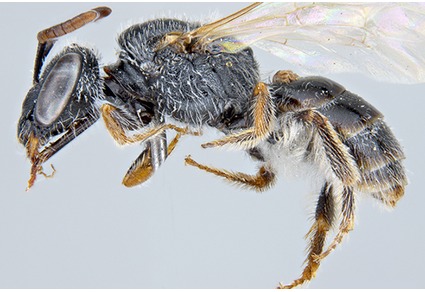
Australian species of the Lasioglossum Curtis 1833 subgenus Ctenonomia Cameron 1903 are revised, to stabilise the taxonomy, and to facilitate identifications. This revision resolved there are 15 valid Australian species in this subgenus. Ten new species are erected, five described species are confirmed valid, six new synonyms are made and one described species has a new status.
For Australian Lasioglossum (Ctenonomia) new species include: L. (C.) batleyi new species, L. (C.) boreum new species, L. (C.) flutinum new species, L. (C.) floccosum new species, L. (C.) forresti (Cockerell 1906), L. (C.) hirtiglossa new species, L. (C.) leviorum new species, L. (C.) luculentum new species, L. (C.) picticorne (Cockerell 1930a), L. (C.) quadrifidum new species, L. (C.) rotundatum new species, and L. (C.) sagitta new species. New synonyms include: Halictus tribuarium Rayment 1935 is a new junior subjective synonym of L. (C.) clarigaster (Cockerell 1918); Halictus repertulus Cockerell 1916b, Halictus semipolitus expulsus Cockerell 1916c, Halictus speculellus Cockerell 1918 and Halictus barretti Cockerell 1929a are new junior subjective synonyms of L. (C.) semipolitum (Cockerell 1916b); and, Halictus cyclurus Cockerell 1915a is a new junior subjective synonym of L. (C.) sturti (Cockerell 1906). Lasioglossum (Ctenonomia) blandulum (Cockerell 1929c) is transferred to L. (Chilalictus) blandulum new status.
A case of secondary homonymy is addressed, which occurred when Homalictus was reclassified to a subgenus of Lasioglossum. Lasioglossum (Ctenonomia) punctatum (Smith 1858, Indonesia) is a senior primary homonym of L. (Homalictus) punctatum (Smith 1879, Australia). Lasioglossum (Homalictus) exlautum (Cockerell 1905, Australia), originally described as a subspecies of L. punctatum, is the valid name for the Australian species.
All valid Ctenonomia species are described or redescribed, some with the male sex for the first time. Keys to both sexes, taxonomy, chresonymy, subgenus and species diagnoses, taxonomic notes, biology, etymologies, (re)descriptions, colour montage and SEM images, floral hosts, flight phenologies, range and distribution maps are provided. Analyses of species distributions, floral data, flight, phenologies discussions on associated organisms, female acarinaria, male sternal/tergal “mite pouch”, female macrocephaly, and sternal hair types are presented and compared with other Australian Lasioglossum subgenera.
The Australian endemic and monotypic Lasioglossum subgenus Glossalictus is reappraised and retained as valid. A review of subgeneric morphological characters suggests Glossalictus is most closely aligned with the subgenus Chilalictus. Both sexes are redescribed, figured and characters discussed.
This study marks the completion of revisions for all Australian Lasioglossum subgenera. The Australian Lasioglossum fauna contains 264 valid species with 12 valid subgenera. These revisions have erected four new subgenera, 120 new species, synonymised 187 species and one subgenus and removed one subgenus from the Australian fauna. Biological and morphological overviews and keys to both sexes for the Australian and New Zealand Lasioglossum subgenera are presented.
References
- ABRS (2025) Australian Faunal Directory. Australian Biological Resources Study, Canberra. Available from: https://biodiversity.org.au/afd/taxa/Lasioglossum_%28Ctenonomia%29/names (accessed 20 February 2025)
- APNI (2025) Australian Plant Name Index. Available from: https://www.anbg.gov.au/apni/ (accessed 20 March 2025)
- Arneson, L. & Wcislo, W.T. (2003) Dominant‐subordinate relationships in a facultatively social, nocturnal bee, Megalopta genalis (Hymenoptera: Halictidae). Journal of the Kansas Entomological Society, 76 (2), 183–193. https://doi.org/10.1007/s00040-005-0861-6
- Ascher, J.S., Heang, P., Kheam, S., Ly, K., Lorn, S., Chui, S.X., de Greef, S., Chartier, G. & Phauk, S. (2016) A report on the bees (Hymenoptera: Apoidea: Anthophila) of Cambodia. Cambodian Journal of Natural History, 1, 23–39.
- Ascher, J.S., Soh, Z.W.W., Chui, S.X., Soh, E.J.Y., Ho, B.M., Lee, J.X.Q., Gajanur, A.R. & Xin Rui Ong, X.R. (2022) The bees of Singapore (Hymenoptera: Apoidea: Anthophila): First comprehensive country checklist and conservation assessment for a Southeast Asian bee fauna. Raffles Bulletin of Zoology, 69, 39–64. https://doi.org/10.26107/RBZ-2022-0004
- Ascher, J.S. & Pickering, J. (2025) Discover Life bee species guide and world checklist (Hymenoptera: Apoidea: Anthophila). Available from: https://www.discoverlife.org/mp/20q?guide=Apoidea_species (accessed 30 February 2025)
- Ascher, J.S. (2024) “Lasioglossum exlautum vs Lasioglossum punctatum”. Available from: https://www.inaturalist.org/journal/asaph01 (accessed 27 April 2025)
- AVH (2025a) The Australasian Virtual Herbarium: Map view for Trimenia moorei. Available from: https://avh.ala.org.au/occurrences/search?taxa=Trimenia+moorei#tab_mapView (accessed 25 August 2025)
- AVH (2025b) The Australasian Virtual Herbarium: Map view for Brachychiton xanthophyllus. Available from: https://avh.ala.org.au/occurrences/search?taxa=Brachychiton+xanthophyllus#tab_mapView (accessed 18 March 2025)
- AVH (2025c) The Australasian Virtual Herbarium: Map view for Conospermum stoechadis. Available from: https://avh.ala.org.au/occurrences/search?taxa=Conospermum+stoechadis#tab_mapView (accessed 20 March 2025)
- Baker, D.B. (1993) The Type Material of the Nominal Species of Exotic Bees Described by Frederick Smith (Hymenoptera, Apoidea) PhD thesis, Oxford University and St John’s College, Oxford, 312 pp.
- Batra, S.W.T. (1966) Nests and social behaviour of halictine bees of India (Hymenoptera: Halictidae). Indian Journal of Entomology, 28, 375–393.
- Batra, S.W.T. (1977) Bees of India (Apoidea), their behaviour, management and a key to the genera. Oriental Insects, 11 (3), 289–324. https://doi.org/10.1080/00305316.1977.10433811
- Bee Mite ID (2025) Anoetus Bee Mite ID. Available from: https://idtools.org/bee_mite/index.cfm?packageID=1&entityID=79 (accessed 09 April 2025)
- Benoist, R. (1962) Nouvelles especes d’apides malgaches. Bulletin de la Societe Entomologique de France, 67, 214–223. https://doi.org/10.3406/bsef.1962.20675
- BOM (2025) Bureau of Meteorology - Australian Government. Available from: http://www.bom.gov.au/climate/maps/averages/climate-classification/?maptype=tmp_zones (accessed 11 August 2025)
- Blüthgen, P. (1925) Beitrâge zur Synonymie der Bienengattung Halictus IV. Deutsche entomologische Zeitschrift, 1925, 385–419. https://doi.org/10.1002/mmnd.192619250506
- Blüthgen, P. (1961) Ergebnisse der Deutschen Afghanistan-Expedition 1956 der Landessammlungen für Naturkunde Karlsruhe. Diploptera und Apoidea (partim) (Hymenoptera). Beiträge zur Naturkundlichen Forschung in Südwestdeutschland, 19 (3), 277–287.
- Cane, J.H. (1979) The hind tibiotarsal and tibial spur articulations in bees. Journal of the Kansas Entomological Society, 52, 123–137.
- Cane, J.H. (1987) Estimation of bee size using intertegular span (Apoidea). Journal of the Kansas Entomological Society, 60, 145–147.
- Cane, J.H. & Sipes, S. (2006) Characterizing floral specialization by bees: analytical methods and a revised lexicon for oligolecty. In: Waser, N.M. & Ollerton, J. (Eds.), Plant-Pollinator Interactions. From Specialization to Generalization. University of Chicago Press, Chicago, Illinois, pp. 99–122. https://doi.org/10.1093/aob/mcl174
- Cameron, P. (1897) Hymenoptera Orientalia, or Contributions to a knowledge of the Hymenoptera of the Oriental Zoological Region. Part V. Memoirs and Proceedings of the Manchester Literary and Philosophical Society, 4, 1–44. https://doi.org/10.5962/bhl.part.9307
- Cameron, P. (1898) Hymenoptera Orientalia, or contributions to a knowledge of the Hymenoptera of the Oriental zoological region, Part VII. Memoirs and Proceedings of the Manchester Literary and Philosophical Society, 42, 1–84. https://doi.org/10.5962/bhl.part.9307
- Cameron, P. (1903) Descriptions of new genera and species of Hymenoptera taken by Mr. Robert Shelford at Sarawak, Borneo. Journal of the Straits Branch of the Royal Asiatic Society, 39, 89–181.
- Cariveau, D.P., Nayak, G.K., Bartomeus, I., Zientek, J., Ascher, J.S., Gibbs, J. & Winfree, R. (2016) The allometry of bee proboscis length and its uses in ecology. PLoS ONE, 11 (3), 1–13. https://doi.org/10.1371/journal.pone.0151482
- Cockerell, T.D.A. (1897) On the generic position of some bees hitherto referred to Panurgus and Calliopsis. The Canadian Entomologist, 29, 287–290. https://doi.org/10.4039/Ent29287-12
- Cockerell, T.D.A. (1905) Descriptions and records of bees—II. Annals and Magazine of Natural History, 16 (7), 292–301. https://doi.org/10.1080/03745480509442865
- Cockerell, T.D.A. (1906) New Australian bees in the collection of the British Museum–II. Entomologist, 39, 56–60. https://doi.org/10.5962/bhl.part.1556
- Cockerell, T.D.A. (1910) New and little - known bees. Transactions of the American Entomological Society, 36, 199–249.
- Cockerell, T.D.A. (1912) Descriptions and records of bees—XLIII. Annals and Magazine of Natural History, Series 8, 9 (52), 377–387. https://doi.org/10.1080/00222931208693146
- Cockerell, T.D.A. (1914) Descriptions and records of bees—LIX. Annals and Magazine of Natural History, Series 8, 13 (77), 504–522. https://doi.org/10.1080/00222931408693518
- Cockerell, T.D.A. (1915a) Descriptions and records of bees—LXIX. Annals and Magazine of Natural History, Series 8, 16 (92), 96–104. https://doi.org/10.1080/00222931508693693
- Cockerell, T.D.A. (1915b) Descriptions and records of bees—LXX. Annals and magazine of natural history, Series 8, 16 (96), 482–489. https://doi.org/10.1080/00222931508693741
- Cockerell, T.D.A. (1915c) Descriptions and records of bees—LXVIII. Annals and Magazine of Natural History, Series 8, 16 (91), 1–9. https://doi.org/10.1080/00222931508693679
- Cockerell, T.D.A. (1916a) Descriptions and records of bees—LXXII. Annals and Magazine of Natural History, Series 8, 17 (102), 428–435. https://doi.org/10.1080/00222931608693809
- Cockerell, T.D.A. (1916b) A collection of bees from Queensland. Memoirs of the Queensland Museum, 5, 197–204.
- Cockerell, T.D.A. (1916c) Some bees from Australia, Tasmania and the New Hebrides. Proceedings of the Academy of Natural Sciences, Philadelphia, 68, 360–375.
- Cockerell, T.D.A. (1918) Some bees collected in Queensland. Memoirs of the Queensland Museum, 6, 112–120.
- Cockerell, T.D.A. (1919) The metallic-coloured Halictine bees of the Philippine Islands. Philippine Journal of Science, 15, 9–13. https://doi.org/10.5962/bhl.part.11763
- Cockerell, T.D.A. (1922) Descriptions and records of bees—XCIV. Annals and Magazine of Natural History, Series 9, 9 (54), 660–668. https://doi.org/10.1080/00222932208632725
- Cockerell, T.D.A. (1925) Descriptions and records of bees—CIV. Annals and Magazine of Natural History, Series 15, 9 (88), 489–496. https://doi.org/10.1080/00222932508633238
- Cockerell, T.D.A. (1929a) Bees, chiefly Australian species, described or determined by Dr. H. Friese. American Museum Novitates, 343, 1–20.
- Cockerell, T.D.A. (1929b) Descriptions and records of bees—CXX. Annals and Magazine of Natural History, Series 10, 4 (24), 584–594. https://doi.org/10.1080/00222932908673101
- Cockerell, T.D.A. (1929c) Bees in the Australian Museum Collection. Records of the Australian Museum, 17, 199–243. https://doi.org/10.3853/j.0067-1975.17.1929.762
- Cockerell, T.D.A. (1929d) Bees in the Queensland Museum. Memoirs of the Queensland Museum, 9, 298–323.
- Cockerell, T.D.A. (1930a) New Australian bees. Memoirs of the Queensland Museum, 10, 37–50. https://doi.org/10.1155/1930/65105
- Cockerell, T.D.A. (1930b) Australian Bees in the Museum of Comparative Zoology. Psyche, 37, 141–154. https://doi.org/10.1155/1930/65105
- Cockerell, T.D.A. (1932) The bees of Australia. The Australian Zoologist, 7, 206–218.
- Cockerell, T.D.A. (1933) The bees of Australia. The Australian Zoologist, 7, 291–324.
- Cockerell, T.D.A. (1935) Scientific results of the Vernay-Lang Kalahari expedition, March to September 1930, Hymenoptera (Apoidea). Annals of the Transvaal Museum, 17, 63–91.
- Crawford, J.C. (1910) New Hymenoptera of the Philippines Islands. Proceedings of the United States National Museum, 38, 119–133. https://doi.org/10.5479/si.00963801.38-1733.119
- Cross, E.A. (1965) The generic relationships of the family Pyemotidae (Acarina : Trombidiformes). University of Kansas Science Bulletin, 45, 29–275.
- Crowley, F.K. (2006) Forrest, Sir John (1847–1918). Australian Dictionary of Biography. National Centre of Biography, Australian National University, Canberra. Available from: https://adb.anu.edu.au/biography/forrest-sir-john-6211 (accessed 18 March 2025)
- Curtis, J. (1833) British Entomology, Vol. 10. Privately published, London, 48 pls. [pls. 434–481]
- Danforth, B.N. (1989) The evolution of hymenopteran wings: the importance of size. Journal of Zoology, 218, 247–276. https://doi.org/10.1111/j.1469-7998.1989.tb02536.x
- Danforth, B.N., Minckley, R.L. & Neff, J.L. (2019) The microcosm of the brood cell. In: The solitary bees: biology, evolution, conservation. Princeton University Press, Princeton, New Jersey, pp. 224–239. https://doi.org/10.1515/9780691189321-010
- Danforth, B.N. & Ji, S. (2001) Australian Lasioglossum + Homalictus form a monophyletic group: resolving the “Australian enigma”. Systematic Biology, 50 (2), 268–283. https://doi.org/10.1080/713849618
- Donovan, B.J. (2007) Apoidea (Insecta: Hymenoptera). Fauna of New Zealand, 57, 295. https://doi.org/10.7931/J2/FNZ.57
- Donovan, B.J., Munzinger, J., Pauly, A. & McPherson, G. (2013) Flower-Visiting Records of the Native Bees of New Caledonia. Annals of the Missouri Botanical Garden, 99 (1), 19–43. https://doi.org/10.3417/2010076
- Dorey, J.B., Schwarz, M.P. & Stevens, M.I. (2019) Review of the bee genus Homalictus Cockerell (Hymenoptera: Halictidae) from Fiji with description of nine new species. Zootaxa, 4674 (1), 1–46. https://doi.org/10.11646/zootaxa.4674.1.1
- Dorey, J.B., Gilpin, A.-M., Johnston, N.P., Esquerré, D., Hughes, A.C., Ascher, J.S. & Orr, M.C. (2026) Estimating global bee species richness and taxonomic gaps. Nature Communications, 17 (1), 1762. https://doi.org/10.1038/s41467-026-69029-4
- Dujardin, F. (1842) Sous la nom d’Anoete (Anoetus), un petit animal articulé, roisin des Acariens. Sciences mathématiques, physiques et naturelles, Paris, 454, 316.
- Eichwort, G.C. & Fisher, R.L. (1963) A Morphological Study of the Tibial Spurs of Bees of the Subfamily Halictinae (Hymenoptera: Halictidae) of Eastern North America. Annals of the Entomological Society of America, 56 (3), 348–354. https://doi.org/10.1093/aesa/56.3.348
- Eickwort, G.C. (1994) Evolution and life-history patterns of mites associated with bees. In: Houck, M.A. (Ed.), Mites: Ecological and Evolutionary Analyses of Life-History Patterns. Chapman & Hall, New York, New York, pp. 218–251. https://doi.org/10.1007/978-1-4615-2389-5_9
- Engel, M.S. (2001) A monograph of the Baltic amber bees and evolution of the Apoidea (Hymenoptera). Bulletin of the American Museum of Natural History, 259, 1–192. https://doi.org/10.1206/0003-0090(2001)259<0001:amotba>2.0.co;2
- Engel, M.S. (2009) Revision of the bee genus Chlerogella (Hymenoptera, Halictidae), Part I: Central American species. Zookeys, 23, 47–75. https://doi.org/10.3897/zookeys.23.248
- Engel, M.S., Hinjosa-Díaz, I.A. & Yáñez-Ordóñez, Y. (2007) The Augochlora-like Dialictus from Guatemala and southern México (Hymenoptera: Halictidae). Acta Zoológica Mexicana, 23, 125–134. https://doi.org/10.21829/azm.2007.233596
- Engel, M.S., Hinojosa-Díaz, I.A. & Bennett, D.J. (2012) New species of macrocephalic halictine bees (Hymenoptera: Halictidae). Annales Zoologici, 62 (2), 297–307. https://doi.org/10.3161/000345412X652837
- Evenhuis, N.L., Eldredge, L.G., Arakaki, K.T., Oishi, D., Garcia, J.N. & Haines, W.P. (2010) Terrestrial Arthropod Surveys on Pagan Island, Northern Marianas. Contribution No. 2010-015 to the Pacific Biological Survey. Pacific Biological Survey, Bishop Museum, Honolulu, Hawaii, 71 pp.
- Friese, H. (1909) Die Bienenfauna von Neu-Guinea. Annales Musei Nationalis Hungarici, 7, 179–288.
- Friese, H. (1924) Ueber die Bienen Australiens. Konowia, 3, 216–249.
- Gardner, J. & Gibbs, J. (2020) The ‘red-tailed’ Lasioglossum (Dialictus) (Hymenoptera: Halictidae) of the western Nearctic. European Journal of Taxonomy, 725, 1–242. https://doi.org/10.5852/ejt.2020.725.1167
- Gardner, J. & Gibbs, J. (2023) Revision of the Nearctic species of the Lasioglossum (Dialictus) gemmatum species complex (Hymenoptera: Halictidae). European Journal of Taxonomy, 858, 1–222. https://doi.org/10.5852/ejt.2023.858.2041
- Gardner, J. (2023) Bees of the subgenus Lasioglossum (Dialictus) of the western Nearctic region (Hymenoptera: Halictidae: Halictini). PhD Thesis, University of Manitoba, Winnipeg, Manitoba, 555 pp. https://doi.org/10.5852/ejt.2020.725.1167
- GBIF (2025) Global Biodiversity Information Facility. Available from: https://www.gbif.org/species/4571947 (accessed 14 February 2025)
- Gibbney, H.J. (2006) Charles Sturt (1795–1869). Australian Dictionary of Biography. National Centre of Biography, Australian National University, Canberra. Available from: https://adb.anu.edu.au/biography/sturt-charles-2712 (accessed 19 March 2025)
- Gibbs, J. (2009) Integrative taxonomy identifies new (and old) species in the Lasioglossum (Dialictus) tegulare (Robertson) species group (Hymenoptera, Halictidae). Zootaxa, 2032 (1), 1–38. https://doi.org/10.11646/zootaxa.2032.1.1
- Gibbs, J. (2016) Bees of the family Halictidae Thomson, 1869 from Dominica, Lesser Antilles (Hymenoptera: Apoidea). European Journal of Taxonomy, 180, 1–50. https://doi.org/10.5852/ejt.2016.180
- Gibbs, J. (2018) Bees of the genus Lasioglossum (Hymenoptera: Halictidae) from Greater Puerto Rico, West Indies. European Journal of Taxonomy, 400, 1–57. https://doi.org/10.5852/ejt.2018.400
- Gibbs, J., Brady, S.G., Kojun Kanda, K. & Danforth, B.N. (2012) Phylogeny of halictine bees supports a shared origin of eusociality for Halictus and Lasioglossum (Apoidea: Anthophila: Halictidae). Molecular Phylogenetics and Evolution, 65 (3), 926–939. https://doi.org/10.1016/j.ympev.2012.08.013
- Gibbs, J., Packer, L., Dumesh, S. & Danforth, B.N. (2013) Revision and reclassification of Lasioglossum (Evylaeus), L. (Hemihalictus) and L. (Sphecodogastra) in eastern North America (Hymenoptera: Apoidea: Halictidae). Zootaxa, 3672, 1–117. https://doi.org/10.11646/zootaxa.3672.1.1
- Gibbs, J., Bass, A. & Morgan, K. (2022) Habralictus and Lasioglossum of Saint Lucia and Saint Vincent and the Grenadines, Lesser Antilles (Hymenoptera, Apoidea, Halictidae). ZooKeys, 1089, 125–167. https://doi.org/10.3897/zookeys.1089.72645
- Gollan, J.R., Ashcroft, M.B. & Batley, M. (2011) Comparison of yellow and white pan traps in surveys of bee fauna in New South Wales, Australia (Hymenoptera: Apoidea: Anthophila). Australian Journal of Entomology, 50 (2), 174–178. https://doi.org/10.1111/j.1440-6055.2010.00797.x
- González-Orozco, C.E., Laffan, S.W., Knerr, N. & Miller, J.T. (2013) A biogeographical regionalization of Australian Acacia species. Journal of Biogeography, 40, 2156–2166. https://doi.org/10.1111/jbi.12153
- Graham, L. & Packer, L. (2024) Three New Species of Microsphecodes s.str. (Hymenoptera: Halictidae) with an updated key to species of the subgenus. Zootaxa, 5404 (1), 189–205. https://doi.org/10.11646/zootaxa.5404.1.12
- Groom, S. & Schwarz, M. (2011) Bees in the Southwest Pacific: Origins, diversity and conservation. Apidologie, 42 (6), 759–770. https://doi.org/10.1007/s13592-011-0079-8
- Hacker, H. (1921) Catalogue of bees. Memoirs of the Queensland Museum, 7, 99–163.
- Harris, R.A. (1979) A glossary of surface sculpturing. Occasional Papers in Entomology, 28, 1–31. https://doi.org/10.5281/zenodo.26215
- Hettiarachchi, T. & Gibbs, J. (2024) A problematic species complex of Lasioglossum subgeneric diagnostics in North America (Hymenoptera: Halictidae). Zootaxa, 5404 (1), 206–235. https://doi.org/10.11646/zootaxa.5404.1.13
- Houston, T.F. (1983) An extraordinary new bee and adaptation of palpi for nectar-feeding in some Australian Colletidae and Pergidae. Journal of Australian Entomological Society, 22, 263–270. https://doi.org/10.1111/j.1440-6055.1983.tb01894.x
- Houston, T.F. (1987) The symbiosis of acarid mites, Genus Ctenocolletacarus (Acarina: Acariformes) and Stenotritid bees, Genus Ctenocolletes (Insecta: Hymenoptera). Australian Journal of Zoology, 35, 459–468. https://doi.org/10.1071/zo9870459
- Houston, T.F. (1989) Leioproctus bees associated with Western Australian smoke bushes (Conospermum spp.) and their adaptations for foraging and concealment (Hymenoptera: Colletidae: Paracolletini). Records of the Western Australian Museum, 14 (3), 275–292. https://doi.org/10.18195/issn.0312-3162.38.2023.035-048
- IBRA (2025) Interim Biogeographic Regionalisation for Australia - Australia’s bioregions. Available from: https://www.dcceew.gov.au/environment/land/nrs/science/ibra (accessed 25 March 2025)
- Inoka, W.A., Karunaratne, W.A. & Edirisinghe, J.P. (2008) Keys to the common bees of Sri Lanka. Journal of the National Science Foundation of Sri Lanka, 36 (1), 69–89. https://doi.org/10.4038/jnsfsr.v36i1.134
- Janjic, J. & Packer, L. (2001) New descriptions of Halictus (Seladonia) from the New World (Hymenoptera: Halictidae). Journal of Hymenoptera Research, 10 (1), 55–75.
- Karunaratne, I.P. & Edirisinghe, J.P. (2002) Bee diversity and floral hosts in selected habitats of the Peradeniya University Park. Ceylon Journal of Science (Biological Sciences), 30, 21–36.
- Khuat, L.D., Le, H.X., Dang, H.T. & Pham, P.H. (2012) A preliminary study on bees (Hymenoptera: Apoidea: Apiformes) from northern and north central Vietnam. Journal of Biology, 34 (4), 419–426. https://doi.org/10.15625/0866-7160/v34n4.2676
- Kierat, J., Witaliński, W. & Wiorek, M. (2023) New records of the Anoetus halicticola mite (Fain & Erteld, 1998) in Poland and Germany (Acariformes: Histiostomatidae). Naturalia, 9, 2–6.
- Kirby, W. (1802) Monographia Apum Angliae. Vols. 1 & 2. U.K. Privately published, Ipswich, xxii + 258 pp. & 388 pp., 18 pls.
- Klimov, P.B., Bradleigh Vinson, B. & OConnor, B.M. (2007) Acarinaria in associations of apid bees (Hymenoptera) and chaetodactylid mites (Acari). Invertebrate Systematics, 21 (2), 109–136. https://doi.org/10.1071/IS06019
- Knerer, G. & Schwarz, M. (1976) Halictine social evolution: the Australian enigma. Science, 194, 445–448. https://doi.org/10.1126/science.194.4263.445
- Krombein, K.V. (1950) The Aculeate Hymenoptera of Micronesia II. Colletidae, Halictidae, Megachilidae, and Apidae. Proceedings of the Hawaiian Entomological Society, 14 (1), 101–142.
- Kukuk, P.F. & Schwarz, M. (1988) Macrocephalic male bees as functional reproductives and probable guards. Pan-Pacific Entomologist, 64, 131–137.
- Kuhlmann, M. & Timmermann, K. (2011) Nest architecture of the monolectic South African solitary bee, Samba (Prosamba) spinosa Eardley (Hymenoptera: Apoidea: Melittidae). African Entomology, 19 (1), 141–145. https://doi.org/10.4001/003.019.0112
- Laroca, S., Michener, C.D. & Hofmeister, R.M. (1989) Long Mouthparts among “Short-tongued” Bees and the Fine Structure of the Labium in Niltonia (Hymenoptera, Colletidae). Journal of the Kansas Entomological Society, 63 (3), 400–410.
- Latreille, P.A. (1804) Tableau méthodique des insects. In: Nouveau Dictionnaire d’Histoire Naturelle. Vol. 24. Détereville, Paris, pp. 129–200.
- Linnaeus, C. (1758) Systema Naturae per Regna Tria Naturae, Secundum Classes, Ordines, Genera, Species, cum Characteribus, Differentiism Synonymyies, Locis. Vol. 1. 10th Edition. Reformata. Salvii, Holmiae, 824 pp. https://doi.org/10.5962/bhl.title.542
- Macquarie Dictionary (2025) The Macquarie Dictionary. Griffin Press Limited, Sydney, 2049 pp.
- Maslin, B.R. & Hopper, S.D. (1982) Phytogeography of Acacia (Leguminosae: Mimosoideae) in Central Australia. In: Evolution of the Flora and Fauna of Arid Australia. Peacock Publications, Frewville, South Australia, pp. 301–315.
- Maynard, G.V. (2013) Revision of Goniocolletes and seven Australian subgenera of Leioproctus (Hymenoptera: Apoidea: Colletidae), and description of new taxa. Zootaxa, 3715 (1), 001–114. https://doi.org/10.11646/zootaxa.3715.1.1
- McGinley, R.J. (1986) Studies of Halictinae (Apoidea: Halictidae), I. Revision of New World Lasioglossum Curtis. Smithsonian Contributions to Zoology, 429, 1–294. https://doi.org/10.5479/si.00810282.429
- Meira, O.M., Beutel, R.G., Pohl, H., van de Kamp, T., Almeida, E.A.B. & Boudinot, B.E. (2024) Bee morphology: A skeletomuscular anatomy of Thyreus (Hymenoptera: Apidae). Journal of Morphology, 285 (8), e21751. [Erratum in: Journal of Morphology, 285 (9), e21777] https://doi.org/10.1002/jmor.21751 https://doi.org/10.1002/jmor.21777
- Michener, C.D. (1965) A classification of the bees of the Australian and South Pacific regions. Bulletin of the American Museum of Natural History, 130, 1–362.
- Michener, C.D. (1968) Notes on the Nests and Life Histories of Some African Halictid Bees with Description of a New Species. Transactions of the American Entomological Society, 94 (4), 473–497.
- Michener, C.D. (1978) The classification of halictine bees: Tribes and old world nonparasitic genera with strong venation. University of Kansas Science Bulletin, 51, 501–538. https://doi.org/10.5962/bhl.part.17245
- Michener, C.D. (1979) Genus Homalictus in Fiji (Hymenoptera, Halictidae). Pacific Insects, 21, 227–234.
- Michener, C.D. (1980) The large species of Homalictus and related Halictinae from the New Guinea area (Hymenoptera, Apoidea). American Museum Novitates, 2693, 1–21.
- Michener, C.D. (2002) The bee genus Chilicola in the tropical Andes, with observations on nesting biology and a phylogenetic analysis of the subgenera (Hymenoptera: Colletidae, Xeromelissinae). Scientific Papers Natural History Museum University of Kansas, 26, 1–47. https://doi.org/10.5962/bhl.title.8449
- Michener, C.D. (2007) The bees of the world. 2nd Edition. The Johns Hopkins University Press, Baltimore, Maryland, xvi + 953 pp.
- Michez, D. & Eardley, C. (2007) Monographic revision of the bee genus Melitta Kirby 1802 (Hymenoptera: Apoidea: Melittidae). Annales de la Société entomologique de France, Nouvelle Série, 43 (4), 379–440. https://doi.org/10.1080/00379271.2007.10697535
- Miller, J.T., Murphy, D.J., Brown, G.K., Richardson, D.M. & González-Orozco, C.E. (2011) The evolution and phylogenetic placement of invasive Australian Acacia species. Diversity and Distributions, 17 (5), 848–860. https://doi.org/10.1111/j.1472-4642.2011.00780.x
- Moure, J.S. & Hurd, P.D. (1982) On two new groups of Neotropical halictine bees (Hymenoptera, Apoidea). Dusenia, 23, 46.
- Müller, A. & Kuhlmann, M. (2008) Pollen hosts of western palaearctic bees of the genus Colletes (Hymenoptera: Colletidae): the Asteraceae paradox. Biological Journal of the Linnean Society, 95, 719–733. https://doi.org/10.1111/j.1095-8312.2008.01113.x
- Murao, R., Tadauchi, O. & Yamauchi, T. (2009) Taxonomic revision of the subgenus Ctenonomia of the genus Lasioglossum (Hymenoptera, Halictidae) in Japan. Esakia, 49, 75–94. https://doi.org/10.5109/16149
- Murao, R., Yeh, W.C., Lu, S.S. & Sung, I.H. (2020) Discovery of Lasioglossum albescens (Smith 1853) (Hymenoptera, Halictidae) from the Kinmen Islands, Taiwan. Check List, 16 (4), 963–967. https://doi.org/10.15560/16.4.963
- Murao, R. (2021) Redefinition of the sexstrigatus group of Lasioglossum (Hemihalictus) Cockerell 1897 (Hymenoptera, Apoidea, Halictidae), with a revision of Japanese species. European Journal of Taxonomy, 763, 1–74. https://doi.org/10.5852/ejt.2021.763.1463
- Nelson, W., Evans, L., Donovan, B. & Howlett, B. (2023) Lasioglossum bees–the forgotten pollinators. Journal of Apicultural Research, 62 (1), 39–46. https://doi.org/10.1080/00218839.2022.2028966
- Nix, H. (1982) Environmental determinants of biogeography and evolution in Terra Australis. In: Evolution of the Flora and Fauna of Arid Australia. Peacock Publications, Frewville, South Australia, pp. 47–66.
- Niu, Z.Q., Oremek, P. & Zhu, C.D. (2013) First record of the bee genus Homalictus Cockerell for China with description of a new species (Hymenoptera: Halictidae: Halictini). Zootaxa, 3746 (2), 393–400. https://doi.org/10.11646/zootaxa.3746.2.9
- O’Conner, B.M. (1982) Evolutionary ecology of Astigmatid mites. Annual Review of Entomology, 27, 385–408. https://doi.org/10.1146/annurev.en.27.010182.002125
- Packer, L. (1997) The origin of biodiversity in insects: phylogenetic tests of evolutionary scenarios. Mémoires du Muséum national d’histoire naturelle, 173, 11–29.
- Packer, L. (2021) Two new species of Andinopanurgus (Hymenoptera: Andrenidae: Panurginae), with a description of the female of A. amyae. Journal of Melitology, 101, 1–19. https://doi.org/10.17161/jom.i101.13338
- Packer, L. (2023) Bees of the world. A guide to every family. Princeton University Press, Princeton, New Jersey, 240 pp. https://doi.org/10.2307/j.ctv2v6pd2p
- Packer, L. (2024) A survey of keys for the identification of newly described insect genera: recommendations for authors, reviewers, editors, and publishers. ZooKeys, 1215, 65–90. https://doi.org/10.3897/zookeys.1215.130416
- Packer, L. (2025) Two Simple Ways to Make Taxonomic Diagnoses More Useful. Taxonomy, 5, 43. https://doi.org/10.3390/taxonomy5030043
- Packer, L., Coelho, B.W.T., Mateus, S. & Zucchi, R. (2003) Behavioral interactions among females of Halictus (Seladonia) lanei (Moure) (Hymenoptera: Halictidae). Journal of the Kansas Entomological Society, 76 (2), 177–182.
- Pauly, A. (1980a) Les espèces métalliques afrotropicales du sous-genre Ctenonomia du genre Lasioglossum (Hymenoptera, Apoidea, Halictidae). Revue de Zoologie africaine, 94, 1–10. https://doi.org/10.5962/bhl.part.82345
- Pauly, A. (1980b) Les espèces Indonesiennes du genre Homalictus Cockerell. Zoologische Mededelingen, 55, 13–28.
- Pauly, A. (1981) Lasioglossum(Labrohalictus) saegeri, nouveau sous-genre et nouvelle espèce de Halictidae du Parc National de la Garamba (Zaïre) (Hymenoptera, Apoidea). Revue de Zoologie Africaine, 95 (3), 717–720. https://doi.org/10.5962/bhl.part.20305
- Pauly, A. (1984a) Données complémentaires pour l’étude des abeilles afrotropicales du groupe Lasioglossum(Ctenonomia) duponti (Vachal) (Hymenoptera Apoidea Halictidae). Revue zoologique africaine, 98 (2), 334–336.
- Pauly, A. (1984b) Les Homalictus Cockerell (Hymenoptera Apoidea Halictidae) de l’île Rennell (Iles Salomons). The Natural History of Rennel Island, British Solomon Islands, 8, 169–170.
- Pauly, A. (1984c) Classification des Halictidae de Madagascar et des îles voisines I. Halictinae (Hymenoptera Apoidea). Verhandlungen der Naturforschenden Gesellschaft in Basel, 94, 121–156.
- Pauly, A. (1986) Les abeilles de la sous-famille des Halictinae en Nouvelle-Guinee et dans Archipel Bismarck (Hymenoptera: Apoidea: Halictidae). Zoologische Verhandelingen, 227, 1–58.
- Pauly, A. (1998) Hymenoptera Apoidea Gabon. Annales Sciences Zoologiques, 282, 1–121, 8 pls.
- Pauly, A. (1999) Classification des Halictini de la Région Afrotropicale (Hymenoptera Apoidea Halictidae). Bulletin de l’Institut Royal des Sciences Naturelles de Belgique, Entomologie, 69, 137–196. https://doi.org/10.3406/bsef.1999.16562
- Pauly, A. (2001) Lasioglossum(Ctenonomia) bakeri, espèce nouvelle de Bornéo (Hymenoptera: Halictidae). Bulletin de l’Institut royal des Sciences naturelles de Belgique, entomologie, 71, 267–270.
- Pauly, A., Brooks, R.W., Nilsson, L.A., Pesenko, Y.A., Eardley, C.D., Terzo, M., Griswold, T.L., Schwarz, M., Patiny, S., Munzinger, J. & Barbier, Y. (2001) Hymenoptera Apoidea de Madagascar et des îles Voisines. Annales Sciences Zoologiques, 286, 1–390, 16 pls.
- Pauly, A. & Villemant, C. (2009) Hyménoptères Apoidea (Insecta) de l’archipel du Vanuatu. Zoosystema, 31 (3), 719–730. https://doi.org/10.5252/z2009n3a16
- Pauly, A. & Bänziger, H. (2011) Description of Lasioglossum (Mediocralictus) orchidodeceptum sp. n. from Thailand and India (Hymenoptera: Halictidae). Bulletin de al société entomologique Suisse, 84, 15–22.
- Pauly, A., Walker, K., Munzinger, J. & Donovan, B. (2013) Endémisme insulaire et cleptoparasitisme chez les Lasioglossum Curtis 1833 (Hymenoptera : Apoidea : Halictidae) de Nouvelle-Calédonie. Annales de la Société entomologique de France, Nouvelle Série, 49 (2), 127–153. https://doi.org/10.1080/00379271.2013.815036
- Pauly, A., Donovan, B. & Munzinger, J. (2015) Les abeilles du genre Homalictus Cockerell 1919 en Nouvelle-Calédonie (Hymenoptera: Apoidea: Halictidae). Belgian Journal of Entomology, 34, 1–30.
- Pauly, A. (2016) Atlas Hymenoptera. The genus Lasioglossum, subgenus Ctenonomia Cameron 1903. Available from: http://www.atlashymenoptera.net/page.aspx??ID=89 (accessed 24 February 2025)
- Pauly, A., Levy, K., Noel, G., Sonet, G., Boeve, J-L. & Mandelik, Y. (2020) Lasioglossum dorchini (Hymenoptera: Apoidea: Halictidae) a new species of bee from Israel. Belgian Journal of Entomology, 105, 1–24.
- Pauly, A. (2025) Atlas Hymenoptera: Lasioglossum (Ipomalictus). Available from: http://www.atlashymenoptera.net/page.aspx?id=158 (accessed 18 March 2025)
- Pesenko, Y.A. (1986) Annotirovannaya opredeliternaya tabliza palearkticheskikh vidov roda Lasioglossum sensu stricto (Hymenoptera, Halictidae) po samkam, s opisaniem novikh podrod i vidov. Trudy Zoologicheskogo Instituta, Akademiya Nauk SSSR, 159, 113–151.
- Pesenko, Yu.A. & Wu, Ya. (1997) Chinese bees of the genus Pachyhalictus. (Hymenoptera: Halictidae). Zoosystematica Rossica, 6 (1/2), 287–296. https://doi.org/10.31610/zsr/2004.13.1.81
- Pesenko, Yu.A. (2007) A taxonomic study of the bee genus Evylaeus Robertson of Eastern Siberia and the Far East of Russia (Hymenoptera: Halictidae). Zoosystematica Rossica, 16 (1), 79–123. https://doi.org/10.31610/zsr/2007.16.1.79
- PlantNet NSW (2025) “Genus Brachychiton”. Available from: https://plantnet.rbgsyd.nsw.gov.au/cgi-bin/NSWfl.pl?page=nswfl&lvl=gn&name=Brachychiton (accessed 06 May 2025)
- Potts, S.G., Biesmeijer, J.C., Kremen, C., Neumann, P., Schweiger, O. & Kunin, W.E. (2010) Global pollinator declines: trends, impacts and drivers. Trends in Ecology & Evolution, 25 (6), 345–353. https://doi.org/10.1016/j.tree.2010.01.007
- Rayment, T. (1935) A Cluster of Bees. Endeavour Press, Sydney, 752 pp., 101 figs.
- Rayment, T. (1954) Remarkable bees from a rain forest. The Australian Zoologist, 12, 46–56.
- Rayment, T. (1955) Dimorphism and parthenogensis in halictine bees. The Australian Zoologist, 12, 142–153.
- Rayment, T. (1959) A new genus of bees in the family Colletidae. The Australian Zoologist, 12, 324–329.
- Richards, M.H. & Packer, L. (2021) Lasioglossum. In: Starr, C.K. (Ed.), Encyclopedia of Social Insects. Springer International Publishing, Cham, pp. 550–554. https://doi.org/10.1007/978-3-030-28102-1_71
- Robertson, C. (1902) Synopsis of Halictinae. The Canadian Entomologist, 34, 243–250. https://doi.org/10.4039/Ent34243-9
- Robertson, C. (1918) Some genera of bees. Entomological News, 29, 91–92.
- Sakagami, S.F. & Fukushima, K. (1961) Female dimorphism in a social halictine bee, Halictus (Seladonia) aerarius (Smith) (Hymenoptera, Apoidea). Japanese Journal of Ecology, 11 (3), 118–124.
- Sakagami, S.F. (1989) Taxonomic notes on a Malesian bee Lasioglossum carinatum, the type species of the subgenus Ctenonomia, and ITD allies (Hymenoptera: Halictidae). Journal of the Kansas Entomological Society, 62 (4), 496–510. https://doi.org/10.2317/jkes0806.16.1
- Sakagami, S.F. (1991) The Halictine Bees of Sri Lanka and the Vicinity II. Nesohalictus (Hymenoptera, Halictidae). Zoological science, 8 (1), 169–178. https://doi.org/10.5109/2624
- Sakagami, S., Ebmer, A.W. & Tadauchi, O. (1996) The Halictine Bees of Sri Lanka and the Vicinity III. Sudila (Hymenoptera, Halictidae) Part l. Esakia, 36, 143–189. https://doi.org/10.5109/2600
- Sandhouse, G.A. (1943) The type species of the genera and subgenera of bees. Proceedings of the United States National Museum, 92 (3156), 519–619. https://doi.org/10.5479/si.00963801.3156.519
- Shorthouse, D.P. (2010) SimpleMappr, an online tool to produce publication-quality point maps. Available from: https://www.simplemappr.net (accessed 21 August 2024) [Note: To be decommissioned 1 September 2026]
- Smith, F. (1853) Catalogue of Hymenopterous Insects in the Collection of the British Museum. Part 1. British Museum, London, i + 198 pp., vi pls.
- Smith, F. (1857) Catalogue of the hymenopterous insects collected in Sarawak, Borneo; Mount Ophir, Malacca; and at Singapore by A.R. Wallace. Journal of the Proceedings of the Linnean Society of London, Zoology, 2, 42–88. https://doi.org/10.1111/j.1096-3642.1857.tb01759.x
- Smith, F. (1858) Catalogue of Hymenopterous Insects collected at Celebes by Mr. A. R. Wallace. Journal of the Proceedings of the Linnean Society, 3, 4–27. https://doi.org/10.1111/j.1096-3642.1858.tb02506.x
- Smith, F. (1879) Descriptions of New Species of Hymenoptera in the Collection of the British Museum. British Museum, London, xxi + 240 pp.
- Smith, A.R., Kapheim, K.M., O’Donnell, S. & Wcislo, W.T. (2009) Social competition but not subfertility leads to a division of labour in the facultatively social sweat bee Megalopta genalis (Hymenoptera: Halictidae). Animal Behaviour, 78 (5), 1043–1050. https://doi.org/10.1016/j.anbehav.2009.06.032
- Stone, G.N., Raine, N.E., Prescott, M. & Willmer, P.G. (2003) Pollination ecology of acacias (Fabaceae, Mimosoideae). Australian Systematic Botany, 16 (1), 103–118. https://doi.org/10.1071/SB02024
- Su, Y.N. (2016) A simple and quick method of displaying liquid-preserved morphological structures for microphotography. Zootaxa, 4208 (6), 592–593. https://doi.org/10.11646/zootaxa.4208.6.6
- Thomson, C.G. (1869) Opuscula Entomologica. Fasciculus 1. Tryckt i Lundbergska Boktryckeriet, Lund, 82 pp.
- Venn, S., Teerikangas, J. & Paukkunen, J. (2023) Bees and pollination in grassland habitats in Helsinki (Finland) are diverse but dominated by polylectic species. Basic and Applied Ecology, 69, 1–12. https://doi.org/10.1016/j.baae.2023.03.003
- Walker, K.L. (1986) Revision of the Australian species of the genus Homalictus Cockerell (Hymenoptera: Halictidae). Memoirs of Museum Victoria, 47, 105–200. https://doi.org/10.24199/j.mmv.1986.47.05
- Walker, K.L. (1995) Revision of the Australian native bee subgenus Lasioglossum(Chilalictus) Hymenoptera: Halictidae. Memoirs of the Museum of Victoria, 55 (Part 1 & 2), 1–214 & 215–423. https://doi.org/10.24199/j.mmv.1995.55.01 https://doi.org/10.24199/j.mmv.1995.55.02
- Walker, K.L. (1997) Supplement to a revision of Australian members of the bee genus Homalictus (Cockerell) (Hymenoptera: Halictidae). Memoirs of the Museum of Victoria, 56 (1), 69–82. https://doi.org/10.24199/j.mmv.1997.56.03
- Walker, K.L. (1999) Replacement names for five species of Australian Lasioglossum (Chilalictus) (Hymenoptera: Halictidae). Memoirs of Museum Victoria, 57 (2), 261. https://doi.org/10.24199/j.mmv.1999.57.14
- Walker, K.L. (2022a) Taxonomic revision of the Australian native bee subgenus Callalictus (Hymenoptera: Halictidae: Halictini: genus Lasioglossum). Australian Journal of Taxonomy, 7, 1–19. https://doi.org/10.54102/ajt.mk64x
- Walker, K.L. (2022b) Taxonomic revision of the Australian native bee subgenus Australictus (Hymenoptera: Halictidae: Halictini: genus Lasioglossum)—“Wood-Splitting Axe Bees”. Memoirs of Museum Victoria, 81, 135–162. https://doi.org/10.24199/j.mmv.2022.81.06
- Walker, K.L. & Sparks, K.S. (2024) Taxonomic revision of the native bee subgenus Parasphecodes Smith 1853 in Australia (Hymenoptera: Halictidae: Halictini: Lasioglossum Curtis 1833). Zootaxa, 5408 (1), 1–184. https://doi.org/10.11646/zootaxa.5408.1.1
- Walker, K.L. (2025) The “weak-veined” Lasioglossum in Australia, New Zealand and West New Guinea, with descriptions of three new subgenera (Hymenoptera: Apoidea: Halictidae). Zootaxa, 5651 (1), 1–94. https://doi.org/10.11646/zootaxa.5651.1.1
- Walsh, G.P. (2006) Robert Etheridge (1846–1920). Australian Dictionary of Biography. National Centre of Biography, Australian National University, Canberra. Available from: https://adb.anu.edu.au/biography/etheridge-robert-6117 (accessed 30 June 2025)
- Walter, D.E., Beard, J.J., Walker, K.L. & Sparks, K. (2002) Of mites and bees: A review of mite–bee associations in Australia and a revision of Raymentia Womersley (Acari: Mesostigmata: Laelapidae), with the description of two new species of mites from Lasioglossum (Parasphecodes) spp. (Hymenoptera: Halictidae). Australian Journal of Entomology, 41, 128–148. https://doi.org/10.1046/j.1440-6055.2002.00280.x
- Wille, A. & Orozco, E. (1970) The life cycle and behavior of the social bee Lasioglossum (Dialictus) umbripenne (Hymenoptera: Halictidae). Revista de Biologia Tropical, 17 (2), 199–245.
- Wijesekara, A. (2001) An annotated list of bees (Hymenoptera: Apoidea: Apiformis) of Sri Lanka. Tijdschrift voor Entomologie, 144, 145–157. https://doi.org/10.1163/22119434-99900063
- Womersley, H. (1956) On some new Acarina-Mesostigmata from Australia, New Zealand and New Guinea. Journal of the Linnean Society of London, Zoology, 42, 505–599. https://doi.org/10.1111/j.1096-3642.1956.tb02218.x
- Wood, T.J., Risch, S., Orr, M.C. & Hogan, J.E. (2025) An illustrated type catalogue of the bee species collected by Alfred Russel Wallace and described by Frederick Smith from Southeast Asia (Hymenoptera: Apoidea). European Journal of Taxonomy, 1028, 1–144. https://doi.org/10.5852/ejt.2025.1028.3129