

Abstract
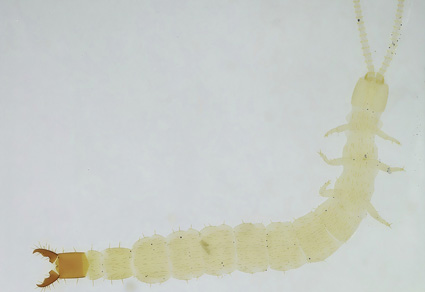
The recent discovery of two new species of Indian Lepidocampa continues the systematic survey of Diplura across various habitats of India. Two surveys were undertaken in two different states of India, viz., West Bengal and Uttarakhand (Garhwal Himalaya; Western Himalaya). Two different families of Diplura were encountered with two new species, Lepidocampa devprayagensis sp. nov. and Parajapyx sendrai sp. nov. The discovery of a new Parajapyx species represents only the second known member of the genus in India, after 113 years. The study also generated molecular barcodes for L. devprayagensis sp. nov. and compared its genetic distances and phylogenetic placement with those of other available molecular barcodes of the members of that genus.
References
- Alviola, M.S., Lucañas, C.C. & Lit Jr, I.L. (2023) Parajapyx giecuevasae n. sp., the first Parajapygidae (Diplura) from the Philippines. Philippine Journal of Systematic Biology, 16, 39–44. https://doi.org/10.26757/pjsb2022a16006
- Alviola, M.S., Lucañas, C.C., Barrion-Dupo, A.L.A., Eusebio, O.L., Duran, C.F.D., Cammayo, M.F.K.M., Cantalejo, M.N.R.T., Taray, K.J. & Lit Jr, I.L. (2024) A new species of Parajapyx (Diplura: Parajapygidae) from Minalokan Cave, Cavinti, Laguna, Philippines. Philippine Journal of Systematic Biology, 17, 54–60. https://doi.org/10.26757/pjsb202317009
- Condé, B. (1956) Matériaux pour une monographie des Diploures Campodéidés. Mémoires Muséum National d’Histoire Naturelles, série A. Zoologie, 12, 1–202.
- Condé, B. (1993) Campodeidae from Sumatra and Singapore (Diplura). Revue Suisse de Zoologie, 100 (4), 949–960. https://doi.org/10.5962/bhl.part.79894
- Folmer, O., Black, M., Hoeh, W., Lutz, R. & Vrijenhoek, R. (1994) DNA primers for amplification of mitochondrial cytochrome c oxidase subunit I from diverse metazoan invertebrates. Molecular Marine Biology and Biotechnology, 3 (5), 294–299.
- García-Gómez, A. (2009) Nuevo género y nueva especie de Parajapygidae (Hexápoda: Diplura) de la Selva Lacandona, México. Acta Zoológica Mexicana, 25, 527–535. https://doi.org/10.21829/azm.2009.253659
- Hall, T.A. (1999) BioEdit: A user-friendly biological sequence alignment editor and analysis program for Windows 95/98/NT. Nucleic Acids Symposium Series, 41, 95–98.
- Kar, S., Mazumdar, S., Mandal, P., Mandal, G.P. & Suman, K.K. (2026a) Description of a new species of Lepidocampa Oudemans, 1890 (Diplura: Campodeidae) from Eastern Himalayan regions and molecular identification of Lepidocampa juradii bengalensis from West Bengal, India. Zootaxa, 5741 (3), 482–494. https://doi.org/10.11646/zootaxa.5741.3.3
- Kar, S., Mandal, P., Mazumdar, S. & Mandal, G.P. (2026b) A new species and a redescription of Lepidocampa Oudemans, 1890 (Diplura: Campodeidae) from the Eastern Himalayas, India. European Journal of Taxonomy, 1043 (1), 87–102. https://doi.org/10.5852/ejt.2026.1043.3209
- Kumar, S., Stecher, G., Suleski, M., Sanderford, M., Sharma, S. & Tamura, K. (2024) MEGA12: Molecular Evolutionary Genetic Analysis Version 12 for adaptive and green computing. Molecular Biology and Evolution, 41 (12), 1–9. https://doi.org/10.1093/molbev/msae263
- Montejo-Cruz, M., García-Gómez, A. & Palacios-Vargas, J. (2021) Four new species of Parajapyx (Diplura: Parajapygidae) from Mexico with redescription of Parajapyx isabellae aztecus Silvestri. Zootaxa, 4948 (2), 221–244. https://doi.org/10.11646/zootaxa.4948.2.4
- Paclt, J. (1957) Genera Insectorum. P. Wytsman, Crainhem, 123 pp.
- Pagés, J. (1952) Parajapyginae (Insecta, Entotrophi, Japygidae) de l’Angola. Servicos culturales Companhia de Diamantes de Angola, 13, 53–96.
- Pagés, J. (1959) Remarques sur la classification des diploures. Travaux du Laboratoire de Zoologie et de la Station aquicole Grimaldi de la Faculte des sciences de Dijon, 26, 1–25.
- Pagés, J. (1987) Dicellurata Genevensia XIV. Japygoidea du Sud-Est asiatique. N°5. Revue Suisse Zoologie, 94 (1), 41–47. https://doi.org/10.5962/bhl.part.79709
- Pagés, J. (1998) Japygoidea (Diplura) du Sud-est asiatique no. 8: Indonesie (Java, Bali), Singapour et Brunei - Dicellurata Genevensia XXIII. Revue Suisse de Zoologie, 105 (4), 879–899. https://doi.org/10.5962/bhl.part.80062
- Potapov, A.M., Beaulieu, F., Birkhofer, K., Bluhm, S.L., Degtyarev, M.I., Devetter, M., Goncharov, A.A., Gongalsky, K.B., Klarner, B., Korobushkin, D.I., Liebke, D.F., Maraun, M., Mc Donnell, R.J., Pollierer, M.M., Schaefer, I., Shrubovych, J., Semenyuk, I.I., Sendra, A., Tuma, J., Tůmová, M., Vassilieva, A.B., Chen, T.W., Geisen, S., Schmidt, O., Tiunov, A.V. & Scheu, S. (2022) Feeding habits and multifunctional classification of soil-associated consumers from protists to vertebrates. Biological Reviews of the Cambridge Philosophical Society, 97 (3), 1057–1117. https://doi.org/10.1111/brv.12832
- Recuero, E. & Caterino, M.S. (2024) Molecular diversity of Diplura in southern High Appalachian leaf litter. Biodiversity Data Journal, 12, e125162. https://doi.org/10.3897/bdj.12.e125162.figure2
- Sendra, A., Arnedo, M.A., Ribera, C., Teruel, S. & Bidegaray-Batista, L. (2012) Revision of Cestocampa Condé (Diplura, Campodeidae), with description of a new species from caves in the eastern Iberian Peninsula. Zootaxa, 3252 (1), 43–56. https://doi.org/10.11646/zootaxa.3252.1.2
- Sendra, A., Jiménez-Valverde, A., Selfa, J. & Reboleira, A.S.P.S. (2021) Diversity, ecology, distribution and biogeography of Diplura. Insect Conservation and Diversity, 14, 415–425. https://doi.org/10.1111/icad.12480
- Sendra, A., Selfa, J., Bu, Y. & Luan, Y.X. (2025) A synopsis of the Campodeidae dipluran fauna from China (Arthropoda, Hexapoda) with a taxonomic key. ZooKeys, 1239, 147–181. https://doi.org/10.3897/zookeys.1239.144945
- Silvestri, F. (1913) On Some Thysanura in the Indian Museum. Records of the Zoological Survey of India, 9 (2), 51–62. https://doi.org/10.26515/rzsi/v9/i2/1913/163677
- Silvestri, F. (1933) First contribution to the knowledge of the Indomalayan Campodeidae (Thysanura-Entotropha). Records of the Zoological Survey of India, 379–392. https://doi.org/10.26515/rzsi/v35/i4/1933/162581