
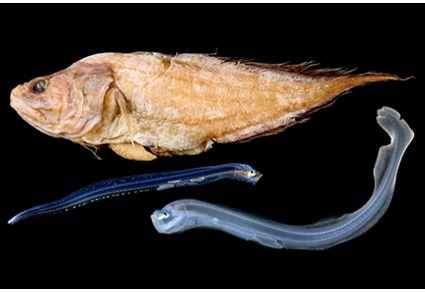

Abstract
The tropical and subtropical genus of viviparous cusk-eels Diplacanthopoma (Teleostei: Bythitidae) is differentiated from other bythitids in having a naked head, a fleshy flap bearing a large sensory pore above the opercle, and a large sensory pore on the cheek. The sensory pore on the cheek (i.e., “Diplacanthopoma” pore) is only known from two genera of ophidiiforms, Diplacanthopoma and Hephthocara. Diplacanthopoma includes eight nominal species, with seven in the Indian or Pacific Oceans, and one, D. brachysoma, from the western Atlantic. Recently, blackwater SCUBA divers collected two elongate larval fishes off West Palm Beach, Florida. Fin-ray and vertebral/myomere counts and DNA sequence data support the identification of one of the larvae as D. brachysoma; the first time the larval form for this genus of fishes has been identified. The second larva has higher numbers of medial-fin rays (184 dorsal-fin rays, 140 anal-fin rays) than D. brachysoma (125–164 dorsal-fin rays and 88–127 anal-fin rays), and mitochondrial cytochrome c oxidase subunit 1 barcode divergence of >9%, indicating the presence of a second undescribed species of Diplacanthopoma from the western Atlantic Ocean. We found three specimens (one from southern Brazil and two from the Bay of Campeche) in the Leibniz Institute for the Analysis of Biodiversity Change and the Smithsonian Institution’s National Museum of Natural History fish collections that overlap in fin-ray and vertebral/myomere counts with the larval specimen from Florida. We describe this new species of Diplacanthopoma based on larval and adult characters. We also highlight intraspecific variation in counts and measurements for D. brachysoma, emphasizing further study is needed to understand the taxonomic diversity of this genus of the Bythitidae.
References
- Afonso, G.V.F., Johnson, G.D., Collins, R. & Pastana, M.N.L. (2025) Associations between fishes (Actinopterygii: Teleostei) and anthozoans (Anthozoa: Hexacorallia) in epipelagic waters based on in situ records. Journal of Fish Biology, 107 (6), 2166–2172. https://doi.org/10.1111/jfb.70214
- Baldwin, C.C., Mounts, J.H., Smith, D.G. & Weigt, L.A. (2009) Genetic identification and color descriptions of early life-history stages of Belizean Phaeoptyx and Astrapogon (Teleostei: Apogonidae) with comments on identification of adult Phaeoptyx. Zootaxa, 2008 (1), 1–22. https://doi.org/10.11646/zootaxa.2008.1.1
- Cohen, D.M. & Haedrich, R.L. (1983) The fish fauna of the Galapagos thermal vent region. Deep Sea Research Part A. Oceanic Research Papers, 30 (4), 371–379. https://doi.org/10.1016/0198-0149(83)90072-9
- Cohen, D.M. & Nielsen, J. (2002) Diplacanthopoma kreffti (Pisces, Bythitidae), a new species from the Northwest Australian shelf, with comments on the name D. alcockii Goode and Bean, 1896. Archive of Fishery and Marine Research, 50 (1), 11–15.
- Fahay, M.P. (2007) Early Stages of Fishes in the Western North Atlantic Ocean (Davis Strait, Southern Greenland and Flemish Cap to Cape Hatteras). Northwest Atlantic Fisheries Organization, Dartmouth, Nova Scotia, 1696 pp.
- Fahay, M.P. & Nielsen, J. (2003) Ontogenetic evidence supporting a relationship between Brotulotaenia and Lamprogrammus (Ophidiiformes: Ophidiidae) based on the morphology of exterilium and rubaniform larvae. Ichthyological Research, 50 (3), 209–220. https://doi.org/10.1007/s10228-003-0159-5
- Fedorov, A., Beichel, R., Kalpathy-Cramer, J., Finet, J., Fillion-Robin, J.-C., Pujol, S., Bauer, C., Jennings, D., Fennessy, F., Sonka, M., Buatti, J., Aylward, S., Miller, J.V., Pieper, S. & Kikinis, R. (2012) 3D Slicer as an image computing platform for the Quantitative Imaging Network. Magnetic Resonance Imaging, 30 (9), 1323–1341. https://doi.org/10.1016/j.mri.2012.05.001
- Fraser, T.H. & Smith, M.M. (1974) An exterilium larval fish from South Africa with comments on its classification. Copeia, 1974 (4), 886–892. https://doi.org/10.2307/1442587
- Fricke, R., Eschmeyer, W.N. & Van der Laan, R. (Eds.) (2025) Eschmeyer’s Catalog of Fishes: Genera, Species, References. Available from: http://researcharchive.calacademy.org/research/ichthyology/catalog/fishcatmain.asp (accessed 15 December 2025)
- GBIF.org (2025) GBIF Occurrence Download. Available from: https://doi.org/10.15468/dl.vwpwda (accessed 15 December 2025)
- Girard, M.G., Carter, H.J. & Johnson, G.D. (2023a) New species of Monomitopus (Ophidiidae) from Hawaiʻi, with the description of a larval coiling behavior. Zootaxa, 5330 (2), 265–279. https://doi.org/10.11646/zootaxa.5330.2.5
- Girard, M.G., Davis, M.P. & Smith, W.L. (2020) The phylogeny of carangiform fishes: morphological and genomic investigations of a new fish clade. Copeia, 108 (2), 265–298. https://doi.org/10.1643/ci-19-320
- Girard, M.G., Davis, M.P., Tan, H.H., Wedd, D.J., Chakrabarty, P., Ludt, W.B., Summers, A.P. & Smith, W.L. (2022) Phylogenetics of archerfishes (Toxotidae) and evolution of the toxotid shooting apparatus. Integrative Organismal Biology, 4 (1), obac013. https://doi.org/10.1093/iob/obac013
- Girard, M.G., Mundy, B.C., Nonaka, A. & Johnson, G.D. (2023b) Cusk-eel confusion: revisions of larval Luciobrotula and Pycnocraspedum and re-descriptions of two bythitid larvae (Ophidiiformes). Ichthyological Research, 70 (4), 474–489. https://doi.org/10.1007/s10228-023-00906-4
- Girard, M.G., Nonaka, A., Baldwin, C.C. & Johnson, G.D. (2024) Discovery and description of elaborate larval cusk-eels and the relationships among Acanthonus, Tauredophidium and Xyelacyba (Teleostei: Ophidiidae). NOAA Professional Paper NMFS, 24, 20–42. https://doi.org/10.7755/pp.24.3
- Goode, G.B. & Bean, T.H. (1896) Oceanic Ichthyology: A Treatise on the Deep-sea and Pelagic Fishes of the World, Based Chiefly upon the Collections Made by the Steamers Blake, Albatross, and Fishhawk in the Northwestern Atlantic, with an Atlas Containing 417 Figures. Government Printing Office, Washington, 553 pp. https://doi.org/10.5962/bhl.title.48521
- Gosline, W.A. (1954) Fishes killed by the 1950 eruption of Mauna Loa II. Brotulidae. Pacific Science, 8, 68–83.
- Günther, A. (1887) Report on the deep-sea fishes collected by H. M. S. Challenger during the years 1873–76. In: Thomson, C.W. & Murray, J. (Eds.), Report on the Scientific Results of the Voyage of H. M. S. Challenger during the Years 1873–76. Zoology–Vol. XXII. Eyre & Spottiswoode, London, pp. i–lx + 1–335. https://doi.org/10.5962/bhl.title.15693
- Johnson, G.D., Collins, R.A. & Brothers, E.B. (2025) Putative Batesian mimicry of gelatinous zooplankton by larvae of marine fishes: a closer look based on in-situ images by blackwater photographers. Journal of the Ocean Science Foundation, 42, 91–119. https://doi.org/10.5281/zenodo.14889573
- Kearse, M., Moir, R., Wilson, A., Stones-Havas, S., Cheung, M., Sturrock, S., Buxton, S., Cooper, A., Markowitz, S., Duran, C., Thierer, T., Ashton, B., Meintjes, P. & Drummond, A. (2012) Geneious Basic: an integrated and extendable desktop software platform for the organization and analysis of sequence data. Bioinformatics, 28 (12), 1647–1649. https://doi.org/10.1093/bioinformatics/bts199
- Machida, Y. (1988) An additional specimen of imperfectly known bythitid fish, Diplacanthopoma japonicum (Bythitidae, Ophidiiformes). Reports of the Usa Marine Biological Institute, Kochi University, (10), 69–73.
- Nielsen, J.G., Cohen, D.M., Markle, D.F. & Robins, C.R. (1999) Ophidiiform fishes of the world (order Ophidiiformes). FAO Species Catalogue, 18, 1–178.
- Nolf, D. (1980) Etude monographique des otolithes des Ophidiiformes actuels et revision des especes fossiles (Pisces, Teleostei). Mededelingen van de Werkgroep voor Tertiaire en Kwartaire Geologie, 17 (2), 71–195.
- Nonaka, A., Milisen, J.W., Mundy, B.C. & Johnson, G.D. (2021) Blackwater diving: an exciting window into the planktonic arena and its potential to enhance the quality of larval fish collections. Ichthyology & Herpetology, 109 (1), 138–156. https://doi.org/10.1643/i2019318
- Okiyama, M. (Ed.) (2014) An Atlas of Early Stage Fishes in Japan. 2nd Edition. Tokai University Press, Tokyo, 1154 pp.
- Pastana, M.N.L., Girard, M.G., Bartick, M.I. & Johnson, G.D. (2022) A novel association between larval and juvenile Erythrocles schlegelii (Teleostei: Emmelichthyidae) and pelagic tunicates. Ichthyology & Herpetology, 110 (4), 675–679. https://doi.org/10.1643/i2022008
- Potthoff, T. (1984) Clearing and staining techniques. In: Moser, H.G., Richards, W.J., Cohen, D.M., Fahay, M.P., Kendall, Jr., A.W. & Richardson, S.L. (Eds.), Ontogeny and Systematics of Fishes. The American Society of Ichthyologists and Herpetologists, Lawrence, pp. 35–37.
- Richards, W.J. (Ed.) (2005) Early Stages of Atlantic Fishes: An Identification Guide for the Western Central North Atlantic. CRC Press, Boca Raton, Florida, 1312 pp.
- Rolfe, S., Pieper, S., Porto, A., Diamond, K., Winchester, J., Shan, S., Kirveslahti, H., Boyer, D., Summers, A. & Maga, A.M. (2021) SlicerMorph: An open and extensible platform to retrieve, visualize and analyse 3D morphology. Methods in Ecology and Evolution, 12 (10), 1816–1825. https://doi.org/10.1111/2041-210x.13669
- Sabaj, M.H. (2020) Codes for natural history collections in ichthyology and herpetology. Copeia, 108 (3), 593–669. https://doi.org/10.1643/asihcodons2020
- Schwarzhans, W. (1981) Vergleichende morphologische Untersuchungen an rezenten und fossilen Otolithen der Ordnung Ophidiiformes. Berliner Geowissenschaftliche Abhandlungen (A), 32, 63–122.
- Weigt, L.A., Driskell, A.C., Baldwin, C.C. & Ormos, A. (2012) DNA barcoding fishes. In: Kress, W.J. & Erickson, D.L. (Eds.), DNA barcodes: Methods and Protocols. Humana Press, New York, New York, pp. 109–126. https://doi.org/10.1007/978-1-61779-591-6_6