

Abstract
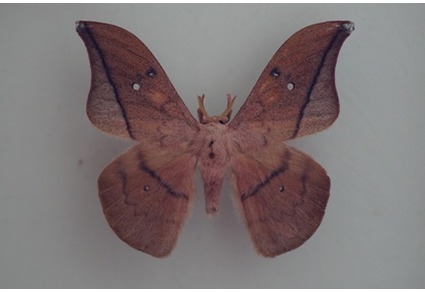
In March 2025, unknown Saturniidae larvae were found on Jianfengling Mountain, western Hainan Island, and reared to adulthood, revealing a complete life history. Morphological comparisons and COI barcode‑based phylogenetic analyses supported the new taxon as an independent lineage. The new species is characterized by unique male genitalia (vesica with a deeply embedded, never fully everted cornutus), and distinctive larval characters (semi‑fused dorsal scoli on A8, extensive black coloration). Herein described as Cricula qiongya sp. nov., it is currently known only from a restricted area on Jianfengling Mountain.
References
- Ahmad, M. & Ahmad, M. (1991) A new host plant record for the mango defoliator, C. trifenestrata, from Mymensingh, Bangladesh. Bangladesh Journal of Entomology, 1 (1), 89.
- Ahmad, F. & Alam, M.Z. (1994) Biology of mango defoliator C. trifenestrata Helfer (Lepidoptera, Saturniidae). Bangladesh Journal of Scientific Research, 12 (2), 151–156.
- Akai, H. (1996) The golden wild silkmoth of Indonesia. Senshoku α, 188, 23–27. [in Japanese]
- Akai, H. (2000) Successful example of wild silk development from Cricula trifenestrata in Indonesia. International Journal of Wild Silkmoth and Silk, 5, 91–97.
- Akai, H., Ichikawa, M., Uehara, K., Nagashima, T. & Hiyama, Y. (2014) Space fraction of small pores in porous silk cocoons. International Journal of Wild Silkmoth and Silk, 18, 65–75. [in Japanese with English summary]
- Akai, H. & Nagashima, T. (2005) Some information of Cricula silkmoths. International Journal of Wild Silkmoth and Silk, 10, 49–52.
- Akai, H., Nagashima, T. & Nakatomi, R. (1996) Structural and ultrastructural characteristics of golden cocoons of Cricula trifenestrata. International Journal of Wild Silkmoth and Silk, 2, 27–35.
- Akai, H., Shimizu, O. & Tsuchiya, N. (2005) A large temperate Cricula from Baguio. International Journal of Wild Silkmoth and Silk, 10, 91–93. [in Japanese]
- Ali, M.I. & Karim, M.A. (1991) Notes on the biology, behaviour and biocontrol agents of mango defoliator Cricula trifenestrata (Lepidoptera, Saturniidae). Bangladesh Journal of Entomology, 1, 83–87.
- Biswas, S., Hath, T.K. & Ray, N. (2013) Effect of different host plants on nutritional indices of wild silk moth, Cricula trifenestrata. Journal of Entomological Research, 37 (3), 223–227.
- Borah, P., Rajkhowa, A., Brahma, D., Gogoi, D., Singha, T.A., Bora, N. & Bora, N.R. (2024) Life cycle and population dynamics of Amphutukoni Muga (Cricula trifenestrata Helfer). Uttar Pradesh Journal of Zoology, 45 (18), 114–123. https://doi.org/10.56557/upjoz/2024/v45i184429
- Bouvier, E.L. (1936) Étude des Saturnioïdes normaux. Famille des Saturniidés. Muséum national d'Histoire naturelle, Paris, 143–354.
- Brechlin, R. (2004) Drei neue Saturniiden (Lepidoptera) aus China. Cricula australosinica n. sp., Cricula hainanensis n. sp. und Loepa sinjaevi n. sp. Arthropoda, Magazin über Wirbellose im Terrarium, 12 (3), 17–25.
- Brechlin, R. (2010) Neue Taxa der Gattung Cricula Walker, 1855 (Lepidoptera, Saturniidae). Entomo-Satsphingia, 3 (1), 36–44.
- Cai, J.X. & Zhang, K.J. (2009) A new model for the Indochina and South China collision during the Late Permian to the Middle Triassic. Tectonophysics, 467, 35–43. https://doi.org/10.1016/j.tecto.2008.12.003
- Chen, L.S., Li, K.Y., Huang, H.H., Lin, F.X. & Chen, T.S. (2019) Primary research on Cricula variabilis – a new defoliator of broad-leaved trees from south China. Forest Pest and Disease, 38 (3), 1–5. [in Chinese with English summary]
- Chou, W.H., Nguyen, T.Q. & Pauwels, O.S.G. (2001) A new species of Takydromus (Reptilia, Lacertidae) from Vietnam. Herpetologica, 57, 497–508.
- Clark, P.U., Dyke, A.S., Shakun, J.D., Carlson, A.E., Clark, J., Wohlfarth, B., Mitrovica, J.X., Hostetler, S.W. & Mccabe, A.M. (2009) The last glacial maximum. Science, 325 (5941), 710–714. https://doi.org/10.1126/science.1172873
- Comstock, J.H. (1918) The Wings of Insects, an Exposition of the Uniform Terminology of the Wing-Veins of Insects and a Discussion of the More General Characteristics of the Wings of the Several Orders of Insects. The Comstock Publishing Company, New York, 430 pp. https://doi.org/10.5962/bhl.title.54605
- Cotes, E. & Swinhoe, C. (1887) A catalogue of the moths of India. Indian Museum, Calcutta, 842 pp. https://doi.org/10.5962/bhl.title.10967
- Geyh, M.A., Kudrass, H.R. & Streif, H. (1979) Sea-level changes during the Late Pleistocene and Holocene in the Strait of Malacca. Nature, 278, 441–443. https://doi.org/10.1038/278441a0
- Gharde, S.K. & Chaudhuri, N. (2018) The life history and population growth parameters of leaf eating caterpillar Cricula trifenestrata Helfer (Lepidoptera, Saturniidae) infesting Machilus bombycina King. International Journal of Current Microbiology and Applied Sciences, 7 (2), 710–717. https://doi.org/10.20546/ijcmas.2018.702.089
- Gupta, S.K. & Prasad, K. (2021) Influence of humidity on feed utilization of Cricula trifenistrata [sic] (Helfer) (Lepidoptera, Saturniidae). Entomon, 46 (2), 177–182. https://doi.org/10.33307/entomon.v46i2.604
- Hall, R. (1998) The plate tectonics of Cenozoic SE Asia and the distribution of land and sea. In: Hall, R. & Holloway, J.D. (Eds.), Biogeography and Geological Evolution of Southeast Asia. Backhuys Publishers, Leiden, pp. 99–124.
- Hanebuth, T., Stattegger, K. & Grootes, P.M. (2000) Rapid flooding of the Sunda Shelf. Global and Planetary Change, 26, 37–52.
- Hoang, D.T., Chernomor, O., von Haeseler, A., Minh, B.Q. & Vinh, L.S. (2018) UFBoot2, Improving the ultrafast bootstrap approximation. Molecular Biology and Evolution, 35 (2), 518–522. https://doi.org/10.1093/molbev/msx281
- Honda, M., Ota, H., Kobayashi, M., Nabhitabhata, J., Yong, H.-S. & Hikida, T. (2000) Phylogenetic relationships, character evolution, and biogeography of the subfamily Lygosominae (Reptilia, Scincidae) inferred from mitochondrial DNA sequences. Molecular Phylogenetics and Evolution, 15, 452–461. https://doi.org/10.1006/mpev.1999.0767
- Honda, M., Ota, H., Hikida, T. & Darevsky, I. (2001) A new species of the worm-like lizard, Dibamus Duméril & Bibron, 1839 (Squamata, Dibamidae), from Vietnam. Tropical Zoology, 14, 119–125. https://doi.org/10.1080/03946975.2001.10531146
- Hridya, H., Guha, L., Mazumdar, M., Sarkar, B.N., Vijayakumar, S. & Borpuzari, P. (2021) Probing the potentiality of the defoliator Cricula trifenestrata Helfer silk, a revisit. Bulletin of the National Research Centre, 45 (1), 215. https://doi.org/10.1186/s42269-021-00669-w
- Huang, F.S. (2002) Forest Insects of Hainan. Science Press, Beijing, 584 pp. [in Chinese]
- Jordan, K. (1909) On the species of Cricula, a genus of Saturniidae. Novitates Zoologicae, 16 (1), 300–306. https://doi.org/10.5962/bhl.part.21964
- Jordan, K. (1939) On some Old-World Lepidoptera Heterocera. Novitates Zoologicae, 41, 433–436.
- Kalyaanamoorthy, S., Minh, B.Q., Wong, T.K.F., von Haeseler, A. & Jermiin, L.S. (2017) ModelFinder, fast model selection for accurate phylogenetic estimates. Nature Methods, 14, 587–589. https://doi.org/10.1038/nmeth.4285
- Katoh, K., Rozewicki, J. & Yamada, K.D. (2019) MAFFT online service, multiple sequence alignment, interactive sequence choice and visualization. Briefings in Bioinformatics, 20 (4), 1160–1166. https://doi.org/10.1093/bib/bbx108
- Kitching, I.J., Rougerie, R., Zwick, A., Hamilton, C.A., St Laurent, R.A., Naumann, S., Mejia, L.B. & Kawahara, A.Y. (2018) A global checklist of the Bombycoidea (Insecta, Lepidoptera). Biodiversity Data Journal, 6, e22236. https://doi.org/10.3897/bdj.6.e22236
- Kristensen, N.P. (2003) 4. Skeleton and muscles: adults. In: Kristensen, N.P. (Ed.), Handbook of Zoology. Vol. IV. Part 36. Lepidoptera, Moths and Butterflies. Morphology, Physiology and Development. Vol. 2. De Gruyter, Berlin, Boston, pp. 39–131. https://doi.org/10.1515/9783110893724.39
- Kuroda, F. (2000) Outline of Indonesia wild silkmoth development project (Practical use of golden cocoon and the world’s biggest moth). International Journal of Wild Silkmoth and Silk, 5, 85–97.
- Lampe, R.E.J. (2010) Saturniidae of the World. Their Life Stages from the Eggs to the Adults. Verlag Dr. Friedrich Pfeil, München, 368 pp.
- Lande, R. (1980) Genetic variation and phenotypic evolution during allopatric speciation. The American Naturalist, 116 (4), 463–479. https://doi.org/10.1086/283642
- Lazell, J. (1999) The origins of the herpetofauna of the islands on the continental shelf of South China. In: Ota, H. (Ed.), Tropical island herpetofauna. Elsevier, Amsterdam, pp. 79–96.
- Le Moult, E. (1933) Formes nouvelles ou peu connues de Saturnidae [sic] (Lep.) (1re note). Novitates Entomologicae, 3 (1–4), 20–23.
- Liu, Z.Y. (2023) An “American” silkmoth endemic to Himalayas, part I, life history and natural distribution of Antheraea compta Rothschild, 1899 (Lepidoptera, Saturniidae). Deutsche Entomologische Zeitschrift, 70 (2), 261–282. https://doi.org/10.3897/dez.70.102952
- López-Pujol, J., Zhang, F.M. & Ge, S. (2006) Plant biodiversity in China, richly varied, endangered, and in need of conservation. Biodiversity and Conservation, 15, 3983–4026. https://doi.org/10.1007/s10531-005-3015-2
- Magnussen, K., Sumida, M., Kangrang, A., Vollrath, F., Katisart, T. & Butiman, C. (2025a) External morphology, defensive adaptations, aposematic coloration, and sexual dimorphism of the fifth instar larva of Cricula silkmoth, Cricula trifenestrata Helfer (Lepidoptera, Saturniidae) from Thailand. Insects, 16 (2), 105. https://doi.org/10.3390/insects16020105
- Magnussen, K., Sumida, M., Promma, S., Kangrang, A., Vollrath, F., Thunchailertthakul, T. & Butiman, C. (2025b) Life history plasticity and gregarious cocooning behavior of the wild silkmoth Cricula trifenestrata Helfer (Lepidoptera, Saturniidae) on a novel host plant, cinnamon, in Thailand. Insects, 16 (9), 914. https://doi.org/10.3390/insects16090914
- Metcalfe, I. (2013) Gondwana dispersion and Asian accretion, tectonic and palaeogeographic evolution of eastern Tethys. Journal of Asian Earth Sciences, 66, 1–33. https://doi.org/10.1016/j.jseaes.2012.12.020
- Minh, B.Q., Schmidt, H.A., Chernomor, O., Schrempf, D., Woodhams, M.D., von Haeseler, A. & Lanfear, R. (2020) IQ-TREE 2, new models and efficient methods for phylogenetic inference in the genomic era. Molecular Biology and Evolution, 37 (5), 1530–1534. https://doi.org/10.1093/molbev/msaa015
- Moore, F. (1859) Synopsis of the known Asiatic species of silk-producing moths, with descriptions of some new species from India. Proceedings of the Zoological Society of London, 28, 237–270, pls. 64–65.
- Munaan, A. (1986) Controlling Cricula trifenestrata Helf. on cashew trees. Indonesian Agricultural Research and Development Journal, 8 (1), 12–15.
- Myers, N., Mittermeier, R.A., Mittermeier, C.G., Da Fonseca, G.A. & Kent, J. (2000) Biodiversity hotspots for conservation priorities. Nature, 403 (6772), 853–858. https://doi.org/10.1038/35002501
- Nässig, W.A. (1985) A previously undescribed species of Cricula from China (Lepidoptera, Saturniidae). Nota Lepidopterologica, 8, 184–188.
- Nässig, W.A. (1989) Systematic catalogue of the genus Cricula Walker, 1855 (Lepidoptera, Saturniidae). Entomologische Zeitschrift, 99, 181–198.
- Nässig, W.A. (1995) Eine Revision der Gattung Cricula Walker 1855 sowie ein Versuch einer phylogenetischen Analyse der Tribus Saturniini (Lepidoptera: Saturniidae). Dissertation, Goethe University Frankfurt, Frankfurt, 113 pp.
- Nässig, W.A. (1997) A new, unexpected species of Lemaireia Nässig & Holloway, 1987 from the South of Vietnam. Nachrichten des Entomologischen Vereins Apollo, 17, 275–282.
- Nässig, W.A. & Wang, M. (2006) First record of the saturniid genus Lemaireia Nässig & Holloway, 1987 from Hainan Island (PR China) with the description of a new species. Nachrichten des Entomologischen Vereins Apollo, 27, 23–25.
- Nässig, W.A., Brechlin, R. & Naumann, S. (1999) Notes on the Cricula Walker, 1855 of Vietnam, with description of a new species (Insecta, Lepidoptera, Saturniidae). Senckenbergiana biologica, 78, 183–192.
- Nässig, W.A., Kitching, I.J., Peigler, R.S. & Treadaway, C.G. (2010) The group of Cricula elaezia, comments on synonyms and priority questions, with illustrations of barcode similarity trees, distribution maps, a revised checklist and a formerly unknown female (Lepidoptera, Saturniidae). Nachrichten des Entomologischen Vereins Apollo, 31, 145–165.
- Nässig, W.A. & Treadaway, C.G. (2010) Revisional notes on the luzonica-group of Cricula. Nachrichten des Entomologischen Vereins Apollo, 31, 187–196.
- Naumann, S. (1999) Antheraea (Antheraea) harndti n. sp., eine neue Saturniide von der chinesischen Insel Hainan (Lepidoptera, Saturniidae). Galathea, Berichte des Kreises Nürnberger Entomologen ev, 6 (Supplement), 72–80.
- Naumann, S. & Löffler, S. (2010) Notes on the Asian genus Cricula Walker, 1855, with descriptions of new species. Neue Entomologische Nachrichten, Supplement 2, 1–24.
- Naumann, S. & Löffler, S. (2013) Two new species of the genus Cricula Walker, 1855 from Myanmar and India, with synonymic notes (Lepidoptera, Saturniidae). Nachrichten des Entomologischen Vereins Apollo, 33, 177–184.
- Nindhia, T.G.T., Knejzlik, Z., Ruml, T. & Nindhia, T.S. (2014) Tensile properties and biocompatibility of Indonesian wild silk Cricula trifenestrata, a preliminary study. Journal of Medical and Bioengineering, 3 (2), 101–104. https://doi.org/10.12720/jomb.3.2.140-143
- Ota, H., Honda, M., Chen, S.L., Hikida, T., Panha, S., Oh, H.S. & Matsui, M. (2002) Phylogenetic relationships, taxonomy, character evolution and biogeography of the lacertid lizards of the genus Takydromus (Reptilia, Squamata) a molecular perspective. Biological Journal of the Linnean Society, 76, 493–509. https://doi.org/10.1046/j.1095-8312.2002.00084.x
- Pal, S. & Medda, P.S. (2006) Occurrence of wild silk moth, Cricula trifenestrata (Helfer) on cashew, Anacardium occidentale L. under terai conditions of West Bengal. The Orissa Journal of Horticulture, 34 (1), 117.
- Paukstadt, L.H. & Paukstadt, U. (2013) Beobachtungen zum Spinnverhalten bei Cricula trifenestrata javana Watson, 1913 von Java, Indonesien (Lepidoptera, Saturniidae) [Rearing observations on Cricula trifenestrata javana from the island of Java, Indonesia]. Beiträge zur Kenntnis der wilden Seidenspinner, 11, 143–146.
- Paukstadt, U. & Paukstadt, L.H. (2009) Cricula pelengensis sp. nov., eine neue Saturniide vom Banggai Archipel, Indonesien (Lepidoptera, Saturniidae). Beiträge zur Kenntnis der wilden Seidenspinner, 7 (8), 416–424.
- Paukstadt, U. & Paukstadt, L.H. (2010) Beitrag zur Identität von Cricula pelengensis Paukstadt & Paukstadt, 2009 und weiterer Taxa der Gattung Cricula Walker, 1855 (Lepidoptera, Saturniidae). Beiträge zur Kenntnis der wilden Seidenspinner, 8, 55–64. https://doi.org/10.1007/bf03367401
- Paukstadt, U. & Paukstadt, L.H. (2013) Cricula brechlini sp. nov., eine neue Saturniide von Flores, östliche Kleine Sundainseln, Indonesien (Lepidoptera, Saturniidae). Beiträge zur Kenntnis der wilden Seidenspinner, 11, 55–65.
- Rono, M.M.A., Ahad, M.A., Hasan, M.S., Uddin, M.F. & Islam, A.K.M.N. (2008) Morphometrics measurement of mango defoliator Cricula trifenestrata (F. Lepidoptera, Saturniidae). Bangladesh Journal of Entomology, 18 (1), 45–52.
- Sathiamurthy, E. & Voris, H.K. (2006) Maps of Holocene sea level transgression and submerged lakes on the Sunda Shelf. Tropical Natural History, 6 (2), 1–44. https://doi.org/10.58837/tnh.6.2.102930
- Simon, C., Frati, F., Beckenbach, A., Crespi, B., Liu, H. & Flook, P. (1994) Evolution, weighting, and phylogenetic utility of mitochondrial gene sequence and a compilation of conserved polymerase chain reaction primers. Annals of the Entomological Society of America, 87 (6), 651–701. https://doi.org/10.1093/aesa/87.6.651
- Singh, S.P. (1992) Frequent outbreaks of Cricula trifenestrata Helfer (Lepidoptera, Saturniidae) on mango. Indian Journal of Plant Protection, 20 (2), 231–232.
- Sirimungkararat, S., Saksirirat, W., Pitirit, T., Apinakpong, K. & Nathongkam, A. (2010) Value added creation of processed insect food menus of avocado hairy caterpillar (Cricula trifenestrata H.). International Journal of Wild Silkmoth and Silk, 14, 31–38.
- Siswanti, R., Supriyadi, S. & Subagiya, S. (2017) Hubungan Tingkat Serangan Ulat Kipat (Cricula trifenestrata) terhadap Hasil Mete. Agrotechnology Research Journal, 1 (1), 21–27. [in Indonesian] https://doi.org/10.20961/agrotechresj.v1i1.18866
- Sunarintyas, S., Siswomihardjo, W. & Tontowi, A.E. (2012) Cytotoxicity of Cricula triphenestrata [sic] cocoon extract on human fibroblasts. International Journal of Biomaterials, 2012, 493075. https://doi.org/10.1155/2012/493075
- Suriana, S., Solihin, D.D., Noor, R.R. & Thohari, A.M. (2011) Characterization of partial coding region fibroin gene on wild silkmoth Cricula trifenestrata Helfer (Lepidoptera, Saturniidae). Tropical Animal Science Journal, 34 (1), 23–30. https://doi.org/10.5398/medpet.2011.34.1.23
- Tikader, A. & Pachuau, L. (2010) Performance of Cricula trifenestrata Helfer on different host plants and its variability. International Journal of Wild Silkmoth and Silk, 15, 153–165.
- Tikader, A., Vijayan, K. & Saratchandra, B. (2014) Cricula trifenestrata (Helfer) (Lepidoptera, Saturniidae) – a silk producing wild insect in India. Tropical Lepidoptera Research, 24 (1), 22–29.
- Veenakumari, K., Prashanth, M. & Nässig, W.A. (1997) Cricula andamanica Jordan, 1909 (Lepidoptera, Saturniidae) — an endemic wild silk moth from the Andaman islands, India. Nachrichten des Entomologischen Vereins Apollo, N.F., 17 (4), 263–274.
- Wu, R., Ma, G., Long, Y., Yu, J., Li, S. & Jiang, H. (2011) The performance of nature reserves in capturing the biological diversity on Hainan Island, China. Environmental Science and Pollution Research, 18, 800–810. https://doi.org/10.1007/s11356-011-0440-5
- Xia, M.N., Lu, J.H., Luo, J., Chen, M.B., Liang, Y.P., Chen, K.B. & Zhang, B.Q. (2025) Species diversity and annual dynamics of Saturniidae in Limushan. Journal of Tropical Biology. [in Chinese]
- Yadav, S. & Kumar, A. (2003) New record of wild silk caterpillar Cricula trifenestrata Helfer on large cardamom and notes on its biology. Uttar Pradesh Journal of Zoology, 23 (1), 67–69.
- Yamada, H. & Tsubouchi, K. (2001) Characterization of silk proteins in the cocoon fibers of Cricula trifenestrata. International Journal of Wild Silkmoth and Silk, 6, 25–31.
- Yunita, M., Mubarik, N.R. & Solihin, D.D. (2016) Isolation and identification of chitinolytic bacteria as biocontrol agent of pathogenic fungi on gold silkworm cocoon Cricula trifenestrata. HAYATI Journal of Biosciences, 23 (3), 126–131. https://doi.org/10.21161/mjm.74415
- Zhang, W. & Kohll, S. (2008) Salassa shuyiae sp. nov., a new giant silkmoth from Hainan, China. Nachrichten des Entomologischen Vereins Apollo, 29, 47–52.
- Zhu, H.F. & Wang, L.Y. (1993) The Saturniidae of China (Lepidoptera). I. Subfamily Attacinae. II. Subfamily Saturniinae. Sinozoologia, 10, 251–296. [in Chinese with English summary]
- Zhu, H.F. & Wang, L.Y. (1996) Fauna Sinica, Insecta, Lepidoptera, Bombycidae, Saturniidae and related families. Science Press, Beijing, 302 pp. [in Chinese with English summary]