

Abstract
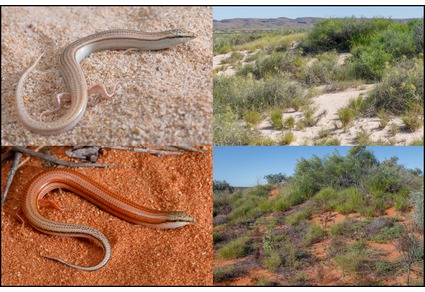
In reptile taxonomy, many subspecies have been described based on subtle variation in morphological traits like colour pattern and scalation. However, the subspecific rank itself has received increasing scrutiny on both conceptual and operational grounds. The species-rich (~100 species) and morphologically diverse Australian lizard genus Lerista Bell, 1833 provides opportunities to assess the evolutionary significance of subspecies taxa, given that subspecies throughout the genus were described before the widespread use of genetic-based assessments of divergence in taxonomy. Based on a combined analysis of patterns of genetic and morphological variation in Lerista planiventralis (Lucas & Frost, 1902), we found that partitioning of populations into subspecies, namely L. p. planiventralis (Lucas & Frost, 1902), L. p. decora Storr, 1978 and L. p. maryani Storr, 1991, is unwarranted. We found negligible molecular or phenotypic divergence corresponding to those names, revealing continuous, overlapping clinal variation rather than discrete, diagnosable units. Consequently, we synonymise all three subspecies under a single, morphologically variable L. planiventralis and present its revised species-level diagnosis.
References
- Arnold, E.N. (1995) Identifying the effects of history on adaptation: origins of different sand‐diving techniques in lizards. Journal of Zoology, 235 (3), 351–388. https://doi.org/10.1111/j.1469-7998.1995.tb01758.x
- Bachman, S., Moat, J., Hill, A.W., de la Torre, J. & Scott, B. (2011) Supporting Red List threat assessments with GeoCAT: geospatial conservation assessment tool. ZooKeys, 150, 117–126. https://doi.org/10.3897/zookeys.150.2109
- Bell, T. (1833) Characters of two new genera of reptiles. Proceedings of the Zoological Society of London, 1, 98–99.
- Beranek, C., Mahony, S. & Scott, S. (2021) A significant range extension for the Western Soil-Crevice Skink Proablepharus reginae (Glauert 1960) and an updated reptile species list of Cape Range, Western Australia. Australian Zoologist, 42, 146–155. https://doi.org/10.7882/AZ.2021.029
- Braby, M.F., Eastwood, R. & Murray, N. (2012) The subspecies concept in butterflies: Has its application in taxonomy and conservation biology outlived its usefulness? Biological Journal of the Linnean Society, 106, 699–716. https://doi.org/10.1111/j.1095-8312.2012.01909.x
- Burbrink, F.T., Crother, B.I., Murray, C.M., Smith, B.T., Ruane, S., Myers, E.A. & Pyron, R.A. (2022) Empirical and philosophical problems with the subspecies rank. Ecology and Evolution, 12, e9069. https://doi.org/10.22541/au.164847286.69025170/v1
- Bush, B., Maryan, B. & Browne-Cooper, R. (2007) Reptiles and frogs in the bush: Southwestern Australia. UWA Publishing, Crawley, Western Australia.
- Chan, K.O. & Grismer, L.L. (2022) GroupStruct: an R package for allometric size correction. Zootaxa, 5124 (4), 471–482. https://doi.org/10.11646/zootaxa.5124.4.4
- Chang, C., Wu, P., Baker, R.E., Maini, P.K., Alibardi, L. & Chuong, C-M. (2009) Reptile scale paradigm: evodevo, pattern formation and regeneration. The International Journal of Developmental Biology, 53, 813–826. https://doi.org/10.1387/ijdb.072556cc
- Chapple, D.G., Tingley, R., Mitchell, N.J., Macdonald, S.L., Keogh, J.S., Shea, G.M., Bowles, P., Cox, N.A. & Woinarski, J.C.Z. (2019) The Action Plan for Australian Lizards and Snakes 2017. CSIRO Publishing, Melbourne. https://doi.org/10.1071/9781486309474
- Cogger, H.G. (2018) Reptiles & Amphibians of Australia. Updated Seventh Edition. CSIRO Publishing, Melbourne.
- Cowan, M., How, R., Gaikhorst, G. & Ford, S. (2017) Lerista planiventralis. The IUCN Red List of Threatened Species, e.T109477108A109477161. https://doi.org/10.2305/iucn.uk.2017-3.rlts.t109477108a109477161.en
- Darwin, C. (1859) On the origin of species by means of natural selection. John Murray, London, 466 pp.
- de Queiroz, K. (1998) The general lineage concept of species, species criteria, and the process of speciation: A conceptual unification and terminological recommendations. In: Howard, D.J. & Berlocher, S.H. (Eds.), Endless Forms: Species and Speciation. Oxford University Press, Oxford, pp. 57–75.
- de Queiroz, K. (2020) An updated concept of subspecies resolves a dispute about the taxonomy of incompletely separated lineages. Herpetological Review, 51, 459–461.
- Department of Biodiversity, Conservation and Attractions (2019) Conservation Codes for Western Flora and Fauna. Government of Western Australia, Perth.
- Dixon, I.R., Dixon, K.W. & Barret, M. (2001) Eradication of buffel grass (Cenchrus ciliaris) on Airlie Island, Pilbara coast, Western Australia. In: Veitch, C.R. & Clout, M.N. (Eds.), Turning the Tide in the Eradication of Invasive Species. IUCN SSC Invasive Species Specialist Group, IUCN, Gland, Switzerland and Cambridge, UK, pp. 92–101.
- Ehmann, H. (1992) Encyclopedia of Australian Animals. Reptiles. Angus & Robertson, Sydney, 4 pp.
- Farquhar, J.E., Prates, I., Doughty, P., Rabosky, D.L. & Chapple, D.G. (2024) Morphological and genetic data challenge species and subspecies in the Lerista microtis group (Squamata: Scincidae). Zootaxa, 5437 (3), 336–362. https://doi.org/10.11646/zootaxa.5437.3.2
- Gaikhorst, G. (2015) Ecology and distribution of the slider skink, Lerista nevinae. Journal of the Royal Society of Western Australia, 98, 131–136.
- Greer, A.E. (1967) A new generic arrangement for some Australian scincid lizards. Breviora Museum of Comparative Zoology, 267, 1–19.
- Greer, A.E. (1979) A phylogenetic subdivision of Australian skinks. Records of the Australian Museum, 32, 339–371. https://doi.org/10.3853/j.0067-1975.32.1979.459
- Greer, A.E. (1986) Diagnosis of the Lerista bipes species-group (Lacertilia: Scincidae), with a description of a new species and an updated diagnosis of the genus. Records of the Western Australian Museum, 13, 121–127.
- Hey, J. (2001) Genes, categories, and species: The evolutionary and cognitive causes of the species problem. Oxford University Press, New York, 240 pp.
- Horner, P. (1991) Skinks of the Northern Territory. Northern Territory Museum Handbook Series No. 2. Northern Territory Museum of Arts and Sciences, Darwin.
- Hull, D.L. (1976) Are species really individuals? Systematic Biology, 25, 174–191.
- Hutchinson, M., Adams, M. & Fricker, S. (2006) Genetic variation and taxonomy of the Ctenotus brooksi species-complex (Squamata: Scincidae). Transactions of the Royal Society of South Australia, 130, 48–65. https://doi.org/10.1080/3721426.2006.10887047
- IUCN (2024) The Guidelines for Using the IUCN Red List Categories and Criteria. Available from: https://www.iucnredlist.org/resources/redlistguidelines (accessed 10 August 2024)
- Jackson, D.A. (1993) Stopping rules in principal components analysis: a comparison of heuristical and statistical approaches. Ecology, 74, 2204–2214. https://doi.org/10.2307/1939574
- James, F.C. (2010) Avian subspecies: introduction. Ornithological Monographs, 67, 1–5.
- Kassambara, A. (2025) Ggcorrplot: Visualization of a correlation matrix using ggplot2. [https://github.com/kassambara/ggcorrplot?tab=readme-ov-file]
- Kassambara, A. & Mundt, F. (2017) Factoextra: Extract and visualize the results of multivariate data analyses. [https://CRAN.R-project.org/package=factoextra]
- Kendrick, P.G. (1989) Two new species of Lerista (Lacertilia: Scincidae) from the Cape Range and Kennedy Range of Western Australia. Journal of Herpetology, 23, 350–355. https://doi.org/10.2307/1564045
- Kendrick, P.G. (1991) The phylogenetics and comparative ecology of Lerista Bell, 1833; patterns of evolution in a genus of sand-swimming skinks. Unpublished PhD Thesis, University of Western Australia.
- Keogh, J.S., Scott, I.A.W. & Hayes, C. (2005) Rapid and repeated origin of insular gigantism and dwarfism in Australian tiger snakes. Evolution, 59, 163–170. https://doi.org/10.1554/04-310
- Lê, S., Josse, J. & Husson, F. (2008) FactoMineR: an R package for multivariate analysis. Journal of Statistical Software, 25, 1–18. https://doi.org/10.18637/jss.v025.i01
- Lleonart, J., Salat, J. & Torres, G.J. (2000) Removing allometric effects of body size in morphological analysis. Journal of Theoretical Biology, 205, 85–93. https://doi.org/10.1006/jtbi.2000.2043
- Lucas, A.H.S. & Frost, C. (1902) Descriptions of some new lizards from Western Australia. Proceedings of the Royal Society of Victoria, 15, 76–79.
- Martinez Arbizu, P. (2017) pairwiseAdonis: Pairwise multilevel comparison using adonis. [https://github.com/pmartinezarbizu/pairwiseAdonis]
- Maryan, B. (2005) A herpetofauna hotspot, the central west coast of Western Australia. The Western Australian Naturalist, 25, 1–24. https://doi.org/10.5962/p.297329
- Maryan, B., Brennan, I.G., Hutchinson, M.N. & Geidans, L.S. (2020) What’s under the hood? Phylogeny and taxonomy of the snake genera Parasuta Worrell and Suta Worrell (Squamata: Elapidae), with a description of a new species from the Pilbara, Western Australia. Zootaxa, 4778 (1), 1–47. https://doi.org/10.11646/zootaxa.4778.1.1
- Maryan, B., Gaikhorst, G., O’Connell, M. & Callan, S. (2015) Notes on the distribution and conservation status of the Perth Lined Skink, Lerista lineata: a small lizard in a big city. The Western Australian Naturalist, 30, 12–29. https://doi.org/10.5962/p.440912
- Mayr, E. (1965) Systematics and the origin of species from the viewpoint of a zoologist. Dover Publications, New York, 354 pp.
- Mayr, E. (1982) Of what use are subspecies? The Auk, 99, 593–595.
- McCoy, M.W., Bolker, B.M., Osenberg, C.W., Miner, B.G. & Vonesh, J.R. (2006) Size correction: Comparing morphological traits among populations and environments. Oecologia, 148, 547–554. https://doi.org/10.1007/s00442-006-0403-6
- McKenzie, N.L., Rolfe, J.K., Aplin, K.P., Cowan, M.A. & Smith, L.A. (2000) Herpetofauna of the southern Carnarvon Basin, Western Australia. In: Burbidge, A.H., Harvey, M.S. & McKenzie, N.L. (Eds.), Biodiversity of the southern Carnarvon Basin. Records of the Western Australian Museum, Supplement No. 61, pp. 335–360. https://doi.org/10.18195/issn.0313-122x.61.2000.335-360
- O’Hara, R.J. (1993) Systematic generalization, historical fate, and the species problem. Systematic Biology, 42, 231–246.
- Oksanen, J., Kindt, R., Legendre, P., O’Hara, B., Stevens, M.H.H., Oksanen, M.J. & Suggests, M.A.S.S. (2007) The vegan package. Community ecology package, 10, 631–637.
- Oppel, M. (1811) Die Ordnungen, Familien und Gattungen der Reptilien als Prodrome einer Naturgeschichte derselben. Joseph Lindauer, München, xii + 86 + [1] pp.
- Owen, D.F. (1963a) Screech owl polymorphism. Wilson Bulletin, 75, 183–189.
- Owen, D.F. (1963b) Variation in North American screech owls and the subspecies concept. Systematic Zoology, 12, 8–14. https://doi.org/10.2307/2411890
- OZCAM (2023) Online Zoological Collections of Australian Museums.
- Paradis, E., Claude, J. & Strimmer, K. (2004) APE: analyses of phylogenetics and evolution in R language. Bioinformatics, 20, 289–290. https://doi.org/10.1093/bioinformatics/btg412
- Patten, M.A. (2015) Subspecies and the philosophy of science. The Auk, 132, 481–485.
- Patton, J.L. & Conroy, C.J. (2017) The conundrum of subspecies: morphological diversity among desert populations of the California vole (Microtus californicus, Cricetidae). Journal of Mammalogy, 98, 1010–1026. https://doi.org/10.1093/jmammal/gyx074
- Prates, I., Doughty, P. & Rabosky, D.L. (2022) Subspecies at crossroads: the evolutionary significance of genomic and phenotypic variation in a wide-ranging Australian lizard (Ctenotus pantherinus). Zoological Journal of the Linnean Society, 197, 768–786.
- Prates, I., Hutchinson, M.N., Singhal, S., Moritz, C. & Rabosky, D.L. (2024) Notes from the taxonomic disaster zone: Evolutionary drivers of intractable species boundaries in an Australian lizard clade (Scincidae: Ctenotus). Molecular Ecology, 33 (20), e17074. https://doi.org/10.1111/mec.17074
- Rabosky, D.L., Hutchinson, M.N., Donnellan, S.C., Talaba, A.L. & Lovette, I.J. (2014) Phylogenetic disassembly of species boundaries in a widespread group of Australian skinks (Scincidae: Ctenotus). Molecular Phylogenetics and Evolution, 77, 71–82. https://doi.org/10.1016/j.ympev.2014.03.026
- Reist, J.D. (1985) An empirical evaluation of several univariate methods that adjust for size variation in morphometric data. Canadian Journal of Zoology, 63, 1429–1439. https://doi.org/10.1139/z85-213
- Reydon, T.A.C. & Kunz, W. (2021) Classification below the species level: When are infraspecific groups biologically meaningful? Biological Journal of the Linnean Society, 134, 246–260. https://doi.org/10.1093/biolinnean/blab067
- Shea, G.M. (2021) Nomenclature of supra-generic units within the Family Scincidae (Squamata). Zootaxa, 5067 (3), 301–351. https://doi.org/10.11646/zootaxa.5067.3.1
- Shine, R. (1991) Australian Snakes: A Natural History. Reed New Holland, Sydney.
- Skinner, A. (2010) Rate heterogenity, ancestral character state reconstruction and the evolution of limb morphology in Lerista (Scincidae, Squamata). Systematic Biology, 59, 723–740. https://doi.org/10.1093/sysbio/syq055
- Smith, H.M. & White, F.N. (1956) A case for the trinomen. Systematic Zoology, 5, 183–190.
- Stamatakis, A. (2014) RAxML version 8: a tool for phylogenetic analysis and post-analysis of large phylogenies. Bioinformatics, 30, 1312–1313. https://doi.org/10.1093/bioinformatics/btu033
- Sternfeld, R. (1925) Beitrage zur Herpetologie Inner-Australiens. Abhandlungen Herausgegeben von der Senckenbergischen Naturforschenden Gesellschaft, 38, 221–251.
- Storr, G.M. (1970) The genus Ctenotus (Lacertilia: Scincidae) in the Northern Territory. Journal of the Royal Society of Western Australia, 52, 97–108.
- Storr, G.M. (1971) The genus Lerista (Lacertilia, Scincidae) in Western Australia. Journal of the Royal Society of Western Australia, 54, 59–75.
- Storr, G.M. (1978) Taxonomic notes on the reptiles of the Shark Bay region, Western Australia. Records of the Western Australian Museum, 6, 303–318.
- Storr, G.M. (1981) Ten new Ctenotus (Lacertilia: Scincidae) from Australia. Records of the Western Australian Museum, 9, 125–146.
- Storr, G.M. (1991a) A new subspecies of Lerista planiventralis (Lacertilia: Scincidae) from Western Australia. Records of the Western Australian Museum, 15, 483–485.
- Storr, G.M. (1991b) Partial revision of the Lerista macropisthopus group (Lacertilia: Scincidae). Records of the Western Australian Museum, 15, 149–161.
- Storr, G.M. (1991c) Revision of Lerista microtis (Lacertilia: Scincidae). Records of the Western Australian Museum, 15, 469–476.
- Storr, G.M. & Hanlon, T.M.S. (1980) Herpetofauna of the Exmouth region, Western Australia. Records of the Western Australian Museum, 8, 423–439.
- Storr, G.M. & Harold, G. (1980) Herpetofauna of the Zuytdorp Coast and Hinterland, Western Australia. Records of the Western Australian Museum, 8, 359–375.
- Storr, G.M. & Harold, G. (1984) Herpetofauna of the Lake Macleod region, Western Australia. Records of the Western Australian Museum, 11, 173–189.
- Storr, G.M. & Harold, G. (1985) Herpetofauna of the Onslow region, Western Australia. Records of the Western Australian Museum, 12, 277–291.
- Storr, G.M., Smith, L.A. & Johnstone, R.E. (1999) Lizards of Western Australia. I Skinks. Revised Edition. Western Australian Museum, Perth.
- Thorpe, R.S. (1975) Quantitative handling of characters useful in snake systematics with particular reference to intraspecific variation in the ringed snake Natrix natrix (L.). Biological Journal of the Linnean Society, 7, 27–43. https://doi.org/10.1111/j.1095-8312.1975.tb00732.x
- Thorpe, R.S. (1983) A review of the numerical methods for recognising and analysing racial differentiation. In: Felsenstein, J. (Ed.), Numerical Taxonomy. NATO ASI Series, Volume 1. Springer, Berlin, Heidelberg, pp. 404–423. https://doi.org/10.1007/978-3-642-69024-2_43
- Wilson, E.O. & Brown, W.L. (1953) The subspecies concept and its taxonomic application. Systematic Zoology, 2, 97–111.
- Wilson, S. & Swan, G. (2025) A Complete Guide to Reptiles of Australia, Seventh Edition. Reed New Holland, Wahroonga.
- Wilson, S.K. & Knowles, D.G. (1988) Australia’s Reptiles. A Photographic Reference to the Terrestrial Reptiles of Australia. Collins, Sydney, 447 pp.
- Worrell, E. (1963) Reptiles of Australia. Angus & Robertson, Sydney.
- Zink, R.M. (2004) The role of subspecies in obscuring avian biological diversity and misleading conservation policy. Proceeding of the Royal Society B, 271, 561–564. https://doi.org/10.1098/rspb.2003.2617
- Zozaya, S.M., Vanderduys, E., Macor, S.A., Read, W.J. & Amey, A.P. (2025) Lerista karichigara sp. nov. (Scincidae; Sphenomorphini), a new fossorial skink from Australia’s underexplored Gulf Plains Bioregion. Zootaxa, 5613 (2), 262–278. https://doi.org/10.11646/zootaxa.5613.2.3