

Abstract
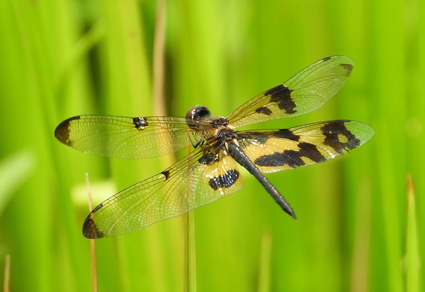
Rhyothemis variegata (Linnaeus, 1763) and R. phyllis (Sulzer, 1776) are conspicuous, widespread and well-known species described in 18th century, the former by Linnaeus himself. They are considered broadly co-occurring in south-east Asia, with the former extending to the Indian subcontinent and the latter to Sundaland and Oceania. They are assumed to strongly differ in wing coloration, however this concerns females only, while the differences in males were characterised by Ris (1913) and Fraser (1936) as subtle. This circumstance is scarcely known to people interested in dragonflies, so that many of them got an impression that in the regions where both species co-occur, R. variegata is represented by females only. No structural difference between these two species has ever been reported. Fifteen years ago the first author supposed that the dragonflies associated with these two species names in fact represent the same biological species. Here, this statement is proved by sequencing two molecular markers, the mitochondrial COI gene fragment and the nuclear histone H3–H4 region, from eight females collected in the same swarm in Cambodia and classified to four distinct phenotypes, of which one formally corresponds to R. phyllis and three to R. variegata. The sequences were nearly identical: only three positions in COI and four (one with a two nucleotide indel) in the histone H3–H4 region (ca 0.5% of positions in both cases) were variable, without correspondence to phenotypes. Two specimens of R. variegata from Western Ghats of India shared the same haplotypes. Analysis of the COI sequences from GenBank proved the same near identity and the lack of correspondence to identifications as R. phyllis or R. variegata. Based on this, R. phyllis is claimed to be a junior subjective synonym of R. variegata. The nominotypical subspecies of the former is re-attributed to the latter, as Rhyothemis variegata phyllis comb. nov., while validity of other subspecies earlier proposed under R. phyllis is left for further studies.
References
- Asahina, S. (1989) A list of the Odonata recorded from Thailand, Part XX. Libellulidae-2. Tombo, 32 (1–4), 2–14.
- Dow, R.A., Choong, C.Y., Grinang, J., Lupiyaningdyah, P., Ngiam, R.W.J. & Kalkman, V.J. (2024) Checklist of the Odonata (Insecta) of Sundaland and Wallacea (Malaysia, Singapore, Brunei, Indonesia and Timor Leste). Zootaxa, 5460 (1), 1–122. https://doi.org/10.11646/zootaxa.5460.1.1
- Drury, D. (1773) Illustrations of Natural History: Wherein are exhibited Upwards of Two Hundred and Forty Figures of Exotic Insects, According to their different Genera: Very few of which have hitherto been figured by any Author, Being engraved and coloured from Nature, with the greatest Accuracy, and under the Author’s own Inspection, on Fifty Copper-plates; With a particular Description of each Insect; Interiperfed with Remarks and Reflections of the Nature and Properties of many of them. Vol. 2. Published by the author, London, vii + 90 pp.
- Fabricius, J.C. (1781) Species insectorum, exhibentes eorum differentias specificas, synonyma auctorum, loca natalia, metamorphosin, adjectis observationibus, descriptionibus. Carol Ernest Bonhii, Hamburgi et Kilonii, 552 pp. https://doi.org/10.5962/bhl.title.36509
- Folmer, O., Black, M., Hoeh, W., Lutz, R. & Vrijenhoek, R. (1994) DNA primers for amplification of mitochondrial cytochrome c oxidase subunit I from diverse metazoan invertebrates. Molecular Marine Biology and Biotechnology, 3 (5), 294–299.
- Fraser, F.C. (1936) The Fauna of British India including Ceylon and Burma: Odonata. Vol. 3. Taylor and Francis Ltd., London, 461 pp.
- Goodenough, U. (1984) Genetics. CBS College Publishing, Hong Kong, 894 pp.
- Hagen, H.A. (1867) Nolizen beim Studium von Brauer’s Novara-Neuropteren. Verhandlungen der Zoologisch-Botanischen Gesellschaft in Wien, 17, 31–62.
- Hämäläinen, M. & Pinratana, A. (1999) Atlas of the Dragonflies of Thailand. Distribution maps by provinces. Brothers of St. Gabriel in Thailand, Bangkok, 176 pp.
- iNaturalist (2025) Internet resource. Available from: https://www.inaturalist.org/observations/ (accessed 9 July 2025)
- Kalkman, V.J., Babu, R., Bedjanič, M., Conniff, K., Gyeltshen, M.K., Khan, M.K., Subramanian, K.A., Zia, A. & Orr, A.G. (2020) Checklist of the dragonflies and damselflies (Insecta: Odonata) of Bangladesh, Bhutan, India, Nepal, Pakistan and Sri Lanka. Zootaxa, 4849 (1), 1–84. https://doi.org/10.11646/zootaxa.4849.1.1
- Katoh, K. & Standley, D.M. (2013) MAFFT multiple sequence alignment software version 7: improvements in performance and usability. Molecular Biology and Evolution, 30, 772–780. https://doi.org/10.1093/molbev/mst010
- Kosterin, O.E. (2010) A glance at the Odonata of the Cambodian coastal mountainous regions: end of dry season in 2010. International Dragonfly Fund Report, 29, 1–75.
- Kosterin, O.E. (2011) Odonata of the Cambodian coastal regions revisited: beginning of dry season 2010. International Dragonfly Fund Report, 40, 1–108.
- Kosterin, O.E. (2012) Odonata of the Cambodian coastal regions in late rainy season of 2011. International Dragonfly Fund Report, 45, 1–102.
- Kosterin, O.E. (2014) Odonata briefly observed on the islands of Bali and Lombok, Lesser Sundas, Indonesia, in the late February 2014. International Dragonfly Fund Report, 74, 1–48.
- Kosterin, O.E. (2022) Osnovy genetiki: uchebnik [Basics of Genetics: a textbook]. 2nd, revised edition. Publishing & Polygraphic Centre of Novosibirsk State University, Novosibirsk, 650 pp. [in Russian] https://doi.org/10.25205/978-5-4437-1323-6
- Lieftinck, M.A. (1953) The Odonata of the island Sumba with a survey of the dragonfly fauna of the Lesser Sunda Islands. Verhandlungen der naturforschenden Gesellschaft Basel, 64 (1), 118–228.
- Linnaeus, C. (1763) CXXI. Centuria insectorum quam praeside D. D. Car. von Linné proposuit Boas Johansson, Calmariensis (Upsaliae 1763. Junii 23). In: Linnaeus, C. (Ed.), Amoenitates academicae; seu dissertationes variae physicae, medicae, botanicae, antehac seorsim editae, nunc collectae et auctae cum tabulis aeneis. Tomus 6. G. Kiesewetter, Holmiae, pp. 384–415.
- Marinov, M. (2015) The seven “oddities” of Pacific Odonata biogeography. Faunistic Studies in South-east Asian and Pacific Islands, 11, 1–58.
- Mayr, E. (1970) Populations, Species and Evolution. The Belknap Press of Harward University Press, Cambridge, Massachusets, 453 pp.
- Mglinets, A.V., Bulgakova, V.S. & Kosterin, O.E. (2025) A new molecular marker including parts of conservative histone H3 and H4 genes and the spacer between them for phylogenetic studies in dragonflies (Insecta, Odonata), extendable to other organisms. Vavilovskii Zhurnal Genetiki i Selektsii, 29 (6), 868–882. https://doi.org/10.18699/vjgb-25-94
- Minh, B.Q., Nguen, M.A.T. & Von Haeseler, A. (2013) Ultrafast approximation for phylogenetic bootstrap. Molecular Biology and Evolution, 30, 1188–1195. https://doi.org/10.1093/molbev/mst024
- Ozono, A., Kawashima, I. & Futahashi, R. (2012) [Dragonflies of Japan]. Bunichi-Sogo Syuppan Co. Ltd, Tokyo, 532 pp. [in Japanese]
- Paulson, D., Schorr, M., Abbott, J., Bota-Sierra, C., Deliry, C., Dijkstra, K.-D. & Lozano, F. (Coordinators) (2025) World Odonata List. Odonata Central, University of Alabama, Tuscaloosa. Available from: https://www.odonatacentral.org/app/#/wol/ (accessed 9 July 2025)
- Ris, F. (1913) Libellulines. Vol. 3. Collections zoologiques du Baron Edm. de Selys Longchamps, Catalogue systematique et descriptif. Fasc. XV–XVI. Hayez, Imprimer des Académies, Bruxelles, 385 pp.
- Selys Longchamps, E. (1883a) Les odonates du Japon. Annales de la Société Entomologique de Belgique, 27, 82–143.
- Swezey, O.H. & Williams, F.X. (1942) Dragonflies of Guam. Bernice P. Bishop Museum Bulletin, 172, 3–6.
- Sukhikh, I., Bugrov, A., Chobanov, D., Fet, V., Biryukov, M. & Blinov, A. (2025) Molecular phylogenetic analysis and taxonomy of the Palearctic Pamphagidae grasshoppers (Orthoptera, Acridoidea) based on DNA markers. Insect Systematics & Evolution, 55, 1–13. https://doi.org/10.1163/1876312X-bja10072
- Sulzer, J.H. (1776) Abgekürtze Geschichte der Insekten nach dem Linnaeischen System. 1. H. Steiner & Co., Wintetthur, 274 pp. https://doi.org/10.5962/bhl.title.34407
- Trifinopoulos, J., Nguyen, L.T., Von Haeseler, A. & Minh, B.Q. (2016) W-IQ-TREE: a fast online phylogenetic tool for maximum likelihood analysis. Nucleic Acids Research, 44, W232–W235. https://doi.org/10.1093/nar/gkw256
- Tsuda, S. (2000) A Distributional List of World Odonata. S. Tsuda, Osaka, 430 pp.
- Zhang, H-M. (2019) Dragonflies and Damselflies of China. Chongqing University Press, Chongqing, 1460 pp. [in Chinese, with English annotations]