
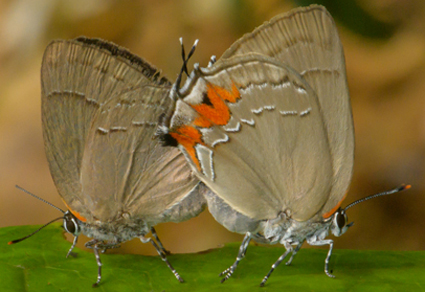

Abstract
A review of the genena species group of Thereus Hübner is provided, based on literature, barcoded specimens, genome type material and recent collecting data, as part of an ongoing revisionary work on this genus. Previously, the genena species group contained five species and four synonyms, this study reveals nine new species and two previously unrecognized species whose names are here removed from synonymy. Thereus geminus Faynel & Fåhraeus sp. nov. (type-locality: Peru) is similar to T. endera but the ventral hindwing postmedian line is straight (no gap as in T. endera). Thereus cacao Faynel & Fåhraeus sp. nov. (type-locality: French Guiana) is close to T. endera but males have blue-violet coloration dorsally (compared to the grey-dull blue of T. endera) and the ventral postmedian line is displaced on the forewing. Thereus antecum Faynel & Fåhraeus sp. nov. (type-locality: French Guiana) is a large species reminiscent of Thereus endera (Hewitson), with a different shape of the postmedian line ventrally. Thereus chontachaca Faynel, Fåhraeus & González-Mercado sp. nov. (type-locality: Peru) is similar to Thereus ortalus (Godman & Salvin) and Thereus praxis (Godman & Salvin), although smaller and with a bigger black scent patch on the male dorsal forewing. Thereus ramirezi Faynel, Huertas & Fåhraeus sp. nov. (type-locality: Peru) is characterized by a wave-shaped dorsal edge of the vinculum supporting brush organs in the male genitalia, a character that is unique in the genena species group. Thereus borbaensis Faynel, O’Brien & Fåhraeus sp. nov. (type-locality: Brazil) is bigger than the previous two species with a wider black scent patch on the male forewing. Thereus confusus Faynel & Fåhraeus sp. nov. (type-locality: Brazil) was previously confused with T. ortalus but differs by its flattened oval scent patch on the male dorsal forewing. Thereus praxioides Faynel & Fåhraeus sp. nov. (type-locality: French Guiana) resembles T. praxis but differs by having thinner black margins and different oval scent patch on the male forewing. Thereus aguacatal Faynel, Le Crom, & Fåhraeus sp. nov. (type-locality: Colombia) looks like T. ortalus but has a single androconial patch on the male dorsal forewing. In addition to these new descriptions, some species-names are removed from synonymy: Thereus angulus (Le Crom & K. Johnson), stat. rev., type locality: Colombia (Meta), from T. endera, type-locality: Brazil (Amazonas) and Thereus ortaloides (Lathy), stat. rev., type-locality: Brazil (Rio de Janeiro), from T. ortalus, type-locality: Mexico (Veracruz). Consequently, we reinstate these nominal taxa to their original status, arrangements that are supported also by genomic work and barcoding of type material. To stabilize nomenclature, lectotypes are designated for Thecla endera Hewitson, Thecla genena Hewitson, Thecla praxis Godman & Salvin and Thecla ortalus Godman & Salvin. A neotype is designated for Thecla tiasa Hewitson to define this nominal taxon objectively. A key to identify species of the genena species group is provided using male characters.
References
- Bächtold, A. (2014) A comunidade de licenídeos de uma área de cerrado: especificidade de dieta, interações ecológicas e seleção de plantas hospedeiras. Tese de Doutorado, Universidade de São Paulo, Ribeirão Preto, 135 pp.
- Bálint, Z. (2005) Systematics and taxonomic notes on Neotropical hairstreak lycaenids in connection to the genus Megathecla (Lycaenidae: Theclinae: Eumaeini). Boletín Científico del Museo de Historia Natural de la Universidad de Caldas, 9, 278–294.
- Beccaloni, G.W., Hall, S.K., Viloria, A.L. & Robinson, G.S. (2008) Catalogue of the hostplants of the Neotropical butterflies. Catálogo de las plantas huésped de las mariposas neotropicales. Monografías del Tercer Milenio. Vol. 8. Sociedad Entomológica Aragonesa, Zaragoza, 536 pp.
- Comstock, J.H. (1918) The wings of insects. The Comstock Publishing Company, Ithaca, New Yor, 430 pp.
- Dabney, J., Knapp, M., Glocke, I., Gansauge, M.T., Weihmann, A., Nickel, B., Valdiosera, C., García, N., Pääbo, S., Arsuaga, J.-L. & Meyer, M. (2013) Complete Mitochondrial Genome Sequence of a Middle Pleistocene Cave Bear Reconstructed from Ultrashort DNA Fragments. Proceedings of the National Academy of Sciences, 110 (39), 15758–15763. https://doi.org/10.1073/pnas.1314445110
- Druce, H.H. (1907) On Neotropical Lycaenidae, with descriptions of new species. Proceedings of the Zoological Society of London, 3, 566–632, pls. 31–36. https://doi.org/10.1111/j.1469-7998.1907.tb06947.x
- Elias, D.C. (2024) Novas interações multitróficas entre lepidópteros herbívoros, erva-de-passarinho e plantas hospedeiras no dossel urbano. Dissertação de Mestrado, Universidade Federal do Rio Grande do Sul, Porto Alegre, 54 p.
- Eliot, J.N. (1973) The Higher Classification of the Lycaenidae (Lepidoptera): A Tentative Arrangement. Bulletin of the British Museum (Natural History) Entomology, 28, 371–505. https://doi.org/10.5962/bhl.part.11171
- Faynel, C. (2003) Cinq années d’observation sur les Theclinae de Guyane française (Lepidoptera: Lycaenidae). In: Lacomme, D. & Manil, L. (Eds.), Lépidoptères de Guyane. Bulletin des lépidoptéristes parisiens numéro, Hors Série, 24, pp. 49–62.
- Faynel, C. (2010) 3ème note sur les Theclinae de Guyane (Lepidoptera: Lycaenidae). Lambillionea, 110 (1), 9–16.
- Faynel, C. & Bálint, Z. (2004) Supplementary information on neotropical Eumaeini primary type material and further historical specimens deposited in the Muséum national d'Histoire naturelle, Paris (Lycaenidae, Theclinae). Bulletin de la Société Entomologique de France, 109 (3), 263–286.
- https://doi.org/10.3406/bsef.2004.16126
- Faynel, C. & Fåhraeus, C. (2023) Two new Thereus species from Peru, with notes on ecological niche partitioning (Lepidoptera: Lycaenidae: Theclinae). Zootaxa, 5315 (4), 301–314. https://doi.org/10.11646/zootaxa.5315.4.1
- Faynel, C., Busby, R.C., Dolibaina, D.R., Huertas, B. & Fåhraeus, C. (2025) A review of the Ocaria arpoxais species group (Lycaenidae: Theclinae) with the description of a new species previously confused with O. cinerea (Lathy). Zootaxa, 5618 (1), 47–67. https://doi.org/10.11646/zootaxa.5618.1.3
- Faynel, C. & Moser, A. (2008) The neotropical genus Oenomaus Hübner with the description of eight new species belonging to the atena group (Lepidoptera, Lycaenidae). Lambillionea, 108 (2) (Supplement I), 1–36.
- Godman, F.D. & Salvin, O. (1885–88) Biologia Centrali-Americana. Insecta. Lepidoptera-Rhopalocera. 1 (43). Dulau & Co., Bernard Quaritch, London, 40 pp. [pp. 361–400]
- Hall, A.C., Powell, O.N., Cuber, P. & Price, B.W. (2023) Low-Cost Museum DNA Extraction Using Magnetic Beads. Protocols.io. Available from: https://www.protocols.io/view/low-cost-museum-dna-extraction-using-magnetic-bead-4r3l27ebxg1y/v2 (accessed 12 November 2025) https://doi.org/10.17504/protocols.io.4r3l27ebxg1y/v2
- Hebert, P.D.N., Ratnasingham, S. & de Waard, J.R. (2003) Barcoding animal life. Proceedings of the Royal Society B, Biological Sciences, 270 (Supplement 1), S96–S99. https://doi.org/10.1098/rsbl.2003.0025
- Heredia, M.D. & Robbins, R.K. (2016) Natural history of the mistletoe-feeding Thereus lomalarga (Lepidoptera, Lycaenidae, Eumaeini) in Colombia. Zootaxa, 4117 (3), 301–320. https://doi.org/10.11646/zootaxa.4117.3.1
- Hewitson, W.C. (1867–9) Illustrations of diurnal Lepidoptera, Lycænidæ. John Van Voorst, London, 77–136, pls. 31–54.
- Hijmans, R. (2025) raster: Geographic Data Analysis and Modeling. R Package Version 3.6-31. Available from: https://CRAN.R-project.org/package=raster (accessed 12 November 2025)
- Hijmans, R.J., Barbosa, M., Ghosh, A. & Mandel, A. (2024) geodata: Download Geographic Data. R Package Version 0.6-2. Available from: https://CRAN.R-project.org/package=geodata (accessed 12 November 2025)
- Hill, R.I., Elias, M., Dasmahapatra, K.K., Jiggins, C.D., Koong, V., Willmott, K.R. & Mallet, J. (2012) Ecologically relevant cryptic species in the highly polymorphic Amazonian butterfly Mechanitis mazaeus s.l. (Lepidoptera: Nymphalidae; Ithomiini). Biological Journal of the Linnean Society, 106 (3), 540–560. https://doi.org/10.1111/j.1095-8312.2012.01874.x
- Hoang, D.T., Chernomor, O., Von Haeseler, A., Minh, B.Q. & Vinh, L.S. (2018) UFBoot2: improving the ultrafast bootstrap approximation. Molecular Biology and Evolution, 35 (2), 518–522. https://doi.org/10.1093/molbev/msx281
- Kalyaanamoorthy, S., Minh, B.Q., Wong, T.K.F., Von Haeseler, A. & Jermiin, L.S. (2017) ModelFinder: fast model selection for accurate phylogenetic estimates. Nature Methods, 14 (6), 587–589. https://doi.org/10.1038/nmeth.4285
- Kaminski, L.A. (2021) iNaturalist observation. Available from: https://www.inaturalist.org/observations/90313874 (accessed 20 May 2025)
- Kaminski, L.A. (2023a) iNaturalist observation. Available from: https://www.inaturalist.org/observations/159550291 (accessed 20 May 2025)
- Kaminski, L.A. (2023b) iNaturalist observation. Available from: https://www.inaturalist.org/observations/159548780 (accessed 20 May 2025)
- Kaminski, L.A. (2025a) iNaturalist observation. Available from: https://www.inaturalist.org/observations/282508749 (accessed 20 May 2025)
- Kaminski, L.A. (2025b) iNaturalist observation. Available from: https://www.inaturalist.org/observations/282512236 (accessed 20 May 2025)
- Kaminski, L.A. (2025c) iNaturalist observation. Available from: https://www.inaturalist.org/observations/282514726 (accessed 20 May 2025)
- Kapp, J.D., Green, R.E. & Shapiro, B. (2021) A Fast and Efficient Single-Stranded Genomic Library Preparation Method Optimized for Ancient DNA. Journal of Heredity, 112 (3), 241–249. https://doi.org/10.1093/jhered/esab012
- Kawahara, A.Y., Storer, C., Carvalho, A.P.S., Plotkin, D.M., Condamine, F.L., Braga, M.P., Ellis, E.A., St Laurent, R.A., Li, X., Barve, V., Cai, L., Earl, C., Frandsen, P.B., Owens, H.L., Valencia-Montoya, W.A., Aduse-Poku, K., Toussaint, E.F.A., Dexter, K.M., Doleck, T., Markee, A., Messcher, R., Nguyen, Y.-L., Badon, J.A.T., Benítez, H.A., Braby, M.F., Buenavente, P.A.C., Chan, W.-P., Collins, S.C., Childers, R.A.R., Dankowicz, E., Eastwood, R., Fric, Z.F., Gott, R.J., Hall, J.P.W., Hallwachs, W., Hardy, N.B., Hawkins Sipe, R.L., Heath, A., Hinolan, J.D., Homziak, N.T., Hsu, Y.-F., Inayoshi, Y., Itliong, M.G.A., Janzen, D.H., Kitching, I.J., Kunte, K., Lamas, G., Landis, M.J., Larsen, E.A., Larsen, T.B., Leong, J.V., Lukhtanov, V., Maier, C.A., Martinez, J.I., Martins, D.J., Maruyama, K., Maunsell, S.C., Mega, N.O., Monastyrskii, A., Morais, A.B.B., Müller, C.J., Naive, M.A.K., Nielsen, G., Padrón, P.S., Peggie, D., Romanowski, H.P., Sáfián, S., Saito, M., Schröder, S., Shirey, V., Soltis, D., Soltis, P., Sourakov, A., Talavera, G., Vila, R., Vlasanek, P., Wang, H., Warren, A.D., Willmott, K.R., Yago, M., Jetz, W., Jarzyna, M.A., Breinholt, J.W., Espeland, M., Ries, L., Guralnick, R.P., Pierce, N.E. & Lohman, D.J. (2023) A global phylogeny of butterflies reveals their evolutionary history, ancestral hosts and biogeographic origins. Nature Ecology & Evolution, 7, 903–913. https://doi.org/10.1038/s41559-023-02041-9
- Lamas, G., Ramírez, J.J. & Robbins, R.K. (2004) The first known female of Megathecla gigantea (Hewitson, 1867) (Lepidoptera: Lycaenidae: Eumaeini). Revista Peruana de Biologia, 11 (1), 99–102. https://doi.org/10.15381/rpb.v11i1.2439
- Lamas, G., McInnis, M.L., Busby, R.C. & Robbins, R.K. (2021) The lycaenid butterfly fauna (Lepidoptera) of Cosñipata, Peru: annotated checklist, elevational patterns, and rarity. Ins. Mundi, Gainesville, 861, 1–34.
- Lathy, P.I. (1930) Notes on South American Lycaenidae, with descriptions of new species. Transaction of the entomological Society of London, 78 (1), 133–137, pl. 9. https://doi.org/10.1111/j.1365-2311.1930.tb01205.x
- Le Crom, J.F. & Johnson, K. (1997) Additions to the Strymon fauna of Colombia (Eumaeini; Strymonina). Revista de Theclinae colombianos, 2 (16), 1–47, pls. 13–14.
- Maldonado Howard, H. (2021) iNaturalist observation. Available from: https://www.inaturalist.org/observations/76024342 (accessed 20 May 2025)
- Martins, A.R.P., Duarte, M. & Robbins, R.K. (2019) Hairstreak butterflies (Lepidoptera, Lycaenidae) and evolution of their male secondary sexual organs. Cladistics, 35 (2), 173–197. https://doi.org/10.1111/cla.12355
- Massicotte, P. & South, A. (2023) rnaturalearth: World Map Data from Natural Earth. R Package Version 1.0.1. Available from: https://CRAN.R-project.org/package=rnaturalearth (accessed 12 November 2025)
- Mayr, E. (1942) Systematics and the Origin of Species. Columbia University Press, New York, New York, xiv + 334 pp.
- Minh, B.Q., Schmidt, H.A., Chernomor, O., Schrempf, D., Woodhams, M.D., Von Haeseler, A. & Lanfear, R. (2020) IQ-TREE 2: new models and efficient methods for phylogenetic inference in the genomic era. Molecular Biology and Evolution, 37 (5), 1530–1534. https://doi.org/10.1093/molbev/msaa015
- Nicolay, S.S. & Robbins, R.K. (2005) Five new dry-area South American Strymon species (Lycaenidae: Theclinae) and their biogeographic significance. Journal of Research on the Lepidoptera, 38, 35–49. https://doi.org/10.5962/p.263981
- Nielsen, G. (2022) iNaturalist observation. Available from: https://www.inaturalist.org/observations/143451944 (accessed 20 May 2025)
- Nguyen, R., Kapp, J.D., Sacco, S., Myers, S.P. & Green, R.E. (2023) A Computational Approach for Positive Genetic Identification and Relatedness Detection from Low-Coverage Shotgun Sequencing Data. Journal of Heredity, 114 (5), 504–512. https://doi.org/10.1093/jhered/esad041
- Oliveira-Neto, J.F., Kaminski, L.A. & Malucelli, L.H. (2023) Borboletas do litoral sul do Brasil: Riodinidae e Lycaenidae. 1st Edition. Unespar, Paranaguá, 55 pp.
- Pebesma, E. (2018) Simple Features for R: Standardized Support for Spatial Vector Data. The R Journal, 10 (1), 439–446. https://doi.org/10.32614/RJ-2018-009
- Pebesma, E. & Bivand, R. (2023) Spatial Data Science: With Applications in R. Chapman and Hall/CRC, London, 314 pp. https://doi.org/10.1201/9780429459016
- Posit team (2024) RStudio: Integrated Development Environment for R. Posit. Software, PBC, Boston, Massachusetts. Available from: http://www.posit.co/ (accessed 12 November 2025)
- Prieto, C. & Dahners, H.W. (2006) Eumaeini (Lepidoptera: Lycaenidae) del cerro San Antonio: Dinámica de la riqueza y comportamiento de “Hilltopping”. Rev. Colomb. Entomol., 32 (2), 179–190. https://doi.org/10.25100/socolen.v32i2.9388
- Rambaut, A. (2012) FigTree. Version 1.4.0. University of Oxford, Oxford. Available from: http://tree.bio.ed.ac.uk/software/figtree (accessed 26 February 2025)
- R Core Team (2024) R: A Language and Environment for Statistical Computing. R Foundation for Statistical Computing, Vienna. Available from: https://www.R-project.org/ (accessed 12 November 2025)
- Ratnasingham, S. & Hebert, P.D.N. (2007) BOLD: The Barcode of Life Data System (www.barcodinglife.org). Molecular Ecology Notes, 7, 355–364. https://doi.org/10.1111/j.1471-8286.2006.01678.x
- Robbins, R.K. (1991) Evolution, comparative morphology, and identification of the Eumaeine butterfly genus Rekoa Kaye (Lycaenidae: Theclinae). Smithsonian Contributions to Zoology, 498, 1–64. https://doi.org/10.5479/si.00810282.498
- Robbins, R.K. (2004) Theclinae. In: Lamas, G. (Ed.), Atlas of Neotropical Lepidoptera Checklist: Part4A Hesperioidea-Papilionoidea. Scientific Publishers, Gainesville, pp. 118–137.
- Robbins, R.K., Heredia, M.D. & Busby, R.C. (2015) Male secondary sexual structures and the systematics of the Thereus oppia species group (Lepidoptera, Lycaenidae, Eumaeini). ZooKeys, 520, 109–130. https://doi.org/10.3897/zookeys.520.10134
- Robbins, R.K. & Nicolay, S.S. (2002) An overview of Strymon Hübner (Lycaenidae: Theclinae: Eumaeini). Journal of the Lepidopterists’ Society, 55 (3), 85–100.
- Robbins, R.K., Martins, A.R., Busby, R.C. & Duarte, M. (2012) Loss of male secondary sexual structures in allopatry in the Neotropical butterfly genus Arcas (Lycaenidae: Theclinae: Eumaeini). Insect Systematics & Evolution, 43, 35–65. https://doi.org/10.1163/187631212X626195
- Robbins, R.K., Cong, Q., Zhang, J., Shen, J., Busby, R.C., Faynel, C., Duarte, M., Martins, A.R.P., Prieto, C., Lamas, G. & Grishin, N.V. (2022) Genomics-based higher classification of the species-rich hairstreaks (Lepidoptera: Lycaenidae: Eumaeini). Systematic Entomology, 47 (3), 445–469. https://doi.org/10.1111/syen.12541
- Rohland, N., Glocke, I., Aximu-Petri, A. & Meyer, M. (2018) Extraction of Highly Degraded DNA from Ancient Bones, Teeth and Sediments for High-Throughput Sequencing. Nature Protocols, 13 (11), 2447–2461. https://doi.org/10.1038/s41596-018-0050-5
- Salazar, J.A. (1996) Sobre la concentración de lepidópteros ropalóceros en la cumbre de un cerro del noroccidente de Caldas, Colombia. SHILAP Revista de lepidopterología, 24 (94), 183–195.
- Shields, O. (1967) Hilltopping. An ecological study of summit congregation behavior of butterflies on a southern California hill. Journal of Research on the Lepidoptera, 6 (2), 69–178. https://doi.org/10.5962/p.333400
- South, A., Michael, S. & Massicotte, P. (2024) rnaturalearthdata: World Vector Map Data from Natural Earth Used in 'rnaturalearth'. R Package Version 1.0.0. Available from: https://CRAN.R-project.org/package=rnaturalearthdata (accessed 12 November 2025)
- Valencia-Montoya, W.A., Quental, T.B., Tonini, J.F.R., Talavera, G., Crall, J.D., Lamas, G., Busby, R.C., Carvalho, A.P.S., Morais, A.B., Oliveira Mega, N., Romanowski, H.P., Lienard, M.A., Salzman, S., Whitaker, M.R.L., Kawahara, A.Y., Lohman, D.J., Robbins, R.K. & Pierce, N.E. (2021) Evolutionary trade-offs between male secondary sexual traits revealed by a comprehensive phylogeny of the hyperdiverse tribe Eumaeini (Lepidoptera: Lycaenidae). Proceedings of the Royal Society of London B, 288 (1950), 20202512. https://doi.org/10.1098/rspb.2020.2512
- Weyermanns, M.I. (2024) iNaturalist observation. Available from: https://www.inaturalist.org/observations/201407191 (accessed 20 May 2025)
- Wickham, H. (2016) ggplot2: Elegant Graphics for Data Analysis. Springer-Verlag New York, 260 pp. https://doi.org/10.1007/978-3-319-24277-4_9
- Wickham, H., François, R., Henry, L., Müller, K. & Vaughan, D. (2023) dplyr: A Grammar of Data Manipulation. R Package Version 1.1.4. Available from: https://CRAN.R-project.org/package=dplyr (accessed 12 November 2025)
- Wilson, J. (2012) DNA barcodes for insects. Methods in Molecular Biology, 858, 17–46. https://doi.org/10.1007/978-1-61779-591-6_3
- Winter, W.D. (2000) Basic Techniques for Observing and Studying Moths and Butterflies. Memoir No. 5). The Lepidopterists’ Society, San Francisco, California, 444 pp.