
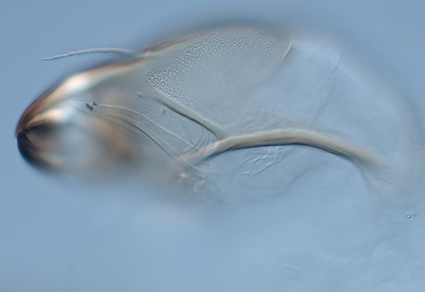

Abstract
The genus Ovobates (Oribatida, Oribatulidae) comprises two species distributed in the Oriental region. A new species—Ovobates ochrocarpicus sp. nov.—is described, based on adult and nymphal instars, collected from branches of the ochrocarp tree in southern Vietnam. The adult of the new species is characterized by the presence of the five pairs of notogastral porose areas and the epimeral formula 3-1-3-3. The nymphs of the new species are characterized by presence of clavate bothridial seta; setiform interlamellar seta; short, setiform, thin gastronotic setae c1, c2, da, la; medium-sized to long, setiform, gastronotic setae dm c3, lm, p2, and p3; medium-sized, bacilliform gastronotic setae dp, h1, and h3; long, subflagellate, gastronotic setae lp, h2, and p1; epimeral formula 3-1-2-2 in tritonymph; and seven setae on the leg tarsus IV in protonymph. The generic diagnosis and a morphological comparison of adults and juvenile instars of the known species of Ovobates are presented.
References
- Balogh, J. & Balogh, P. (1984) A review of the Oribatuloidea Thor, 1929 (Acari: Oribatei). Acta Zoologica Hungarica, 30, 257–313.
- Berlese, A. (1913) Acari nuovi. Manipulus 7–8. Redia, 9, 77–111.
- Ermilov, S.G. & Salavatulin, V.M. (2025) Ontogenetic instars of Ovobates khaustovi (Acari, Oribatida, Oribatulidae), a new arboreal mite associated with mangrove trees in Vietnam. Systematic and Applied Acarology, 30, 1582–1596. https://doi.org/10.11158/saa.30.9.4
- Hammer, M. (1982) On a collection of oribatid mites from Bali, Indonesia (Acari: Cryptostigmata). Entomologica Scandinavica, 13, 445–464. https://doi.org/10.1163/187631282X00291
- Mahunka, S. (1994) Further notes, additions and redescriptions of the oribatid species preserved in the Berlese Collection (Acari, Oribatida) I. Acta Zoologica Academiae Scientiarum Hungaricae, 40, 29–49.
- Norton, R.A. (1977) A review of F. Grandjean's system of leg chaetotaxy in the Oribatei (Acari) and its application to the family Damaeidae. In: Dindal, D.L. (Ed.), Biology of oribatid mites. SUNY College of Environmental Science and Forestry, Syracuse, New York, pp. 33–61.
- Norton, R.A. & Behan-Pelletier, V.M. (2009) Chapter 15. Suborder Oribatida. In: Krantz, G.W. & Walter, D.E. (Eds.), A Manual of Acarology. Texas Tech University Press, Lubbock, Texas, pp. 430–564.
- Norton, R.A. & Ermilov, S.G. (2014) Catalogue and historical overview of juvenile instars of oribatid mites (Acari: Oribatida). Zootaxa, 3833 (1), 1–132. https://doi.org/10.11646/zootaxa.3833.1.1
- Salavatulin, V.M. (2019) Microhabitat distribution of arboreal oribatid mites (Oribatida), associated with the Siberian pine (Pinus sibirica) of Western Siberia. Experimental and Applied Acarology, 78, 469–483. https://doi.org/10.1007/s10493-019-00401-4
- Travé, J. & Vachon, M. (1975) François Grandjean. 1882–1975 (Notice biographique et bibliographique). Acarologia, 17, 1–19.