

Abstract
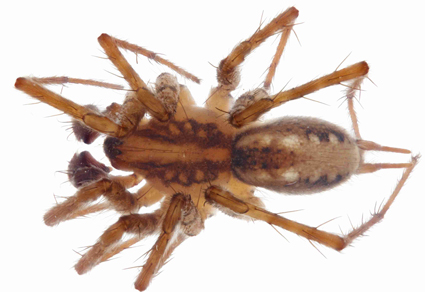
In this study, we document the diversity of funnel-weaving spiders (Agelenidae: Ageleninae) in arid western South Africa, a fauna that has historically been understudied. Examination of collected material revealed 16 new species belonging to two tribes, Textricini and Agelenini, representing three genera, including two newly described herein. Afrotrix gen. nov. (Textricini) is described to comprise A. deserticola (Simon, 1910) comb. nov. (ex. Benoitia Lehtinen, 1967), for which a lectotype is newly designated, as well as nine new species: A. spicula sp. nov. (type species, ♂♀), A. booyseni sp. nov. (♂♀), A. dejagerae sp. nov. (♂♀), A. goegap sp. nov. (♀), A. karooica sp. nov. (♂♀), A. lyonsae sp. nov. (♂♀), A. reginaldi sp. nov. (♂♀), A. sauria sp. nov. (♀) and A. tankwa sp. nov. (♂♀). Benoitia Lehtinen, 1967 (Agelenini) is represented by the following five new species: B. arida sp. nov. (♀), B. leroyae sp. nov. (♀), B. lunata sp. nov. (♀), B. meridionalis sp. nov. (♂♀) and B. namaqua sp. nov. (♂♀). Finally, Namagelena gen. nov. (Agelenini) is described to comprise two new species, N. sola sp. nov. (type species, ♂♀) and N. guttata sp. nov. (♀). A molecular phylogeny is presented based on cytochrome c oxidase subunit I (COI) sequences of 12 species of South African Agelenidae, including 10 described in this paper, which supports the delimitation of the three genera treated. Distribution maps are provided for all the species.
References
- Aharon, S., Ballesteros, J.A., Gainett, G., Hawlena, D., Sharma, P.P. & Gavish-Regev, E. (2023) In the land of the blind: exceptional subterranean speciation of cryptic troglobitic spiders of the genus Tegenaria (Araneae: Agelenidae) in Israel. Molecular Phylogenetics and Evolution, 183, 107705. https://doi.org/10.1016/j.ympev.2023.107705
- Almquist, S. (2006) Swedish Araneae, part 1 – families Atypidae to Hahniidae (Linyphiidae excluded). Insect Systematics & Evolution, Supplement, 62(2005), 1–284.
- Álvarez-Padilla, F. & Hormiga, G. (2007) A protocol for digesting internal soft tissues and mounting spiders for scanning electron microscopy. Journal of Arachnology, 35, 538–542. https://doi.org/10.1636/Sh06-55.1
- Canadian Centre for DNA Barcoding [CCDB] (2019) CCDB Protocols. CCDB [Internet], Guelph. Available from: http://ccdb.ca/site/wp-content/uploads/2016/09/CCDB_Amplification.pdf (accessed 19 December 2023)
- Dippenaar-Schoeman, A.S., Haddad, C.R., Foord, S.H. & Lotz, L.N. (2020) The Agelenidae of South Africa. Version 1. South African National Survey of Arachnida Photo Identification Guide, Irene, 23 pp. https://doi.org/10.5281/zenodo.5981186
- Dippenaar-Schoeman, A.S. & Jocqué, R. (1997) African spiders: an identification manual. Plant Protection Research Institute Handbook No. 9. Agricultural Research Council, Pretoria, 392 pp.
- Edgar, R.C. (2004) MUSCLE: a multiple sequence alignment method with reduced time and space complexity. BMC Bioinformatics, 5, 113. https://doi.org/10.1186/1471-2105-5-113
- Felsenstein, J. (1985) Confidence limits on phylogenies: An approach using the bootstrap. Evolution, 39, 783–791. https://doi.org/10.1111/j.1558-5646.1985.tb00420.x
- Foord, S.H., Dippenaar-Schoeman, A.S. & Haddad, C.R. (2011) Chapter 8 – South African spider diversity: African perspectives on the conservation of a mega-diverse group. In: Grillo, O. & Venora, G. (Eds.), Changing Diversity in Changing Environment. InTech Publishing, Rijeka, pp. 163–182.
- Foord, S.H., Dippenaar-Schoeman, A.S., Haddad, C.R., Lyle, R., Lotz, L.N., Sethusa, T. & Raimondo, D. (2020) The South African National Red List of spiders: patterns, threats, and conservation. Journal of Arachnology, 48, 110–118. https://doi.org/10.1636/0161-8202-48.2.110
- Haddad, C.R., Booysen, R., Vickers, M.E., Christiaan, R., Stander, A., Dippenaar-Schoeman, A.S. & Van der Mescht, A. (2025) A little goes a long way: a rapid sampling protocol repeated seasonally generates considerable spider biodiversity data in an arid national park. Biodiversity and Conservation, 34, 3453–3479. https://doi.org/10.1007/s10531-025-03107-9
- Haddad, C.R. & Marusik, Y.M. (2019) Clarifying the taxonomic status and distributions of the spider species collected during the Leonhard Schultze expeditions in western and central southern Africa. Zootaxa, 4608 (3), 451–483. https://doi.org/10.11646/zootaxa.4608.3.3
- Hebert, P.D.N., Ratnasingham, S. & de Waard, J.R. (2003) Barcoding animal life: Cytochrome C oxidase subunit 1 divergences among closely related species. Proceedings of the Royal Society of London B: Biological Sciences, 270, S96–S99. https://doi.org/10.1098/rsbl.2003.0025
- Hernández-Triana, L.M., Prosser, S.W., Rodríguez-Perez, M.A., Chaverri, L.G., Hebert, P.D.N. & Gregory, T.R. (2014) Recovery of DNA barcodes from blackfly museum specimens (Diptera: Simuliidae) using primer sets that target a variety of sequence lengths. Molecular Ecology Resources, 14, 508–518. https://doi.org/10.1111/1755-0998.12208
- Hrdina, A. & Romportl, D. (2017) Evaluating global biodiversity hotspots – Very rich and even more endangered. Journal of Landscape Ecology, 10, 108–115. https://doi.org/10.1515/jlecol-2017-0013
- Janion-Scheepers, C., Measey, J., Braschler, B., Chown, S.L., Coetzee, L., Colville, J., Dames, J., Davies, A.B., Davies, S., Davis, A., Dippenaar-Schoeman, A.S., Duffy, G., Fourie, D., Griffiths, C., Haddad, C.R., Hamer, M., Herbert, D., Hugo-Coetzee, L.E.A., Jacobs, A., Jansen Van Rensburg, C., Lamani, S., Lotz, L.N., Louw, S.vdM., Lyle, R., Malan, A., Marais, M., Neethling, J.A., Nxele, T., Plisko, D., Prendini, L., Rink, A.N., Swart, A., Theron, P., Truter, M., Ueckermann, E., Uys, V.M., Villet, M.H., Willows-Munrow, S. & Wilson, J.R.U. (2016) Soil biota in a megadiverse country: Current knowledge and future research directions in South Africa. Pedobiologia, 59, 129–174. https://doi.org/10.1016/j.pedobi.2016.03.004
- Kioko, G.M., Jäger, P., Kioko, E.N., Ji, L.Q. & Li, S.Q. (2019) On the species of the genus Mistaria Lehtinen, 1967 studied by Roewer (1955) from Africa (Araneae, Agelenidae). African Invertebrates, 60, 109–132. https://doi.org/10.3897/AfrInvertebr.60.34359
- Kioko, G.M., Kioko, E.N., Li, S.Q. & Li, L.Q. (2018) On four species of the genus Mistaria Lehtinen, 1967 (Araneae, Agelenidae) from Kenya. African Invertebrates, 59, 111–126. https://doi.org/10.3897/AfrInvertebr.59.26617
- Kumar, S., Stecher, G., Suleski, M., Sanderford, M., Sharma, S. & Tamura, K. (2024) Molecular Evolutionary Genetics Analysis Version 12 for adaptive and green computing. Molecular Biology and Evolution, 41, 1–9. https://doi.org/10.1093/molbev/msae263
- Lehtinen, P.T. (1967) Classification of the cribellate spiders and some allied families, with notes on the evolution of the suborder Araneomorpha. Annales Zoologici Fennici, 4, 199–468.
- Levy, G. (1996) The agelenid funnel-weaver family and the spider genus Cedicus in Israel (Araneae, Agelenidae and Cybaeidae). Zoologica Scripta, 25, 85–122. https://doi.org/10.1111/j.1463-6409.1996.tb00154.x
- Lyons, C.-L. (2008) Evaluating restoration success of alluvial diamond- mined sites in South Africa using invertebrate community indicators. Unpublished MSc thesis, University of Cape Town, Cape Town, 107 pp.
- Lyons, C.-L., Picker, M.D. & Carrick, P.J. (2008) Community structure of soil invertebrates under differing restoration practices – alluvial diamond-mined sites in South Africa. In: Fourie, A.B., Tibbett, M., Weiersbye, I.M. & Dye, P.J. (Eds.), Mine Closure 2008: Proceedings of the Third International Seminar on Mine Closure. Australian Centre for Geomechanics, Perth, pp. 821–830
- Mu, Y.N., Wang, L.Y., Ren, T.Y., Tian, Y. & Zhang, Z.S. (2025) Review of the genus Ageleradix Xu & Li, 2007 (Araneae, Agelenidae), with descriptions of three new species. ZooKeys, 1236, 197–208. https://doi.org/10.3897/zookeys.1236.143650
- Mucina, L. & Rutherford, M.C. (2006) The vegetation of South Africa, Lesotho and Swaziland. Strelitzia 19. South African National Biodiversity Institute, Pretoria, 820 pp.
- Myers, N., Mittermeier, R.A., Mittermeier, C.G., Da Fonseca, G.A.B. & Kent, J. (2000) Biodiversity hotspots for conservation priorities. Nature, 403, 853–858. https://doi.org/10.1038/35002501
- Ponomarev, A.V., Mikhailov, K.G. & Shmatko, V.Y. (2024) Review of spiders of the genus Tegenaria Latreille, 1804 (Aranei: Agelenidae) of Ciscaucasia and the Russian Caucasus. III. New data on fauna and distribution, with material from neighbouring regions. Arthropoda Selecta, 33, 273–287. https://doi.org/10.15298/arthsel.33.2.15
- Purcell, W.F. (1908) Araneae (I). In: Schultze, L. (Ed.), Zoologische und anthropologische Ergebnisse einer Forschungsreise im westlichen und zentralen Südafrika. Erster Band: Systematik und Tiergeographie. Zweite Lieferung. Denkschriften der Medizinisch-Naturwissenschaftlichen Gesellschaft zu Jena, 13, 203–246.
- Ratnasingham, S. & Hebert, P.D.N. (2007) BOLD: The Barcode of Life Data System (www.barcodinglife.org). Molecular Ecology Notes, 7, 355–364. https://doi.org/10.1111/j.1471-8286.2006.01678.x
- Ratnasingham, S. & Hebert, P.D.N. (2013) A DNA-based registry for all animal species: the Barcode Index Number (BIN) system. PLoS ONE, 8, e66213. https://doi.org/10.1371/journal.pone.0066213
- Roewer, C.F. (1955) Araneae Lycosaeformia I. (Agelenidae, Hahniidae, Pisauridae) mit Berücksichtigung aller Arten der äthiopischen Region. Exploration du Parc National de l’Upemba, Mission G. F. de Witte, 30, 1–420.
- Saitou, N. & Nei, M. (1987) The neighbor-joining method: A new method for reconstructing phylogenetic trees. Molecular Biology and Evolution, 4, 406–425.
- Simon, E. (1910) Arachnoidea. Araneae (II.). In: Schultze, L. (Ed.), Zoologische und anthropologische Ergebnisse einer Forschungsreiseim westlichen und zentralen Südafrika. Denkschriften der Medizinisch-Naturwissenschaftlichen Gesellschaft zu Jena, 16, 175–218.
- Song, D.X., Zhu, M.S. & Chen, J. (1999) The spiders of China. Hebei Science and Technology Publishing House, Shijiazhuang, 640 pp.
- Tamura, K. & Nei, M. (1993) Estimation of the number of nucleotide substitutions in the control region of mitochondrial DNA in humans and chimpanzees. Molecular Biology and Evolution, 10, 512–526. https://doi.org/10.1093/oxfordjournals.molbev.a040454
- Van der Mescht, A.C., Haddad, C.R., Foord, S.H. & Dippenaar-Schoeman, A.S. (2024) Completing the web: identifying sampling bias and knowledge gaps within South African spider surveys (Arachnida, Araneae). African Invertebrates, 65, 223–246. https://doi.org/10.3897/AfrInvertebr.65.138881
- World Spider Catalog (2025) World Spider Catalog. Version 26. Natural History Museum Bern, Bern. Available from: http://wsc.nmbe.ch (accessed 13 August 2025) https://doi.org/10.24436/2
- Xu, X. & Li, S.Q. (2007) A new genus and species of the spider family Agelenidae from western Sichuan Province, China (Arachnida: Araneae). Revue Suisse de Zoologie, 114, 59–64. https://doi.org/10.5962/bhl.part.80388
- Zamani, A., Kaya, R.S. & Marusik, Y.M. (2024) New taxonomic and faunistic data on the funnel-weavers (Araneae, Agelenidae) of Turkiye and the Caucasus, with five new species. ZooKeys, 1218, 251–286. https://doi.org/10.3897/zookeys.1218.135249
- Zamani, A. & Marusik, Y.M. (2020) A review of Agelenini (Araneae: Agelenidae: Ageleninae) of Iran and Tajikistan, with descriptions of four new genera. Arachnology, 18, 368–386. https://doi.org/10.13156/arac.2020.18.4.368