
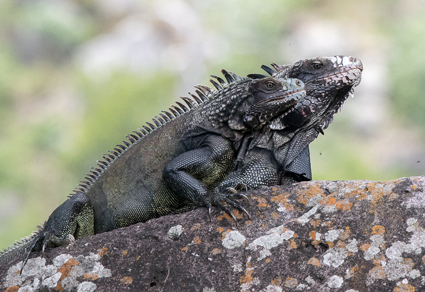

Abstract
Among Iguaninae species, Iguana iguana (Linnaeus) has the largest geographic range, spanning most of the Neotropical mainland and numerous islands including several in the Lesser Antilles. Genetic data indicated the presence of cryptic diversity and at least four major, mtDNA clades. However, rather than assessing the taxonomic status of these four major clades, recent taxonomic work has focused more narrowly on populations in the Lesser Antilles nested deeply within one major clade. In one such case, melanistic populations on Saba, Montserrat, and in northern Venezuela have been proposed as Iguana melanoderma Breuil et al. Here we re-evaluate the taxonomic status of I. melanoderma within the broader context of the I. iguana species complex. We generated museomic data from 10 specimens collected as early as 1929 from 10 new localities across northern Venezuela, and two samples from Trinidad, resulting in eight previously unknown ND4 haplotypes. We conducted divergence comparisons and phylogenetic analyses using mtDNA sequences. Our results indicate that the previously reported genetic distinctiveness of I. melanoderma was over-estimated due to limited geographic sampling. Instead, genetic data from northern South America reveal an eroded distinction and shallow divergences among sampled populations of the I. iguana species complex (Clade IV), including the proposed Iguana melanoderma. Numerous sampling gaps remain in this region of northern South America, which hamper taxonomic interpretations of current genetic data. Beyond genetics, the morphological dataset underlying the description of I. melanoderma was geographically limited and lacked data from crucial populations. We argue that, for the present, I. melanoderma should not be recognized but instead should be considered part of I. iguana (Clade IV), and we highlight the importance of broader sampling efforts in future taxonomic research on this species complex as well as the necessity of considering range-wide variation in taxonomic studies of wide-ranging taxa more generally.
References
- Bianchini, G. & Sánchez-Baracaldo, P. (2024) TreeViewer: Flexible, modular software to visualise and manipulate phylogenetic trees. Ecology and Evolution, 14, e10873. https://doi.org/10.1002/ece3.10873
- Bock, B., Malone, C.L., Knapp, C., Aparicio, J., Avila-Pires, T.C.S., Cacciali, P., Caicedo, J.R., Chaves, G., Cisneros-Heredia, D.F., Gutiérrez-Cárdenas, P., Lamar, W., Moravec, J., Perez, P., Porras, L.W., Rivas, G., Scott, N., Solórzano, A. & Sunyer, J. (2022) Iguana iguana (amended version of 2020 assessment). The IUCN Red List of Threatened Species, 2022, e.T174481A218317281. Available from: https://doi.org/10.2305/IUCN.UK.2022-2.RLTS.T174481A218317281.en (accessed 8 April 2024)
- Breuil, M. (2013) Caractérisation morphologique de l’iguane commun Iguana iguana (Linnaeus, 1758), de l’iguane des Petites Antilles Iguana delicatissima Laurenti, 1768 et de leurs hybrides. Bulletin Société Herpétologique de France, 147, 309–346.
- Breuil, M. (2016) Morphological characterization of the common iguana Iguana iguana (Linnaeus, 1758), of the Lesser Antillean iguana Iguana delicatissima Laurenti, 1768 and of their hybrids. International Reptile Conservation Foundation, Tucson, Arizona, 37 pp. [English translation of Breuil (2013)]
- Breuil, M., Schikorski, D., Vuillaume, B., Krauss, U., Morton, M.N., Corry, E., Bech, N., Jelić, M. & Grandjean, F. (2020) Painted black: Iguana melanoderma (Reptilia, Squamata, Iguanidae) a new melanistic endemic species from Saba and Montserrat islands (Lesser Antilles). ZooKeys, 926, 95–131. https://doi.org/10.3897/zookeys.926.48679
- Breuil, M., Vuillaume, B., Schikorski, D., Krauss, U., Morton, M.N., Haynes, P., Daltry, J.C., Corry, E., Gaymes, G., Gaymes, J. & Bech, N. (2019) A story of nasal horns: two new subspecies of Iguana Laurenti, 1768 (Squamata, Iguanidae) in Saint Lucia, St Vincent & the Grenadines, and Grenada (southern Lesser Antilles). Zootaxa, 4608 (2), 203–232. https://doi.org/10.11646/zootaxa.4608.2.1
- Campos, P.F. & Gilbert, T.M. (2012) DNA extraction from formalin-fixed material. In: Shapiro, B. & Hofreiter, M. (Eds.), Ancient DNA: methods and protocols. Humana Press, Totowa, New Jersey, pp. 81–85. https://doi.org/10.1007/978-1-61779-516-9_11
- Clusella-Trullas, S., Terblanche, J.S., Blackburn, T.M. & Chown, S.L. (2008) Testing the thermal melanism hypothesis: a macrophysiological approach. Functional Ecology, 22, 232–238. https://doi.org/10.1111/j.1365-2435.2007.01377.x
- De Jesús Villanueva, C.N., Falcón, W., Velez-Zuazo, X., Papa, R. & Malone, C.L. (2021) Origin of the green iguana (Iguana iguana) invasion in the greater Caribbean Region and Fiji. Biological Invasions, 23, 2591–2610. https://doi.org/10.1007/s10530-021-02524-5
- Dunn, E.R. (1934) Notes on Iguana. Copeia, 1934 (1), 1–4. https://doi.org/10.2307/1436422
- Edler, D., Klein, J., Antonelli, A. & Silvestro, D. (2021) raxmlGUI 2.0: A graphical interface and toolkit for phylogenetic analyses using RAxML. Methods in Ecology and Evolution, 12 (2), 373–377. https://doi.org/10.1111/2041-210X.13512
- Giovas, C.M. (2019) The beasts at large–perennial questions and new paradigms for Caribbean translocation research. Part I: ethnozoogeography of mammals. Environmental Archaeology, 24 (2), 182–198. https://doi.org/10.1080/14614103.2017.1315208
- Hahn, E.E., Alexander, M.R., Grealy, A., Stiller, J., Gardiner, D.M. & Holleley, C.E. (2022) Unlocking inaccessible historical genomes preserved in formalin. Molecular Ecology Resources, 22 (6), 2130–2147. https://doi.org/10.1111/1755-0998.13505
- Hijmans, R.J., Cameron, S.E., Parra, J.L., Jones, P.G. & Jarvis, A. (2005) Very high resolution interpolated climate surfaces for global land areas. International Journal of Climatology, 25, 1965–1978. https://doi.org/10.1002/joc.1276
- Hummelinck, P.W. (1940) n.k. In: Studies on the Fauna of Curaçao, Aruba, Bonaire and the Venezuelan Islands. N.V. Drukkerij P. den Boer, Utrecht, pp. 59–108.
- IWTG (2016) A checklist of the iguanas of the world (Iguanidae; Iguaninae). In: Iverson, J.B., Grant, T.D., Knapp, C.R. & Pasachnik, S.A. (Eds.), Iguanas: Biology, Systematics, and 255 Conservation. University of California Press, Berkeley, California, pp. 4–46.
- Iguana Taxonomy Working Group, Buckley, L.J., de Queiroz, K., Grant, T.D., Hollingsworth, B.D., Malone, C.L., Pasachnik, S.A., Reynolds, R.G. & Zarza, E. (2022) A checklist of the iguanas of the world (Iguanidae; Iguaninae) 2022 supplement to: 2016. Herpetological Conservation and Biology, 11, 4–46 and 2019 Supplement. [https://www.iucn-isg.org/wp-content/uploads/2022/05/ITWG_Checklist_2022_Supplement.pdf]
- Janke, A., Erpenbeck, D., Nilsson, M. & Arnason, U. (2001) The mitochondrial genomes of the iguana (Iguana iguana) and the caiman (Caiman crocodylus): implications for amniote phylogeny. Proceedings of the Royal Society of London. Series B: Biological Sciences, 268 (1467), 623–631. https://doi.org/10.1098/rspb.2000.1402
- Jaramillo, A.F., De La Riva, I., Guayasamin, J.M., Chaparro, J.C., Gagliardi-Urrutia, G., Gutiérrez, R.C., Brcko, I., Vilà, C. & Castroviejo-Fisher, S. (2020) Vastly underestimated species richness of Amazonian salamanders (Plethodontidae: Bolitoglossa) and implications about plethodontid diversification. Molecular Phylogenetics and Evolution, 149, 106841. https://doi.org/10.1016/j.ympev.2020.106841
- Kearse, M., Moir, R., Wilson, A., Stones-Havas, S., Cheung, M., Sturrock, S., Buxton, S., Cooper, A., Markowitz, S., Duran, C., et al. (2012) Geneious Basic: an integrated and extendable desktop software platform for the organization and analysis of sequence data. Bioinformatics, 28 (12), 1647–1649. https://doi.org/10.1093/bioinformatics/bts199
- Lazell, J.D. (1973) The Lizard Genus Iguana in the Lesser Antilles. Bulletin of the Museum of Comparative Zoology, 145, 1–28.
- Lewis, T.H. (1949) Dark coloration in the reptiles of the Tularosa Malpais, New Mexico. Copeia, 1949 (3), 181–184. https://doi.org/10.2307/1438984
- Malone, C.L. & Davis, S.K. (2004) Genetic contributions to Caribbean iguana conservation. In: Alberts, A.C., Carter, R.L., Hayes W.K. & Martins E.P. (Eds.), Iguanas: Biology and Conservation. University of California Press, Berkeley, California, pp. 45–57. https://doi.org/10.1525/california/9780520238541.003.0004
- Martin, J.L., Knapp, C.R., Gerber, G.P., Thorpe, R.S. & Welch, M.E. (2015) Phylogeography of the endangered Lesser Antillean iguana, Iguana delicatissima: a recent diaspora in an archipelago known for ancient herpetological endemism. Journal of Heredity, 106 (3), 315–321. https://doi.org/10.1093/jhered/esv004
- Micheletti, S., Parra, E. & Routman, E.J. (2012) Adaptive color polymorphism and unusually high local genetic diversity in the side-blotched lizard, Uta stansburiana. PLoS ONE, 7 (10), e47694. https://doi.org/10.1371/journal.pone.0047694
- Nakahara, S., Zacca, T., Huertas, B., Neild, A.F., Hall, J.P., Lamas, G., Holian, L.A., Espeland, M. & Willmott, K.R. (2018) Remarkable sexual dimorphism, rarity and cryptic species: a revision of the ‘aegrota species group’ of the Neotropical butterfly genus Caeruleuptychia Forster, 1964 with the description of three new species (Lepidoptera, Nymphalidae, Satyrinae). Insect Systematics & Evolution, 49 (2), 130–182. https://doi.org/10.1163/1876312X-00002167
- de Queiroz, K. (1995) Checklist and key to the extant species of Mexican iguanas (Reptilia: Iguaninae). Publicaciones Especiales del Museu de Zoología, 9, 1–48.
- Rosenblum, E.B., Hickerson, M.J. & Moritz, C. (2007) A multilocus perspective on colonization accompanied by selection and gene flow. Evolution, 61, 2971–2985. https://doi.org/10.1111/j.1558-5646.2007.00251.x
- Stamatakis, A. (2014) Raxml version 8: a tool for phylogenetic analysis and post-analysis of large phylogenies. Bioinformatics, 30, 1312–1313. https://doi.org/10.1093/bioinformatics/btu033
- Stephen, C.L., Reynoso, V.H., Collett, W.S., Hasbun, C.R. & Breinholt, J.W. (2013) Geographical structure and cryptic lineages within common green iguanas, Iguana iguana. Journal of Biogeography, 40 (1), 50–62. https://doi.org/10.1111/j.1365-2699.2012.02780.x
- Sullivan, J., Abdo, Z., Joyce, P. & Swofford, D.L. (2005) Evaluating the performance of a successive-approximations approach to parameter optimization in maximum-likelihood phylogeny estimation. Molecular Biology and Evolution, 22 (6), 1386–1392. https://doi.org/10.1093/molbev/msi129
- Swofford, D.L. (2003) PAUP*. Phylogenetic Analysis Using Parsimony (*and Other Methods). Sinauer Associates, Sunderland, Massachusetts. [program]
- Tamura, K. & Nei, M. (1993) Estimation of the number of nucleotide substitutions in the control region of mitochondrial DNA in humans and chimpanzees. Molecular Biology and Evolution, 10 (3), 512–526.
- van Buchem, R., van den Burg, M.P. & Meirmans, P.G. (2025) iNaturalist Observations Indicate Piebaldism in Iguana iguana Could be a Regional Color Morph: Response to López and Mora (2025). Caribbean Journal of Science, 55 (2), 592–597. https://doi.org/10.18475/cjos.v55i2.a28
- van den Burg, M.P., Grandjean, F., Schikorski, D., Breuil, M. & Malone, C.L. (2021) A genus-wide analysis of genetic variation to guide population management, hybrid identification, and monitoring of invasions and illegal trade in Iguana (Reptilia: Iguanidae). Conservation Genetics Resources, 13 (4), 435–445. https://doi.org/10.1007/s12686-021-01216-5
- van den Burg, M.P., Ramón-Laca, A., Carné Constans, A., Debrot, A.O. & Vieites, D.R. (2023a) The complete mitochondrial genome of the Critically Endangered Saba Green Iguana, Iguana iguana (Squamata: Iguanidae). Mitochondrial DNA, Part B, 8 (4), 475–478. https://doi.org/10.1080/23802359.2023.2195510
- van den Burg, M.P., Goetz, M., Brannon, L., Weekes, T.S., Ryan, K.V. & Debrot, A.O. (2023b) An integrative approach to assess non-native iguana presence on Saba and Montserrat: are we losing all native Iguana populations in the Lesser Antilles? Animal Conservation, 26 (2023), 813–825. https://doi.org/10.1111/acv.12869
- van den Burg, M.P., van der Horn, S.A., Ahlen, P.A., Jansen, L., Wulf, K. & Debrot, A.O. (2025a) Larger hybrid clutch size could drive regional displacement of native Iguana populations across the Lesser Antilles. bioRxiv, July 2025, 1–19. https://doi.org/10.1101/2025.07.31.667849
- van den Burg, M.P., Madden, H. & Debrot, A.O. (2025b) Population estimate and conservation of the melanistic Iguana iguana population on Saba, Caribbean Netherlands. Herpetological Journal, 35 (3), 176–186. https://doi.org/10.33256/35.3.176186
- Wüster, W. (2025) Shedding the mitochondrial blinkers: A long-overdue challenge for species delimitation in herpetology. Vertebrate Zoology, 75, 259–275. https://doi.org/10.3897/vz.75.e161536