

Abstract
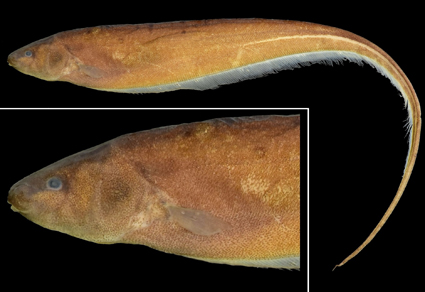
A new species of longtail electric knifefish, Sternopygus embera sp. nov., is described from the trans-Andean Río Baudó and Río San Juan basins of the Pacific coast of northwestern Colombia. The new species is diagnosed from all congeners by a unique combination of characters, including the complete lack of a humeral spot, morphology of the Weberian apparatus, lack of pigment bars or saddles, possession of endopterygoid teeth, vertically-oriented ascending endopterygoid process, a short snout, convex dorsal margin of neurocranium in adults, and 22–23 precaudal vertebrae. Despite sharing more external morphological similarities with species of the S. macrurus complex, the new species is phylogenetically nested within the larger-bodied and longer-snouted trans-Andean S. aequilabiatus species group, based on phylogenetic analysis of the mitochondrial barcode gene. Alternative hypotheses for these contrasting results, including mitochondrial introgression, incomplete lineage sorting, and paedomorphosis, are discussed. The description of this species is a step towards deconstructing the S. macrurus complex ahead of a future systematic revision.
References
- Abell, R., Thieme, M.L., Revenga, C., Bryer, M., Kottelat, M., Bogutskaya, N., Coad, B., Mandrak, N., Conteras Balderas, S., Bussing, W., Stiassny, M.L.J., Skelton, P., Allen, G.R., Unmack, P., Naseka, A., Ng, R., Sindorf, N., Robertson, J., Armijo, E., Higgins, J.V., Heibel, T.J., Wikramanayake, E., Olson, D., López, H.L. Reis, R.E. Lundberg, J.G., Sabaj Pérez, M.H. & Petry, P. (2008) Freshwater ecoregions of the world: a new map of biogeographic units for freshwater biodiversity conservation. BioScience, 58 (5), 403–414. https://doi.org/10.1641/B580507
- Adriaens, D. & Verraes, W. (1998) Ontogeny of the osteocranium in the African catfish, Clarias gariepinus Burchell (1822) (Siluriformes: Clariidae): ossification sequence as a response to functional demands. Journal of Morphology, 235 (3), 183–237. https://doi.org/10.1002/(SICI)1097-4687(199803)235:3<183::AID-JMOR2>3.0.CO;2-8
- Albert, J.S. (2001) Species diversity and phylogenetic systematics of American knifefishes (Gymnotiformes, Teleostei). Miscellaneous Publications, Museum of Zoology, University of Michigan, 190, 1–127.
- Albert, J.S. & Crampton, W.G.R. (2005) Electroreception and electrogenesis. In: Evans, D.H. & Claiborne, J.B. (Eds.), The physiology of fishes. 3rd Edition. CRC Press, New York, New York, pp. 431–472.
- Albert, J.S. & Fink, W.L. (1996) Sternopygus xingu, a new species of electric fish from Brazil (Teleostei: Gymnotoidei), with comments on the phylogenetic position of Sternopygus. Copeia, (1), 85–102. https://doi.org/10.2307/1446944
- Albert, J.S., Lovejoy, N.R. & Crampton, W.G.R. (2006) Miocene tectonism and the separation of cis-and trans-Andean river basins: Evidence from Neotropical fishes. Journal of South American Earth Sciences, 21 (1–2), 14–27. https://doi.org/10.1016/j.jsames.2005.07.010
- Albert, J.S., Petry, P. & Reis, R.E. (2011) Major biogeographic and phylogenetic patterns. In: Albert, J.S. & Reis, R.E. (Eds.), Historical Biogeography of Neotropical Freshwater Fishes. University of California Press, Berkeley, California, pp. 20–57. [https://www.jstor.org/stable/10.1525/j.ctt1pp29c.6]
- https://doi.org/10.1525/california/9780520268685.003.0002
- Albert, J.S., Val, P. & Hoorn, C. (2018) The changing course of the Amazon River in the Neogene: center stage for Neotropical diversification. Neotropical Ichthyology, 16 (3), e180033. https://doi.org/10.1590/1982-0224-20180033
- Almeida, J.S., Migues, V.H., Diniz, D. & Affonso, P.R.A. (2015) A unique sex chromosome system in the knifefish Gymnotus bahianus with inferences about chromosomal evolution of Gymnotidae. Journal of Heredity, 106 (2), 177–183. https://doi.org/10.1093/jhered/esu087
- Almeida-Toledo, L.F., Foresti, F., Daniel, M.Z. & Toledo-Filho, S.A. (1993) Nucleolar chromosome variants in Sternopygus macrurus (Pisces, Sternopygidae) from three Brazilian river basins. Caryologia, 46 (1), 53–61. https://doi.org/10.1080/00087114.1993.10797246
- Anderson, E.P. & Maldonado-Ocampo, J.A. (2011) A regional perspective on the diversity and conservation of tropical Andean fishes. Conservation Biology, 25 (1), 30–39. https://doi.org/10.1111/j.1523-1739.2010.01568.x
- Arratia, G. (2013) Morphology, taxonomy, and phylogeny of Triassic pholidophorid fishes (Actinopterygii, Teleostei). Journal of Vertebrate Paleontology, 33 (Supplement), 1–138. https://doi.org/10.1080/02724634.2013.835642
- Artaxo, P., de Campos, R.C., Fernandes E.T., Martins, J.V., Xiao, Z., Lindqvist, O., Fernández-Jiménez, M.T. & Maenhaut, W. (2000) Large scale mercury and trace element measurements in the Amazon basin. Atmospheric Environment, 34 (24), 4085–4096 https://doi.org/10.1016/S1352-2310(00)00106-0
- Ballen, G.A., Jaramillo, C., Dagosta, F.C. & De Pinna, M.C. (2022) A fossil fish assemblage from the middle Miocene of the Cocinetas Basin, northern Colombia. Papers in Palaeontology, 8 (1), e1405. https://doi.org/10.1002/spp2.1405
- Bastian, J. (1981) Electrolocation: I. How the electroreceptors of Apteronotus albifrons code for moving objects and other electrical stimuli. Journal of comparative physiology, 144, 465–479. https://doi.org/10.1007/BF01326832
- Bloch, M.E. & Schneider, J.G. (1801) Systema Ichthyologiae Iconibus ex Illustratum. Sumtibus auctoris impressum et Bibliopolio Sanderiano commissum, Berolini, 584 pp.
- Bossu, C.M. & Near, T.J. (2009) Gene trees reveal repeated instances of mitochondrial DNA introgression in orangethroat darters (Percidae: Etheostoma). Systematic Biology, 58 (1), 114–129. https://doi.org/10.1093/sysbio/syp014
- Chakona, A., Kadye, W.T., Bere, T., Mazungula, D.N. & Vreven, E. (2018) Evidence of hidden diversity and taxonomic conflicts in five stream fishes from the Eastern Zimbabwe Highlands freshwater ecoregion. ZooKeys, 768, 69–95. https://doi.org/10.3897/zookeys.768.21944
- Chapman, F.A., Fitz-Coy, S., Thunberg, E., Rodrick, J.T., Adams, C.M. & Andre, M. (1994) An analysis of the United States of America international trade in ornamental fish. University of Florida, Gainesville, Florida, 58 pp.
- Crampton, W.G.R., Hulen, K.G. & Albert, J.S. (2004a) Redescription of Sternopygus obtusirostris (Gymnotiformes: Sternopygidae) from the Amazon basin, with description of osteology, ecology and electric organ discharges. Ichthyological Exploration of Freshwaters, 15 (2), 121–134.
- https://doi.org/10.1643/CI-03-105R1
- Crampton, W.G.R, Hulen, K.G. & Albert, J.S. (2004b) Sternopygus branco: a new species of Neotropical electric fish (Gymnotiformes: Sternopygidae) from the lowland Amazon basin, with descriptions of osteology, ecology, and electric organ discharges. Copeia, 2004 (2), 245–259. https://doi.org/10.1643/CI-03-105R1
- Crampton, W.G.R. (2019) Electroreception, electrogenesis and electric signal evolution. Journal of Fish Biology, 95 (1), 92–134. https://doi.org/10.1111/jfb.13922
- Dagosta, F.C. & de Pinna, M.C. (2019) The fishes of the Amazon: Distribution and biogeographical patterns, with a comprehensive list of species. Bulletin of the American Museum of Natural History, 431 (1), 1–163. https://doi.org/10.1206/0003-0090.431.1.1
- Díaz-Merlano, J.M. & Gast-Harders, F. (2009) El Chocó Biogeográfico de Colombia. Banco de Occidente Credencial, Cali, 205 pp.
- DoNascimiento, C., Herrera-Collazos, E.E., Herrera-R, G.A., Ortega-Lara, A., Villa-Navarro, F.A., Oviedo, J.S.U. & Maldonado-Ocampo, J.A. (2017) Checklist of the freshwater fishes of Colombia: a Darwin Core alternative to the updating problem. ZooKeys, 708, 25. https://doi.org/10.3897/zookeys.708.13897
- Dutra, G.M., Peixoto, L.A.W., Abrahão, V.P., Wosiacki, W.B., Menezes, N.A. & de Santana, C.D. (2021) Morphology‐based phylogeny of Eigenmanniinae Mago‐Leccia, 1978 (Teleostei: Gymnotiformes: Sternopygidae), with a new classification. Journal of Zoological Systematics and Evolutionary Research, 59 (8), 2010–2059. https://doi.org/10.1111/jzs.12535
- Eaton, D.A. & Ree, R.H. (2013) Inferring phylogeny and introgression using RADseq data: an example from flowering plants (Pedicularis: Orobanchaceae). Systematic Biology, 62 (5), 689–706. https://doi.org/10.1093/sysbio/syt032
- Escobar-Camacho, D., Barragán, K.S., Guayasamin, J.M., Gavilanes, G. & Encalada, A.C. (2024) New records of native and introduced fish species in a river basin of Western Ecuador, the Chocó-Darien Ecoregion, using DNA barcoding. PLoS One, 19 (3), e0298970. https://doi.org/10.1371/journal.pone.0298970
- Evans, K.M., Waltz, B.T., Tagliacollo, V., Chakrabarty, P. & Albert, J.S. (2017) Why the short face? Developmental disintegration of the neurocranium drives convergent evolution in neotropical electric fishes. Ecology and Evolution, 7 (6), 1783–1801. https://doi.org/10.1002/ece3.2704
- Evans, K.M., Bernt, M.J., Kolmann, M.A., Ford, K.L. & Albert, J.S. (2019) Why the long face? Static allometry in the sexually dimorphic phenotypes of Neotropical electric fishes. Zoological Journal of the Linnean Society, 186 (3), 633–649. https://doi.org/10.1093/zoolinnean/zly076
- Faircloth, B.C., McCormack, J.E., Crawford, N.G., Harvey, M.G., Brumfield, R.T. & Glenn, T.C. (2012) Ultraconserved elements anchor thousands of genetic markers spanning multiple evolutionary timescales. Systematic Biology, 61 (5), 717–726. https://doi.org/10.1093/sysbio/sys004
- Fedorov, A., Beichel, R., Kalpathy-Cramer, J., Finet, J., Fillion-Robin, J.C., Pujol, S., Bauer, C., Jennings, D., Fennessy, F., Sonka, M., Buatti, J., Aylward, S., Miller, J.V., Pieper, S. & Kikinis, R. (2012) 3D Slicer as an image computing platform for the Quantitative Imaging Network. Magnetic resonance imaging, 30 (9), 1323–1341. https://doi.org/10.1016/j.mri.2012.05.001
- Ferraris Jr, C.J., de Santana, C.D. & Vari, R.P. (2017) Checklist of Gymnotiformes (Osteichthyes: Ostariophysi) and catalogue of primary types. Neotropical Ichthyology, 15, e160067. https://doi.org/10.1590/1982-0224-20160067
- Fink, S. V. & Fink, W. L. (1981) Interrelationships of the ostariophysan fishes (Teleostei). Zoological Journal of the Linnean Society, 72 (4), 297–353. https://doi.org/10.1111/j.1096-3642.1981.tb01575.x
- Funk, D.J. & Omland, K.E. (2003) Species-level paraphyly and polyphyly: frequency, causes, and consequences, with insights from animal mitochondrial DNA. Annual Review of Ecology, Evolution, and Systematics, 34 (1), 397–423. https://doi.org/10.1146/annurev.ecolsys.34.011802.132421
- Galindo-Cuervo, A.M. (2024) Revisão taxonômica de Sternopygus (Gymnotiformes: Sternopygidae). PhD Dissertation, Pontifica Universidade Católica do Rio Grande do Sul, Porto Alegre, 199 pp.
- Gentry, A.H. (1986) Species richness and floristic composition of Chocó region plant communities. Caldasia, 1986, 71–91.
- Hawkins, O.H., Ortega-Jiménez, V.M. & Sanford, C. P. (2022) Knifefish turning control and hydrodynamics during forward swimming. Journal of Experimental Biology, 225 (7), jeb243498. https://doi.org/10.1242/jeb.243498
- Heiligenberg, W. (1991) Neural nets in electric fish. MIT Press, Cambridge, MS, 198 pp.
- Hoorn, C., Wesselingh, F.P., Ter Steege, H., Bermudez, M.A., Mora, A., Sevink, J., Sanmartín, I., Sanchez-Meseguer, A., Anderson, C.L., Figueiredo, J.P., Jaramillo, C., Riff, D., Negri, F.R., Hooghiemstra, H., Lundberg, J.G., Stadler, T., Särkinen, T. & Antonelli, A. (2010) Amazonia through time: Andean uplift, climate change, landscape evolution, and biodiversity. Science, 330 (6006), 927–931. https://doi.org/10.1126/science.1194585
- Hulen, K.G., Crampton, W.G.R. & Albert, J.S. (2005) Phylogenetic systematics and historical biogeography of the Neotropical electric fish Sternopygus (Teleostei: Gymnotiformes). Systematics and Biodiversity, 3 (4), 407–432. https://doi.org/10.1017/S1477200005001726
- Jiménez-Prado, P., Aguirre, W., Laaz-Moncayo, E., Navarrete-Amaya, R., Nugra-Salazar, F., Monsalve-Rebolledo, E., Zárate-Hugo, E., Torres-Noboa, A. & Valdiviezo-Rivera, J. (2015) Guía de peces para las aguas continentales en la vertiente occidental del Ecuador. Pontificia Universidad Católica del Ecuador Sede Esmeraldas (PUCESE); Universidad del Azuay (UDA) y Museo Ecuatoriano de Ciencias Naturales (MECN) del Instituto Nacional de Biodiversidad, Esmeraldas, 416 pp.
- Karrer, C., Whitehead, P.J. & Paepke, H.J. (1994) Bloch & Schneider, Systema Ichthyologiae, 1801: History and Authorship of Fish Names. Bloch & Schneiders Systema Ichthyologiae, 1801: Geschichte und Autorschaft der Fischnamen. Mitteilungen aus dem Museum für Naturkunde in Berlin. Zoologisches Museum und Institut für Spezielle Zoologie, Berlin, 70 (1), 99–111. https://doi.org/10.1002/mmnz.19940700105
- Lannoo, M.J. & Lannoo, S.J. (1993) Why do electric fishes swim backwards? An hypothesis based on gymnotiform foraging behavior interpreted through sensory constraints. Environmental Biology of Fishes, 36, 157–165. https://doi.org/10.1007/BF00002795
- Losos, J.B. (2011) Convergence, adaptation, and constraint. Evolution, 65 (7), 1827–1840. https://doi.org/10.1111/j.1558-5646.2011.01289.x
- Lovejoy, N.R., Albert, J.S. & Crampton, W.G.R. (2006) Miocene marine incursions and marine/freshwater transitions: Evidence from Neotropical fishes. Journal of South American Earth Sciences, 21 (1–2), 5–13. https://doi.org/10.1016/j.jsames.2005.07.009
- Lundberg, J.G. & Mago-Leccia, F. (1986) A review of Rhabdolichops (Gymnotiformes, Sternopygidae), a genus of South American freshwater fishes, with descriptions of four new species. Proceedings of the Academy of Natural Sciences of Philadelphia, 138 (1), 53–85. https://doi.org/10.5962/p.208178
- Lundberg, J.G., Lewis Jr, W.M., Saunders III, J.F. & Mago-Leccia, F. (1987) A major food web component in the Orinoco River channel: evidence from planktivorous electric fishes. Science, 237 (4810), 81–83.
- https://doi.org/10.1126/science.237.4810.81
- Lundberg, J.G., Marshall, L.G., Guerrero, J., Horton, B., Malabarba, M.C.S.L. & Wesselingh, F. (1998) The stage for neotropical fish diversification: a history of tropical South American rivers. In: Malabarba, L.R., Reis, R.E., Vari, R.P., Lucena, Z.M. & Lucena, C.A.S. (Eds.), Phylogeny and classification of Neotropical fishes. Edipucrs, Porto Alegre, pp. 13–68.
- Maddison, W.P. (1997) Gene trees in species trees. Systematic Biology, 46 (3), 523–536. https://doi.org/10.1093/sysbio/46.3.523
- Mago-Leccia, F. (1978) Los peces de la familia Sternopygidae de Venezuela. Acta Científica Venezolana, 29 (1), 1–89.
- Mago-Leccia, F. (1994) Electric fishes of the continental waters of America. Biblioteca de la Academia de Ciencias Fisicas, Matematicas, y Naturales, Caracas, Venezuela, 206 pp.
- Maldonado-Ocampo, J.A., Vari, R.P. & Usma, J.S. (2008) Checklist of the freshwater fishes of Colombia. Biota Colombiana, 9 (2), 143–237.
- Maldonado-Ocampo, J.A. (2011) Filogenia molecular da família Sternopygidae (Gymnotiformes: Sternopygoidei). PhD Dissertation, Universidade Federal do Rio De Janeiro, Rio de Janeiro, 112 pp.
- Maldonado-Ocampo, J. A., Usma-Oviedo, J. S., Villa-Navarro, F. A., Ortega-Lara, A., Prederos, P., Jiménez, L. F., Jaramillo Villa, Ú., Arango, A., Rivas, T.S. & Sánchez Garcés, G.C. (2012). Peces dulceacuícolas del Chocó biogeográfico de Colombia. WWF Colombia, Bogotá, 400 pp.
- Maulana, F., Soelistyowati, D.T. & Furqon, M.F. (2021) Spawning of Black Ghost Knifefish, Apteronotus albifrons with different sex ratios. Indonesian Aquaculture Journal, 16 (1), 29–34. https://doi.org/10.15578/iaj.16.1.2021.29-34
- Maurice-Bourgoin, L., Quiroga, I., Chincheros, J. & Courau, P. (2000) Mercury distribution in waters and fishes of the upper Madeira rivers and mercury exposure in riparian Amazonian populations. Science of the Total Environment, 260 (1–3), 73–86. https://doi.org/10.1016/S0048-9697(00)00542-8
- Montes, C., Cardona, A., Jaramillo, C., Pardo, A., Silva, J. C., Valencia, V., Ayala, C., Pérez-Angel, L.C., Rodriguez-Parra, L.A. & Niño, H. (2015) Middle Miocene closure of the Central American seaway. Science, 348 (6231), 226–229. https://doi.org/10.1126/science.aaa2815
- Montes, C., Silva, C.A., Bayona, G.A., Villamil, R., Stiles, E., Rodriguez-Corcho, A.F., Beltran-Triviño, A., Lamus, F., Muñoz-Granados, M.D., Pérez-Angel, L.C., Hoyos, N., Gomez, S., Galeano, J.J., Romero, E., Baquero, M., Cardenas-Rozo, A.L. & von Quadt, A. (2021) A middle to late Miocene trans-Andean portal: Geologic record in the Tatacoa Desert. Frontiers in Earth Science, 8, 587022. https://doi.org/10.3389/feart.2020.587022
- Moreira, C.M., Crampton, W.G.R., de Andrade Affonso, P.H., Martins, C. & Cardoso, A. L. (2025) Genomic landscape of repetitive DNAs in Neotropical electric fishes. Molecular Genetics and Genomics, 300 (1), 1–11. https://doi.org/10.1007/s00438-025-02248-4
- Musilová, Z., Říčan, O. & Novák, J. (2009) Phylogeny of the Neotropical cichlid fish tribe Cichlasomatini (Teleostei: Cichlidae) based on morphological and molecular data, with the description of a new genus. Journal of Zoological Systematics and Evolutionary Research, 47 (3), 234–247. https://doi.org/10.1111/j.1439-0469.2009.00528.x
- Myers, N., Mittermeier, R.A., Mittermeier, C.G., Da Fonseca, G.A. & Kent, J. (2000) Biodiversity hotspots for conservation priorities. Nature, 403 (6772), 853–858. https://doi.org/10.1038/35002501
- Nelson, M.E. & Maciver, M.A. (1999) Prey capture in the weakly electric fish Apteronotus albifrons: sensory acquisition strategies and electrosensory consequences. Journal of Experimental Biology, 202 (10), 1195–1203. https://doi.org/10.1242/jeb.202.10.1195
- Palacios-Torres, Y., Caballero-Gallardo, K. & Olivero-Verbel, J. (2018) Mercury pollution by gold mining in a global biodiversity hotspot, the Chocó biogeographic region, Colombia. Chemosphere, 193, 421–430. https://doi.org/10.1016/j.chemosphere.2017.10.160
- Peixoto, L.A.W. & de Pinna, M. (2022) Patterns of diversification and phylogenetic structure in the dorsolateral head musculature of Neotropical electric eels (Ostariophysi: Gymnotiformes), with a myological synonymy. Neotropical Ichthyology, 20, e210009. https://doi.org/10.1590/1982-0224-2021-0009
- Ruiz-Torres, R., Curet, O.M., Lauder, G.V. & MacIver, M.A. (2013) Kinematics of the ribbon fin in hovering and swimming of the electric ghost knifefish. Journal of Experimental Biology, 216 (5), 823–834.
- https://doi.org/10.1242/jeb.076471
- Sabaj, M.H. (2020) Codes for natural history collections in ichthyology and herpetology. Copeia, 108 (3), 593–669. https://doi.org/10.1643/ASIHCODONS2020
- Salazar-Camacho, C., Salas-Moreno, M., Marrugo-Madrid, S., Marrugo-Negrete, J. & Díez, S. (2017) Dietary human exposure to mercury in two artisanal small-scale gold mining communities of northwestern Colombia. Environment International, 107, 47–54. https://doi.org/10.1016/j.envint.2017.06.011
- Salazar-Camacho, C., Salas-Moreno, M., Paternina-Uribe, R., Marrugo-Negrete, J. & Díez, S. (2021) Mercury species in fish from a tropical river highly impacted by gold mining at the Colombian Pacific region. Chemosphere, 264, 128478. https://doi.org/10.1016/j.chemosphere.2020.128478
- Salazar-Camacho, C., Salas-Moreno, M., Marrugo-Madrid, S., Paternina-Uribe, R., Marrugo-Negrete, J. & Díez, S. (2022) A human health risk assessment of methylmercury, arsenic and metals in a tropical river basin impacted by gold mining in the Colombian Pacific region. Environmental Research, 212 (B), 113120. https://doi.org/10.1016/j.envres.2022.113120
- Salles, M.M., Carvalho, A.L., Leaché, A.D., Martinez, N., Bauer, F., Motte, M., Espíndola, V., Rodrigues, M.T., Piantoni, C., Pie, M.R., Olivotta, A., Colli, G.R., Choueri, E.L., Werneck, F.P. & Domingos, F.M.C.B. (2025) Ancient introgression explains mitochondrial genome capture and mitonuclear discordance among South American collared Tropidurus lizards. Molecular Ecology, 34 (21), e70130. https://doi.org/10.1111/mec.70130
- Shirgaonkar, A.A., Curet, O.M., Patankar, N.A. & MacIver, M.A. (2008) The hydrodynamics of ribbon-fin propulsion during impulsive motion. Journal of Experimental Biology, 211 (21), 3490–3503. https://doi.org/10.1242/jeb.019224
- Silva, D.S., Milhomem, S.S.R., de Souza, A.C.P., Pieczarka, J.C. & Nagamachi, C.Y. (2008) A conserved karyotype of Sternopygus macrurus (Sternopygidae, Gymnotiformes) in the Amazon region: differences from other hydrographic basins suggest cryptic speciation. Micron, 39 (8), 1251–1254. https://doi.org/10.1016/j.micron.2008.04.001
- Sloan, D.B., Havird, J.C. & Sharbrough, J. (2017) The on‐again, off‐again relationship between mitochondrial genomes and species boundaries. Molecular Ecology, 26 (8), 2212–2236. https://doi.org/10.1111/mec.13959
- Smith, C.L. (1975) The evolution of hermaphroditism in fishes. In: Reinboth, R. (Ed.), Intersexuality in the animal kingdom. Springer Berlin Heidelberg, Berlin and Heidelberg, pp. 295–310.
- https://doi.org/10.1007/978-3-642-66069-6_28
- Smith, G.T., Proffitt, M.R., Smith, A.R. & Rusch, D.B. (2018) Genes linked to species diversity in a sexually dimorphic communication signal in electric fish. Journal of Comparative Physiology A, 204 (1), 93–112. https://doi.org/10.1007/s00359-017-1223-3
- Tagliacollo, V.A., Bernt, M.J., Craig, J.M., Oliveira, C. & Albert, J.S. (2016) Model-based total evidence phylogeny of Neotropical electric knifefishes (Teleostei, Gymnotiformes). Molecular Phylogenetics and Evolution, 95, 20–33. https://doi.org/10.1016/j.ympev.2015.11.007
- Taylor, S.A. & Larson, E.L. (2019) Insights from genomes into the evolutionary importance and prevalence of hybridization in nature. Nature Ecology & Evolution, 3 (2), 170–177. https://doi.org/10.1038/s41559-018-0777-y
- Toews, D.P. & Brelsford, A. (2012) The biogeography of mitochondrial and nuclear discordance in animals. Molecular Ecology, 21 (16), 3907–3930. https://doi.org/10.1111/j.1365-294X.2012.05664.x
- Torgersen, K.T. & Albert, J.S. (2022) A new species of Sternopygus (Gymnotiformes: Sternopygidae) from the Atlantic Coast of the Guiana Shield. Ichthyology & Herpetology, 110 (4), 714–727. https://doi.org/10.1643/i2022013
- Torgersen, K.T., Bogotá-Gregory, J.D., Acosta-Santos, A., Potosí-Chuña, J.J., Agudelo-Cordoba, E. & Albert, J.S. (2023a) Gymnotiform electric fishes of the Tres Fronteras region of the western Amazon. Check List, 19 (5), 767–790. https://doi.org/10.15560/19.5.767
- Torgersen, K.T., Galindo-Cuervo, A.M., Reis, R.E. & Albert, J.S. (2023b) A new species of barred Sternopygus (Gymnotiformes: Sternopygidae) from the Orinoco River. Neotropical Ichthyology, 21 (1), e220088.
- https://doi.org/10.1590/1982-0224-2022-0088
- Torgersen, K.T., Akin, D.R., Figueiredo-Filho, J.M., Hawkins, O.H. & Albert, J.S. (2024) A Dorsally Expressed Anal Fin in the Black Ghost Knifefish Apteronotus albifrons (Gymnotiformes: Apteronotidae). Ichthyology & Herpetology, 112 (4), 645–651. https://doi.org/10.1643/i2024032
- Tribuzy-Neto, I.A., Beltrão, H., Benzaken, Z.S. & Yamamoto, K.C. (2020) Analysis of the ornamental fish exports from the Amazon State, Brazil. Boletim do Instituto de Pesca, 46 (4), 1–14. https://doi.org/10.20950/1678-2305.2020.46.4.554
- Triques, M.L. (2000) Sternopygus castroi, a new species of Neotropical freshwater electric fish, with new synapomorphies to the genus (Sternopygidae: Gymnotiformes: Teleostei). Studies on Neotropical Fauna and Environment, 35 (1), 19–26. https://doi.org/10.1076/0165-0521(200004)35:1;1-M;FT019
- Unguez, G.A. & Zakon, H.H. (1998) Phenotypic conversion of distinct muscle fiber populations to electrocytes in a weakly electric fish. Journal of Comparative Neurology, 399 (1), 20–34. https://doi.org/10.1002/(SICI)1096-9861(19980914)399:1<20::AID-CNE2>3.0.CO;2-C
- Youngerman, E.D., Flammang, B.E. & Lauder, G.V. (2014) Locomotion of free-swimming ghost knifefish: anal fin kinematics during four behaviors. Zoology, 117 (5), 337–348. https://doi.org/10.1016/j.zool.2014.04.004
- Zuluaga‐Gómez, A., Giarrizzo, T., Andrade, M. & Arango‐Rojas, A. (2014) Length–weight relationships of 33 selected fish species from the Cauca River Basin, trans‐Andean region, Colombia. Journal of Applied Ichthyology, 30 (5), 1077–1080. https://doi.org/10.1111/jai.12435