

Abstract
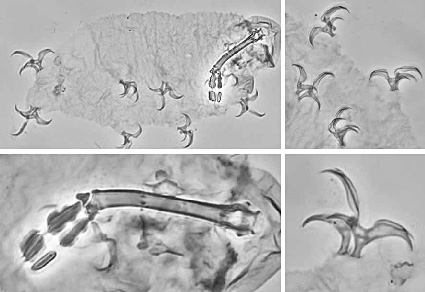
In this paper I present the results of the first faunistic investigation of the Sakhalin freshwater tardigrade fauna with the use of the integrative taxonomy. In samples of bottom sediments collected in several rivers of South Sakhalin, I found eight species representing three of the four parachelan superfamilies. For most of the species, I obtained mitochondrial COI and nuclear ribosomal 18S rRNA, 28 rRNA and ITS-2 nucleotide sequences, as well as morphological data obtained using light contrast and scanning electron microscopy. The number of tardigrade species known for Sakhalin Island increased from 1 to 9. Among the eight species one is similar to Dactylobiotus dervizi, previously known from Komandorskiye Islands, and one—to Murrayon hastatus. The remaining six species, representing the genera Mixibius, Hypsibius, Dianea and Mesobiotus, are new for science, yet their formal description is not possible because of the small number of isolated specimens. Nevertheless, the inclusion of new molecular data in the phylogenetic analysis of the superfamily Hypsibioidea revealed, for the first time, the presence of a well-supported clade of the enigmatic genus Mixibius and allowed for a establishing its phylogenetic position as a sister clade to the genus Acutuncus within the family Acutuncidae. Moreover, a critical analysis of original descriptions of two species of the genus Mixibius, M. parvus and M. tibetanus, resulted in their transfer to the genus Isohypsibius on the basis of claw morphology. In consequence, amended diagnoses of the family Acutuncidae and the genus Acutuncus are given.
References
- Abe, W. (2004) A New Species of the Genus Hypsibius (Tardigrada: Parachela: Hypsibiidae) from Sakhalin Island, Far East Russia. Zoological Science, 21, 957–962. https://doi.org/10.2108/zsj.21.957
- Atherton, S., Hulterström, J., Guidetti, R. & Jönsson, K.I. (2025) Three new species of Mesobiotus (Eutardigrada: Macrobiotidae) from Sweden with an updated phylogeny of the genus. Scientific Reports, 15, 4535. https://doi.org/10.1038/s41598-025-88063-8
- Astrin, J.J. & Stüben, P.E. (2008) Phylogeny in cryptic weevils: molecules, morphology and new genera of western Palaearctic Cryptorhynchinae (Coleoptera: Curculionidae). Invertebrate Systematics, 22, 503–522. https://doi.org/10.1071/IS07057
- Bertolani, R. (2003) Thulinius, new generic name substituting for Thulinia Bertolani, 1981 (Tardigrada, Eutardigrada). Zootaxa, 314 (1), 1–4. https://doi.org/10.11646/zootraxa.314.1.1
- Bertolani, R. & Pilato, G. (1988) Struttura delle unghie nei Macrobiotidae e descrizione di Murrayon n. gen. (Eutardigrada). Animalia, 15, 17–24.
- Bertolani, R., Marley, N. & Nelson, D.R. (1999) Re-description of the genus Thulinia (Eutardigrada, Hypsibiidae) and of Thulinia augusti (Murray, 1907) comb. n. Zoologischer Anzeiger, 238, 139–145.
- Bertolani, R., Rebecchi, L., Giovannini, I. & Cesari, M. (2011) DNA barcoding and integrative taxonomy of Macrobiotus hufelandi C.A.S. Schultze 1834, the first tardigrade species to be described, and some related species. Zootaxa, 2997 (1), 19–36. https://doi.org/10.11646/zootaxa.2997.1.2
- Bertolani, R., Guidetti, R., Marchioro, T., Altiero, T., Rebecchi, L. & Cesari, M. (2014) Phylogeny of Eutardigrada: new molecular data and their morphological support lead to the identification of new evolutionary lineages. Molecular Phylogenetics and Evolution, 76, 110–126. https://doi.org/10.1016/j.ympev.2014.03.006
- Betancur-R, R., Naylor, G.J.P. & Ortí, G. (2014) Conserved Genes, Sampling Error, and Phylogenomic Inference. Systematic Biology, 63, 257–262. https://doi.org/10.1093/sysbio/syt073
- Biserov, V.I. (1992) A new genus and three new species of tardigrades (Tardigrada: Eutardigrada) from the USSR. Bollettino di zoologia, 59, 95–103. https://doi.org/10.1080/11250009209386654
- Biserov, V.I. (1998) The Tardigrada of Komandorskiye Islands, with a description of Dactylobiotus dervizi, sp. nov. (Eutardigrada, Macrobiotidae). Entomologische Mitteilungen aus dem Zoologischen Museum Hamburg, 12 (158), 327–336.
- Biserov, V.I. (1999) A review of the Tardigrada from Novaya Zemlya; with description of three new species and an evaluation of the state of the environment in the region. Zoologischer Anzeiger, 238, 169–182.
- Camarda, D., Pai, C.Y., Kristensen, R.M. & Stec, D. (2025) Integrative description of a new freshwater tardigrade species, Dactylobiotus taiwanensis (Tardigrada: Eutardigrada: Murrayidae), discovered through social media. Zoological Studies, 64, 14. https://doi.org/10.6620/ZS.2025.64-14
- Chen, M.-Y., Liang, D. & Zhang, P. (2015) Selecting question-specific genes to reduce incongruence in phylogenomics: A case study of jawed vertebrate backbone phylogeny. Systematic Biology, 64, 1104–1120. https://doi.org/10.1093/sysbio/syv059
- Dastych, H. (1990) Isohypsibius sattleri (Richters 1902), a valid species (Tardigrada). Senckenbergiana Biologica, 71, 181–189.
- Dastych, H. (1992) Paradiphascon manningi gen. n. sp. n., a new water-bear from South Africa, with the erecting of a new subfamily Diphasconinae (Tardigrada). Mitteilungen aus dem hamburgischen zoologischen Museum und dem Institut für zoologische Systematik, 89, 125–139.
- Dastych, H. (2019) Cryobiotus roswithae gen. n., sp. n., a new genus and species of glacier-dwelling tardigrades from northern Norway (Tardigrada, Panarthropoda). Entomologie Heute, 31, 95–111.
- Degma, P. & Guidetti, R. (2015) Actual checklist of Tardigrada species. Available from: https://doi.org/10.25431/11380_1178608 (accessed 1 August 2025)
- Doyère, L.M.F. (1840) Memoire sur les Tardigrades. Annales des sciences naturelles, Paris, Series 2, 14, 269–362.
- Ehrenberg, C.G. (1848) Fortgesetzte Beobachtungen über jetzt herrschende atmosphärische mikroskopische, etc. mit Nachtrag und Novarum Specierum Diagnosis. Akademie der Wissenschaften zu Berlin, 13, 370–381.
- Gąsiorek, P. (2024) Catch me if you can, or how paradigms of tardigrade biogeography evolved from cosmopolitism to ‘localism’. Zoological Journal of the Linnean Society, 202 (2), zlad191. https://doi.org/10.1093/zoolinnean/zlad191
- Gąsiorek, P. & Michalczyk, Ł. (2020) Phylogeny of Itaquasconinae in the light of the evolution of the flexible pharyngeal tube in Tardigrada. Zoologica Scripta, 49, 499–515. https://doi.org/10.1111/zsc.12424
- Gąsiorek, P., Stec, D., Morek, W. & Michalczyk, Ł. (2018a) An integrative redescription of Hypsibius dujardini (Doyère, 1840), the nominal taxon for Hypsibioidea (Tardigrada: Eutardigrada). Zootaxa, 4415 (1), 45–75. https://doi.org/10.11646/zootaxa.4415.1.2
- Gąsiorek, P., Stec, D., Zawierucha, K., Kristensen, R.M. & Michalczyk, Ł. (2018b) Revision of Testechiniscus Kristensen, 1987 (Heterotardigrada: Echiniscidae) refutes the polar‐temperate distribution of the genus. Zootaxa, 4472 (2), 261–297. https://doi.org/10.11646/zootaxa.4472.2.3
- Gąsiorek, P., Stec, D., Morek, W. & Michalczyk, Ł. (2019) Deceptive conservatism of claws: Distinct phyletic lineages concealed within Isohypsibioidea (Eutardigrada) revealed by molecular and morphological evidence. Contributions to Zoology, 88, 78–132. https://doi.org/10.1163/18759866-20191350
- Gąsiorek, P., Blagden, B., Morek, W. & Michalczyk, Ł. (2023) What is a ‘strong’ synapomorphy? Redescriptions of Murray’s type species and descriptions of new taxa challenge the systematics of Hypsibiidae (Eutardigrada: Parachela). Zoological Journal of the Linnean Society, 202 (1), zlad151. https://doi.org/10.1093/zoolinnean/zlad151
- Gąsiorek, P., Sørensen, M.V., Lillemark, M.R., Leerhøi, F. & Tøttrup, A.P. (2024) Too rough to be a Hypsibius: multipopulation survey accentuates the phylogenetic position and apomorphies of Hypsibius scabropygus (Eutardigrada: Hypsibiidae). Zoological Journal of the Linnean Society, 202 (4), zlae160. https://doi.org/10.1093/zoolinnean/zlae160
- Gouy, M., Guindon, S. & Gascuel, O. (2010) SeaView version 4: a multiplatform graphical user interface for sequence alignment and phylogenetic tree building. Molecular Biology and Evolution, 27, 221–224. https://doi.org/10.1093/molbev/msp259
- Guidetti, R., Schill, R.O., Bertolani, R., Dandekar, T. & Wolf, M. (2009) New molecular data for tardigrade phylogeny, with the erection of Paramacrobiotus gen. nov. Journal of Zoological Systematics and Evolutionary Research, 47 (4), 315–321. https://doi.org/10.1111/j.1439-0469.2009.00526.x
- Guidetti, R., Rebecchi, L. & Bertolani, R. (2000) Cuticule structure and systematics of Macrobiotidae (Tardigrada: Eutardigrada). Acta Zoologica, 81, 27–36. https://doi.org/10.1046/j.1463-6395.2000.00034.x
- Guil, N. & Giribet, G. (2012) A comprehensive molecular phylogeny of tardigrades-adding genes and taxa to a poorly resolved phylum-level phylogeny. Cladistics, 28, 21–49. https://doi.org/10.1111/j.1096-0031.2011.00364.x
- Guil, N., Jørgensen, A. & Kristensen, R. (2019) An upgraded comprehensive multilocus phylogeny of the Tardigrada tree of life. Zoologica Scripta, 48, 120–137. https://doi.org/10.1111/zsc.12321
- Kalyaanamoorthy, S., Minh, B., Wong, T., von Haeseler, A. & Jermiin, L.S. (2017) ModelFinder: fast model selection for accurate phylogenetic estimates. Nature Methods, 14, 587–589. https://doi.org/10.1038/nmeth.4285
- Kaczmarek, Ł., Michalczyk, Ł. & Mcinnes, S.J. (2015) Annotated zoogeography of non-marine Tardigrada. Part II: South America. Zootaxa, 3923 (1), 1–107. https://doi.org/10.11646/zootaxa.3923.1.1
- Kaczmarek, Ł., Michalczyk, Ł. & Mcinnes, S.J. (2016) Annotated zoogeography of non-marine Tardigrada. Part III: North America and Greenland. Zootaxa, 4203 (1), 1–249. https://doi.org/10.11646/zootaxa.4203.1.1
- Kaczmarek, Ł., Bartylak, T., Stec, D., Kulpa, A., Kepel, M., Kepel, A. & Roszkowska, M. (2020) Revisiting the genus Mesobiotus Vecchi et al., 2016 (Eutardigrada, Macrobiotidae) – remarks, updated dichotomous key and an integrative description of new species from Madagascar. Zoologischer Anzeiger, 287, 121–146. https://doi.org/10.1016/j.jcz.2020.05.003
- Katoh, K., Misawa, K., Kuma, K. & Miyata, T. (2002) MAFFT: a novel method for rapid multiple sequence alignment based on fast Fourier transform. Nucleic Acids Research, 30 (14), 3059–3066. https://doi.org/10.1093/nar/gkf436
- Klopfstein, S., Massingham, T. & Goldman, N. (2017) More on the best evolutionary rate for phylogenetic analysis. Systematic Biology, 66, 769–785. https://doi.org/10.1093/sysbio/syx051
- Larsson, A. (2014) AliView: a fast and lightweight alignment viewer and editor for large data sets. Bioinformatics, 30 (22), 3276–3278. https://doi.org/10.1093/bioinformatics/btu531
- Li, H. & Li, X. (2008) Two new species of Hypsibiidae (Tardigrada: Eutardigrada) from China. Proceedings of the Biological Society of Washington, 121 (1), 41–48. https://doi.org/10.2988/07-37.1
- Li, L., Ge, Z., Liu, S., Zheng, K., Li, Y., Chen, K., Fu, Y., Lei, X., Cui, Z., Wang, Y., Huang, J., Liu, Y., Duan, M., Sun, Z., Chen, J., Li, L., Shen, P., Wang, G., Chen, J., Li, R., Li, C., Yang, Z., Ning, Y., Luo, A., Chen, B., Seim, I., Liu, X., Wang, F., Yao, Y., Guo, F., Yang, M., Liu, C.H., Fan, G., Wang, L., Yang, D. & Zhang, L. (2024) Multi-omics landscape and molecular basis of radiation tolerance in a tardigrade. Science, 386, eadl0799. https://doi.org/10.1126/science.adl0799
- Lisi, O., Sabella, G. & Pilato, G. (2014) Mixibius parvus sp. nov. and Diphascon (Diphascon) ziliense sp. nov., two new species of Eutardigrada from Sicily. Zootaxa, 3802 (4), 459–468. https://doi.org/10.11646/zootaxa.3802.4.3
- Meng-Yun, C., Dan, L. & Peng, Z. (2015) Selecting question-specific genes to reduce incongruence in phylogenomics: a case study of jawed vertebrate backbone phylogeny. Systematic Biology, 64, 1104–1120. https://doi.org/10.1093/sysbio/syv059
- Michalczyk, Ł., Wełnicz, W., Frohme, M. & Kaczmarek, Ł. (2012) Redescriptions of three Milnesium Doyère, 1840 taxa (Tardigrada: Eutardigrada: Milnesiidae), including the nominal species for the genus. Zootaxa, 3154 (1), 1–20. https://doi.org/10.11646/zootaxa.3154.1.1
- Minh, B.Q., Schmidt, H.A., Chernomor, O., Schrempf, D., Woodhams, M.D., von Haeseler, A. & Lanfear, R. (2020) IQ-TREE 2: New models and efficient methods for phylogenetic inference in the genomic era. Molecular Biology and Evolution, 37, 1530–1534. https://doi.org/10.1093/molbev/msaa015
- Mironov, S.V., Dabert, J. & Dabert, M. (2012) A new feather mite species of the genus Proctophyllodes Robin, 1877 (Astigmata: Proctophyllodidae) from the Long‐tailed Tit Aegithalos caudatus (Passeriformes: Aegithalidae) – morphological description with DNA barcode data. Zootaxa, 3253 (1), 54–61. https://doi.org/10.11646/zootaxa.3253.1.2
- Murray, J. (1907a) Arctic Tardigrada collected by Wm. S. Bruce. Transactions of the Royal Society of Edinburgh, 45, 669–681. https://doi.org/10.1017/S0080456800011789
- Murray, J. (1907b) Scottish Tardigrada, collected by the Lake Survey. Transactions of the Royal Society of Edinburgh, 45, 641–668. https://doi.org/10.1017/S0080456800011777
- Nelson, D.R., Bartels, P.J. & Guil, N. (2018) Tardigrade Ecology. In: Schill, R.O. (Ed.), Water Bears: The Biology of Tardigrades. Zoological Monographs 2. Springer, Cham, pp. 163–210. https://doi.org/10.1007/978-3-319-95702-9_7
- Ono, M., Takeuchi, N. & Zawierucha, K. (2022) Description of a new species of Tardigrada Hypsibius nivalis sp. nov. and new phylogenetic line in Hypsibiidae from snow ecosystem in Japan. Scientific Reports, 12, 14995. https://doi.org/10.1038/s41598-022-19183-8
- Pilato, G. (1969) Evoluzione e nuova sistemazione degli Eutardigrada. Bollettino di Zoologia, 36, 327–345. https://doi.org/10.1080/11250006909436925
- Pilato, G. (1973) Tardigradi delle acque dolci siciliane. Nota seconda. Bollettino delle Sedute della Academia Gioenia di Scienze Naturali in Catania, Serie IV, 12 (295–296), 177–186.
- Pilato, G. (1992) Mixibius, nuovo genere di Hypsibiidae (Eutardigrada). Animalia, 19, 121–125.
- Pilato, G. & Binda, M.G. (1997) Acutuncus, a new genus of Hypsibiidae (Eutardigrada). Entomologische Mitteilungen aus dem Zoologischen Museum Hamburg, 12, 159–162.
- Pilato, G. & Binda, M.G. (2010) Definition of families, subfamilies, genera and subgenera of the Eutardigrada, and keys to their identification. Zootaxa, 2404, 1–54. https://doi.org/10.11646/zootaxa.2404.1.1
- Pilato, G., Binda, M.G. & Lisi, O. (2004) Notes on some tardigrades from Thailand, with the description of two new species. New Zealand Journal of Zoology, 31, 319–325. https://doi.org/10.1080/03014223.2004.9518385
- Pilato, G., Guidetti, R., Rebecchi, L., Lisi, O., Hansen, J.G. & Bertolani, R. (2006) Geonemy, ecology, reproductive biology and morphology of the tardigrade Hypsibius zetlandicus (Eutardigrada: Hypsibiidae) with erection of Borealibius gen. n. Polar Biology, 29, 595–603. https://doi.org/10.1007/s00300-005-0094-1
- Pilato, G., Lisi, O. & Binda, M.G. (2010) Tardigrades of Israel with description of four new species. Zootaxa, 2665 (1), 1–28. https://doi.org/10.11646/zootaxa.2665.1.1
- Pilato, G., Sabella, G., D’urso, V. & Lisi, O. (2017) Two new species of Eutardigrada from Victoria Land, Antarctica. Zootaxa, 4317 (3), 541–558. https://doi.org/10.11646/zootaxa.4317.3.6
- Plate, L.H. (1888) Beiträge zur Naturgeschichte der Tardigraden. Zoologische Jahrbücher. Abteilung für Anatomie und Ontogenie der Tiere, 3, 487–550. https://doi.org/10.5962/bhl.part.1265
- Ramazzotti, G. (1966) Tardigradi del Lago Baikal e descrizione di Hypsibius (I.) granulifer baikalensis var. nov. Memorie dell’Istituto Italiano di Idrobiologia, 20, 201–207.
- Rambaut, A. (2018) Figtree. Version 1.4.4. Institute of Evolutionary Biology, University of Edinburgh, Edinburgh. Available from: https://tree.bio.ed.ac.uk/software/figtree/ (accessed 1 December 2025)
- Rambaut, A., Drummond, A.J., Xie, D., Baele, G. & Suchard, M.A. (2018) Posterior summarisation in Bayesian phylogenetics using Tracer 1.7. Systematic Biology, 67 (5), 901–904. https://doi.org/10.1093/sysbio/syy032
- Richters, F. (1902) Beiträge zur Kenntnis der Fauna der Umgebung von Frankfurt a M. Bericht der Senckenbergische Naturforschende Gesselschaft in Frankfurt am Main, 1902, 23–26.
- Richters, F. (1903) Nordische Tardigraden. Zoologischer Anzeiger, 27, 168–172.
- Richters, F. (1904) Vorlœufiger Bericht über die antarktische Moosfauna. Verhandlungen der Deutschen Zoologischen Gesellschaft, 14, 236–239.
- Richters, F. (1926) Tardigrada. In: Kükenthal, W. & Krumbach, T. (Eds.), Handbuch der Zoologie. Vol. III. Walter de Gruyter & Co., Berlin & Leipzig, pp. 58–61.
- Ronquist, F. & Huelsenbeck, J.P. (2003) MrBayes 3: Bayesian phylogenetic inference under mixed models. Bioinformatics, 19, 1572–1574. https://doi.org/10.1093/bioinformatics/btg180
- Sands, C.J., McInnes, S.J., Marley, N.J., Goodall-Copestake, W.P., Convey, P. & Linse, K. (2008) Phylum Tardigrada: An “individual” approach. Cladistics, 24, 861–871. https://doi.org/10.1111/j.1096-0031.2008.00219.x
- Schultze, C.A.S. (1834) Macrobiotus Hufelandii animal e crustaceorum classe novum, reviviscendi post diuturnam asphixiam et aridiatem potens, etc. 8. 1 tab. C. Curths, Berlin, 6 pp., I table.
- Schuster, R.O., Nelson, D.R., Grigarick, A.A. & Chistenberry, D. (1980) Systematic criteria of the Eutardigrada. Transctions of the American Microscopical Society, 99 (3), 284–303. https://doi.org/10.2307/3226004
- Stec, D., Smolak, R., Kaczmarek, Ł. & Michalczyk, Ł. (2015) An integrative description of Macrobiotus paulinae sp. nov. (Tardigrada: Eutardigrada: Macrobiotidae: hufelandi group) from Kenya. Zootaxa, 4052 (5), 501–526. https://doi.org/10.11646/zootaxa.4052.5.1
- Stec, D., Zawierucha, K. & Michalczyk, Ł. (2017) An integrative description of Ramazzottius subanomalus (Biserov, 1985) (Tardigrada) from Poland. Zootaxa, 4300 (3), 403–420. https://doi.org/10.11646/zootaxa.4300.3.4
- Stec, D., Arakawa, K. & Michalczyk, Ł. (2018a) An integrative description of Macrobiotus shonaicus sp. nov. (Tardigrada: Macrobiotidae) from Japan with notes on its phylogenetic position within the hufelandi group. PLoS One, 13 (2), e0192210. https://doi.org/10.1371/journal.pone.0192210
- Stec, D., Morek, W., Gąsiorek, P. & Michalczyk, Ł. (2018b) Unmasking hidden species diversity within the Ramazzottius oberhaeuseri complex, with an integrative redescription of the nominal species for the family Ramazzottiidae (Tardigrada: Eutardigrada: Parachela). Systematics and Biodiversity, 16, 357–376. https://doi.org/10.1080/14772000.2018.1424267
- Surmacz, B., Vecchi, M., Fontaneto, D., Budzik, K., Godziek, J., Matsko, Y. & Stec, D. (2025) COI Metabarcoding With a Curated Reference Database and Optimized Protocol Provides a Reliable Species-Level Diversity Assessment of Tardigrades. Integrative Zoology. [early view] https://doi.org/10.1111/1749-4877.12972
- Tamura, K., Stecher, G. & Kumar, S. (2021) MEGA11: Molecular Evolutionary Genetics Analysis version 11. Molecular Biology and Evolution, 38, 3022–3027. https://doi.org/10.1093/molbev/msab120
- Thulin, G. (1928) Über die Phylogenie und das System der Tardigraden. Hereditas, 11 (2–3), 207–266. https://doi.org/10.1111/j.1601-5223.1928.tb02488.x
- Tumanov, D.V. (2018) Hypsibius vaskelae, a new species of Tardigrada (Eutardigrada, Hypsibiidae) from Russia. Zootaxa, 4399 (3), 434–442. https://doi.org/10.11646/zootaxa.4399.3.12
- Tumanov, D.V. (2020) Integrative redescription of Hypsibius pallidoides Pilato et al., 2011 (Eutardigrada: Hypsibioidea) with the erection of a new genus and discussion on the phylogeny of Hypsibiidae. European Journal of Taxonomy, 681, 1–37. https://doi.org/10.5852/ejt.2020.681
- Tumanov, D.V. (2022) End of a mystery: Integrative approach reveals the phylogenetic position of an enigmatic Antarctic tardigrade genus Ramajendas (Tardigrada, Eutardigrada). Zoologica Scripta, 51, 217–231. https://doi.org/10.1111/zsc.12521
- Tumanov, D.V. & Avdeeva, G.S. (2021) Integrative description of Hypsibius repentinus sp. nov. (Eutardigrada: Hypsibiidae) from Sweden. Zoosystematica Rossica, 30 (1), 101–115. https://doi.org/10.31610/zsr/2021.30.1.101
- Tumanov, D.V. & Tsvetkova, A.Yu. (2023) Some have drops and some do not, but can we rely on that? Re-investigation of Diphascon tenue (Tardigrada: Eutardigrada) with discussion of the phylogeny and taxonomy of the superfamily Hypsibioidea. Zoosystematica Rossica, 32 (1), 50–74. https://doi.org/10.31610/zsr/2023.32.1.50
- Urbanowicz, C. (1925) Sur la variabilité de Macrobiotus oberhaeuseri. Bulletin biologique de la France et de la Belgique (Paris), 59, 124–142.
- Vecchi, M., Cesari, M., Bertolani, R., Jönsson, K.J., Rebecchi, L. & Guidetti, R. (2016) Integrative systematic studies on tardigrades from Antarctica identify new genera and new species within Macrobiotoidea and Echiniscoidea. Invertebrate Systematics, 30, 303–322. https://doi.org/10.1071/IS15033
- Vecchi, M., Tsvetkova, A., Stec, D., Ferrari, C., Calhim, S. & Tumanov, D. (2023) Expanding Acutuncus: Phylogenetics and morphological analyses reveal a considerably wider distribution for this tardigrade genus. Molecular Phylogenetics and Evolution, 180, 107707. https://doi.org/10.1016/j.ympev.2023.107707
- Vvedenskaya, T.L. (2009) Tardigrada fauna in some waterbodies of Kamchatka. In: Alimov, A.F. & Adrianov, A.V. (Eds.), X Congress of the Hydrobiological Society of the Russian Academy of Sciences. Vladivostok (Russia), 28 September–2 October 2009. Conference theses. Dalnauka, Vladivostok, pp. 64–65. [in Russian]
- Wang, L. (2009) Tardigrades from the Yunnan-Guizhou Plateau (China) with description of two new species in the genera Mixibius (Eutardigrada: Hypsibiidae) and Pseudechiniscus (Heterotardigrada: Echiniscidae). Journal of Natural History, 43 (41–42), 2553–2570. https://doi.org/10.1080/00222930903221547
- Zawierucha, K., Buda, J., Jaromerska, T.N., Janko, K. & Gąsiorek, P. (2020) Integrative approach reveals new species of water bears (Pilatobius, Grevenius, and Acutuncus) from Arctic cryoconite holes, with the discovery of hidden lineages of Hypsibius. Zoologischer Anzeiger, 289, 141–165. https://doi.org/10.1016/j.jcz.2020.09.004
- Zawierucha, K., Stec, D., Dearden, P.K. & Shain, D.H. (2023) Two new tardigrade genera from New Zealand’s Southern Alp glaciers display morphological stasis and parallel evolution. Molecular Phylogenetics and Evolution, 178, 107634. https://doi.org/10.1016/j.ympev.2022.107634
- Zhang, J., Kapli, P., Pavlidis, P. & Stamatakis, A.A. (2013) General Species Delimitation Method with Applications to Phylogenetic Placements. Bioinformatics, 29 (22), 2869–2876. https://doi.org/10.1093/bioinformatics/btt499