

Abstract
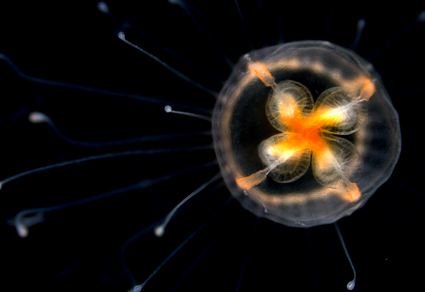
Turritopsis nutricula McCrady, 1857, the type species of the genus Turritopsis, has been historically misidentified. This study presents the first comprehensive analysis of medusae morphologically consistent with T. nutricula, and collected from Baldhead Island, North Carolina, in the vicinity of the species’ type locality. Using DNA sequencing of the mitochondrial 16S gene, we provide definitive molecular evidence that distinguishes T. nutricula as a separate lineage within the Turritopsis clade. Our phylogenetic analyses reveal that this species is geographically restricted to the western Atlantic, contradicting earlier claims of its cosmopolitan distribution. Furthermore, we investigate the species’ ability to revert from medusa to polyp, a trait observed in T. dohrnii. Our findings indicate that T. nutricula does not possess this capability, suggesting distinct life cycle characteristics. This research not only clarifies the taxonomic status of T. nutricula but also sets the stage for future genomic studies aimed at understanding reverse development within the genus and the Hydrozoa.
References
- Bavestrello, G., Sommer, C. & Sarà, M. (1992) Bi-directional conversion in Turritopsis nutricula (Hydrozoa). Scientia Marina, 56 (2–3), 137–140.
- Calder, D.R. & Kirkendale, L. (2005) Hydroids (Cnidaria, Hydrozoa) from shallow-water environments along the Caribbean coast of Panama. Caribbean Journal of Science.
- Cartwright, P., Evans, N.M., Dunn, C.W., Marques, A.C., Miglietta, M.P., Schuchert, P. & Collins, A.G. (2008) Phylogenetics of Hydroidolina (Hydrozoa: Cnidaria). Journal of the Marine Biological Association of the United Kingdom, 88 (8), 1663–1672. https://doi.org/10.1017/S0025315408002257
- Cunningham, C.W. & Buss, L.W. (1993) Molecular evidence for multiple episodes of paedomorphosis in the family Hydractiniidae. Biochemical Systematics and Ecology, 21 (1), 57–69. https://doi.org/10.1016/0305-1978(93)90009-G
- Felsenstein, J. (1985) Confidence limits on phylogenies: an approach using the bootstrap. Evolution, 39, 783–791. https://doi.org/10.1111/j.1558-5646.1985.tb00420.x
- Kramp, P.L. (1961) Synopsis of the medusae of the world. Journal of the Marine Biological Association UK, 40, 1–469. https://doi.org/10.1017/S0025315400007347
- Matsumoto, Y. & Miglietta, M.P. (2021) Cellular reprogramming and immortality: expression profiling reveals putative genes involved in Turritopsis dohrnii’s life cycle reversal. Genome Biology and Evolution, 13 (7), evab136. https://doi.org/10.1093/gbe/evab136
- Matsumoto, Y., Piraino, S. & Miglietta, M.P. (2019) Transcriptome characterization of reverse development in Turritopsis dohrnii (Hydrozoa, Cnidaria). G3: Genes, Genomes, Genetics, 9 (12), 4127–4138. https://doi.org/10.1534/g3.119.400487
- Mayer, A.G. (1910) Medusae of the World. Hydromedusae, Vols. I & II. ScyphoMedusae, Vol III. Carnegie Institution, Washington, 735 pp., pls. 1–76. https://doi.org/10.5962/bhl.title.159245
- McCrady, J. (1857) Description of Oceania (Turritopsis) nutricula nov. spec. and the embryological history of a singular medusan larva, found in the cavity of its bell. Proc. Elliott Soc. nat. Hist., 1, 55–90.
- Miglietta, M.P., Odegard, D., Faure, B. & Faucci, A. (2015) Barcoding techniques help tracking the evolutionary history of the introduced species Pennaria disticha (Hydrozoa, Cnidaria). PLoS One, 10 (12), e0144762. https://doi.org/10.1371/journal.pone.0144762
- Miglietta, M.P. & Lessios, H.A. (2009) A silent invasion. Biological Invasions, 11, 825–834. https://doi.org/10.1007/s10530-008-9296-0
- Miglietta, M.P., Piraino, S., Kubota, S. & Schuchert, P. (2007) Species in the genus Turritopsis (Cnidaria, Hydrozoa): a molecular evaluation. Journal of Zoological Systematics and Evolutionary Research, 45 (1), 11–19. https://doi.org/10.1111/j.1439-0469.2006.00379.x
- Miglietta, M.P., Maggioni, D. & Matsumoto, Y. (2018) Phylogenetics and species delimitation of two hydrozoa (phylum Cnidaria): Turritopsis (McCrady, 1857) and Pennaria (Goldfuss, 1820). Marine Biodiversity, 49 (3), 1085–1100. https://doi.org/10.1007/s12526-018-0891-8
- Nguyen, L.T., Schmidt, H.A., Von Haeseler, A. & Minh, B.Q. (2015) IQ-TREE: a fast and effective stochastic algorithm for estimating maximum-likelihood phylogenies. Molecular Biology and Evolution, 32 (1), 268–274. https://doi.org/10.1093/molbev/msu300
- Pascual-Torner, M., Carrero, D., Pérez-Silva, J.G., Álvarez-Puente, D., Roiz-Valle, D., Bretones, G., Rodríguez, D. et al. (2022) Comparative genomics of mortal and immortal cnidarians unveils novel keys behind rejuvenation. Proceedings of the National Academy of Sciences, 119 (36), e2118763119. https://doi.org/10.1073/pnas.2118763119
- Rambaut, A., Drummond, A.J., Xie, D., Baele, G. & Suchard, M.A. (2018) Posterior summarization in Bayesian phylogenetics using Tracer 1.7. Systematic Biology, 67 (5), 901–904. https://doi.org/10.1093/sysbio/syy032
- Ronquist, F., Teslenko, M., van der Mark, P., Ayres, D.L., Darling, A., Höhna, S., Larget, B., Liu, L., Suchard, M.A. & Huelsenbeck, J.P. (2012) MrBayes 3.2: efficient Bayesian phylogenetic inference and model choice across a large model space. Systematic Biology, 61, 539–542. https://doi.org/10.1093/sysbio/sys029
- Schmich, J., Kraus, Y., De Vito, D., Graziussi, D., Boero, F. & Piraino, S. (2007) Induction of reverse development in two marine Hydrozoans. International Journal of Developmental Biology, 51 (1), 45. https://doi.org/10.1387/ijdb.062152js
- Schuchert, P. (2004) Revision of the European athecate hydroids and their medusae (Hydrozoa, Cnidaria): families Oceanidae and Pachycordylidae. Revue suisse de Zoologie, 111 (2), 315–370. https://doi.org/10.5962/bhl.part.80242
- Schuchert, P. (2016) The polyps of Oceania armata identified by DNA barcoding (Cnidaria, Hydrozoa). Zootaxa, 4175, 539–555. https://doi.org/10.11646/zootaxa.4175.6.3
- Schuchert, P. & Collins, R. (2021) Hydromedusae observed during night dives in the Gulf Stream. Revue Suisse de Zoologie, 128, 237–356. https://doi.org/10.35929/RSZ.0049