

Abstract
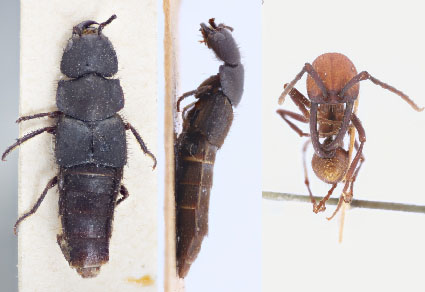
The genus Termitoquedius Bernhauer, 1912 (Staphylininae: Staphylinini) comprises myrmecophilous rove beetles with a Neotropical distribution. Until recently, it included only two species from Brazil recorded in association with army ants of the genus Eciton Latreille, 1804. Recent phylogenetic analyses have assessed its systematic placement, initially recovering the genus as incertae sedis within Staphylinini and later placing it within the Neotropical lineage of the subtribe Philonthina (Staphylinini). Based on this phylogenetic evidence, Termitoquedius is formally transferred to Philonthina, providing new insights into the evolutionary history of myrmecophily within the subtribe. Additionally, a lectotype is designated for its type species, Termitoquedius iheringi Bernhauer, 1912. Two new species are described: Termitoquedius ecitonis sp. nov. from Peru and Termitoquedius andinus sp. nov. from Bolivia. These, along with additional records from Colombia and Ecuador, represent the first records of the genus for these four countries. A taxonomic key, diagnostic characters, descriptions or redescriptions, illustrations, and a distributional map are also provided for all Termitoquedius species treated in herein.
References
- Asenjo, A., Irmler, U., Klimaszewski, J., Herman, L.H. & Chandler, D.S. (2013) A complete checklist with new records and geographical distribution of the rove beetles (Coleoptera, Staphylinidae) of Brazil. Insecta Mundi, 0277, 1–419.
- Bachmann, A.O., Chani-Posse, M., Guala, M.E. & Newton, A.F. (2017) A catalog of the types of Staphylinidae (Insecta, Coleoptera) deposited in the Museo Argentino de Ciencias Naturales, Buenos Aires (MACN). Zootaxa, 4223 (1), 1–74. https://doi.org/10.11646/zootaxa.4223.1.1
- Bernhauer, M. (1912) Zur Staphylinidenfauna von Südamerika, (10. Beitrag.) Verhandlungen der Kaiserlich-Königlichen Zoologisch-Botanischen Gesellschaft in Wien, 62 (1), 26–48.
- Bernhauer, M. & Schubert, K. (1916) Staphylinidae V. In: Schenkling, S. (Ed.), Coleopterorum Catalogus. Vol. 67. W. Junk, Berlin, pp. 409–498.
- Blackwelder, R.E. (1944) Checklist of the coleopterous insects of Mexico, Central America, the West Indies, and South America. Part 1. Bulletin of the United States National Museum, 185, i–xii + 1–188. https://doi.org/10.5479/si.03629236.185.i
- Blackwelder, R.E. (1952) The generic names of the beetle family Staphylinidae, with an essay on genotypy. Bulletin of the United States National Museum Bulletin, 200, i–iv + 1–483.
- Borgmeier, T. (1959) Nota prévia sôbre alguns coleópteros ecitófilos da família Staphylinidae. Boletim do Museu Nacional, Rio de Janeiro. Zoologia, New Series, 214, 1–15.
- Caron, E., Buss, B.C., Zilberman, B. & Bortoluzzi, S. (2025) Illustrated catalog of the types of Staphylinidae (Insecta: Coleoptera) deposited in the Museu de Zoologia da Universidade de São Paulo, Brazil. Zootaxa, 5579 (1), 1–82. https://doi.org/10.11646/zootaxa.5579.1.1
- Chani‐Posse, M.R., Brunke, A.J., Chatzimanolis, S., Schillhammer, H. & Solodovnikov, A. (2018a) Phylogeny of the hyper‐diverse rove beetle subtribe Philonthina with implications for classification of the tribe Staphylinini (Coleoptera: Staphylinidae). Cladistics, 34 (1), 1–40. https://doi.org/10.1111/cla.12188
- Chani-Posse, M., Newton, A., Hansen, A. & Solodovnikov, A. (2018b) Checklist and taxonomic changes for central and south American Philonthina (Coleoptera: Staphylinidae). Zootaxa, 4449 (1), 1–95. https://doi.org/10.11646/zootaxa.4449.1.1
- Chani-Posse, M.R. & Ramírez-Salamanca, J.M. (2020a) To be biased or to be neotropical: systematic reassessment of a megadiverse lineage of rove-beetles (Philonthina, Staphylinini, Staphylininae). Cladistics, 36 (2), 194–217. https://doi.org/10.1111/cla.12395
- Chani-Posse, M.R. & Ramírez-Salamanca, J.M. (2020b) Konradus leehermani—a new genus and species of Philonthina from the Neotropical region and its phylogenetic relationships (Coleoptera: Staphylinidae: Staphylininae). Zootaxa, 4759 (2), 237–251. https://doi.org/10.11646/zootaxa.4759.2.6
- Chani-Posse, M.R. & Rodríguez-Melgarejo, M.E. (2024) Origin and early diversification of a high Andean rove-beetle clade: Corisantis gen. nov., phylogeny, and historical biogeography. Zoologischer Anzeiger, 313, 395–416. https://doi.org/10.1016/j.jcz.2024.11.002
- Chani-Posse, M.R., Rodríguez-Melgarejo, M.E. & Ramírez-Salamanca, J.M. (2025) Systematics and phylogeny of the Andean genera Konradus Chani-Posse & Ramírez-Salamanca and Yuracarus gen. nov. (Coleoptera: Staphylinidae). Arthropod Systematics & Phylogeny, 83, 331–352. https://doi.org/10.3897/asp.83.e150304
- Chatzimanolis, S., Cohen, I.M., Schomann, A. & Solodovnikov, A. (2010) Molecular phylogeny of the mega‐diverse rove beetle tribe Staphylinini (Insecta, Coleoptera, Staphylinidae). Zoologica Scripta, 39 (5), 436–449. https://doi.org/10.1111/j.1463-6409.2010.00438.x
- Herman, L.H. (2001) Catalog of the Staphylinidae (Insecta: Coleoptera). 1758 to the End of the Second Millennium. VI. Staphylinine Group (Part 3) Staphylininae: Staphylinini (Quediina, Staphylinina, Tanygnathinina, Xanthopygina), Xantholinini Staphylinidae Incertae Sedis Fossils, Protactinae. Bulletin of the American Museum of Natural History, 265, 3021–3840. https://doi.org/10.1206/0003-0090.265.1.6
- Horn, W., Kahle, I., Friese, G. & Gaedike, R. (1990) Collectiones Entomologicae. Ein Kompendium über den Verbleib entomologischer Sammlungen der Welt bis 1960. Teil I: A bis K und Teil II L bis Z. Akademie der Landwirtschaftswissenschaften der Deutschen Demokratischen Republik, Berlin, pp. 1–573 (Teil I and Teil II).
- ICZN (1999) International Code of Zoological Nomenclature. 4th Edition. The International Trust for Zoological Nomenclature, London, xxix + 306 pp.
- Kistner, D.H. (1979) Social and evolutionary significance of social insect symbionts. In: Herman, H.R. (Ed.), Social insects. Vol. I. Academic Press, New York, pp. 339–413. https://doi.org/10.1016/B978-0-12-342201-9.50015-X
- Kistner, D.H. (1982) The social insects’ bestiary. In: Hermann, H.R. (Ed.), Social Insects. Vol. III. Academic Press, New York, New York, pp. 1–244. https://doi.org/10.1016/B978-0-12-342203-3.50008-4
- Lawrence, J.F., Zhou, Y.-L., Lemann, C., Sinclair, B. & Ślipiński, A. (2021) The Hind Wing of Coleoptera (Insecta): Morphology, Nomenclature and Phylogenetic Significance. Part 1. General Discussion and Archostemata—Elateroidea. Annales Zoologici, 71 (3), 421–606. https://doi.org/10.3161/00034541ANZ2021.71.3.001
- Lucas, R. (1920) Catalogus alphabeticus generum et subgenerum Coleopterorum orbis terrarum totius (famil., trib., subtr., sect. incl.). Pars I. Archiv für Naturgeschichte, 84A, i–xxxi + 1–696. [Note: nominal year of publication 1918]
- Mittermeier, R.A., Turner, W.R., Larsen, F.W., Brooks, T.M. & Gascon, C. (2011) Global biodiversity conservation: the critical role of hotspots areas. In: Zachos, F.E. & Habel, J.C. (Eds.), Biodiversity hotspots: distribution and protection of conservation priority. Springer, Berlin and Heidelberg, pp. 3–22. https://doi.org/10.1007/978-3-642-20992-5_1
- Morrone, J.J., Escalante, T., Rodríguez-Tapia, G., Carmona, A., Arana, M. & Mercado-Gómez, J.D. (2022) Biogeographic regionalization of the Neotropical region: New map and shapefile. Anais da Academia Brasileira de Ciências, 94 (1), e20211167. https://doi.org/10.1590/0001-3765202220211167
- Myers, N., Mittermeier, R.A., Mittermeier, C.G., Da Fonseca, G.A. & Kent, J. (2000) Biodiversity hotspots for conservation priorities. Nature, 403 (6772), 853–858. https://doi.org/10.1038/35002501
- Newton, A. (2025) StaphBase (version Aug 2022). In: Bánki, O., Roskov, Y., Döring, M., Ower, G., Hernández Robles, D.R., Plata Corredor, C.A., Stjernegaard Jeppesen, T., Örn, A., Vandepitte, L., Hobern, D., Schalk, P., DeWalt, R.E., Ma, K., Miller, J., Orrell, T., Aalbu, R., Abbott, J., Adlard, R., Adriaenssens, E.M., et al. Catalogue of Life. Version 11 September 2025. Catalogue of Life Foundation, Amsterdam. Available from: https://www.catalogueoflife.org/data/dataset/1204 (accessed 06 October 2025) https://doi.org/10.48580/dg9ld-3gk
- Parker, J. (2016) Myrmecophily in beetles (Coleoptera): Evolutionary patterns and biological mechanisms. Myrmecological News, 22, 65–108. https://doi.org/10.25849/myrmecol.news_022:065
- Ramírez‐Salamanca, J.M., Cornejo, P. & Chani‐Posse, M.R. (2024) Early evolution of the megadiverse subtribe Philonthina (Staphylinidae: Staphylininae: Staphylinini) and its Neotropical lineage. Systematic Entomology, 49 (1), 28–47. https://doi.org/10.1111/syen.12605
- Rodríguez-Melgarejo, M.E., Ramírez‐Salamanca, J.M. & Chani‐Posse, M.R. (2025) Integrative systematics reveals new brachypterous genera and sheds light on hind wing evolution in the Neotropical lineage of Philonthina (Coleoptera: Staphylinidae). Invertebrate Systematics, 39 (11), IS24104. https://doi.org/10.1071/IS24104
- Seevers, C.H. (1965) The systematics, evolution and zoogeography of staphylinid beetles associated with army ants (Coleoptera, Staphylinidae). Fieldiana Zoology, 47 (2), 139–351. https://doi.org/10.5962/bhl.title.3063
- Silvestri, F. (1946) Primo contributo alla conoscenza dei termitofili viventi con specie di Syntermes. Commentationes della Pontificia Academia Scientiarum, 9 (13), 515–559. [1945]
- Smetana, A. (1995) Rove beetles of the subtribe Philonthina of America north of Mexico (Coleoptera: Staphylinidae): Classification, phylogeny and taxonomic revision. Memoirs on Entomology, International, 3, i–x + 1–946.
- Shorthouse, D.P. (2010) SimpleMappr, an online tool to produce publication-quality point maps. Available from: http://www.simplemappr.net (accessed 4 October 2025)
- Wasmann, E. (1925) Die Ameisenmimikry, ein exakter Beitrag zum Mimikryproblem und zur Theorie der Anpassung. Abhandlungen zur theoretischen Biologie, 19, i–xii + 1–164.
- Scheerpeltz, O. (1933) Staphylinidae VII. In: Schenkling, S. (Ed.), Coleopterorum Catalogus. Vol. 129. W. Junk, Berlin, pp. 989–1500.
- Wasmann, E. (1904) Contribuição para o estudo dos hóspedes de abelhas brasileiras. Revista Museo Paulista, São Paulo, 6, 482–487.