

Abstract
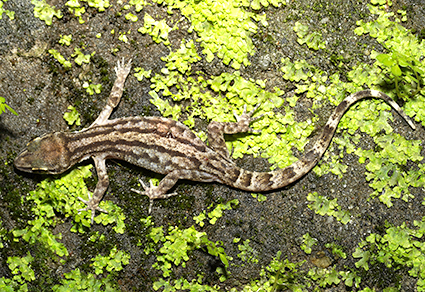
Cyrtodactylus Gray, 1827, represents the most diverse reptile genus in the Himalayan region. Despite ongoing research, Cyrtodactylus diversity remains incompletely documented in Nepal. We describe a new species from Sunsari District in eastern Nepal using integrated morphological and genetic evidence. Belonging to the C. khasiensis group, Cyrtodactylus khambui sp. nov. is distinguished from regional congeners by: (1) smaller body size (SVL < 60 mm), (2) proportional head dimensions, (3) interorbital-head width proportion (IO/HW%), (4) dorsal patterning of 7–9 irregular transverse crossbars, (5) absence of a mid-dorsal line, (6) presence of eight small precloacal pores, and (7) >12% mitochondrial ND2 sequence divergence from its closest relative (C. martinstolli). Phylogenetic analyses (maximum likelihood, Bayesian inference) and species delimitation unanimously support its distinct evolutionary status. Cyrtodactylus khambui sp. nov. exhibits color variation among individuals, lacks femoral pores and grooves, and inhabits diverse ecosystems including anthropogenic structures (abandoned walls) and natural forests (Sal-dominated and mixed deciduous).
References
- Agarwal, I. (2016) Two new species of ground-dwelling Cyrtodactylus (Geckoella) from the Mysore Plateau, south India. Zootaxa, 4193 (2), 228–244. https://doi.org/10.11646/zootaxa.4193.2.2
- Agarwal, I., Bauer, A.M., Jackman, T.R. & Karanth, K.P. (2014a) Insights into Himalayan biogeography from geckos: A molecular phylogeny of Cyrtodactylus (Squamata: Gekkonidae). Molecular Phylogenetics and Evolution, 80 (1), 145–155. https://doi.org/10.1016/j.ympev.2014.07.018
- Agarwal, I., Bauer, A.M., Jackman, T.R. & Karanth, P. (2014b) Cryptic species and Miocene diversification of Palaearctic naked-toed geckos (Squamata: Gekkonidae) in the Indian dry zone. Zoologica Scripta, 43 (5), 455–471. https://doi.org/10.1111/zsc.12062
- Agarwal, I., Khandekar, A. & Bauer, A.M. (2018a) A new bent-toed gecko (Squamata: Gekkonidae: Cyrtodactylus) from the Western Himalayas, Himachal Pradesh, India. Zootaxa, 4446 (4), 442–454. https://doi.org/10.11646/zootaxa.4446.4.2
- Agarwal, I., Mahony, S., Giri, V.B., Chaitanya, R. & Bauer, A.M. (2018b) Six new Cyrtodactylus (Squamata: Gekkonidae) from northeast India. Zootaxa, 4524 (5), 501–535. https://doi.org/10.11646/zootaxa.4524.5.1
- Agarwal, I., Mahony, S., Giri, V.B., Chaitanya, R. & Bauer, A.M. (2018c) Two new species of bent toed geckos, Cyrtodactylus Gray, 1827 (Squamata: Gekkonidae) from Northeast India with comments on name-bearing types from the region. Zootaxa, 4420 (3), 334–356. https://doi.org/10.11646/zootaxa.4420.3.2
- Ampai, N., Rujirawan, A., Yodthong, S., Termprayoon, K., Stuart, B.L. & Aowphol, A. (2024) A new species of karst-dwelling bent-toed gecko of the Cyrtodactylus intermedius group (Squamata, Gekkonidae) from eastern Thailand and the phylogenetic placement of C. intermedius. ZooKeys, 1211, 101–130. https://doi.org/10.3897/zookeys.1211.122563
- Bauer, A.M. (2003) Descriptions of seven new Cyrtodactylus (Squamata: Gekkonidae) with a key to the species of Myanmar (Burma). Proceedings of the California Academy of Sciences, 54 (25), 463–498.
- Bauer, A.M., Masroor, R., Titus-Mcquillan, J., Heinicke, M.P., Daza, J.D. & Jackman, T.R. (2013) A preliminary phylogeny of the Palearctic naked-toed geckos (Reptilia: Squamata: Gekkonidae) with taxonomic implications. Zootaxa, 3599 (4), 301–324. https://doi.org/10.11646/zootaxa.3599.4.1
- Beddome, R.H. (1870) Descriptions of new reptiles from the Madras Presidency. Proceedings of the Zoological Society of London, 1877, 685–686. [https://biostor.org/reference/51979]
- Dayrat, B. (2005) Towards integrative taxonomy. Biological Journal of the Linnean Society, 85, 407–415. https://doi.org/10.1111/j.1095-8312.2005.00503.x
- Bhattarai, S., Gautam, B., Neupane, B.P., Khandekar, A., Thackeray, T., Agarwal, I., Olson, A.R., Hogan, F. & Wright, W. (2025a) Description of two new species of Cyrtodactylus Gray, 1827 (Squamata, Gekkonidae) from Nepal. ZooKeys, 1253, 131–160. https://doi.org/10.3897/zookeys.1253.161933
- Bhattarai, S., Gautam, B., Neupane, B.P., Khandekar, A., Thackeray, T., Agarwal, I., Tillack, F., Olson, A.R., Hogan, F. & Wright, W. (2025b) A review of the genus Cyrtodactylus Gray 1827 (Squamata: Gekkonidae) of Nepal with descriptions of three new species. Zootaxa, 5594 (3), 401–451. https://doi.org/10.11646/zootaxa.5594.3.1
- Boruah, B., Narayanan, S., Aravind, N.A., Lalronunga, S., Deepak, V. & Das, A. (2024) Description of six new species of Cyrtodactylus Gray (Squamata: Gekkonidae) from northeastern India. Vertebrate Zoology, 74, 453–486. https://doi.org/10.3897/vz.74.e124752
- Burland, T.G. (1999) DNASTAR’s Lasergene Sequence Analysis Software. In: Misener, S. & Krawetz, S.A. (Eds.), BT - Bioinformatics Methods and Protocols. Humana Press, Totowa, New Jersey, pp. 71–91.
- Chan, K.O. & Grismer, L.L. (2021) A standardized and statistically defensible framework for quantitative morphological analyses in taxonomic studies. Zootaxa, 5023 (2), 293–300. https://doi.org/10.11646/zootaxa.5023.2.9
- Chomdej, S., Pradit, W., Pawangkhanant, P., Kuensaen, C., Phupanbai, A., Naiduangchan, M., Piboon, P., Nganvongpanit, K., Yuan, Z., Zhang, Y., Che, J., Sucharitakul, P. & Suwannapoom, C. (2022) A new Cyrtodactylus species (Reptila: Gekkonidae) from Nan Province, Northern Thailand. Asian Herpetological Research, 13 (2), 96–108. https://doi.org/10.16373/j.cnki.ahr.210055
- Claude, J. (2008) Morphometric with R. Springer, New York, New York, 15 pp.
- Darevsky, I.S., Helfenberger, N., Orlov, N.L. & Shah, K. (2011) Two new species of the genus Gonydactylus (Sauria: Gekkonidae) from eastern Nepal. Russian Journal of Herpetology, 4 (2), 89–93. https://doi.org/10.30906/1026-2296-1997-4-2-89-93
- Darriba, D., Taboada, G.L., Doallo, R. & Posada, D. (2012) JModelTest 2: More models, new heuristics and parallel computing. Nature Methods, 9 (8), 772. https://doi.org/10.1038/nmeth.2109
- Daudin, F.M. (1802) Histoire naturelle, générale et particulière des Reptiles. Tome quatrième. F. Dufart, Paris, 397 pp.
- DNPWC (1973) National Parks and Wildlife Conservation Act, 2029 (1973). Department of National Parks and Wildlife Conservation, Kathmandu. [unknown pagination]
- Duméril, A.M.C. & Bibron, G. (1836) Erpétologie générale ou Histoire naturelle complète des Reptiles. Tome Troisième. Roret, Paris, 517 pp.
- Duong, T.V.A.N., Vu, L.V.A.N., Vu, H.T.T., Mulcahy, D., Bragin, A.M., Poyarkov, N.A. & Grismer, L.L. (2024) Another new species of Cyrtodactylus Gray, 1927 (Squamata: Gekkonidae) of the angularis group from the karstic landscape of Phong Nha-Ke Bang National Park, central Vietnam. Zootaxa, 5471 (5), 555–571. https://doi.org/10.11646/zootaxa.5471.5.3
- Government of Nepal (2014) National Biodiversity Strategy and Action Plan 2014-2020. Government of Nepal, Kathmandu, 226 pp.
- Gray, J.E. (1827) XI. A synopsis of the genera of Saurian reptiles, in which some new genera are indicated, and the others reviewed by actual examination. The Philosophical Magazine, 2 (7), 54–58. https://doi.org/10.1080/14786442708675620
- Grismer, L.L., Poyarkov, N.A., Quah, E.S.H., Grismer, J.L. & Wood, P.L. (2022) The biogeography of bent-toed geckos, Cyrtodactylus (Squamata: Gekkonidae). PeerJ, 10 (e13153), 1–21. https://doi.org/10.7717/peerj.13153
- Grismer, L.L., Wood, Jr., P.L., Poyarkov, N.A., Le, M.D., Kraus, F., Agarwal, I., Oliver, P.M., Nguyen, S.N., Nguyen, T.Q., Karunarathna, S., Welton, L.J., Stuart, B.L., Luu, V.Q., Bauer, A.M., O’Connell, K.A., Quah, E.S.H., Chan, K.O., Ziegler, T., Ngo, H., Nazarov, R.A., Aowphol, A., Chomdej, S., Suwannapoom, C., Siler, C.D., Anuar, S. & Tri, N.V. (2021) Phylogenetic partitioning of the third-largest vertebrate genus in the world, Cyrtodactylus Gray, 1827 (Reptilia; Squamata; Gekkonidae) and its relevance to taxonomy and conservation. Vertebrate Zoology, 71, 101–154. https://doi.org/10.3897/vz.71.e59307
- Grismer, L.L., Wood, P.L., Kyaw Thura, M., Thaw, Z.I.N., Quah, E.S.H., Murdoch, M.L., Grismer, M.S., Aung, L.I.N. & Kyaw, H. (2018a) Twelve new species of Cyrtodactylus Gray (squamata: Gekkonidae) from isolated limestone habitats in east-central and southern Myanmar demonstrate high localized diversity and unprecedented microendemism. Zoological Journal of the Linnean Society, 182 (4), 862–959. https://doi.org/10.1093/zoolinnean/zlx057
- Grismer, L.L., Wood, P.L., Quah, E.S.H., Grismer, M.S., Thura, M.K., Oaks, J.R. & Lin, A. (2020) Two new species of Cyrtodactylus Gray, 1827 (Squamata: Gekkonidae) from a karstic archipelago in the Salween Basin of southern Myanmar (Burma). Zootaxa, 4718 (2), 151–183. https://doi.org/10.11646/zootaxa.4718.2.1
- Grismer, L.L., Wood, P.L., Thura, M.K., Quah, E.S.H., Murdoch, M.L., Grismer, M.S., Herr, M.W., Lin, A. & Kyaw, H. (2018b) Three more new species of Cyrtodactylus (Squamata: Gekkonidae) from the Salween basin of eastern Myanmar underscore the urgent need for the conservation of karst habitats. Journal of Natural History, 52 (19–20), 1243–1294. https://doi.org/10.1080/00222933.2018.1449911
- Hayek, L.-A.C., Heyer, W.R. & Gascon, C. (2001) Frog morphometrics: a cautionary tale. Alytes, 18 (3–4), 153–177.
- Kamei, R.G. & Mahony, S. (2021) A new species of bent-toed gecko (Squamata: Gekkonidae: Cyrtodactylus Gray, 1827) from the Garo hills, Meghalaya state, North-East India, and discussion of morphological variation for C. Urbanus. Herpetological Journal, 31 (3), 177–196. https://doi.org/10.33256/31.3.177196
- Kästle, W., Khambu, K.R. & Schleich, H. (2013) Field guide to amphibians and reptiles of Nepal. ARCO-Nepal, Munich, 609 pp.
- Mirza, Z.A., Bhosale, H.S., Thackeray, T., Phansalkar, P., Sawant, M., Gowande, G.G. & Patel, H. (2022) A new species of bent-toed geckos of the genus Cyrtodactylus Gray, 1827 from western Arunachal Pradesh, India. Herpetozoa, 35, 65–76. https://doi.org/10.3897/HERPETOZOA.35.E80610
- Mosimann, J.E. (1970) Size allometry: size and shape variables with characterizations of the lognormal and generalized gamma distributions. Journal of the American Statistical Association, 65 (330), 930–945. https://doi.org/10.1080/01621459.1970.10481136
- Padial, J.M., Miralles, A., De la Riva, I. & Vences, M. (2010) The integrative future of taxonomy. Frontiers in Zoology, 7, 16. https://doi.org/10.1186/1742-9994-7-16
- Portik, D., Streicher, J. & Wiens, J. (2023) Frog phylogeny: A time-calibrated, species-level tree based on hundreds of loci and 5,242 species. Molecular Phylogenetics and Evolution, 188, 107907 https://doi.org/10.1016/j.ympev.2023.107907
- Purkayastha, J., Das, M., Bohra, S.C., Bauer, A.M. & Agarwal, I. (2020) Another new Cyrtodactylus (Squamata: Gekkonidae) from Guwahati, Assam, India. Zootaxa, 4732 (3), 375–392. https://doi.org/10.11646/zootaxa.4732.3.2
- Purkayastha, J., Lalremsanga, H.Tl., Bohra, S.C., Biakzuala, L., Vabeiryureilai, M., Chauhan, S. & Rathee, Y.S. (2021) Four new bent-toed geckos (Cyrtodactylus Gray: Squamata: Gekkonidae) from northeast India. Zootaxa, 4980, 451–489. https://doi.org/10.11646/zootaxa.4980.3.2
- Rambaut, A. (2018) FigTree ver 1.4.4. Institute of Evolutionary Biology, University of Edinburgh, Edinburgh. Available from: http://tree.bio.ed.ac.uk/software/figtree/ (accessed 21 December 2025)
- Rambaut, A., Drummond, A.J., Xie, D., Baele, G. & Suchard, M.A. (2018) Posterior summarization in Bayesian phylogenetics using Tracer 1.7. Systematic Biology, 67 (5), 901–904. https://doi.org/10.1093/sysbio/syy032
- Roitberg, E.S., Orlova, V.F., Kuranova, V.N., Bulakhova, N.A., Zinenko, O.I., Ljubisavljevic, K., Shamgunova, R.R., Carretero, M.A., Clasen, A., Fokt, M. & Böhme, W. (2011) Inter-observer and intra-observer differences in measuring body length: A test in the common lizard, Zootoca vivipara. Amphibia Reptilia, 32 (4), 477–484. https://doi.org/10.1163/156853811X601636
- Schleich, H.H. & Kästle, W. (1998) n.k In: 1 Contributions to the Herpetology of S-Asia (Nepal, India). Veröffentlichungen aus dem Fuhlrott-Museum, pp. 87–227.
- Schlick-Steiner, B.C., Steiner, F.M., Seifert, B., Stauffer, C., Christian, E. & Crozier, R.H. (2010) Integrative taxonomy: A multisource approach to exploring biodiversity. Annual Review of Entomology, 55, 421–438. https://doi.org/10.1146/annurev-ento-112408-085432
- Sharma, E., Chettri, N. & Oli, K.P. (2010) Mountain biodiversity conservation and management: A paradigm shifts in policies and practices in the Hindu Kush-Himalayas. Ecological Research, 25 (5), 909–923. https://doi.org/10.1007/s11284-010-0747-6
- Shrestha, A.B., Wake, C.P., Mayewski, P.A. & Dibb, J.E. (1999) Maximum temperature trends in the Himalaya and its vicinity: An analysis based on temperature records from Nepal for the period 1971-94. Journal of Climate, 12 (9), 2775–2786. https://doi.org/10.1175/1520-0442(1999)012<2775:MTTITH>2.0.CO;2
- Silvestro, D. & Michalak, I. (2012) RaxmlGUI: A graphical front-end for RAxML. Organisms Diversity and Evolution, 12 (4), 335–337. https://doi.org/10.1007/s13127-011-0056-0
- Stamatakis, A. (2006) RAxML-VI-HPC: Maximum likelihood-based phylogenetic analyses with thousands of taxa and mixed models. Bioinformatics, 22 (21), 2688–2690. https://doi.org/10.1093/bioinformatics/btl446
- Subba, A., Thapa, A. & Khanal, L. (2025) Phylogeography of the bent‐toed geckos (Squamata: Gekkonidae) reveals complex diversification patterns linked to the orogenic history of the Himalayas. Journal of Zoological Systematics and Evolutionary Research, 2025 (1), 6716689. https://doi.org/10.1155/jzs/6716689
- Tamura, K., Stecher, G. & Kumar, S. (2021) MEGA11: Molecular Evolutionary Genetics Analysis Version 11. Molecular Biology and Evolution, 38 (7), 3022–3027. https://doi.org/10.1093/molbev/msab120
- Thorpe, R.S. (1976) Biometric analysis of geographic variation and racial affinities. Biological Reviews, 5, 407–452. https://doi.org/10.1111/j.1469-185X.1976.tb01063.x
- Vieites, D.R., Wollenberg, K.C., Andreone, F., Köhler, J., Glaw, F. & Vences, M. (2009) Vast underestimation of Madagascar’s biodiversity evidenced by an integrative amphibian inventory. Proceedings of the National Academy of Sciences of the United States of America, 106 (20), 8267–8272. https://doi.org/10.1073/pnas.0810821106
- Wang, K., Ren, J., Wu, J., Jiang, K., Jin, J., Hou, S., Zheng, P., Xie, F., Siler, C.D. & Che, J. (2021) Systematic revision of mountain dragons (Reptilia: Agamidae: Diploderma) in China, with descriptions of six new species and discussion on their conservation. Journal of Zoological Systematics and Evolutionary Research, 59 (1), 222–263. https://doi.org/10.1111/jzs.12414
- Wickham, H. (2007) Reshaping Data with the reshape Package. Journal of Statistical Software, 21 (12 SE-Articles), 1–20. https://doi.org/10.18637/jss.v021.i12
- Wood, P.L., Heinicke, M.P., Jackman, T.R. & Bauer, A.M. (2012) Phylogeny of bent-toed geckos (Cyrtodactylus) reveals a west to east pattern of diversification. Molecular Phylogenetics and Evolution, 65 (3), 992–1003. https://doi.org/10.1016/j.ympev.2012.08.025