
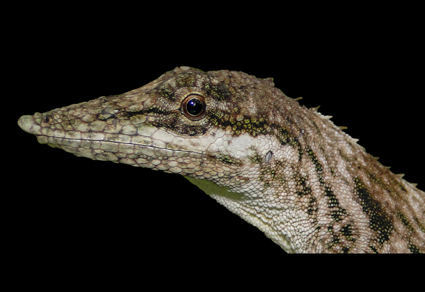

Abstract
Anolis laevis Cope 1876, a poorly known South American anole characterized by an unusual rudimentary rostral appendage, had not been observed since its original description 150 years ago. Here, we report the rediscovery of A. laevis within approximately 50 to 100 km of its type locality in eastern Peru, including two adult males and, for the first time, adult females. Morphological analyses confirm pronounced sexual dimorphism, with females lacking the proboscis. This trait parallels the condition seen in other species of Anolis with a proboscis and may represent evolutionary convergence of the appendage in different lineages. We provide a detailed redescription of A. laevis, highlighting diagnostic morphological traits that distinguish it from other proboscid and morphologically similar South American Anolis species. Unusual traits of A. laevis include large head scales including few loreal rows, a distinct dorsal crest, presence of a dewlap in both sexes, and sexually dimorphic dewlap coloration. Our findings contribute to clarifying the taxonomy and morphological variation of poorly known anoles.
References
- Almendáriz, A. & Vogt (2007) Anolis proboscis (Sauria: Polychrotidae), una lagartija rara pero no extinta. Politécnica, 27 (7), 157–159.
- Ayala-Varela, F., Valverde, S., Poe, S., Narváez, A.E., Yánez-Muñoz, M.H. & Torres-Carvajal, O. (2021) A new giant anole (Squamata: Iguanidae: Dactyloinae) from southwestern Ecuador. Zootaxa, 4991 (2), 295–317. https://doi.org/10.11646/zootaxa.4991.2.4
- Ayala-Varela, F.P., Troya-Rodríguez, D., Talero-Rodríguez, X. & Torres-Carvajal, O. (2014) A new Andean anole species of the Dactyloa clade (Squamata: Iguanidae) from western Ecuador. Amphibian & Reptile Conservation, Special Section, 8 (1), 8–24. [https://www.biodiversitylibrary.org/part/178775]
- Bachman, S.P., Moat, J., Hill, A., Torre, J.de la & Scott, B. (2011) Supporting Red List threat assessments with GeoCAT: geospatial conservation assessment tool. ZooKeys, 150, 117–126. https://doi.org/10.3897/zookeys.150.2109
- Barbour, T. (1934) The anoles. II. The mainland species from México southward. Bulletin of the Museum of Comparative Zoology at Harvard College, 77, 121–155.
- Boulenger, G.A. (1885) Catalogue of the lizards in the British Museum (Natural history). Vol. 2. 2nd Edition. Printed by order of the Trustees, London, xiii + 497 pp. [https://www.biodiversitylibrary.org/item/116006]
- Castañeda, M., Sherratt, E. & Losos, J. (2014) The Mexican amber anole, Anolis electrum, within a phylogenetic context: implications for the origins of Caribbean anoles. Zoological Journal of the Linnean Society, 172, 133–144. https://doi.org/10.1111/ZOJ.12159
- Castañeda, M.D.R. & De Queiroz, K.D.E. (2013) Phylogeny of the Dactyloa clade of Anolis lizards: New insights from combining morphological and molecular data. Bulletin of the Museum of Comparative Zoology, 160 (7), 345–398. https://doi.org/10.3099/0027-4100-160.7.345
- Cope, E.D. (1876) Report on the Reptiles brought by Professor James Orton from the middle and upper Amazon and western Peru. Journal of the Academy of Natural Sciences of Philadelphia, 2 (8), 159–183.
- Duellman, W.E. & Pramuk, J.B. (1999) Frogs of the genus Eleutherodactylus (Anura: Leptodactylidae) in the Andes of northern Peru. Scientific Papers. Natural History Museum, University of Kansas, 13, 1–78. https://doi.org/10.5962/bhl.title.16169
- Ineich, I., Koppetsch, T. & Böhme, W. (2022) Pinocchio lizards and other lizards bearing rostral appendages − the peculiar habitus of the draconine agamid Harpesaurus tricinctus with highlights on its ecological implications and convergence with its New World equivalent, the dactyloid Anolis probosc. Salamandra, 58 (2), 123–138. https://doi.org/10.5334/ijic.ICIC21322
- IUCN (2019) Guidelines for Using the IUCN Red List categories and criteria: Version 14. International Union for Conservation of Nature and Natural Resources, Gland, Switzerland, 113 pp.Available from: https://www.iucnredlist.org/resources/redlistguidelines (accessed 20 May 2025)
- Köhler, G. (2014) Characters of external morphology used in Anolis taxonomy. Definition of terms, advice on usage, and illustrated examples. Zootaxa, 3774 (3), 201–257. https://doi.org/10.11646/zootaxa.3774.3.1
- Moraes, L.J.C. de L., Werneck, F.de P. & Pavan, D. (2019) New record and updated geographic distribution of Anolis phyllorhinus Myers & Carvalho, 1945. Herpetozoa, 31, 229–233.
- Nicholson, K.E., Crother, B.I., Guyer, C. & Savage, J.M. (2012) It is time for a new classification of anoles (Squamata: Dactyloidae). Zootaxa, 3477 (1), 1–108. https://doi.org/10.11646/zootaxa.3477.1.1
- Olson, D.M., Dinerstein, E., Wikramanayake, E.D., Burgess, N.D., Powell, G.V.N., Underwood, E.C., D’amico, J.A., Itoua, I., Strand, H.E., Morrison, J.C., Loucks, C.J., Allnutt, T.F., Ricketts, T.H., Kura, Y., Lamoreux, J.F., Wettengel, W.W., Hedao, P. & Kassem, K.R. (2001) Terrestrial ecoregions of the world: A new map of life on earth: A new global map of terrestrial ecoregions provides an innovative tool for conserving biodiversity. BioScience, 51 (11), 933–938. https://doi.org/10.1641/0006-3568(2001)051[0933:TEOTWA]2.0.CO;2
- Poe, S. (2004) Phylogeny of anoles. Herpetological Monographs, 18 (1), 37–89. https://doi.org/10.1655/0733-1347(2004)018[0037:POA]2.0.CO;2
- Poe, S., Ayala, F., Latella, I.M., Kennedy, T.L., Christensen, J.A., Gray, L.N., Blea, N.J., Armijo, B.M. & Schaad, E.W. (2012) Morphology, phylogeny, and behavior of Anolis proboscis. Breviora, 530 (1), 1–11. https://doi.org/10.3099/530.1
- Poe, S., Nieto-Montes De Oca, A., Torres-Carvajal, O., De Queiroz, K., Velasco, J.A., Truett, B., Gray, L.N., Ryan, M.J., Köhler, G., Ayala-Varela, F., Ayala-Varela, F. & Ian Latella, A. (2017) A phylogenetic, biogeographic, and taxonomic study of all extant species of Anolis (Squamata; Iguanidae). Systematic Biology, 66 (5), 663–697. https://doi.org/10.1093/sysbio/syx029
- Prates, I., Melo-Sampaio, P.R., Queiroz, K.D., Carnaval, A.C., Rodrigues, M.T. & Drummond, L.D.O. (2020) Discovery of a new species of Anolis lizards from Brazil and its implications for the historical biogeography of montane Atlantic Forest endemics. Amphibia Reptilia, 41 (1), 87–103. https://doi.org/10.1163/15685381-20191179
- Prates, I., Rodrigues, M.T., Melo-Sampaio, P.R. & Carnaval, A.C. (2015) Phylogenetic relationships of Amazonian anole lizards (Dactyloa): Taxonomic implications, new insights about phenotypic evolution and the timing of diversification. Molecular Phylogenetics and Evolution, 82 (PA), 258–268. https://doi.org/10.1016/j.ympev.2014.10.005
- Rodrigues, M.T., Xavier, V., Skuk, G. & Pavan, D. (2002) New specimens of Anolis phyllorhinus (Squamata, Polychrotidae): The first female of the species and of proboscid anoles. Papéis Avulsos de Zoologia, 42 (16), 363–380. https://doi.org/10.1590/S0031-10492002001600001
- Uetz, P., Freed, P., Aguilar, R., Reyes, F., Kudera, J. & Hošek, J. (2025) The Reptile Database. Available from: http://www.reptile-database.org (accessed 4 April 2025)
- Williams, E., Rand, H., Rand, A. & O’Hara, R. (1995) A computer approach to the comparison and identification of species in difficult taxonomic groups. Breviora, 502, 1–47. https://doi.org/10.5962/BHL.PART.6027
- Williams, E.E. (1965) South American Anolis (Sauria, Iguanidae): two new species of the punctatus group. Breviora, 233, 1–15.
- Williams, E.E. (1979) South American anoles: the species groups. 2. The proboscis anoles (Anolis laevis group). Breviora, 449, 1–19.
- Yánez-Muñoz, M.H., Reyes-Puig, C., Reyes-Puig, J.P., Velasco, J.A., Ayala-Varela, F. & Torres-Carvajal, O. (2018) A new cryptic species of Anolis lizard from northwestern South America (Iguanidae, Dactyloinae). ZooKeys, 2018 (794), 135–163. https://doi.org/10.3897/zookeys.794.26936
- Yánez-Muñoz, M.H., Urgilés, M.A., Altamirano-Benavides, M. & Cáceres, S.R. (2010) Redescripción de Anolis proboscis Peters & Orcés (Reptilia: Polychrotidae), con el descubrimiento de las hembras de la especie y comentarios sobre su distribución y taxonomía. Avances en Ciencias e Ingenierías, 2 (3), B7–B15. https://doi.org/10.18272/aci.v2i3.39