

Abstract
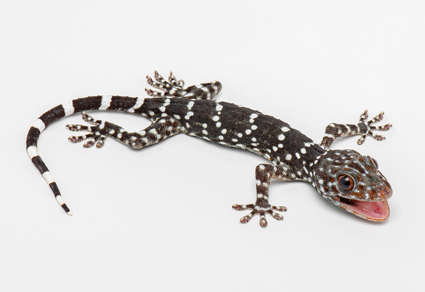
We describe Gekko dam sp. nov. based on type specimens from a limestone hill in Palian District, Trang Province, southern peninsular Thailand. The new species is also found in Satun Province, southern peninsular Thailand, and in Perlis State, northwestern Peninsular Malaysia. A member of the subgenus Gekko, it differs from all currently recognized Gekko species by the following combination of morphological characters and pattern: maximal known snout-vent length of 149.1 mm, lack of contact between nostrils and rostral, 21–24 interorbital scales between supraciliaries, 72–83 scale rows around midbody, 12–14 dorsal tubercle rows at midbody, 26–28 ventral scale rows at midbody, 22 precloacal pores in males, two postcloacal tubercles on each side of the base of the tail, 14–17 subdigital lamellae on 1st toe and 19–21 on 4th toe, a Y-shaped mark on head, white spots on head, dark grey to black dorsal background with four regular bands of contrasting white spots on dorsum between limb insertions, throat and venter white with orange patches, and a copper iris.
References
- Amanda, F., Riyanto, A. & Mumtazah, D.F. (2021) Dua kelompok besar spesies Gekko di Indonesia berdasarkan spesimen museum Zoologicum Bogoriense Puslit Biologi Lembaga Ilmu Pengetahuan Indonesia (LIPI). Jurnal Pendidikan Biologi Undiksha, 8 (2), 70–82.
- Aowphol, A., Yodthong, S., Rujirawan, A. & Thirakhupt, K. (2019) Mitochondrial diversity and phylogeographic patterns of Gekko gecko (Squamata: Gekkonidae) in Thailand. Asian Herpetological Research, 10 (3), 158–169. https://doi.org/10.16373/j.cnki.ahr.180087
- Bauer, A.M., Sumontha, M. & Pauwels, O.S.G. (2008) A new red-eyed Gekko (Reptilia: Gekkonidae) from Kanchanaburi Province, Thailand. Zootaxa, 1750 (1), 32–42. https://doi.org/10.11646/zootaxa.1750.1.3
- Bourret, R. (2009) Les lézards de l’Indochine. Publication fondée sur le manuscrit original de 1937–1947 déposé par l’auteur au Muséum national d’Histoire naturelle de Paris. Edition Chimaira, Frankfurt-am-Main, 624 pp.
- Chan-ard, T., Grossmann, W., Gumprecht, A. & Schulz, K.-D. (1999) Amphibians and reptiles of Peninsular Malaysia and Thailand. An illustrated checklist. Amphibien und Reptilien der Halbinsel Malaysia und Thailands. Eine illustrierte Checkliste. Bushmaster Publications, Wuerselen, 240 pp.
- Chan-ard, T. & Makchai, S. (2011) An inventory of reptiles and amphibians on the Koh Man Islands and in the Coastal Prasae Estuaries, Rayong Province, South-eastern Thailand. The Thailand Natural History Museum Journal, 5 (1), 25–37.
- Chandramouli, S.R., Gokulakrishnan, G., Sivaperuman, C. & Grismer, L.L. (2021) A new species of the genus Gekko Laurenti, 1768 (Squamata: Gekkonidae) from the Nicobar Archipelago, with an overview of congeners from the Andaman and Nicobar Islands. Amphibian & Reptile Conservation, 15 (1), 108–125.
- Gaulke, M. (2010) Gekko gecko. Reptilia, Münster, 15 (81), 47–50.
- Gogoi, M., Kundu, S., Goswami, J., Saikia, D. & Pandey, N. (2018) First record of tail bifurcation in Tokey [sic] Gecko (Gekko gecko) from the Kaziranga, Assam, India: a field observation. International Journal of Experimental Research and Review, 15, 5–8. https://doi.org/10.52756/ijerr.2018.v15.002
- Grismer, L.L. (2011) Lizards of Peninsular Malaysia, Singapore and their adjacent archipelagos. Edition Chimaira, Frankfurt am Main, 728 pp.
- Grismer, L.L., del Pinto, L., Quah, E.S.H., Anuar, S., Cota, M., McGuire, J.A., Iskandar, D.T., Wood, P.L.Jr & Grismer, J.L. (2022) Phylogenetic and multivariate analyses of Gekko smithii Gray, 1842 recover a new species from Peninsular Malaysia and support the resurrection of G. albomaculatus (Giebel, 1861) from Sumatra. Vertebrate Zoology, 72, 47–80. https://doi.org/10.3897/vz.72.e77702
- Grossmann, W. (1987) Über einen ungewöhnlich gefärbten Tokeh aus Thailand—ein Gekko gecko (Linnaeus, 1758)? Sauria, 9 (4), 19–20.
- Grossmann, W. (2006) Der Tokeh, Gekko gecko. Natur und Tier Verlag, Münster, 64 pp.
- Grossmann, W. & Simon, G. (2014) Tokeh-Morphen, Gekko gecko (Linnaeus, 1758) sensu lato im Terrarium. Teil 2: “Blauköpfige Grüne”. Sauria, 36 (2), 21–35.
- Grossmann, W. & Ulber, T. (1990) Ein neuer Gecko aus Zentral-Thailand: Gekko siamensis sp. nov. (Reptilia: Sauria: Gekkonidae). Sauria, 12 (3), 9–18.
- Ho, S.-K., Chan, H.-K. & Karraker, N.E. (2023) The identity of Tokays (Squamata: Gekkonidae: Gekko) from Hong Kong. Zootaxa, 5297 (2), 282–290. https://doi.org/10.11646/zootaxa.5297.2.7
- Koch, A., McGuire, J.A., Arida, E., Riyanto, A. & Hamidy, A. (2009) First record of Gekko smithii Gray, 1842 (Reptilia: Gekkonidae) from Sulawesi, Indonesia. Salamandra, 45 (3), 172–176.
- Leaché, A.D. & Reeder, T.W. (2002) Molecular systematics of the eastern fence lizard (Sceloporus undulatus): a comparison of parsimony, likelihood, and Bayesian approaches. Systematic Biology, 51 (1), 44–68. https://doi.org/10.1080/106351502753475871
- Manzili, S., Ibrohim & Hamidy, A. (2020) Study of morphological variations of Gekko gecko (Linnaeus 1758) population in Indonesia. AIP Conference Proceedings, 2231, 040062. https://doi.org/10.1063/5.0002491
- Meesook, W., Sumontha, M., Donbundit, N. & Pauwels, O.S.G. (2021) A new cave-dwelling Gekko (Gekko) from Lopburi Province, central Thailand (Squamata, Gekkonidae). Zootaxa, 4969 (2), 318–330. https://doi.org/10.11646/zootaxa.4969.2.5
- Mertens, R. (1955) Über eine eigenartige Rasse des Tokehs (Gekko gecko) aus Ost-Pakistan. Senckenbergiana Biologia, 36, 21–24.
- Ota, H., Hikida, T. & Matsui, M. (1991) Re-evaluation of the status of Gecko verreauxi Tytler, 1864, from the Andaman Islands, India. Journal of Herpetology, 25, 147–151. https://doi.org/10.2307/1564641
- Ota, H. & Nabhitabhata, J. (1991) A new species of Gekko (Gekkonidae: Squamata) from Thailand. Copeia, 1991, 503–509. https://doi.org/10.2307/1446598
- Padial, J.M., Miralles, A., De la Riva, I. & Vences, M. (2010) The integrative future of taxonomy. Frontiers in Zoology, 7, 16. https://doi.org/10.1186/1742-9994-7-16
- Panitvong, N., Sumontha, M., Konlek, K. & Kunya, K. (2010) Gekko lauhachindai sp. nov., a new cave-dwelling gecko (Reptilia: Gekkonidae) from central Thailand. Zootaxa, 2671 (1), 40–52. https://doi.org/10.11646/zootaxa.2671.1.4
- Patawang, I. & Tanomtong, A. (2015) The variation of Tokay Gecko, Gekko gecko (Linnaeus, 1758) between two populations in southern China and Indochinese Peninsula. Srinakharinwirot Science Journal, 31 (2), 175–186.
- Pauwels, O.S.G., Meesook, W., Donbundit, N., Jindamad, T., Topai, N. & Sumontha, M. (2025) Gekko (Gekko) shiva, a new limestone-dwelling gecko from Sa Kaeo Province, eastern Thailand (Squamata, Gekkonidae). Zootaxa, 5588 (2), 305–322. https://doi.org/10.11646/zootaxa.5588.2.6
- Qin, X.-M., Li, H.-.M, Zeng, Z.-H., Zeng, D.-L. & Guan, Q.-X. (2012) Genetic variation and differentiation of Gekko gecko from different populations based on mitochondrial cytochrome b gene sequences and karyotypes. Zoological Science, 29 (6), 384–389. https://doi.org/10.2108/zsj.29.384
- Qin, X., Zeng, Z. & Liang, Y. (2007) Genetic variation and differentiation of Gekko gecko from different population. Zoological Research, 28, 286–290. [in Chinese]
- Rai, T.P. (2021) Tail bifurcation in a Tokay Gecko, Gekko gecko (Linnaeus 1758), with notes on the natural history of the species in Ilam, Nepal. Reptiles & Amphibians, 28 (2), 312–313. https://doi.org/10.17161/randa.v28i2.15584
- Rösler, H. (2001) Studien am Tokeh: 1. Gekko gecko azhari Mertens, 1955 (Sauria: Gekkonidae). Gekkota, 3, 33–46.
- Rösler, H. (2005) Studien am Tokeh: 2. Intraspezifische Variation der südostasiatischen Populationen von Gekko gecko (Linnaeus, 1758). Gekkota, 5, 65–149.
- Rösler, H., Bauer, A.M., Heinicke, M.P., Greenbaum, E., Jackman, T., Nguyen, T.Q. & Ziegler, T. (2011) Phylogeny, taxonomy, and zoogeography of the genus Gekko Laurenti, 1768 with the revalidation of G. reevesii Gray, 1831 (Sauria: Gekkonidae). Zootaxa, 2989 (1), 1–50. https://doi.org/10.11646/zootaxa.2989.1.1
- Saijuntha, W., Sedlak, S., Agatsuma, T., Jongsomchai, K., Pilap, W., Kongbuntad, W., Tawong, W., Suksavate, W., Petney, T.N. & Tantrawatpan, C. (2019) Genetic structure of the Red-spotted Tokay Gecko, Gekko gecko (Linnaeus, 1758) (Squamata: Gekkonidae) from mainland Southeast Asia. Asian Herpetological Research, 10 (2), 69–78. https://doi.org/10.16373/j.cnki.ahr.180066
- Shahrudin, S. (2013) Notes on Gekko smithii Gray, 1842 (Reptilia: Gekkonidae) from Sungai Sedim, Kedah, Malaysia. Herpetology Notes, 6, 83–84.
- Shahrudin, S. (2016) An unusual oviposition site for Gekko smithii (Squamata: Gekkonidae) from peninsular Malaysia. Phyllomedusa, 15 (2), 187–189. https://doi.org/10.11606/issn.2316-9079.v15i2p187-189
- Simon, G. & Grossmann, W. (2013) Tokeh-Morphen, Gekko gecko (Linnaeus, 1758) sensu lato im Terrarium. Teil 1: "Calico"-Tokehs. Sauria, 35 (4), 37–52.
- Singh, B. & Choudhury, P. (2016) Habitat preference of Tokay Gecko (Gekko gecko) in Barak Valley of Assam, India. Journal of Bioresources, 3 (1), 53–59.
- Sites, J.J.W. & Marshall, J.C. (2003) Delimiting species: a renaissance issue in systematic biology. Trends in Ecology & Evolution, 18, 462–470. https://doi.org/10.1016/S0169-5347(03)00184-8
- Smith, M.A. (1935) The Fauna of British India, Including Ceylon and Burma. Reptilia and Amphibia. Vol. II. Sauria. Taylor and Francis, London, xiii + 440 pp., 1 pl., 2 folding maps.
- Stanner, M., Thirakhupt, K., Werner, N. & Werner, Y.L. (1998) Observations and comments on the tokay in Thailand and China as predator and as prey (Reptilia: Sauria: Gekkonidae: Gekko gecko). Dactylus, 3, 69–84.
- Tamura, K., Stecher, G. & Kumar, S. (2021) MEGA11: Molecular Evolutionary Genetics Analysis version 11. Molecular Biology and Evolution, 38 (7), 3022–3027. https://doi.org/10.1093/molbev/msab120
- Taylor, E.H. (1963) The lizards of Thailand. University of Kansas Science Bulletin, 44, 687–1077.
- ter Borg, J. (2004) De tokkeh, Gekko gecko -een eenvoudige handleiding. Lacerta, 62 (6), 256–260.
- Thompson, J.D., Higgins, D.G. & Gibson, T.J. (1994) CLUSTAL W: improving the sensitivity of progressive multiple sequence alignment through sequence weighting, position-specific gap penalties and weight matrix choice. Nucleic Acids Research, 22, 4673–4680. https://doi.org/10.1093/nar/22.22.4673
- Wang, G., Peng, Q., Wu, L., Wang, T., Peng, R., Li, L., Zeng, X. & Zou, F. (2012) Nuclear and mitochondrial DNA reveals significant intraspecific differentiation of tokay gecko in southern China and northern Vietnam. Journal of Zoology, 287, 215–223. https://doi.org/10.1111/j.1469-7998.2012.00906.x
- Wood, P.L., Guo, X., Travers, S.L., Su, Y.-C., Olson, K.V., Bauer, A.M., Grismer, L.L., Siler, C.D., Moyle, R.G., Andersen, M.J. & Brown, R.F. (2020) Parachute geckos free fall into synonymy: Gekko phylogeny, and a new subgeneric classification, inferred from thousands of ultraconserved elements. Molecular Phylogenetics and Evolution, 146, 106731. https://doi.org/10.1016/j.ympev.2020.106731
- Yu, X., Peng, Y., Aowphol, A., Ding, L., Brauth, S.E. & Tang, Y.Z. (2011) Geographic variation in the advertisement calls of Gekko gecko in relation to variations in morphological features: implications for regional population differentiation. Ethology, Ecology & Evolution, 23, 211–228. https://doi.org/10.1080/03949370.2011.566581
- Zhang, Q.Q, Tang, Y.Z., Huang, Y.C. & Zeng, F.H. (1997) Investigation on the geographical variance of the tokay, Gekko gecko. Chinese Journal of Zoology, 32, 44–46. [in Chinese]
- Zhang, Y., Chen, C., Li, L., Zhao, C., Chen, W. & Huang, Y. (2014) Insights from ecological niche modeling on the taxonomic distinction and niche differentiation between the black-spotted and red-spotted tokay geckoes (Gekko gecko). Ecology and Evolution, 4 (17), 3383–3394. https://doi.org/10.1002/ece3.1183
- Zhang, Y.Y., Mo, X.C., Zeng, W.M. & Hu, D.N. (2006) A molecular phylogeny of red tokay and black tokay (Gekko gecko) based on mitochondrial 12S rRNA gene sequences. Guangxi Medical Journal, 28, 793–796.