

Abstract
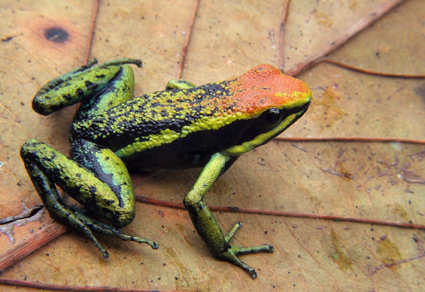
We describe a new species of poison frog from north-central Peru that was previously considered a morph of Ameerega bassleri. Our phylogenetic results indicate that A. bassleri as currently defined is polyphyletic, with the nominal clade (A. bassleri sensu stricto) sister to A. pepperi, and a second, as yet unnamed clade, sister to A. yoshina. This latter clade contains the well-known yellow morph occurring in the mountains near Tarapoto, which for the last ca. 20 years was erroneously thought to represent the nominal form of A. bassleri. Observations of color-pattern and analyses of male advertisement call traits (note-rate and dominant frequencies) reveal consistent differences between A. pepperi, A. yoshina, and the two lineages of A. bassleri (treated as separate groups), supporting the hypothesis that these four clades are independent evolutionary lineages. Based on these results, we restrict A. bassleri to the clade containing the Chrome-green and Black morphs and describe the Yellow morph as a new species.
References
- Andermann, T., Fernandes, A.M., Olsson, U., Töpel, M., Pfeil, B., Oxelman, B., Aleixo, A., Faircloth, B. & Antonelli, A. (2018) Allele phasing dreatly improves the phylogenetic utility of ultraconserved elements. Systematic Biology, 68 (1), 32–46. https://doi.org/10.1093/sysbio/syy039
- Bolger, A.M., Lohse, M. & Usadel, B. (2014) Trimmomatic: a flexible trimmer for Illumina sequence data. Bioinformatics, 30 (15), 2114–2120. https://doi.org/10.1093/bioinformatics/btu170
- Brown, J.L., Schulte, R. & Summers, K. (2006) A new species of Dendrobates (Anura: Dendrobatidae) from the Amazonian lowlands in Perú. Zootaxa, 1152 (1), 1–17. https://doi.org/10.11646/zootaxa.1152.1.2
- Brown, J.L. & Twomey, E.M. (2009) Complicated histories: three new species of poison frogs of the genus Ameerega (Anura: Dendrobatidae) from north-central Peru. Zootaxa, 2049 (1), 1–38. https://doi.org/10.11646/zootaxa.2049.1.1
- Brown, J.L. & Twomey, E.M. (2016a) Bassler’s Poison Frog. In: Kahn, T., Marca, E., Lötters, S. & Brown, J.L., Twomey, E.M. & Adolfo, A. (Eds.), Aposematic Poison Frogs (Dendrobatidae) of the Andean Countries: Bolivia, Colombia, Ecuador, Peru and Venezuela. Conservation International Tropical Field Guide Series. Conservation International, Arlington, Virginia, pp. 121–126.
- Brown, J.L. & Twomey, E.M. (2016b) Pepper’s Poison Frog. In: Kahn, T., Marca, E., Lötters, S. & Brown, J.L., Twomey, E.M. & Adolfo, A. (Eds.), Aposematic Poison Frogs (Dendrobatidae) of the Andean Countries: Bolivia, Colombia, Ecuador, Peru and Venezuela. Conservation International Tropical Field Guide Series. Conservation International, Arlington, Virginia, pp. 177–181.
- Brown, J.L. & Twomey, E.M. (2016c) Ameerega yoshina Brown and Twomey, 2009. In: Kahn, T., Marca, E., Lötters, S. & Brown, J.L., Twomey, E.M. & Adolfo, A. (Eds.), Aposematic Poison Frogs (Dendrobatidae) of the Andean Countries: Bolivia, Colombia, Ecuador, Peru and Venezuela. Conservation International Tropical Field Guide Series. Conservation International, Arlington, Virginia, pp. 230–234.
- Brown, J.L., Siu-Ting, K., von May, R., Twomey, E.M., Guillory, W.X., Deutsch, M.X. & Chávez, G. (2019) Systematics of the Ameerega rubriventris complex (Anura: Dendrobatidae) with descriptions of two new cryptic species from the East-Andean versant of Peru. Zootaxa, 4712 (2), 211–235. https://doi.org/10.11646/zootaxa.4712.2.3
- Claessens, L.S.A., Ganchev, N.O., Kukk, M.M., Schutte, C.J. & Sloggett, J.J. (2020) An investigation of toe‐tapping behaviour in anurans by analysis of online video resources. Journal of Zoology, 312 (3), 158–162. https://doi.org/10.1111/jzo.12815
- Clough, M. & Summers, K. (2000) Phylogenetic systematics and biogeography of the poison frogs: evidence from mitochondrial DNA sequences. Biological Journal of the Linnean Society, 70 (3), 515–540. https://doi.org/10.1111/j.1095-8312.2000.tb01236.x
- Edgar, R.C. (2004) MUSCLE: multiple sequence alignment with high accuracy and high throughput. Nucleic Acids Research, 32 (5), 1792–1797. https://doi.org/10.1093/nar/gkh340
- ESRI (2022) ArcGIS Desktop: Release 10.8.2. Environmental Systems Research Institute, Redlands, California. [program]
- Faircloth, B.C. (2013) Illumiprocessor: a trimmomatic wrapper for parallel adapter and quality trimming. Available from: https://github.com/faircloth-lab/illumiprocessor (accessed 21 December 2025) https://doi.org/10.6079/J9ILL
- Faircloth, B.C. (2016) PHYLUCE is a software package for the analysis of conserved genomic loci. Bioinformatics, 32 (5), 786–788. https://doi.org/10.1093/bioinformatics/btv646
- Faircloth, B.C., McCormack, J.E., Crawford, N.G., Harvey, M.G., Brumfield, R.T. & Glenn, T.C. (2012) Ultraconserved Elements anchor thousands of genetic markers spanning multiple evolutionary timescales. Systematic Biology, 61 (5), 717–726. https://doi.org/10.1093/sysbio/sys004
- French, C.M., Deutsch, M.S., Chávez, G., Almora, C.E. & Brown, J.L. (2019) Speciation with introgression: Phylogeography and systematics of the Ameerega petersi group (Dendrobatidae). Molecular Phylogenetics and Evolution, 138, 31–42. https://doi.org/10.1016/j.ympev.2019.05.021
- Grant, T., Frost, D.R., Caldwell, J.P., Gagliardo, R.G., Haddad, C.F.B., Kok, P.J.R., Means, B.D., Noonan, B.P., Schargel, W.C. & Wheeler, W.C. (2006) Phylogenetic systematics of dart-poison frogs and their relatives (Amphibia: Athesphatanura: Dendrobatidae). Bulletin of the American Museum of Natural History, 299, 1–262.
- Grant, T., Rada, M., Anganoy-Criollo, M., Batista, A., Henrique Dias, P., Moriguchi Jeckel, A., Machado, D.J. & Rueda-Almonacid, J.V. (2017) Phylogenetic systematics of dart-poison frogs and their relatives revisited (Anura: Dendrobatoidea). South American Journal of Herpetology, 12 (s1), S1–90. https://doi.org/10.2994/SAJH-D-17-00017.1
- Guillory, W.X. & Brown, J.L. (2021) A new method for integrating ecological niche modeling with phylogenetics to estimate ancestral distributions. Systematic Biology, 70 (5), 1033–1045. https://doi.org/10.1093/sysbio/syab016
- Guillory, W.X., French, C.M., Twomey, E.M., Chávez, G., Prates, I., von May, R., de la Riva, I., Lötters, S., Reichle, S., Serrano-Rojas, S.J., Whitworth, A., & Brown, J.L. (2020) Phylogenetic relationships and systematics of the Amazonian poison frog genus Ameerega using ultraconserved genomic elements. Molecular Phylogenetics and Evolution, 142, 106638. https://doi.org/10.1016/j.ympev.2019.106638
- Guillory, W.X., Muell, M.R., Summers, K. & Brown, J.L. (2019) Phylogenomic reconstruction of the Neotropical poison frogs (Dendrobatidae) and their conservation. Diversity, 11 (8), 126. https://doi.org/10.3390/d11080126
- Hagman, M., Pape, T. & Schulte, R. (2005) Flesh fly myiasis (Diptera, Sarcophagidae) in Peruvian poison frogs genus Epipedobates (Anura, Dendrobatidae). Phyllomedusa: Journal of Herpetology, 4 (1), 69. https://doi.org/10.11606/issn.2316-9079.v4i1p69-73
- Hijmans, R.J., Cameron, S.E., Parra, J.L., Jones, P.G. & Jarvis, A. (2005) Very high resolution interpolated climate surfaces for global land areas. International Journal of Climatology, 25, 1965–1978. https://doi.org/10.1002/joc.1276
- Jeckel, A.M., Bolton, S.K., Waters, K.R., Antoniazzi, M.M., Jared, C., Matsumura, K., Nishikawa, K., Morimoto, Y., Grant, T. & Saporito, R.A. (2022) Dose‐dependent alkaloid sequestration and N‐methylation of decahydroquinoline in poison frogs. Journal of Experimental Zoology Part A: Ecological and Integrative Physiology, 337 (5), 537–546. https://doi.org/10.1002/jez.2587
- Yang, K.L. (2022) Raven Pro: Interactive Sound Analysis Software. Version 1.6.3. Computer Software. The Cornell Lab of Ornithology, Ithaca, New York. Available from: https://ravensoundsoftware.com/ (accessed 21 December 2025)
- Kahn, T., Marca, E., Lötters, S., Brown, J.L., Twomey, E.M. & Adolfo, A. (2016) Aposematic Poison Frogs (Dendrobatidae) of the Andean Countries: Bolivia, Colombia, Ecuador, Peru and Venezuela. https://doi.org/10.13140/RG.2.1.3204.9360
- Kalyaanamoorthy, S., Minh, B.Q., Wong, T.K.F., von Haeseler, A. & Jermiin, L.S. (2017) ModelFinder: fast model selection for accurate phylogenetic estimates. Nature Methods, 14 (6), 587–589. https://doi.org/10.1038/nmeth.4285
- Köhler, J., Jansen, M., Rodríguez, A., Kok, P.J.R., Toledo, L.F., Emmrich, M., Glaw, F., Haddad, C.F.B., Rödel, M.O. & Vences, M.V. (2017) The use of bioacoustics in anuran taxonomy: theory, terminology, methods, and recommendations for best practice. Zootaxa, 4251 (1), 1–124. https://doi.org/10.11646/zootaxa.4251.1.1
- Lötters, S., Reichle, S. & Jungfer, K.-H. (2003) Advertisement calls of Neotropical poison frogs (Amphibia: Dendrobatidae) of the genera Colostethus, Dendrobates and Epipedobates, with notes on dendrobatid call classification. Journal of Natural History, 37, 1899–1911. https://doi.org/10.1080/00222930110089157
- Lötters, S., Jungfer, K.-H., Henkel, F. & Schmidt, W. (2007) Poison Frogs: Biology, Species & Captive Husbandry.
- Mayer, M., Böning, P., Lima, A., Krehenwinkel, H., Bitar, Y., Sérgio Bernarde, P., Veith, M., Souza, M. & Lötters, S. (2023) Disentangling the biogeographic history of a truly pan-Amazonian amphibian - the case of the three-striped poison frog, Ameerega trivittata (Dendrobatidae: Colostethinae). Salamandra, 59, 63–77.
- Medeiros, L.A., De, E.G., Kaefer, I.L. & Cohn-Haft, M. (2024) Distribution and diversification of Adelphobates, emblematic poison frogs from Brazilian Amazonia. Anais Da Academia Brasileira de Ciências, 96 (1), e20230659. https://doi.org/10.1590/0001-3765202320230659
- Melin, D. (1941) Contributions to the knowledge of the Amphibia of South America. Göteborgs Kungl. Vetenskaps-Och Vitterhets-Samhälles. Handlingar. Serien B, Matematiska Och Naturvetenskapliga Skrifter, 1, 1–71
- Minh, B.Q., Nguyen, M.A.T. & von Haeseler, A. (2013) Ultrafast approximation for phylogenetic bootstrap. Molecular Biology and Evolution, 30 (5), 1188–1195. https://doi.org/10.1093/molbev/mst024
- Morales, V.R. (1992) Dos especies nuevas de Dendrobates (Anura: Dendrobatidae) para Perú. Caribbean Journal of Science, 28, 191–199.
- Myers, C.W., Rodríguez, L. & Icochea, J. (1998) Epipedobates simulans, a new cryptic species of poison frog from south-eastern Peru, with notes on E. macero and E. petersi (Dendrobatidae). American Museum Novitates, 3238, 1–20.
- Myers, C.W. (1982) Spotted poison frogs: descriptions of three new Dendrobates from western Amazonia, and resurrection of a lost species from ‘Chiriqui.’ American Museum Novitates, 272, 1–23.
- Myers, C.W. (1987) New generic names for some neotropical poison frogs (Dendrobatidae). Papéis Avulsos de Zoologia, 36, 301–306. https://doi.org/10.11606/0031-1049.1983.36.p301-306
- Neves, M.O. (2017) A new species of poison frog, genus Ameerega (Anura: Dendrobatidae), from the southern Amazonian rain forest. Salamandra, 53 (4), 485–493.
- Nguyen, L.-T., Schmidt, H.A., von Haeseler, A. & Minh, B.Q. (2015) IQ-TREE: a fast and effective stochastic algorithm for estimating maximum-likelihood phylogenies. Molecular Biology and Evolution, 32 (1), 268–274. https://doi.org/10.1093/molbev/msu300
- Persons, N.W., Hosner, P.A., Meiklejohn, K.A., Braun, E.L. & Kimball, R.T. (2016) Sorting out relationships among the grouse and ptarmigan using intron, mitochondrial, and ultra-conserved element sequences. Molecular Phylogenetics and Evolution, 98 (5), 123–132. https://doi.org/10.1016/j.ympev.2016.02.003
- Prjibelski, A.D., Antipov, D., Meleshko, D., Lapidus & Korobeynikov, A. (2020) Using SPAdes de novo assembler. Bioinformatics, 70, e102. https://doi.org/10.1002/cpbi.102
- R Core Team (2024) R: a language and environment for statistical computing. R Foundation for Statistical Computing, Vienna, Austria. Available from: https://www.R-project.org/ (accessed 21 December 2025)
- Riechers, T., Krebs, H.C., Wartchow, R. & Habermehl, G. (1998) Cyclization of 3-Aminoacrylates – total synthesis of Pumiliotoxin C and related stereoisomeric compounds. European Journal of Organic Chemistry, 11, 2641–2646. https://doi.org/10.1002/(SICI)1099-0690(199811)1998:11<2641::AID-EJOC2641>3.0.CO;2-U
- Roberts, J.L., Brown, J.L., von May, R., Arizabal, W., Schulte, R. & Summers, K. (2006) Genetic divergence and speciation in lowland and montane Peruvian poison frogs. Molecular Phylogenetics and Evolution, 41 (1), 149–64. https://doi.org/10.1016/j.ympev.2006.05.005
- Roberts, J.L., Brown, J.L., Schulte, R., Arizabal, W. & Summers, K. (2007) Rapid diversification of colouration among populations of a poison frog isolated on sky peninsulas in the central cordilleras of Peru. Journal of Biogeography, 34 (3), 417–426. https://doi.org/10.1111/j.1365-2699.2006.01621.x
- Santos Dias, P., Brandão, A. & Grant, T. (2018) The buccopharyngeal morphology of the tadpole of Ameerega flavopicta (Anura: Dendrobatidae: Colostethinae), with a redescription of its external morphology. Herpetologica, 74 (4), 323–328. https://doi.org/10.1655/0018-0831.323
- Santos, J.C., Coloma, L.A., Summers, K., Caldwell, J.P., Ree, R. & Cannatella, D.C. (2009) Amazonian amphibian diversity is primarily derived from Late Miocene Andean lineages. PLoS Biology, 7 (3), e1000056. https://doi.org/10.1371/journal.pbio.1000056
- Schulte, R. (1986) Eine neue Dendrobates Art aus Ostperu (Amphibia: Salientia: Dendrobatidae). Sauria, 8 (3), 11–20.
- Schulte, R. (1999) Pfeilgiftfrösche Artenteil - Peru. INBICO, Wailblingen, 292 pp.
- Serrano-Rojas, S.J., Whitworth, A., Villacampa, J., von May, R., Gutiérrez, R.C., Padial, J.M. & Chaparro, J.P. (2017) A new species of poison-dart frog (Anura: Dendrobatidae) from Manu Province, Amazon region of southeastern Peru, with notes on its natural history, bioacoustics, phylogenetics, and recommended conservation status. Zootaxa, 4221 (1), 71–94. https://doi.org/10.11646/zootaxa.4221.1.3
- Silverstone, P.A. (1975) A revision of the poison-arrow frogs of the genus Dendrobates wagler. Bulletin of the Natural History Museum of Los Angeles County, 21, 1–55.
- Silverstone, P.A. (1976) A Revision of the poison-arrow frogs of the genus Phyllobates bibron in Sagra (family Dendrobatidae). Bulletin of the Natural History Museum of Los Angeles County, 27, 1–53.
- Simoes, P.I., Lima, A.P. & Farias, I.P. (2010) The description of a cryptic species related to the Pan-Amazonian frog Allobates femoralis (Boulenger 1883)(Anura: Aromobatidae). Zootaxa, 2406 (1), 1–28. https://doi.org/10.11646/zootaxa.2406.1.1
- Spande, T.F., Jain, P., Garraffo, H.M., Pannell, L.K., Yeh, H.J.C., Daly, J.W., Fukumoto, S., Imamura, K., Tokuyama, T., Torres, J.A., Snelling, R.R., & Jones, T.H. (1999) Occurrence and significance of decahydroquinolines from dendrobatid poison frogs and a myrmicine ant: use of1H and13C NMR in their conformational analysis. Journal of Natural Products, 62 (1), 5–21. https://doi.org/10.1021/np980298v
- Twomey, E.M. & Brown, J.L. (2008) A partial revision of the Ameerega hahneli complex (Anura: Dendrobatidae) and a new cryptic species from the East-Andean versant of Central Peru. Zootaxa, 1757 (1), 49–65. https://doi.org/10.11646/zootaxa.1757.1.3
- Twomey, E.M., Morales, V. & Summers, K. (2008a) The effect of kinship on intraspecific competition in larvae of the poison frog Ameerega bassleri (Anura: Dendrobatidae). Phyllomedusa, 7, 121–126. https://doi.org/10.11606/issn.2316-9079.v7i2p121-126
- Twomey, E.M., Morales, V. & Summers, K. (2008b) Evaluating Condition‐Specific and Asymmetric Competition in a Species‐Distribution Context. Oikos, 117 (8), 1175–1184. [http://www.jstor.org/stable/40235510] https://doi.org/10.1111/j.0030-1299.2008.16676.x
- Zhang, C., Rabiee, M., Sayyari, E. & Mirarab, S. (2018) ASTRAL-III: polynomial time species tree reconstruction from partially resolved gene trees. BMC Bioinformatics, 19 (S6), 153. https://doi.org/10.1186/s12859-018-2129-y
- Zimmermann, H. & Zimmermann, E. (1988) Etho-Taxonomie und zoogeographische Artengruppenbildung bei Pfeilgiftfröschen (Anura: Dendrobatidae). Salamandra, 24, 125–160.