

Abstract
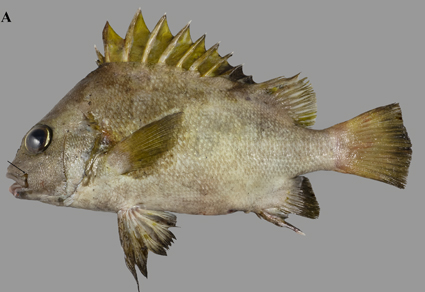
A new species of grunter, Hapalogenys olivaceus, is described based on two specimens trawled during a survey conducted by the research vessel Dr. Fridtjof Nansen from off Tanzania in 2023, representing the first record of the genus from the Western Indian Ocean. Phylogenetic analysis of the COI barcoding region revealed that the species is a member of the H. kishinouyei species complex, the known members of which are characterized by the presence of two to five longitudinal stripes on the body. However, Hapalogenys olivaceus sp. nov. differs from species of this complex by having a uniformly olive-brown head and body and a pale area posterior to the pectoral fins. In addition, the new species can be distinguished from all eight congeners by the following combination of characters: dorsal-fin rays XI,14; pored lateral-lines scales 44–45; nasal pore followed by a series of distinct pores along the ventral margin of the suborbital; suborbital deeply notched; maxilla scaly; relatively short soft rays in dorsal and anal fins; first pelvic-fin ray filamentous; and black membranes in the posterior portion of the spinous dorsal fin.
References
- Appleyard, S.A., Ward, R.D., Pogonoski, J.J., Graham, A., Last, P.R., Deagle, B.E., Holmes, B. & Gomon, M.F. (2024) Australia’s marine fishes DNA barcode reference library for integrated taxonomy, metabarcoding & eDNA research. Scientific Data, 12 (1), 21. https://doi.org/10.1038/s41597-025-04375-4
- Felsenstein, J. (1985) Confidence limits on phylogenies: an approach using the bootstrap. Evolution, 39, 783–791. https://doi.org/10.1111/j.1558-5646.1985.tb00420.x
- Gill, A.C. & Leis, J.M. (2019) Phylogenetic position of the fish genera Lobotes, Datnioides and Hapalogenys, with a reappraisal of acanthuriform composition and relationships based on adult and larval morphology. Zootaxa, 4680 (1), 1–81. https://doi.org/10.11646/zootaxa.4680.1.1
- Gong, L., Wang, K., Lu, Z., Liu, L., Zhang, T., Ping, H. & Shi, H. (2024) Comparative mitogenomes of Lobotiformes provides insights into the phylogentic position of Hapalogenyidae. Regional Studies in Marine Science, 75, 103580. https://doi.org/10.1016/j.rsma.2024.103580
- Hou, G., Chen, W.-T., Lu, H.-S., Cheng, F. & Xie, S.-G. (2017) Developing a DNA barcode library for perciform fishes in the South China Sea: Species identification, accuracy and cryptic diversity. Molecular Ecology Resources, 18 (1), 137–146. https://doi.org/10.1111/1755-0998.12718
- Hubbs, C.L. & Lagler, K.F. (1947) Guide to the fishes of the great lakes and tributary waters. Cranbrook Institute of Science Bulletin, 26, figs. 1–213.
- Iwatsuki, Y. & Nakabo, T. (2005) Redescription of Hapalogenys nigripinnis (Schlegel in Temminck & Schlegel, 1843), a senior synonym of H. nitens Richardson, 1844, and a new species from Japan. Copeia, 2005 (4), 854–867. https://doi.org/10.1643/0045-8511(2005)005[0854:ROHNSI]2.0.CO;2
- Iwatsuki, Y. & Russell, B.C. (2006) Revision of genus Hapalogenys (Teleostei: Perciformes) with two new species from Indo-West Pacific. Memoirs of Museum Victoria, 63 (1), 29–46. https://doi.org/10.24199/j.mmv.2006.63.6
- Iwatsuki, Y., Satapoomin, U. & Amaoka, K. (2000) New species: Hapalogenys merguiensis (Teleostei: Perciformes) from Andaman Sea. Copeia, 2000 (1), 129–139. https://doi.org/10.1643/0045-8511(2000)2000[0129:NSHMTP]2.0.CO;2
- Leis, J.M. & Carson-Ewart, B.M. (Eds.) (2000) The larvae of Indo-Pacific coastal fishes. An identification guide to marine fish larvae. Fauna Malesiana Handbooks 2. Brill, Leiden, 870 pp. https://doi.org/10.1163/9789004474857
- Matsunuma, M., Yoshida, T. & Motomura, H. (2017) Records of Spottobrotula mahodadi (Ophidiiformes: Ophidiidae) and Hapalogenys bengalensis (Perciformes: Hapalogenyidae) from the Andaman Sea, with a note on the fresh coloration of S. mahodadi. Species Diversity, 22, 73–79. https://doi.org/10.12782/sd.22_73
- McKay, R.J. (2001) Haemulidae. In: Carpenter, K.E. & Niem, V.H. (Eds.), FAO Species Identification Guide for Fisheries Purposes. The Living Marine Resources of the Western Central Pacific. Vol. 5. FAO, Rome, pp. 2961–2989.
- Mohapatra, A., Ray, D. & Kumar, V. (2013) A new fish species of the genus Hapalogenys (Perciformes: Hapalogenyidae) from the Bay of Bengal, India. Zootaxa, 3718 (4), 367–377. https://doi.org/10.11646/zootaxa.3718.4.6
- Parenti, P. (2019) Hapalogenyidae, a new family of Percomorpha fishes. aqua, International Journal of Ichthyology, 25 (2), 81–83.
- Psomadakis, P.N., Thein, H., Russell, B.C. & Tun, M.T. (2019) Field identification guide to the living marine resources of Myanmar. FAO Species Identification Guide for Fishery Purposes. FAO and MOALI, Rome, xvii+ 694 pp., 63 colour pls.
- Richardson, J. (1845) Ichthyology.--Part 2. In: Hinds, R.B. (Ed.), The zoology of the voyage of H. M. S. Sulphur, under the command of Captain Sir Edward Belcher, R. N., C. B., F. R. G. S., etc., during the years 1836–42. No. 9. Smith, Elder & Co, London, pp. 71–98.
- Sanciangco, M.D., Rocha, L.A. & Carpenter, K.E. (2011) A molecular phylogeny of the Grunts (Perciformes: Haemulidae) inferred using mitochondrial and nuclear genes. Zootaxa, 2966 (1), 37–50. https://doi.org/10.11646/zootaxa.2966.1.4
- Sanciangco, M.D., Carpenter, K.E. & Betancur-R.R. (2016) Phylogenetic placement of enigmatic percomorph families (Teleostei: Percomorphaceae). Molecular Phylogenetics and Evolution, 94, 565–576. https://doi.org/10.1016/j.ympev.2015.10.006
- Smith, H.M. & Pope, T.E.B. (1906) List of fishes collected in Japan in 1903, with description of new genera and species. Proceedings of the United States National Museum, 31 (1489), 459–499. https://doi.org/10.5479/si.00963801.31-1489.459
- Sunnucks, P. & Hales, D.F. (1996) Numerous transposed sequences of mitochondrial cytochrome oxidase I–II in aphids of the genus Sitobion (Hemiptera: Aphididae). Molecular Biology and Evolution, 13, 510–524. https://doi.org/10.1093/oxfordjournals.molbev.a025612
- Tamura, K., Stecher, G. & Kumar, S. (2021) MEGA11: molecular evolutionary genetics analysis version 11. Molecular Biology and Evolution, 38 (6), 3022–3027. https://doi.org/10.1093/molbev/msab120
- Temminck, C.J. & Schlegel, H. (1843) Pisces. In: Siebold, P.F. de (Ed.) Fauna Japonica, sive descriptio animalium, quae in itinere per Japoniam ... suscepto annis 1823-1830 collegit, notis, observationibus et adumbrationibus illustravit Ph. Fr. de Siebold. Parts 2–4. Lugduni Batavorum [Leiden], pp. 21–72.
- Wang, Z.-D., Guo, Y.-S., Liu, X.-M., Fan, Y.-B. & Liu, C.-W. (2012) DNA barcoding South China Sea fishes. Mitochondrial DNA, 23 (5), 405–410. https://doi.org/10.3109/19401736.2012.710204
- Ward, R.D., Zemlak, T.S., Innes, B.H., Last, P.R. & Hebert, P.D.N. (2005) DNA barcoding Australia’s fish species. Philosophical Transactions of the Royal Society B, 360, 1847–1857. https://doi.org/10.1098/rstb.2005.1716
- Xing, B., Lin, H., Zhang, Z., Wang, C., Wang, Y. & Wang, J. (2018) DNA barcoding for identification of fish species in the Taiwan Strait. PLoS ONE, 13 (6), e0198109. https://doi.org/10.1371/journal.pone.0198109
- Zhang, J. & Hanner, R. (2012) Molecular Approach to the Identification of Fish in the South China Sea. PLoS ONE, 7 (2), e30621. https://doi.org/10.1371/journal.pone.0030621