

Abstract
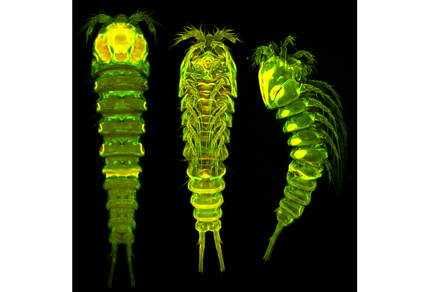
Findings of Enhydrosoma sarsi (Copepoda, Harpacticoida, Cletodidae T. Scott) in the Fehmarn Belt (western Baltic Sea, Germany) during the “MGF Ostsee” research mission enabled a comprehensive and detailed redescription of the species. This prompted a morphology-based phylogenetic study aiming to establish (i) Enhydrosoma as a monophylum and (ii) E. sarsi as a phylogenetically justifiable, distinct species. The phylogenetic characterisation of Enhydrosoma, based on 79 morphological characters, was subject to some reservations, because the four recognised apomorphies also occurred, at least sporadically, in the here compared genera Geehydrosoma, Kollerua, Limnocletodes, Schizacron, Spinapecruris and Strongylacron. In contrast, E. sarsi could be clearly characterised as a distinct species on the basis of six autapomorphies in mainly the antennula. Mitochondrial COI and nuclear 18S (V1–V2) sequence data obtained for selected Enhydrosoma species were used to reinforce morphological identifications and to support the phylogenetic framework. In the course of our phylogenetic analysis, it was noted that two of the 37 species currently assigned to Enhydrosoma must be excluded from the genus. Enhydrosoma pectinatum was transferred to the genus Geehydrosoma as G. pectinatum comb. nov., and E. wellsi to Cletodes as C. wellsi comb. nov. Further inconsistencies with regard to the characterisation of Enhydrosoma and the systematic relationships within the Cletodidae are illustrated with examples. They underline the need for a revision of the Cletodidae, with particular importance dedicated to the redescription of already known species.
References
- Arlt, G. (1983) Taxonomy and ecology of some harpacticoids (Crustacea, Copepoda) in the Baltic Sea and Kattegat. Zoologische Jahrbücher Systematik, 110, 45–85.
- Ax, P. (1984) Das phylogenetische System. Gustav Fischer Verlag, Stuttgart, 349 pp.
- Bodin, P. (1968) Copépodes Harpacticoïdes des étages bathyal et abyssal du Golfe de Gascogne. Mémoires du Muséum National d’Histoire Naturelle A, 55 (1), 1–107.
- Bodin, P. (1970) Copépodes Harpacticoïdes marins des environs de La Rochelle. 1. Espèces de la vase intertidale de Chatelaillon. Tethys, 2 (2), 385–436.
- Bodin, P. (1997) Catalogue of the new marine harpacticoid copepods (1997 edition). Documents de travail de l’Institut Royal des Sciences Naturelles de Belgique, 89, 1–304.
- Boxshall, G.A. & Halsey, S.H. (2004) An introduction to copepod diversit. Vols. 1 & 2. The Ray Society, London, 966 pp.
- BSH [Bundesamt für Seeschifffahrt und Hydrographie] (2023) INSPIRE-Thema Höhe (Bathymetrie). Version 1.0. GeoSeaPortal/GDI-BSH, Hamburg and Rostock. Available from: https://inspire-geoportal.ec.europa.eu/srv/eng/catalog.search#/metadata/5afbd3f9-8bd8-4bfc-a77c-ac3de4ace07f (accessed 7 April 2025)
- BSH [Bundesamt für Seeschifffahrt und Hydrographie] (2025) Seegrenzen der Bundesrepublik Deutschland. Version 1.0. GeoSeaPortal/GDI-BSH, Hamburg and Rostock, Available from: https://www.geoportal.de/Metadata/631b3032-8a57-4354-ba6b-7571ac38fcd7 (accessed 27 September 2025)
- Chislenko, L.L. (1978) New species of copepod harpacticids (Copepoda, Harpacticoida) from Poss’yet Bay, Sea of Japan. Trudy Zoologicheskogo Instituta, Akademii Nauk SSSR, Leningrad, 61, 161–192. [in Russian]
- Drzycimski, I. (1969) Harpactoida (Copepoda) of sea waters in Bergen region (west coast of Norway) and their ecology. Wyzsza Szkola Rolnicza v Szczecinie, 17, 1–72.
- EEA [European Environment Agency] (2017) EEA coastline for analysis (polygon). Version 3.0. EEA SDI (Spatial Data Infrastructure) Catalogue, Copenhagen. Available from: https://sdi.eea.europa.eu/catalogue/srv/api/records/9faa6ea1-372a-4826-a3c7-fb5b05e31c52 (accessed 27 September 2025)
- Fiers, F. (1987) Enhydrosoma vervoorti spec. nov., a new harpacticoid copepod from India (Harpacticoida, Cletodidae). Zoologische Mededelingen Leiden, 61 (20), 295–302.
- Fiers, F. (1996) Redescription of Enhydrosoma lacunae Jakubisiak, 1933 (Copepoda, Harpacticoida); with comments on the Enhydrosoma species reported from west Atlantic localities, and a discussion of cletodid development. Sarsia, 81 (1), 1–27. https://doi.org/10.1080/00364827.1996.10413608
- Folkers, C. & George, K.H. (2011) Community analysis of sublittoral Harpacticoida (Copepoda, Crustacea) in the western Baltic Sea. Hydrobiologia, 666, 11–20. https://doi.org/10.1007/s10750-010-0210-2
- Gee, J.M. (1994) Towards a revision of Enhydrosoma Boeck, 1872 (Harpacticoida: Cletodidae sensu Por); a re-examination of the type species, E. curticauda Boeck, 1872, and the establishment of Kollerua gen. nov. Sarsia, 79, 83–107. https://doi.org/10.1080/00364827.1994.10413550
- Gee, J.M. (1998) A revision of the genus Limnocletodes Borutzky, 1926 (Copepoda: Harpacticoida: Cletodidae) with a description of a new species from Southeast Asian mangrove forests. Raffles Bulletin of Zoology, Singapore, 46 (2), 399–418.
- Gee, J.M. (2001) A reappraisal of the taxonomic position of Enhydrosoma curvirostre (Copepoda: Harpacticoida: Cletodidae). Journal of the Marine Biological Association of the United Kingdom, 81, 33–42. https://doi.org/10.1017/s002531540100337x
- Gee, J.M. & Huys, R. (1996) An appraisal of the taxonomic position of Enhydrosoma buchholzi (Boeck, 1872), E. bifurcarostratum Shen & Tai, 1965, E. barnishi Wells, 1967, and E. vervoorti Fiers, 1987 with definition of two new genera. Sarsia, 81, 161–191. https://doi.org/10.1080/00364827.1996.10413620
- George, K.H. (2020) Restructuring the Ancorabolidae Sars (Copepoda, Harpacticoida) and Cletodidae T. Scott, with a new phylogenetic hypothesis regarding the relationships of the Laophontoidea T. Scott, Ancorabolidae and Cletodidae. Zoosystematics and Evolution, 96 (2), 455–498. https://doi.org/10.3897/zse.96.51349
- George, K.H. (2021) Four new genera of the Ceratonotus group (Copepoda, Harpacticoida), including the description of two new species. European Journal of Taxonomy, 74, 1–41. https://doi.org/10.5852/ejt.2021.774.1525
- Gogina, M. & Schönke, M. (2020) MGF-Ostsee Project: Potential effects of closure for bottom fishing in the marine protected areas (MPAs) of the western Baltic Sea – baseline observations. Cruise No. EMB238/Leg1+2, 26.05.2020–09.06.2020, Rostock (Germany)–Rostock (Germany). In: Elisabeth Mann Borgese-Berichte, Leibniz Institute for Baltic Sea Research Warnemünde (IOW), Rostock, pp. 1–43.
- Gómez, S. (2003) Three new species of Enhydrosoma and a new record of Enhydrosoma lacunae (Copepoda: Harpacticoida: Cletodidae) from the Eastern tropical Pacific. Journal of Crustacean Biology, 23 (1), 94–118. https://doi.org/10.1651/0278-0372(2003)023[0094:TNSOEA]2.0.CO;2
- Gómez, S. (2004) A new species of Enhydrosoma Boeck, 1872 (Copepoda: Harpacticoida: Cletodidae) from the Eastern Tropical Pacific. Proceedings of the Biological Society of Washington, 117 (4), 529–540.
- Gómez, S. & Nazari, F. (2022) Chalarosthrix gen. nov., a new taxon of the Sphingothrix-Triathrix clade (Harpacticoida: Cletodidae) from the Province of Cortez, Eastern Mexican Pacific. Zootaxa, 5116 (3), 410–428. https://doi.org/10.11646/zootaxa.5116.3.6
- GST, Geodatastyrelsen (2024) Danmarks Dybdemodel, 50 m opløsning (DDM50). Version 2.0. Available from: https://dataforsyningen.dk/data/4817 (accessed 7 April 2025)
- HELCOM (2019) Territorial waters. Version 1.0. HELCOM Metadata Catalogue/Baltic Marine Environment Protection Commission, Helsinki. Available from: https://metadata.helcom.fi/geonetwork/srv/eng/catalog.search#/metadata/8a393266-519d-4eaa-a94b-b67f9f589744 (accessed 27 September 2025)
- Hennig, W. (1982) Phylogenetische Systematik. Paul Parey Verlag, Hamburg, 246 pp.
- Huys, R. (1990) Adenopleurella, new genus, Proceropes, new genus, Sarsocletodes Wilson (ex Laophontidae), and Miroslavia Apostolov (ex Cletodidae): representatives of a new family (Copepoda: Harpacticoida). Journal of Crustacean Biology, 10 (2), 340–363. https://doi.org/10.1163/193724090X00140
- Huys, R., Gee, J.M., Moore, C.G. & Hamond, R. (1996) Marine and brackish water harpacticoid copepods. Part 1. Synopsis of the British Fauna, 51, 1–352.
- Jakobi, H. (1955) O gênero Enhydrosoma no manguezal da Costa Sao Paulo – Paraná. Duseina, 6, 89–96.
- Kamanli, S.A., Kihara, T.C., Ball, A.D., Morritt, D. & Clark, P.F. (2017) A 3D imaging and visualization workflow, using confocal microscopy and advanced image processing for brachyuran crab larvae. Journal of Microscopy, 266 (3), 307–323. https://doi.org/10.1111/jmi.12540
- Karanovic, T., Kim, K. & Lee, W. (2015) Concordance between molecular and morphology-based phylogenies of Korean Enhydrosoma (Copepoda: Harpacticoida: Cletodidae) highlights important synapomorphies and homoplasies in this genus globally. Zootaxa, 3990 (4), 451–496. https://doi.org/10.11646/zootaxa.3990.4.1
- Kim, K., Trebukhova, Y., Lee, W. & Karanovic, T. (2014) A new species of Enhydrosoma (Copepoda: Harpacticoida: Cletodidae) from Korea, with redescription of E. intermedia and establishment of a new genus. Proceedings of the Biological Society of Washington, 127 (1), 248–283. https://doi.org/10.2988/0006-324X-127.1.248
- Kunz, H. (1971) Verzeichnis der marinen und Brackwasser bewohnenden Harpacticoiden (Crustacea Copepoda) der deutschen Meeresküste. Kieler Meeresforschungen, 27 (1), 72–93.
- Lang, K. (1936a) Die Familie der Cletodidae Sars, 1909. Zoologische Jahrbücher, 68 (6), 445–480.
- Lang, K. (1936b) Undersökningar över Öresund. Untersuchungen aus dem Öresund. XX. Harpacticiden aus dem Öresund. Lunds Universitets Arsskrift, Nya Följden, 2 (31)8, 1–52.
- Lang, K. (1948) Monographie der Harpacticiden. Otto Koeltz Science Publishers, Königstein, 1682 pp.
- Lang, K. (1965) Copepoda Harpacticoida from the Californian pacific coast. Kungliga Svenska Vetenskapsakademiens Handlingar, 10 (2), 1–566.
- Monard, A. (1927) Synopsis universalis generum Harpacticoidarum. Zoologische Jahrbücher, 54, 139–176.
- Natural Earth (2025) Admin 0–Countries. Version 5.1.1. Available from: https://www.naturalearthdata.com/downloads/10m-cultural-vectors/10m-admin-0-countries/ (accessed 27 September 2025)
- Ostmann, A., Galarza Verkovich, D., Packmor, J., George, K.H., Martínez Arbizu, P. & Khodami, S. (in revision) Baseline studies on meiofauna in the Baltic Sea before bottom-trawl fisheries exclusion IV. First reference barcode libraries for Baltic harpacticoid copepods (Crustacea) reveal cryptic diversity and deep regional divergence. Marine Biology, 173 (2), 24.
- Packmor, J., George, K.H., Schönke, M. & Martínez Arbizu, P. (2025) Baseline studies on meiofauna in the Baltic Sea before bottom-trawl fisheries exclusion I: comparison of communities in the Fehmarn Belt (western Baltic Sea), with special reference to the Harpacticoida (Crustacea, Copepoda). Marine Biodiversity, 55, 11. https://doi.org/10.1007/s12526-024-01488-8
- Pallares, R.E. (1975) Copépodos marinos de la Ría Deseado (Santa Cruz, Argentina). Contribución sistemático-ecológica IV (conclusion). Physis, Sección A: Los Océanos y sus Organismos, 34 (89), 213–227.
- Park, E.-O., Rohal, M. & Lee, W. (2021) A new deep-sea Enhydrosoma (Copepoda, Harpacticoida, Cletodidae) from the northern Gulf of Mexico. Taxonomy, 1, 23–35. https://doi.org/10.3390/taxonomy1010004
- Por, F.D. (1960) Littorale Harpacticoiden der Nordwest-Küsten des Schwarzen Meeres. Travaux du Muséum National d’Histoire Naturelle “Grigore Antipa”, 2, 97–143.
- Por, F.D. (1986) A re-evaluation of the family Cletodidae Sars, Lang (Copepoda, Harpacticoida). Syllogeus, 58, 420–425.
- Raibaut, A. (1965) Sur quelques Cletodidae (Copepoda Harpacticoida) du Bassin de Thau. Crustaceana, 8 (2), 113–120. https://doi.org/10.1163/156854065X00631
- Rossel, S. & Martínez Arbizu, P. (2019) Revealing higher than expected diversity of Harpacticoida (Crustacea:Copepoda) in the North Sea using MALDI-TOF MS and molecular barcoding. Scientific Reports, 9 (1), 9182. https://doi.org/10.1038/s41598-019-45718-7
- Sars, G.O. (1921) Copepoda Supplement. An Account of the Crustacea of Norway. Vol. VII. The Bergen Museum, Bergen, 121 pp., 76 pls.
- Schminke, H.K. (1976) The ubiquitous telson and the deceptive furca. Crustaceana, 30 (3), 292–300. https://doi.org/10.1163/156854076x00657
- Scott, T. (1905) VI. – On some new and rare Crustacea from the Scottish Seas. Twenty-third annual Report of the Fishery Board for Scotland, Part 3, 23, 141–153.
- Sewell, R.B.S. (1949) The littoral and semi-parasitic Cyclopoida, the Monstrilloida and Notodelphyoida. Scientific Reports of the John Murray Expedition. Publications of the British Museum of Natural History, 9 (2), 17–199.
- Somerfield, P.J., Warwick, R.M. & Moens, T. (2005) Meiofauna techniques. In: Eleftheriou, A. & McIntyre, A. (Eds.), Methods for the study of marine benthos. Blackwell Science Ltd., Oxford, pp. 229–272. https://doi.org/10.1002/9780470995129.ch6
- Sonmez, S., Yildiz, I. & Karaytug, S. (2019) A new species of Enhydrosoma Boeck, 1872 (Copepoda: Harpacticoida: Cletodidae) from the Black Sea coast of Turkey with some remarks on the taxonomic status of E. Wellsi Bodin, 1968. Turkish Journal of Fisheries and Aquatic Sciences, 19 (10), 817–823. https://doi.org/10.4194/1303-2712-v19_10_01
- Sudhaus, W. & Rehfeldt, K. (1992) Einführung in die Phylogenetik und Systematik. Gustav Fischer Verlag, Stuttgart, 241 pp.
- Thistle, D. (1980) Enhydrosoma (Copepoda, Harpacticoida): An update and two new species. Transactions of the American Microscopic Society, 99 (4), 384–397. https://doi.org/10.2307/3225649
- Wägele, J.-W. (2001) Grundlagen der Phylogenetischen Systematik. Verlag Dr. Friedrich Pfeil, München, 320 pp.
- Walter, T.C. & Boxshall, G.A. (2025) World of Copepods Database. Cletodidae Scott T., 1904. Available from: https://www.marinespecies.org/aphia.php?p=taxdetails&id=115143 (accessed 8 September 2025)
- Wells, J.B.J. (2007) An annotated checklist and keys to the species of Copepoda Harpacticoida (Crustacea). Zootaxa, 1568 (1), 1–872. https://doi.org/10.11646/zootaxa.1568.1.1