

Abstract
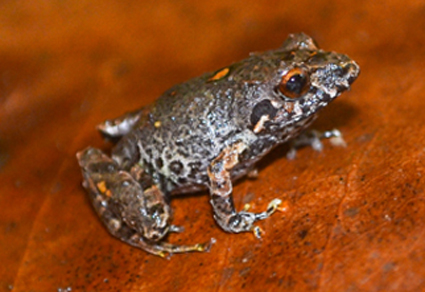
A new species of frog from the Ischnocnema lactea series is described from Serra do Caparaó mountain range, state of Espírito Santo, southeastern Brazil. It is a small robber frog characterized by distinct red coloration on its fingers and toes, as well as on its concealed areas of inguinal region, thigh, tibia, and tarsus. The description of the new species is based on morphological and mtDNA data, and it is placed within the I. lactea species series with high support values. Phylogenetic analyses place the new species as a sister species to I. bocaina and I. spanios, confirming its membership in the I. lactea series. The species was discovered at montane elevations in the Caparaó National Park, a region of great ecological significance as a remnant of the critically endangered Atlantic Forest biome. The discovery of this tiny new species highlights the biological richness of the Caparaó highlands and reinforces the importance of ongoing conservation efforts in this biodiversity hotspot.
References
- Almeida-Silva, D., Silva-Soares, T., Rodrigues, M.T. & Verdade, V.K. (2021) New species of flea-toad, genus Brachycephalus (Anura: Brachycephalidae) from the Atlantic Forest of Espírito Santo, Brazil. Zootaxa, 5068 (4), 517–532. https://doi.org/10.11646/zootaxa.5068.4.3
- Altschul, S.F., Gish, W., Miller, W., Myers, E.W. & Lipman, D.J. (1990) Basic local alignment search tool. Journal of Molecular Biology, 215 (3), 403–410. https://doi.org/10.1016/S0022-2836(05)80360-2
- Berneck, B.V.M., Targino, M. & Garcia, P.C.A. (2013) Rediscovery and re-description of Ischnocnema nigriventris (Lutz, 1925) (Anura: Terrarana: Brachycephalidae). Zootaxa, 3692 (2), 131–142. https://doi.org/10.11646/zootaxa.3694.2.2
- Bruford, M.W., Hanotte, O., Brookfield, J.F.Y. & Burke, T. (1992) Single-locus and multilocus DNA fingerprinting. In: Hoelzel, A.R. (Ed.), Molecular Genetic Analysis of Populations: A Practical Approach. IRL Press, Oxford, pp. 225–269.
- Caramaschi, U. & Canedo, C. (2006) Reassessment of the taxonomic status of the genera Ischnocnema Reinhardt and Lütken, 1862 and Oreobates Jiménez-de-la-Espada, 1872, with notes on the synonymy of Leiuperus verrucosus Reinhardt and Lütken, 1862 (Anura: Leptodactylidae). Zootaxa, 1116 (1), 43–54. https://doi.org/10.11646/zootaxa.1116.1.3
- Cochran, D.M. (1948) Uma nova subespécie de sapo de Itatiaya, Brasil. Museu Americano Novitates, 1375, 1–3.
- Cruz, C.A.G. & Feio, R.N. (2007) Endemismos em Anfíbios em Áreas de Altitude na Mata Atlântica no Sudeste do Brasil. In: Nascimento, L.B. & Oliveira, E.M. (Eds.), Herpetologia no Brasil 2. Sociedade Brasileira de Herpetologia, Belo Horizonte, pp. 117–126.
- Duellman, W.E. (1970) The hylid frogs of Middle America. Monograph of the Museum of Natural History, University of Kansas. Museum of Natural History, University of Kansas, Lawrence, Kansas, 753 pp. https://doi.org/10.5962/bhl.title.2835
- Duellman, W.E. (2001) The Hylid Frogs of Middle America. Society for the Study of Amphibians and Reptiles, Ithaca, New York, 1158 pp.
- Eisenlohr, P.V., de Oliveira-Filho, A.T. & Prado, J. (2015) The Brazilian Atlantic Forest: how much is left, and how is the remaining forest distributed? Implications for conservation. Biological Conservation, 142, 1141–1153. https://doi.org/10.1016/j.biocon.2009.02.021
- Eterovick, P.C. & Sazima, I. (2004) Amphibians of Serra do Cipó, Minas Gerais, Brazil. PUC-Minas, Belo Horizonte, 150 pp.
- Fitzinger, L.J.F.J. (1826) Neue Classification der Reptilien nach ihren Natürlichen Verwandtschaften nebst einer Verwandtschafts-Tafel und einem Verzeichnisse der Reptilien-Sammlung des KK. Zoologisch Museum’s zu Wien. JG Heubner, Vienna, 120 pp. https://doi.org/10.5962/bhl.title.4683
- Frost, D.R. (2026) Amphibian Species of the World: an Online Reference. American Museum of Natural History, New York, New York. Available from: http://research.amnh.org/herpetology/amphibia/index.html (accessed 9 February 2026)
- Galindo-Leal, C. & Câmara, I.G. (2005) Status do hotspot Mata Atlântica: uma síntese. In: Galindo-Leal, C. & Câmara, I.G. (Eds.), Mata Atlântica: Biodiversidade, Ameaças e Perspectivas. Conservação Internacional, Belo Horizonte, pp. 3–11.
- Garcia, P.C.A., Vinciprova, G. & Haddad, C.F.B. (2003) the Taxonomic Status of Hyla Pulchella Joaquini (Anura: Hylidae) With Description of Its Tadpole and Vocalization. Herpetologica, 59, 350–363. https://doi.org/10.1655/01-54
- Giaretta, A.A., Toffoli, D. & Oliveira, L.E.A. (2007) New species of Ischnocnema (Anura: Eleutherodactylinae) from open areas of the Cerrado Biome in southeastern Brazil. Zootaxa, 1666 (1), 53–51. https://doi.org/10.11646/zootaxa.1666.1.3
- Günther, A.C.L.G. (1858) Neue Batrachier in der Sammlung des britischen Museums. In: Archiv für Naturgeschichte. Vol. 24. Issue 1. Nicolaische Verlagsbuchhandlung, Berlin, pp. 319–328. https://doi.org/10.5962/bhl.part.5288
- Hedges, S.B., Duellman, W.E. & Heinicke, M.P. (2008) New World direct-developing frogs (Anura: Terrarana): molecular phylogeny, classification, biogeography, and conservation. Zootaxa, 1737 (1), 1–182. https://doi.org/10.11646/zootaxa.1737.1.1
- Heinicke, M.P., Duellman, W.E. & Hedges, S.B. (2007) Major Caribbean and Central American frog faunas originated by ancient oceanic dispersal. Proceedings of the National Academy of Sciences, 104, 10092–10097. https://doi.org/10.1073/pnas.0611051104
- Heyer, W.R. (1984) Variation, systematics, and zoogeography of Eleutherodactylus guentheri and closely related species (Amphibia: Anura: Leptodactylidae). Smithsonian Contributions to Zoology 402: 1–42.
- Heyer, W.R. (1985) New species of frogs from Boracéia, São Paulo, Brazil. Proceedings of the Biological Society of Washington, 98, 675–671.
- Heyer, W.R., Rand, A.S., Cruz, C.A.G., Peixoto, O.L. & Nelson, C.E. (1990) Frogs of Boracéia. Arquivos de Zoologia, São Paulo 31: 231–410.
- Hoang, D.T., Chernomor, O., von Haeseler, A., Qureshi, M., Ragan, M.A. & Minh, B.Q. (2018) UFBoot2: Improving the ultrafast bootstrap approximation. Molecular Biology and Evolution, 35 (2), 518–522. https://doi.org/10.1093/molbev/msx281
- ICMBio [Instituto Chico Mendes de Conservação da Biodiversidade] (2015) Plano de Manejo do Parque Nacional de Caparaó. ICMBio—Instituto Chico Mendes de Conservação da Biodiversidade (2015) Plano de Manejo do Parque Nacional de Caparaó. Brasília, Brasil, 537 pp.Brasília, Brasil, 537 pp.
- Jiménez de la Espada, M. (1872) Nuevos batrácios Americanos. Anales da Sociedade Espanhola de História Natural, 1, 84–88.
- Kaizer, M.C.Z., Francisco, T.M., Couto, D.R. & Lacerda, J.V.A. (2024) Biodiversidade do Parque Nacional do Caparaó. Eco-Diversa, Tombos, 120 pp.
- Kearse, M., Moir, R., Wilson, A., Stones-Havas, S., Cheung, M., Sturrock, S., Buxton, S., Cooper, A., Markowitz, S., Duran, C., Thierer, T., Ashton, B. & Williams, D. (2012) Geneious Basic: An integrated and extendable desktop software platform for the organization and analysis of sequence data. Bioinformatics, 28 (12), 1647–1649. https://doi.org/10.1093/bioinformatics/bts199
- Langone, J.A. & Segalla, M.V. (1996) Uma nova espécie de Eleutherodactylus do Estado do Paraná, Brasil. Comunicaciones Zoológicas do Museu de História Natural de Montevidéu, 12, 1–5.
- Lima, R.A.F., Mori, D.P., Pitta, G., Melito, M.O., Bello, C. & Magnago, L.F.S. (2015) How much do we know about the endangered Atlantic Forest? Reviewing nearly 70 years of information on tree community surveys. Biodiversity and Conservation, 24, 2135–2148. https://doi.org/10.1007/s10531-015-0953-1
- Lira, P.K., Portela, R.C.Q. & Tambosi, L.R. (2021) Land-cover changes and an uncertain future: will the Brazilian Atlantic Forest lose the chance to become a hopespot? In: Marques, M.C.M. & Grelle, C.E.V. (Eds.), The Atlantic Forest: history, biodiversity, threats and opportunities of the megadiverse forest. Springer, Cham, pp. 233–252. https://doi.org/10.1007/978-3-030-55322-7_11
- Lutz, A. (1925) Batraciens du Brésil. Comptes Rendus et Mémoires Hebdomadaires des Séances da Société de Biologie et des ses Filiales, 93, 137–139.
- Lynch, J.D. & Duellman, W.E. (1997) Frogs of the genus Eleutherodactylus (Anura: Leptodactylidae) in western Ecuador: systematics, ecology, and biogeography. Natural History Museum, University of Kansas, Lawrence, Kansas, 236 pp. https://doi.org/10.5962/bhl.title.7951
- Martins, I.A. & Haddad, C.F.B. (2010) Uma nova espécie de Ischnocnema das terras altas da Mata Atlântica, Sudeste do Brasil (Terrarana, Brachycephalidae). Zootaxa, 2617 (1), 55–65. https://doi.org/10.11646/zootaxa.2617.1.2
- Minh, B.Q., Schmidt, H.A., Chernomor, O., Schrempf, D., Woodhams, M.D., Haeseler, A.V. & Lanfear, R. (2020) IQ-TREE 2: New models and efficient methods for phylogenetic inference in the genomic era. Molecular Biology and Evolution, 37 (5), 1530–1534. https://doi.org/10.1093/molbev/msaa015
- Miranda-Ribeiro, A. (1923) Basanitia lactea (Um novo batracchio das coleções do Museu Paulista). Revista do Museu Paulista, 13, 851–852.
- Miranda-Ribeiro, A. (1926) Notas para servirem ao estudo dos Gymnobatrachios (Anura) brasileiros. Arquivos do Museu Nacional, 27, 1–227.
- Myers, N., Mittermeier, R.A., Mittermeier, C.G., Fonseca, G.A.B. & Kent, J. (2000) Biodiversity hotspots for conservation priorities. Nature, 403, 853–858. https://doi.org/10.1038/35002501
- Navas, C.A. & Otani, L. (2007) Physiology, environmental change, and anuran conservation. Phyllomedusa, 6, 83–103. https://doi.org/10.11606/issn.2316-9079.v6i2p83-103
- Novaes, C.L., Kaizer, M.C., Francisco, T.M. & Couto, D.R. (2024) Parque Nacional do Caparaó. In: Kaizer, M.D.C., Francisco, T.M., Couto, D.R. & Lacerda, J.V.A. (Eds.), Biodiversidade do Parque Nacional do Caparaó. Eco-Diversa, Tombos, Minas Gerais, pp. 11–10.
- Padial, J.M., Reichle, S. & De la Riva, I. (2005) New species of Ischnocnema (Anura: Leptodactylidae) from the Andes of Bolivia. Journal of Herpetology, 392, 186–191. https://doi.org/10.1670/109-04A
- Padial, J.M., Miralles, A., De la Riva, I. & Vences, I. (2010) The integrative future of taxonomy. Frontiers in Zoology, 7, 16. https://doi.org/10.1186/1742-9994-7-16
- Palumbi, S.R., Martin, A., Romano, S., McMillan, W.O., Stice, L. & Grabowski, G. (1991) The Simple Fool’s Guide to PCR, Version 2.0. University of Hawaii, Department of Zoology and Kewalo Marine Laboratory, Honolulu, Hawaii, 45 pp.
- Pombal Jr, J.P. (1999) Oviposição e desenvolvimento de Brachycephalus ephippium (Spix) (Anura: Brachycephalidae). Revista Brasileira de Zoologia, 16, 947–956. https://doi.org/10.1590/S0101-81751999000400004
- Ribeiro, M.C., Metzger, J.P., Martensen, A.C., Ponzoni, F.J. & Hirota, M.M. (2009) The Brazilian Atlantic Forest: how much is left, and how is the remaining forest distributed? Implications for conservation. Biological Conservation, 142, 1141–1153.
- Rossa-Feres, D.C.C., Garey, M.V., Caramaschi, U., Napoli, M.F., Nomura, F., Bispo, A.A., Brasileiro, C.A., Thomé, M.T.C., Sawaya, R.J., Conte, C.E., Cruz, C.A.G., Nascimento, L.B., Gasparini, J.L., Almeida, A.D.P. & Haddad, C.F.B. (2017) Anfíbios da Mata Atlântica: lista de espécies, histórico dos estudos, biologia e conservação. In: Monteiro Filho, E.L.A. & Conte, C.E. (Eds.), Revisões em Zoologia: Mata Atlântica. UFPR, Curitiba, pp. 237–314.
- Silva-Soares, T., Malagoli, L.R., Cruz, C.A.G. & Caramaschi, U. (2018) On the taxonomy and natural history of the secretive Ischnocnema lactea (Miranda-Ribeiro, 1923) (Anura: Brachycephaloidea: Brachycephalidae). Zootaxa, 4444 (1), 137–153. https://doi.org/10.11646/zootaxa.4444.1.8
- Struck, T.H., Feder, J.L., Bendiksby, M., Birkeland, S., Cerca, J., Gusarov, V.I., Kistenich, S., Larsson, K.H., Liow, L.H., Nowak, M.D., Stedje, B., Bachmann, L. & Dimitrov, D. (2018) Finding evolutionary processes hidden in cryptic species. Trends in Ecology & Evolution, 33, 153–163. https://doi.org/10.1016/j.tree.2017.11.007
- Targino, M. & de Carvalho-e-Silva, S.P. (2008) Redescrição de Ischnocnema holti (Amphibia: Anura: Brachycephalidae). Revista Brasileira de Zoologia, 25, 716–723.
- Targino, M., Costa, P.N. & Carvalho-e-Silva, S.P. (2009) Duas novas espécies da série de espécies Ischnocnema lactea do planalto de Itatiaia, sudeste do Brasil (Amphibia, Anura, Brachycephalidae). Revista Sul-Americana de Herpetologia, 4, 139–150. https://doi.org/10.2994/057.004.0205
- Taucce, P.P., Canedo, C., Parreiras, J.S., Drummond, L.O., Nogueira-Costa, P. & Haddad, C.F. (2018) Molecular phylogeny of Ischnocnema (Anura: Brachycephalidae) with the redefinition of its series and the description of two new species. Molecular Phylogenetics & Evolution, 128, 123–146. https://doi.org/10.1016/j.ympev.2018.07.007
- Taucce, P.P., Zaidan, B.F., Zaher, H. & Garcia, P.C. (2019) A new species of Ischnocnema Reinhardt and Lütken, 1862 (Anura: Brachycephalidae) of the I. lactea species series from southeastern Brazil. Zootaxa, 4706 (4), 531–545. https://doi.org/10.11646/zootaxa.4706.4.3
- Thompson, J.D., Higgins, D.G. & Gibson, T.J. (1994) CLUSTAL W: Improving the sensitivity of progressive multiple sequence alignment through sequence weighting, position-specific gap penalties and weight matrix choice. Nucleic Acids Research, 22 (22), 4673–4680. https://doi.org/10.1093/nar/22.22.4673
- Van-Sluys, M., Cruzm, C.A.G., Vrcibradic, D., Silva, H.R., Gomes, A.M. & Rocha, C.F.D. (2009) Anfíbios nos Remanescentes Florestais de Mata Atlântica no Estado do Rio de Janerio. In: Bergallo, H.G., Fidalgo, E.C.C., Rocha, C.F.D., Uzêda, M.C., Costa, M.B., Alves, M.A.S., Van-Sluys, M., Santos, M.A., Costa, T.C.C. & Cozzolino, A.C.R. (Eds.), Estratégias e Ações para a conservação da Biodiversidade no Estado do Rio de Janeiro. Instituto Biomas, Rio de Janeiro, pp. 175–182.
- Whitfield, S.M., Bell, K.E., Philippi, T., Sasa, M., Bolaños, F., Chaves, G., Savage, J.M. & Donnelly, M.A. (2007) Amphibian and reptile declines over 35 years at La Selva, Costa Rica. Proceedings of the National Academy of Sciences of the United States of America, 104, 8352–8356. https://doi.org/10.1073/pnas.0611256104