

Abstract
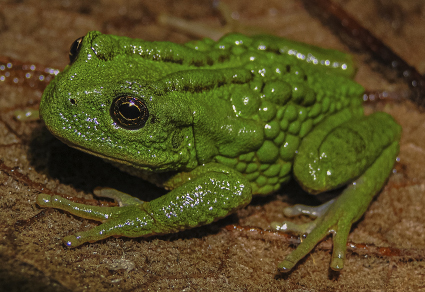
We describe Gastrotheca mittaliiti sp. nov. from the subalpine paramo of Amazonas department in the Andes of northern Peru, in the Huancabamba region, based on phylogenetic analysis of DNA sequences from three mitochondrial and two nuclear genes, genetic distances, and diagnostic morphological characters. Our phylogenetic analysis recovered the new species with high support both as part of the Gastrotheca marsupiata species group and as the sister species of G. trachyplevra. The new species can be distinguished from the rest of its congeners by the combination of the following characters: (i) moderately small size in males (SVL = 27.6–32.5 mm, n = 4); (ii) distinctly thick and elevated supratympanic fold extending from the top edge of the tympanum to the flank covered with prominent and closely packed or fused pustules; (iii) two prominent paravertebral longitudinal pustular ridges; (iv) narrow discs on fingers and toes with truncate terminal margins; (v) dorsum covered with prominent and closely packed rounded pustules; (vi) canthus rostralis thin and straight in dorsal view; and (vii) distal subarticular tubercle rounded. In addition, we report the first record of G. turnerorum in Peru and describe new morphological variation of the Peruvian populations. Our results highlight the Huancabamba region as the hotspot of Gastrotheca species richness, a result that we discuss from a biogeographic and conservation perspective.
References
- AmphibiaWeb (2025) AmphibiaWeb. University of California, Berkeley, California. Available from: https://amphibiaweb.org/ (accessed 8 July 2025)
- Cadle, J.E. (1991) Systematics of lizards of the genus Stenocercus (Iguania: Tropiduridae) from northern Perú: New species and comments on relationships and distribution patterns. Proceedings of the Academy of Natural Sciences of Philadelphia, 143, 1–96.
- Carvajal-Endara, S., Coloma, L.A., Morales-Mite, M.A., Guayasamin, J.M., Szekely, P. & Duellman, W.E. (2019) Phylogenetic systematics, ecology, and conservation of marsupial frogs (Anura: Hemiphractidae) from the Andes of southern Ecuador, with descriptions of four new biphasic species. Zootaxa, 4562 (1), 1–102. https://doi.org/10.11646/zootaxa.4562.1.1
- Castroviejo-Fisher, S., Padial, J.M., De La Riva, I., Pombal Jr, J.P., Da Silva, H.R., Rojas-Runjaic, F.J.M., Medina-Méndez, E. & Frost, D.R. (2015) Phylogenetic systematics of egg-brooding frogs (Anura: Hemiphractidae) and the evolution of direct development. Zootaxa, 4004 (1), 1–75. https://doi.org/10.11646/zootaxa.4004.1.1
- CDC-UNALM (2006) Análisis del Recubrimiento Ecológico del Sistema Nacional de Áreas Naturales Protegidas por el Estado. CDC-UNALM/TNC, Lima, 170 pp.
- de Queiroz, K. (1998) The general lineage concept of species, species criteria, and the process of speciation. In: Howard, D.J. & Berlocher, S.H. (Eds.), Endless forms: species and speciation. Oxford University Press, New York, New York, pp. 57–75. https://doi.org/10.1093/oso/9780195109009.003.0005
- del Pino, E.M., Galarza, M.L., de Albuja, C.M. & Humphries Jr., A.A. (1975) The maternal pouch and development in the marsupial frog Gastrotheca riobambae (Fowler). Biology Bulletin, 149, 480–491. https://doi.org/10.2307/1540381
- Duellman, W.E. (1979) The herpetofauna of the Andes: Patterns of distribution, origins, differentiation, and present communities. In: Duellman, W.E. (Ed.), The South American Herpetofauna: Its Origin, Evolution, and Dispersal. Museum of Natural History, the University of Kansas, Lawrence, Kansas, pp. 371–459. https://doi.org/10.5962/bhl.title.3207
- Duellman, W.E. (2013) An elusive new species of Marsupial frogs (Anura: Hemiphractidae: Gastrotheca) from the Andes of northern Peru. Phyllomedusa, 12, 3–11. https://doi.org/10.11606/issn.2316-9079.v12i1p3-11
- Duellman, W.E. (2015) Marsupial frogs: Gastrotheca and allied genera. The Johns Hopkins University Press, Baltimore, Maryland, 432 pp. https://doi.org/10.1353/book.40894
- Duellman, W.E., Barley, A.J. & Venegas P.J. (2014) Cryptic species diversity in marsupial frogs (Anura: Hemiphractidae: Gastrotheca) in the Andes of northern Peru. Zootaxa, 3768 (2), 159–177. https://doi.org/10.11646/zootaxa.3768.2.4
- Duellman, W.E., Catenazzi, A. & Blackburn, D.C. (2011) A new species of marsupial frog (Anura: Hemiphractidae: Gastrotheca) from the Andes of southern Peru. Zootaxa, 3095 (1), 1–14. https://doi.org/10.11646/zootaxa.3095.1.1
- Duellman, W.E., Lehr, E. & Aguilar, C. (2001) A New Species of Marsupial Frog (Anura: Hylidae: Gastrotheca). Museum of Natural History, the University of Kansas, 22, 1–10. https://doi.org/10.5962/bhl.title.16290
- Duellman, W.E., Lehr, E., Rodriguez, D. & von May, R. (2004) Two new species of marsupial frogs (Anura: Hylidae: Gastrotheca) from the Cordillera Oriental in central Peru. Museum of Natural History, the University of Kansas, 32, 1–10. https://doi.org/10.5962/bhl.title.8483
- Duellman, W.E. & Pramuk, J.B. (1999) Frogs of the genus Eleutherodactylus (Anura: Leptodactylidae) in the Andes of Northern Peru. Museum of Natural History, the University of Kansas, 13, 1–78. https://doi.org/10.5962/bhl.title.16169
- Duellman, W.E., Trueb, L. & Lehr, E. (2006) A new species of marsupial frog (Anura: Hylidae: Gastrotheca) from the Amazonian Slopes of the Cordillera Oriental in Peru. Copeia, 2006, 595–603. https://doi.org/10.1643/0045-8511(2006)6[595:ANSOMF]2.0.CO;2
- Duellman, W.E. & Venegas, P.J. (2005) Marsupial frogs (Anura: Hylidae: Gastrotheca) from the Andes of northern Peru with descriptions of two new species. Herpetologica, 61, 295–307. https://doi.org/10.1655/04-105.1
- Duellman, W.E. & Venegas, P.J. (2016) Diversity of marsupial frogs (Anura: Hemiphractidae: Gastrotheca) in the northern Cordillera Central, Peru, with the descriptions of two new species. Phyllomedusa, 15, 103–117. https://doi.org/10.11606/issn.2316-9079.v15i2p103-117
- Dufresnes, C., Brelsford, A., Jeffries, D.L., Mazepa, G., Suchan, T., Canestrelli, D., Nicieza, A., Fumagalli, L., Dubey, S., Martínez-Solano, I., Litvinchuk, S.N., Vences, M., Perrin, N., Crochet, P.A., Joly, P., Glenn, T.C., Arntzen, J.W., Beukema, W., Boissinot, S., Drillon, V., Gvoždík, V., Jablonski, D., Kryvokhyzha, D., Litvinchuk, S.N., Martínez-Solano, I., Mazepa, G., Perrin, N., Suchan, T., Vences, M., Wielstra, B. & Crochet, P.A. (2021) Mass of genes rather than master genes underlie the genomic architecture of amphibian speciation. Proceedings of the National Academy of Sciences, 118, e2103963118. https://doi.org/10.1073/pnas.2103963118
- Echevarría, L.Y., De la Riva, I., Venegas, P.J., Rojas‐Runjaic, F.J.M., R. Dias, I. & Castroviejo‐Fisher, S. (2021) Total evidence and sensitivity phylogenetic analyses of egg‐brooding frogs (Anura: Hemiphractidae). Cladistics, 37, 375–401. https://doi.org/10.1111/cla.12447
- Echevarría, L.Y., Paluh, D.J., García-Ayachi, L.A., Venegas, P.J., Catenazzi, A., Pradel, R. & Castroviejo-Fisher, S. (2022) Two new species of marsupial frogs (Anura: Hemiphractidae) from the Central Andes of northern Peru. Salamandra, 58, 1–23.
- Fjeldsả, J. & Krabbe, N. (1990) Birds of the high Andes: a manual to the birds of the temperate zone of the Andes and Patagonia, South America. Zoological Museum, University of Copenhagen, Copenhagen, 880 pp.
- Frost, D.R. (2024) Amphibian Species of the World: An Online Reference. Version 6.1. Available from: https://amphibiansoftheworld.amnh.org/index.php (accessed 8 May 2025)
- Guindon, S., Dufayard, J.-F., Lefort, V., Anisimova, M., Hordijk, W. & Gascuel, O. (2010) New algorithms and methods to estimate maximum-likelihood phylogenies: assessing the performance of PhyML 3.0. Systematic Biology, 59, 307–321. https://doi.org/10.1093/sysbio/syq010
- Hazzi, N.A., Moreno, J.S., Ortiz-Movliav, C. & Palacio, R.D. (2018) Biogeographic regions and events of isolation and diversification of the endemic biota of the tropical Andes. Proceedings of the National Academy of Sciences, 115, 7985–7990. https://doi.org/10.1073/pnas.1803908115
- Hoang, D.T., Chernomor, O., Von Haeseler, A., Minh, B.Q. & Vinh, L.S. (2018) UFBoot2: improving the ultrafast bootstrap approximation. Molecular Biology and Evolution, 35, 518–522. https://doi.org/10.1093/molbev/msx281
- Kalyaanamoorthy, S., Minh, B.Q., Wong, T.K.F., Von Haeseler, A. & Jermiin, L.S. (2017) ModelFinder: fast model selection for accurate phylogenetic estimates. Nature methods, 14, 587–589. https://doi.org/10.1038/nmeth.4285
- Katoh, K., Rozewicki, J. & Yamada, K.D. (2019) MAFFT online service: multiple sequence alignment, interactive sequence choice and visualization. Briefings Bioinform, 20, 1160–1166. https://doi.org/10.1093/bib/bbx108
- Köhler, J., Koch, C., Garlacz, R., Preick, M., De la Riva, I. & Vences, M. (2024) Getting back to name-bearing types: archival DNA and morphology clarify the identity of Hyla splendens Schmidt, 1857 and challenge the taxonomy of Bolivian populations of Gastrotheca (Anura: Hemiphractidae). Salamandra, 60, 263–282.
- Kumar, S., Stecher, G., Li, M., Knyaz, C. & Tamura, K. (2018) MEGA X: molecular evolutionary genetics analysis across computing platforms. Molecular Biology and Evolution, 35, 1547. https://doi.org/10.1093/molbev/msy096
- Kuraku, S., Zmasek, C.M., Nishimura, O. & Katoh, K. (2013) aLeaves facilitates on-demand exploration of metazoan gene family trees on MAFFT sequence alignment server with enhanced interactivity. Nucleic Acids Research, 41, W22–W28. https://doi.org/10.1093/nar/gkt389
- Lansac, C., Aguayo, R. & De la Riva, I. (2021) An assessment of the taxonomic validity of three species of marsupial frogs (Anura: Hemiphractidae: Gastrotheca) from the Yungas of Bolivia based on external morphology and cranial osteology. Zootaxa, 5068 (2), 211–239. https://doi.org/10.11646/zootaxa.5068.2.3
- Lehr, E. & Catenazzi, A. (2011) A new species of marsupial frog (Anura: Hemiphractidae: Gastrotheca) from the Río Abiseo National Park in Peru. Herpetologica, 67, 449–459. https://doi.org/10.1655/HERPETOLOGICA-D-11-00002.1
- Luedtke, J.A., Chanson, J., Neam, K., Hobin, L., Maciel, A.O., Catenazzi, A., Borzée, A., Hamidy, A., Aowphol, A. & Jean, A. (2023) Ongoing declines for the world’s amphibians in the face of emerging threats. Nature, 622, 308–314. https://doi.org/10.1038/s41586-023-06578-4
- Mayden, R.L. (1997) A hierarchy of species concepts: The denouement in the saga of the species problem. In: Claridge, M.F., Dawah, H.A. & Wilson, M.R. (Eds.), Species: The units of biodiversity. Chapman and Hall, London, pp. 381–424.
- Minh, B.Q., Nguyen, M.A.T. & Von Haeseler, A. (2013) Ultrafast approximation for phylogenetic bootstrap. Molecular Biology and Evolution, 30, 1188–1195. https://doi.org/10.1093/molbev/mst024
- Minh, B.Q., Schmidt, H.A., Chernomor, O., Schrempf, D., Woodhams, M.D., Von Haeseler, A. & Lanfear, R. (2020) IQ-TREE 2: new models and efficient methods for phylogenetic inference in the genomic era. Molecular biology and evolution, 37, 1530–1534. https://doi.org/10.1093/molbev/msaa015
- Myers, C.W. & Duellman, W.E. (1982) A new species of Hyla from Cerro Colorado, and other tree frog records and geographical notes from western Panama. American Museum novitates, 2752, 1–32.
- Quintana, C., Pennington, R.T., Ulloa, C.U. & Balslev, H. (2017) Biogeographic Barriers in the Andes: Is the Amotape-Huancabamba Zone a Dispersal Barrier for Dry Forest Plants? Annals of the Missouri Botanical Garden, 102, 542–550. https://doi.org/10.3417/D-17-00003A
- Savage, J.M. & Heyers, W.R. (1967) Variation and distribution in the tree‐frog genus Phyllomedusa in Costa Rica, central America: With 6 figures. Studies on Neotropical Fauna and Environment, 5, 111–131. https://doi.org/10.1080/01650526709360400
- Savage, J.M. & Heyers, W.R. (1997) Digital webbing formulae for anurans: a refinement. Herpetological Review, 28, 131.
- Sillitoe, R.H. (1974) Tectonic segmentation of the Andes: implications for magmatism and metallogeny. Nature, 250, 542–545. https://doi.org/10.1038/250542a0
- Simpson, G.G. (1951) The species concept. Evolution, 5, 285–298. https://doi.org/10.1111/j.1558-5646.1951.tb02788.x
- Steigerwald, E., Sorokin, A., Condori, F.P., Guevara, Y.J., Crispin, G. & Chaparro, J.C. (2021) Elevational range extension of the marsupial frog, Gastrotheca marsupiata (Duméril & Bibron, 1841) (Anura, Hemiphractidae), from southern Peru. Check List, 17, 145–150. https://doi.org/10.15560/17.1.145
- Torres-Carvajal, O., Venegas, P.J. & Nunes, P.M.S. (2020) Description and Phylogeny of a New Species of Andean Lizard (Gymnophthalmidae: Cercosaurinae) from the Huancabamba Depression. South American Journal of Herpetology, 18, 13–23. https://doi.org/10.2994/SAJH-D-18-00069.1
- Vaidya, G., Lohman, D.J. & Meier, R. (2011) SequenceMatrix: concatenation software for the fast assembly of multi-gene datasets with character set and codon information. Cladistics, 27, 171–180. https://doi.org/10.1111/j.1096-0031.2010.00329.x
- Venegas, P.J., García-Ayachi, L.A., Echevarría, L.Y., Paluh, D.J., Chávez-Arribasplata, J.C., Marchelie, A. & Catenazzi, A. (2021) A new species of marsupial frog (Anura; Gastrotheca) from the Cordillera de Colán in northeastern Peru. Vertebrate Zoology, 71, 201–218. https://doi.org/10.3897/vz.71.e60097
- Vuilleumier, F. (1969) Pleistocene speciation in birds living in the high Andes. Nature, 223, 1179–1180. https://doi.org/10.1038/2231179a0
- Warne, R.W. & Catenazzi, A. (2016) Pouch brooding marsupial frogs transfer nutrients to developing embryos. Biology Letters, 12, 20160673. https://doi.org/10.1098/rsbl.2016.0673
- Weigend, M. (2004) Additional observations on the biogeography of the Amotape-Huancabamba zone in Northern Peru: Defining the South-Eastern limits. Revista Peruana de Biología, 11, 127–134. https://doi.org/10.15381/rpb.v11i2.2447
- Weir, J.T. (2009) Implications of genetic differentiation in neotropical montane forest birds1. Annals of the Missouri Botanical Garden, 96, 410–433. https://doi.org/10.3417/2008011
- Wiley, E.O. (1978) The evolutionary species concept reconsidered. Systematic Biology, 27, 17–26. https://doi.org/10.2307/2412809
- Winger, B.M. & Bates, J.M. (2015) The tempo of trait divergence in geographic isolation: Avian speciation across the Marañon Valley of Peru. Evolution, 69, 772–787. https://doi.org/10.1111/evo.12607