
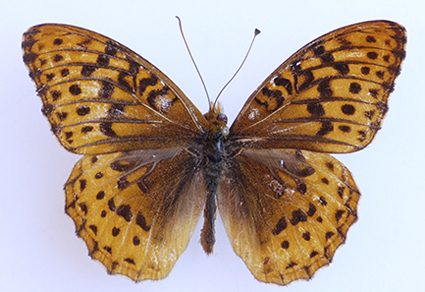

Abstract
There is current disagreement among researchers on whether the Nearctic greater fritillaries, a group that includes several endangered and threatened species, should remain in the genus Speyeria Scudder—in use for 80 years—or be placed as a subgenus of the Palearctic Argynnis Fabricius. A review of the recent scientific literature covering this group revealed the extent of this controversy in that only about half of the articles consulted recognized Speyeria as a subgenus of Argynnis. A summary of molecular phylogenetic studies using a variety of genetic markers provides a possible explanation for why this taxonomic change is controversial. These studies confirmed that species assigned to Speyeria, although generally morphologically similar to Argynnis, form a monophyletic group, a widely-accepted criterion for generic status. Thus, the controversy centers mainly on (1) the issue of taxonomic stability of a long-accepted genus name, (2) the need for increased taxon sampling of Palearctic taxa in phylogenomic studies, and (3) whether genetic divergence thresholds, including those of DNA barcodes analyzed here, can confidently be used as an aid in delimiting genera in the greater fritillaries. Based on the evidence presented here it is proposed that Speyeria be reinstated to full genus status.
References
- Bladon, E.K., Christie, A.P., Smith, R.K., Sutherland, W.J. & Bladon, A.J. (2025) Butterfly and moth conservation: results from a global synopsis of evidence. Journal of Insect Conservation, 29, 19. https://doi.org/10.1007/s10841-024-00646-4
- Bourn, N.A.D., Maes, D., Wilson, R.J., Fox, R., León-Cortés, J.L. & Pryke, J.S. (2024) Conserving Lepidoptera in a changing world: a special issue on the ecology and conservation of butterflies and moths. Journal of Insect Conservation, 28, 889–890. https://doi.org/10.1007/s10841-024-00630-y
- Bried, J.T., Moorehouse, A.K., Carter, K.C. & Holm, H.N. (2025) The conservatism of prairie pollinators according to experts and empiricism. Insect Conservation and Diversity, 2025, 1–11. https://doi.org/10.1111/icad.12836
- Campbell, E.O., Gage, E.V., Gage, R.V. & Sperling, F.A.H. (2020) Single nucleotide polymorphism-based species phylogeny of greater fritillary butterflies (Lepidoptera: Nymphalidae: Speyeria) demonstrates widespread mitonuclear discordance. Systematic Entomology, 45, 269–280. https://doi.org/10.1111/syen.12393
- Campbell, E.O., MacDonald, Z.G., Gage, E.V., Gage, R.V. & Sperling, F.A.H. (2022) Genomics and ecological modelling clarify species integrity in a confusing group of butterflies. Molecular Ecology, 31, 2400–2417. https://doi.org/10.1111/mec.16407
- Chappell, D.R., Boggs, C.L. & Speiser, D.I. (2023) Two sides of the same wing: ventral scales enhance dorsal wing color in the butterfly Speyeria mormonia. Journal of Experimental Biology, 226, jeb246396. https://doi.org/10.1242/jeb.246396
- Chmielewski, M.W., Naya, S., Borghi, M., Cortese, J., Fernie, A.R., Swartz, M.T., Zografou, K., Sewall, B.J. & Spigler, R.B. (2023) Phenology and foraging bias contribute to sex-specific foraging patterns in the rare declining butterfly Argynnis idalia idalia. Ecology and Evolution, 13 (7), e10287. https://doi.org/10.1002/ece3.10287
- Cole, J.S., Loffland, H.L., Looney, C.E. & Siegel, R.B. (2025) Mechanical thinning and prescribed fire benefit bumble bees and butterflies in a northern California conifer forest. Forest Ecology and Management, 588, 122758. https://doi.org/10.1016/j.foreco.2025.122758
- Deitsch, J.F., Huerta, A.C. & Seymoure, B. (2025) Butterflies at porch lights: Exploring nocturnal light visitation in butterflies using community science data from iNaturalist. Insect Conservation and Diversity, 18, 604–616. https://doi.org/10.1111/icad.12826
- de Moya, R.S., Savage, W.K., Tenney, C., Bao, X., Wahlberg, N. & Hill, R.I. (2017) Interrelationships and diversification of Argynnis Fabricius and Speyeria Scudder butterflies. Systematic Entomology, 42, 635–649. https://doi.org/10.1111/syen.12236
- D’Ercole, J., Dapporto, L., Opler, P., Schmidt, C.B., Ho, C., Menchetti, M., Zakharov, E.V., Burns, J.M. & Hebert, P.D.N. (2024) A genetic atlas for the butterflies of continental Canada and United States. PLoS ONE, 19 (4), e0300811. https://doi.org/10.1371/journal.pone.0300811
- Doll, C.F., Converse, S.J. & Schultz, C.B. (2022a) Non‑target effects of herbicides on the Zerene silverspot butterfly, a surrogate subspecies for the threatened Oregon silverspot butterfly. Journal of Insect Conservation, 26, 1–15. https://doi.org/10.1007/s10841-021-00355-2
- Doll, C.F., Converse, S.J., Edwards, C.B. & Schultz, C.B. (2022b) Using structured decision making to guide habitat restoration for butterflies: a case study of Oregon silverspots. Journal of Insect Conservation, 26, 219–230. https://doi.org/10.1007/s10841-022-00379-2
- dos Passos, C.F. & Grey, L.P. (1945) A genitalic survey of the Argynninae (Lepidoptera, Nymphalidae). American Museum Novitates, 1296, 1–29.
- Dunford, J.C. (2009) Taxonomic overview of the greater fritillary genus Speyeria Scudder and the atlantis-hesperis species complexes, with species accounts, type images, and relevant literature (Lepidoptera: Nymphalidae). Insecta Mundi, 0090, 1–74.
- Edwards, C.B., Schultz, C.B., Campbell, S.P., Fallon, C., Henry, E.H., King, K.C., Linders, M., Longcore, T., Marschalek, D.A., Sinclair, D., Swengel, A., Swengel, S., Taron, D.J., Wepprich, T. & Crone, E.E. (2024) Phenological constancy and management interventions predict population trends in at‑risk butterflies in the United States. Journal of Applied Ecology, 61, 2455–2469. https://doi.org/10.1111/1365-2664.14735
- Geest, E.A., Moranz, R.A. & Baum, K.A. (2024) The effect of land use intensity and habitat characteristics on butterfly community composition within the Southern Great Plains of the United States. Grassland Research, 3, 306–317. https://doi.org/10.1002/glr2.12099
- Gordon, S.C.C., Martin, J.G.A. & Kerr, J.T. (2024) Dispersal mediates trophic interactions and habitat connectivity to alter metacommunity composition. Ecology, 105 (2), e4215. https://doi.org/10.1002/ecy.4215
- Hamon, L.E., Kingsolver, J.G., Moore, K.J. & Hurlbert, A.H. (2025) High voltinism, late‑emerging butterflies are sensitive to interannual variation in spring temperature in North Carolina. Environmental Entomology, 54, 77–85. https://doi.org/10.1093/ee/nvae110
- Harman, A.J., Eori, M.M. & Hoback, W.W. (2024) A comparison of butterfly diversity results between iNaturalist and expert surveys in eastern Oklahoma. Diversity, 16 (9), 515. https://doi.org/10.3390/d16090515
- Harman, A.J. & Hoback, W.W. (2025) Population size and life history observations of the Diana Fritillary, Argynnis diana (Nymphalidae), in eastern Oklahoma. Journal of the Lepidopterists’ Society, 79, 175–178. https://doi.org/10.18473/lepi.79i3.a3
- Henry, E., Sheffield, B. & Schultz, C. (2024) Experimental management and mark‑release‑recapture methods fill critical knowledge gaps for an at‑risk butterfly. Journal of Insect Conservation, 28, 951–958. https://doi.org/10.1007/s10841-024-00562-7
- Hill, R.I., Ganeshan, M., Wourms, L., Kronforst, M.R., Mullen, S.P. & Savage, W.K. (2018) Effectiveness of DNA barcoding in Speyeria butterflies at small geographic scales. Diversity, 10, 130. https://doi.org/10.3390/d10040130
- ICZN [International Commission on Zoological Nomenclature] (1999) International Code of Zoological Nomenclature. 4th Edition. The International Trust for Zoological Nomenclature, London, 306 pp.
- iNaturalist (2025) Available from: https://www.inaturalist.org/ (accessed 30 July 2025)
- James, D.G. (2025) Seasonal population biology and migration of Coronis fritillaries, Argynnis (Speyeria) coronis simaetha (dos Passos & Grey) (Nymphalidae) in central Washington. Journal of the Lepidopterists’ Society, 79, 1–14. https://doi.org/10.18473/lepi.79i1.a1
- King, K.C. & Schultz, C.B. (2024) Fecundity without nectar is insufficient for the persistence of a blue butterfly. Oecologia, 206, 241–252. https://doi.org/10.1007/s00442-024-05609-9
- Kuster, E.L. & Miller Hesed, C.D. (2024) Designing and delivering climate training for natural resource managers: Increasing climate literacy and action through education and engagement. Conservation Science and Practice, 6 (10), e13226. https://doi.org/10.1111/csp2.13226
- Laurin, M. (2010) The subjective nature of Linnaean categories and its impact in evolutionary biology and biodiversity studies. Contributions to Zoology, 79, 131–146. https://doi.org/10.1163/18759866-07904001
- Livraghi, L., Hanly, J.J., Loh, L.S., Henry, A., Keck, C., Shirey, V.M., Tsai, C.‑C., Yu, N., Van Belleghem, S.M., Roberts, W.M., Boggs, C.L. & Martin, A. (2025) Genetic basis of an adaptive polymorphism controlling butterfly silver iridescence. Current Biology, 35, 2154–2163. https://doi.org/10.1016/j.cub.2025.03.028
- Marschalek, D.A. & Deutschman, D.H. (2024) Conserved lands unable to maintain butterfly communities in a biodiversity hotspot. Biodiversity and Conservation, 33, 4003–4015. https://doi.org/10.1007/s10531-024-02936-4
- Marschalek, D.A. & Wolcott, D.M. (2024) Regal fritillary (Argynnis idalia) monitoring techniques, movement, and habitat use. Prairie Naturalist, 56, 10–26.
- McHugh, A., Bierzychudek, P., Greever, C., Marzulla, T., Van Buskirk, R. & Binford, G. (2013) A molecular phylogenetic analysis of Speyeria and its implications for the management of the threatened Speyeria zerene hippolyta. Journal of Insect Conservation, 17, 1237–1253. https://doi.org/10.1007/s10841-013-9605-5
- Nelson, S.M. (2025) Observations on Aphrodite Fritillaries (Argynnis aphrodite) at Roxborough State Park, Colorado. Journal of the Lepidopterists’ Society, 79, 153–167. https://doi.org/10.18473/lepi.79i3.a1
- Pavulaan, H. (2022) Subspecific designation for the Central Appalachian Mountains population of Argynnis (Speyeria) atlantis (W. H. Edwards). The Taxonomic Report of the International Lepidoptera Survey, 10 (6), 1–7. [https://digitalcommons.unl.edu/taxrpt/4]
- Pelham, J.P. (2023) A catalogue of the butterflies of the United States and Canada. Available from: http://butterfliesofamerica.com/US-Can-Cat.htm (accessed 8 November 2025)
- Pfeiler, E. (2024) Comments on the taxonomic status of the genus Imelda (Riodinidae: Riodininae). Journal of the Lepidopterists’ Society, 78, 200–203. https://doi.org/10.18473/lepi.78i3.a7
- Plendl, M., van der Voort, G.E. & Janes, J.K. (2024) Assessing floral trait variation in Platanthera dilatata (Orchidaceae) across an elevational gradient. Discover Plants, 1, 63. https://doi.org/10.1007/s44372-024-00071-6
- Polic, D., Yýldýrým, Y., Lee, K.M., Franzén, M., Mutanen, M., Vila, R. & Forsman, A. (2022) Linking large‑scale genetic structure of three Argynnini butterfly species to geography and environment. Molecular Ecology, 31, 4381–4401. https://doi.org/10.1111/mec.16594
- Polic, D., Yýldýrým, Y., Vila, R., Ribeiro Cardoso, P.R., Franzén, M. & Forsman, A. (2023) Large‑scale spatial variation and phenotypic integration in three Argynnini species inform about functions and evolutionary drivers of butterfly wings. Frontiers in Ecology and Evolution, 11, 1087859. https://doi.org/10.3389/fevo.2023.1087859
- Post van der Burg, M. (2024) Measuring butterfly persistence in the face of deep uncertainty: a case study using the regal fritillary. Frontiers in Ecology and Evolution, 12, 1482783. https://doi.org/10.3389/fevo.2024.1482783
- Post van der Burg, M., MacDonald, G., Hefley, T. & Glassberg, J. (2023) Point‑scale habitat and weather patterns influence the distribution of regal fritillaries in the central United States. Ecosphere, 14 (3), e4429. https://doi.org/10.1002/ecs2.4429
- Ratnasingham, S. & Hebert, P.D.N. (2007) BOLD: The Barcode of Life Data System (www.barcodinglife.org). Molecular Ecology Notes, 7, 355–364. https://doi.org/10.1111/j.1471-8286.2007.01678.x
- Reis, G.A., Forister, M.L., Halsch, C.A., Dittemore, C.M., Shapiro, A.M. & Gompert, Z. (2025) Temporal occupancy distributions reveal multifaceted and heterogeneous effects of climatic variation on montane butterflies. Preprint at bioRxiv. [published online] https://doi.org/10.1101/2025.02.07.637160
- Riva, F., Campbell, E.O., Carroll, F. & Acorn, J.H. (2020) Identification “by eye”: integrative character assessment informs regional field identification of greater fritillary butterflies (Nymphalidae: Speyeria). Journal of Insect Conservation, 24, 259–267. https://doi.org/10.1007/s10841-019-00189-z
- Runquist, E., Nordmeyer, C. & Stapleton, S. (2024) Widespread annual occurrence of pesticides within designated critical habitats for endangered prairie butterflies. Journal of Insect Conservation, 28, 539–552. https://doi.org/10.1007/s10841-024-00572-5
- Rutins, I., Schannauer, S., Orellana, S., Laukhuff, H., Lang, E., Becker, T., McKinney, E., Thomas, K., Tilden, V., Swartz, M. & Blair, J.E. (2022) Genetic diversity and Wolbachia (Rickettsiales: Anaplasmataceae) prevalence within a remnant population of Regal fritillary, Argynnis idalia (Lepidoptera: Nymphalidae), in south‑central Pennsylvania. Journal of Insect Science, 22 (1), 24, 1–7. https://doi.org/10.1093/jisesa/ieac006
- Savela, M. (2025) Lepidoptera and other life forms. Nymphalidae. Available from: https://www.funet.fi/pub/sci/bio/life/insecta/lepidoptera/ditrysia/papilionoidea/nymphalidae/heliconiinae/ (accessed 8 November 2025)
- Scudder, S.H. (1872) A Systematic Revision of Some of the American Butterflies, with brief notes on those known to occur in Essex County, Mass. The Salem Press, Salem, Massachusetts, 62 pp.
- Simonsen, T.J. (2006) Fritillary phylogeny, classification, and larval host plants: reconstructed mainly on the basis of male and female genitalic morphology (Lepidoptera: Nymphalidae: Argynnini). Biological Journal of the Linnean Society, 89, 627–673. https://doi.org/10.1111/j.1095-8312.2006.00697.x
- Simonsen, T.J., Wahlberg, N., Brower, A.V.Z. & de Jong, R. (2006) Morphology, molecules and fritillaries: approaching a stable phylogeny for Argynnini (Lepidoptera: Nymphalidae). Insect Systematic and Evolution, 37, 405–418. https://doi.org/10.1163/187631206788831407
- Sims, S.R. (2017) Speyeria (Lepidoptera: Nymphalidae) conservation. Insects, 8, 45. https://doi.org/10.3390/insects8020045
- Smithwick, E.A.H., Wu, H., Spangler, K., Adib, M., Wang, R., Dems, C., Taylor, A., Kaye, M., Zipp, K., Newman, P., Miller, Z.D. & Zhao, A. (2024) Barriers and opportunities for implementing prescribed fire: lessons from managers in the mid‑Atlantic region, United States. Fire Ecology, 20, 77. https://doi.org/10.1186/s42408-024-00315-6
- Strand, M. & Panova, M. (2015) Size of genera—biology or taxonomy? Zoologica Scripta, 44, 106–116. https://doi.org/10.1111/zsc.12087
- Tamura, K., Peterson, D., Peterson, N., Stecher, G., Nei, M. & Kumar, S. (2011) MEGA5: molecular evolutionary genetics analysis using maximum likelihood, evolutionary distance, and maximum parsimony methods. Molecular Biology and Evolution, 28, 2731–2739. https://doi.org/10.1093/molbev/msr121
- Thompson, E., Baumsteiger, J. & Hill, R.I. (2019) Phylogenomic analyses clarify true species within the butterfly genus Speyeria despite evidence of a recent adaptive radiation. Insects, 10, 209. https://doi.org/10.3390/insects10070209
- Tilley, D., Spencer, J. & Wolf, M. (2022) Seed production and propagation of northern bog violet (Viola nephrophylla) for Nokomis Fritillary (Speyeria nokomis) butterfly habitat restoration. Native Plants Journal, 23, 130–138. https://doi.org/10.3368/npj.23.1.130
- Tronstad, L.M., Mazur, M., Short, Z. & Bell, C. (2025) Filling in the gaps: Working in un‑surveyed areas to create baseline data, habitat use and abundance estimates for butterflies in eastern Wyoming, USA. Environments, 12 (4), 122. https://doi.org/10.3390/environments12040122
- Vences, M., Guayasamin, J.M., Miralles, A. & De La Riva, I. (2013) To name or not to name: Criteria to promote economy of change in supraspecific Linnaean classification schemes. Zootaxa, 3636 (2), 201–244. https://doi.org/10.11646/zootaxa.3636.2.1
- Vernygora, O.V., Sperling, F.A.H. & Dupuis, J.R. (2024) Toward transparent taxonomy: an interactive web‑tool for evaluating competing taxonomic arrangements. Cladistics, 40, 181–191. https://doi.org/10.1111/cla.12563
- Vorontsova, M.S., Petersen, K.B., Minx, P., Aubuchon‑Elder, T.M., Cinta Romay, M., Buckler, E.S. & Kellogg, E.A. (2023) Reinstatement and expansion of the genus Anatherum (Andropogoneae, Panicoideae, Poaceae). Systematics and Biodiversity, 21 (1), 2274386. https://doi.org/10.1080/14772000.2023.2274386
- Walker, A., Geest, E. & Royer, E. (2022) Argynnis idalia. The IUCN Red List of Threatened Species, 2022, e.T20515A125885993. Available from: https://doi.org/10.2305/IUCN.UK.2022-1.RLTS.T20515A125885993.en (accessed 6 July 2025)
- Ward, R.D. (2009) DNA barcode divergence among species and genera of birds and fishes. Molecular Ecology Resources, 9, 1077–1085. https://doi.org/10.1111/j.1755-0998.2009.02541.x
- Warren, A.D., Davis, K.J., Stangeland, E.M., Pelham, J.P., Willmott, K.R. & Grishin, N.V. (2024) Illustrated Lists of American Butterflies. 9 March 2024. Available from: http://www.butterfliesofamerica.com/ (accessed 1 September 2025)
- Wells, C.N. & Tonkyn, D.W. (2014) Range collapse in the Diana fritillary, Speyeria diana (Nymphalidae). Insect Conservation and Diversity, 7, 365–380. https://doi.org/10.1111/icad.12059
- Weschler, M. & Tronstad, L. (2024) Wind energy and insects: reviewing the state of knowledge and identifying potential interactions. PeerJ, 12, e18153. https://doi.org/10.7717/peerj.18153
- Whipple, S. & Moss, S. (2024) Leveraging virtual datasets to investigate the interplay of pollinators, protected areas, and SDG 15. Sustainable Earth Reviews, 7, 13. https://doi.org/10.1186/s42055-024-00084-9
- Zhang, J., Shen, J., Cong, Q. & Grishin, N.V. (2019) Genomic analysis of the tribe Emesidini (Lepidoptera: Riodinidae). Zootaxa, 4668 (4), 475–488. https://doi.org/10.11646/zootaxa.4668.4.2
- Zhang, J., Cong, Q., Shen, J., Opler, P.A. & Grishin, N.V. (2020) Genomic evidence suggests further changes of butterfly names. The Taxonomic Report of the International Lepidoptera Survey, 8 (7), 1–40. [https://digitalcommons.unl.edu/taxrpt/22]
- Zhang, J., Cong, Q., Shen, J., Opler, P.A. & Grishin, N.V. (2021) Genomics‑guided refinement of butterfly taxonomy. The Taxonomic Report of the International Lepidoptera Survey, 9 (3), 1–54. [https://digitalcommons.unl.edu/taxrpt/18]