

Abstract
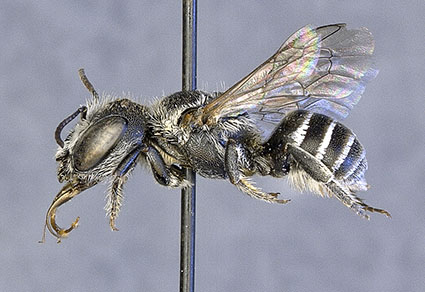
Three new osmiine bee species (Megachilidae, Osmiini) inhabiting the Arabian desert are described: Hoplitis (Hoplitis) heliotropii sp. nov. from Saudi Arabia, H. (Hoplitis) trichodesmae sp. nov. from Saudi Arabia and the Arava Valley in Israel, and H. (Platosmia) trisinuata sp. nov. from Saudi Arabia and Jordan. Field observations and microscopical analyses of female pollen loads indicate that all three species exhibit a pronounced preference for Boraginaceae as pollen hosts, i.e. H. heliotropii and H. trisinuata for Heliotropium and H. trichodesmae for Trichodesma. The females of H. heliotropii and H. trisinuata possess apically curved or hooked bristles on the proboscis and the fore legs, respectively, which they use to scrape pollen out of the narrow flower tubes of Heliotropium, whereas females of H. trichodesmae apply buzzing to shake pollen out of the flowers of Trichodesma. The occurrence of specialized pollen-collecting bristles used by Palaearctic bees and pollen wasps to exploit Heliotropium flowers and the buzzing behaviour in bees of the Megachilidae are discussed.
References
- Akhani, H. (2007) Diversity, biogeography, and photosynthetic pathways of Argusia and Heliotropium (Boraginaceae) in South-West Asia with an analysis of phytogeographical units. Botanical Journal of the Linnean Society, 155, 401–425. https://doi.org/10.1111/j.1095-8339.2007.00707.x
- Ascher, J.S. & Pickering, J. (2020) Discover Life bee species guide and world checklist (Hymenoptera: Apoidea: Anthophila). Available from: http://www.discoverlife.org/mp/20q?guide=Apoidea_species (accessed 12 January 2026)
- Alqarni, A.S., Hannan, M.A. & Engel, M.S. (2014) A new species of the cleptoparasitic bee genus Thyreus from northern Yemen and southwestern Saudi Arabia (Hymenoptera, Apidae). ZooKeys, 428, 29–40. https://doi.org/10.3897/zookeys.428.7821
- Aubert, M., Müller, A. & Praz, C. (2024) A new osmiine bee with a spectacular geographic disjunction: Hoplitis (Hoplitis) onosmaevae sp. nov. (Hymenoptera: Anthophila: Megachilidae). Alpine Entomology, 8, 65–79. https://doi.org/10.3897/alpento.8.118039
- Buchmann, S.L. (1983) Buzz pollination in angiosperms. In: Jones, C.E. & Little, R.J. (Eds.), Handbook of Experimental Pollination Biology. Van Nostrand Reinhold, New York, New York, pp. 73–113.
- Buchmann, S.L. (1985) Bees use vibration to aid pollen collection from non-poricidal flowers. Journal of the Kansas Entomological Society, 58, 517–525.
- Cane, J.H. (2014) The oligolectic bee Osmia brevis sonicates Penstemon flowers for pollen: a newly documented behavior for the Megachilidae. Apidologie, 45, 678–684. https://doi.org/10.1007/s13592-014-0286-1
- Dukas, R. & Dafni, A. (1990) Buzz-pollination in three nectariferous Boraginaceae and possible evolution of buzz-pollinated flowers. Plant Systematics and Evolution, 169, 65–68. https://doi.org/10.1007/BF00935985
- Gotlieb, A., Pisanty, G., Rozen, J.G., Müller, A., Röder, G., Sedivy, C. & Praz, C. (2014) Nests, floral preferences, and immatures of the bee Haetosmia vechti (Hymenoptera, Megachilidae, Osmiini). American Museum Novitates, 3808, 1–20. https://doi.org/10.1206/3808.1
- Griswold, T.L. (2013) New Palearctic bee species of Protosmia subgenus Nanosmia (Hymenoptera: Megachilidae). Journal of Melittology, 20, 1–9. https://doi.org/10.17161/jom.v0i20.4530
- Griswold, T.L. & Michener, C.D. (1998) The classification of the Osmiini of the Eastern Hemisphere (Hymenoptera, Megachilidae). Journal of the Kansas Entomological Society, 70, 207–253.
- Kasparek, M., Schmid-Egger, C. & Roberts, H. (2025) Cryptic and non-cryptic diversity in cleptoparasitic bees of the genus Stelis Panzer, 1806, subgenus Stelidomorpha Morawitz, 1875, with a description of new species from the Arabian Peninsula (Hymenoptera, Megachilidae). Insects, 16 (10), 1030. https://doi.org/10.3390/insects16101030
- Mauss, V., Fateryga, A.V., Praz, C.J., Zimmermann, D., Mauss, H. & Prosi, R. (2024) Evolution of different adaptations for pollen uptake from flowers of Heliotropium (Boraginaceae) with narrow corolla tube in pollen wasps of the genus Celonites (Hymenoptera: Vespidae: Masarinae). Zoological Journal of the Linnean Society, 202, zlae155. https://doi.org/10.1093/zoolinnean/zlae155
- Michener, C.D. (2007) The bees of the world. 2nd Edition. Johns Hopkins University Press, Baltimore, Maryland and London, 953 pp.
- Migahid, A.M. (1996) Flora of Saudi Arabia. Vols. 1–3. 4th Edition. King Saud University, Riyadh, 712 pp.
- Minckley, R.L. & Radke, W.R. (2021) Extreme species density of bees (Apiformes, Hymenoptera) in the warm deserts of North America. Journal of Hymenoptera Research, 82, 317–345. https://doi.org/10.3897/jhr.82.60895
- Minckley, R.L., Roulston, T.H. & Williams, N.M. (2013) Resource assurance predicts specialist and generalist bee activity in drought. Proceedings of the Royal Society of London, Series B, 280, e20122703. https://doi.org/10.1098/rspb.2012.2703
- Müller, A. (2014) Palaearctic Hoplitis bees of the subgenus Stenosmia (Megachilidae, Osmiini): biology, taxonomy and key to species. Zootaxa, 3765 (4), 301–316. https://doi.org/10.11646/zootaxa.3765.4.1
- Müller, A. (2015) Palaearctic Hoplitis bees of the subgenus Platosmia (Megachilidae, Osmiini): biology, taxonomy and key to species. Zootaxa, 3936 (1), 71–81. https://doi.org/10.11646/zootaxa.3936.1.3
- Müller, A. (2022) New Moroccan bee species of the tribe Osmiini (Hymenoptera: Apoidea: Megachilidae). Zootaxa, 5188 (3), 233–263. https://doi.org/10.11646/zootaxa.5188.3.2
- Müller, A. (2026) Palaearctic osmiine bees. Systematics and biology of a fascinating group of solitary bees. Available from: https://blogs.ethz.ch/osmiini/ (accessed 14 January 2026)
- Müller, A. & Griswold, T. (2017) Osmiine bees of the genus Haetosmia (Megachilidae, Osmiini): biology, taxonomy and key to species. Zootaxa, 4358 (2), 351–364. https://doi.org/10.11646/zootaxa.4358.2.8
- Müller, A., Krebs, A. & Amiet, F. (1997) Bienen - Mitteleuropäische Gattungen, Lebensweise, Beobachtung. Naturbuch, Augsburg, 384 pp.
- Müller, A. & Kuhlmann, M. (2008) Pollen hosts of western palaearctic bees of the genus Colletes (Colletidae) - the Asteraceae paradox. Biological Journal of the Linnean Society, 95, 719–733. https://doi.org/10.1111/j.1095-8312.2008.01113.x
- Neff, J.L. & Simpson, B.B. (1988) Vibratile pollen-harvesting by Megachile mendica Cresson (Hymenoptera: Megachilidae). Journal of the Kansas Entomological Society, 61, 242–244.
- Pauly, A. & Monks, J. (2023) Two new species of Pseudapis Kirby, 1900 (Hymenoptera: Halictidae: Nomiinae) from Oman. Zootaxa, 5263 (1), 107–121. https://doi.org/10.11646/zootaxa.5263.1.6
- Sedivy, C., Dorn, S. & Müller, A. (2013a) Evolution of nesting behaviour and cleptoparasitism in a selected group of osmiine bees (Megachilidae). Biological Journal of the Linnean Society, 108, 349–360. https://doi.org/10.1111/j.1095-8312.2012.02024.x
- Sedivy, C., Dorn, S., Widmer, A. & Müller, A. (2013b) Host range evolution in a selected group of solitary bees: the Boraginaceae-Fabaceae paradox. Biological Journal of the Linnean Society, 108, 35–54. https://doi.org/10.1111/j.1095-8312.2012.02013.x
- Teppner, E. (2011) Flowers of Boraginaceae (Symphytum, Onosma, Cerinthe) and Andrena symphyti (Hymenoptera, Andrenidae): morphology, pollen portioning, vibratory pollen collection, nectar robbing. Phyton, 50, 145–328.
- Wood, T.J. & Bossert, S. (2025) An unusually squat new species of the parasitic bee genus Thyreus from Oman (Hymenoptera: Apidae), with notes on two additional species showing Afro-Arabian distributions. Zoology in the Middle East, 72 (1), 1–15. https://doi.org/10.1080/09397140.2025.2607749
- Wood, T.J. (2023) Bee species newly recorded for the Moroccan fauna, including two new species of Ammobatoides and Thyreus (Hymenoptera: Anthophila). Annales de la Société entomologique de France, Nouvelle Série, 59 (3), 177–203. https://doi.org/10.1080/00379271.2023.2215216