
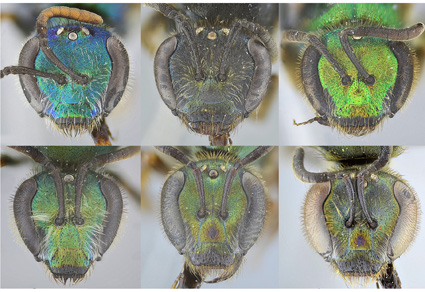

Abstract
The genus Caenohalictus ranges from Mexico to southern South America and currently includes 65 valid names. Some species had their biology studied, indicating that Caenohalictus build nests in the soil and are solitary. A total of 10 species occur in Brazil, but the fauna has never been systematically studied. The objective of this work is to review the species present in southern Brazil, reevaluating known species and describing new species. We examined 627 specimens and recognized twelve species for the region: Caenohalictus curticeps (Vachal, 1903); C. implexus Moure, 1950; C. incertus (Schrottky, 1902); C. palumbes (Vachal, 1903); C. schulthessi (Vachal, 1903); C. tesselatus (Moure, 1940); and six new species: C. arcuatus sp. nov., C. cyanolucens sp. nov., C. leticiae sp. nov., C. longipalpis sp. nov., C. parviformis sp. nov., and C. sesquipalpis sp. nov. Caenohalictus mourei Almeida & Laroca, 2005 is considered to be a junior synonym of C. curticeps; Halictus (Paragapostemon) cicindulus Vachal, 1903 is considered to be a junior synonym of C. incertus. Males of C. implexus and C. palumbes were described for the first time. Identification key, 29 image plates, and distribution maps are presented.
References
- Celis, C.J., Aguilar-Benavides, M.L. & Cure, J.R. (2023) Behavior and nest architecture of the bee Caenohalictus alexandrei (Hymenoptera, Halictinae). Papéis Avulsos de Zoologia, 63, e202363002. https://doi.org/10.11606/1807-0205/2023.63.002
- Coelho, B.W., Felizardo, S.P.D.S. & Engel, M.S. (2014) Three new species of the bee genus Ruizantheda sensu lato (Hymenoptera: Halictidae: Caenohalictina). Zootaxa, 3889 (1), 58–70. https://doi.org/10.11646/zootaxa.3889.1.3
- Coelho, B.W. & Engel, M.S. (2018) A new group of species within the bee genus Ruizantheda, with a revised key to the males of the genus (Hymenoptera: Halictidae: Caenohalictini). Zootaxa, 4415 (3), 513–532. https://doi.org/10.11646/zootaxa.4415.3.6
- Cure, J.R. (1989) Revisão de Pseudagapostemon Schrottky e descrição de Oragapostemon, gen. n. (Hymenoptera, Halictidae). Revista Brasileira de Entomologia, 33 (2), 229–335.
- Dallwitz, M.J. (1980) A general system for coding taxonomic descriptions. Taxon, 29, 41–6. https://doi.org/10.2307/1219595
- Danforth, B.N., Brady, S.G., Sipes, S.D. & Pearson, A. (2004) Single-copy nuclear genes recover Cretaceous-age divergences in bees. Systematic Biology, 309–326. https://doi.org/10.1080/10635150490423737
- Eickwort, G.C. (1969) A comparative morphological study and generic revision of the augochlorine bees (Hymenoptera: Halictidae). The University of Kansas Science Bulletin, 48 (13), 325–524. https://doi.org/10.5962/bhl.part.11227
- Gonçalves, R.B. & Melo, G.A.R. (2009) Phylogeny of the bee subtribe Caenohalictina Michener (Hymenoptera, Apidae sl, Halictinae sl). Zoologica Scripta, 39 (2), 187–197. https://doi.org/10.1111/j.1463-6409.2009.00414.x
- González Vaquero, R.A. & Roig Alsina, A. (2009) The bee genus Ruizantheda (Hymenoptera: Halictidae), its scope and description of a new species. Zootaxa, 2282, 62–68. https://doi.org/10.11646/zootaxa.2282.1.3
- González Vaquero, R.A. & Roig Alsina, A.H. (2013) Revision of the species of the bee genus Caenohalictus (Hymenoptera: Halictidae) occurring in Argentinean Patagonia. Zootaxa, 3670 (4), 493–515. https://doi.org/10.11646/zootaxa.3670.4.5
- Harris, R. (1979) A glossary of surface sculpturing. Occasional Papers in Entomology, State of California Department of Food and Agriculture 28, 1–31. https://doi.org/10.5281/zenodo.26215
- Moure, J.S. & Melo, G.A.R. (2022) Halictini Thomson, 1869. In: Moure, J.S., Urban, D. & Melo, G.A.R. (Eds.), Catalogue of Bees (Hymenoptera, Apoidea) in the Neotropical Region - online version. Available from: https://www.moure.cria.org.br/catalogue (accessed 05 September 2024)
- Laroca, S. (2004) Taxonomia de Apoidea Neotropical. II. Descrição de Caenohalictus mourei sp. n. (Halictidae, Halictini) do Paraná (Sul do Brasil). Acta Biológica Paranaense, 33, 135–141. https://doi.org/10.5380/abpr.v33i0.629
- Liz, J.A.D. & Gonçalves, R.B. (2025) A taxonomic revision of Habralictus Moure, 1941 from Brazil, with description of four new species (Hymenoptera: Apidae). European Journal of Taxonomy, 991, 1–53. https://doi.org/10.5852/ejt.2025.991.2907
- Melo, G.A.R. & Gonçalves, R.B. (2005) Higher-level bee classifications (Hymenoptera, Apoidea, Apidae sensu lato). Revista Brasileira de Zoologia, 22, 153–159. https://doi.org/10.1590/S0101-81752005000100017
- Michener, C.D., Breed, M.D. & Bell, W.J. (1979) Seasonal cycles, nests, and social behavior of some Colombian halictine bees (Hymenoptera; Apoidea). Revista de Biología Tropical, 27 (1), 13–34. [https://archivo.revistas.ucr.ac.cr/index.php/rbt/article/view/25687]
- Michener, C.D. (2007) The Bees of the World. 2nd Edition. The Johns Hopkins University Press, Baltimore, Maryland, 992 pp.
- Olson, D.M., Dinerstein, E., Wikramanayake, E.D., Burgess, N.D., Powell, G.V.N., Underwood, E.C., D’Amico, J.A., Itoua, I., Strand, H.E., Morrison, J.C., Loucks, C.J., Allnutt, T.F., Ricketts, T.H., Kura, Y., Lamoreux, J.F., Wettengel, W.W., Hedao, P & Kassem, K.R. (2001) Terrestrial Ecoregions of the World: A New Map of Life on Earth: A new global map of terrestrial ecoregions provides an innovative tool for conserving biodiversity. BioScience, 51 (11), 933–938. https://doi.org/10.1641/0006-3568(2001)051[0933:TEOTWA]2.0.CO;2
- Pereira, F.W., Carneiro, L. & Gonçalves, R.B. (2021) More losses than gains in ground-nesting bees over 60 years of urbanization. Urban Ecosystems, 24 (2), 233–242. https://doi.org/10.1007/s11252-020-01030-1
- Roberts, R.B. (1972) Revision of the bee genus Agapostemon. University of Kansas Science Bulletin, 49, 437–590.
- Rojas, F. & Toro, H. (2000) Revision de las especies de Caenohalictus (Halictidae-Apoidea) presentes en Chile. Boletín Museo Nacional de Historia Natural, 49, 163–214. https://doi.org/10.54830/bmnhn.v49.2020.354
- Santos, A.K., Warkentin, M., da Silva, J.V., Barbosa, R.N. & Mouga, D.M.D. (2016) Nesting patterns of bees (Apidae) in brick walls in southern Brazil. Acta Biológica Catarinense, 3 (2), 80–90. https://doi.org/10.21726/abc.v3i2.475
- Silveira, F.A., Melo, G.A.R. & Almeida, E.A.B. (2002) Abelhas brasileiras: sistemática e identificação. Authors’ edition, Belo Horizonte, 253 pp.