

Abstract
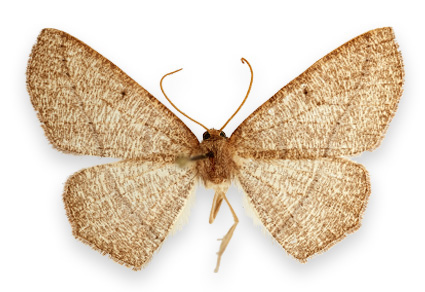
Ralvenia Matson gen. nov. is established to accommodate a lineage of ennomine moths that includes several undescribed cryptic species and others formerly assigned to four unrelated genera. The following new combinations are proposed: Ralvenia accentuata (Barnes & McDunnough) comb. nov. (transferred from Prochoerodes Grote); Ralvenia cervina (Warren) comb. nov. and Ralvenia cervinoides (Schaus) comb. nov. (both transferred from Periclina Guenée); Ralvenia arge (Druce) comb. nov. (transferred from Sabulodes Guenée); and Ralvenia lapa (Dognin) comb. nov. (transferred from Certima Walker). Four new species are described: Ralvenia dactyvalva Matson sp. nov., Ralvenia hamifurca Matson sp. nov., Ralvenia nuda Matson sp. nov., and Ralvenia serrata Matson sp. nov. Adults and male and female genitalia are illustrated. The larva of Ralvenia cervinoides is illustrated. DNA barcode data, when available, are reviewed for each species.
References
- Barnes, W. & McDunnough, J.H. (1918) Notes and new species. Contributions to the Natural History of the Lepidoptera of North America, 4 (2), 59–208.
- BOLD Systems (2025) Barcode of Life Data Systems (Version 5). Available from: https://www.boldsystems.org/ (accessed 8 October 2025)
- Brehm, G., Murillo-Ramos, L., Sihvonen, P., Hausmann, A., Schmidt, B.C., Õunap, E., Moser, A., Mörtter, R., Bolt, D., Bodner, F., Lindt, A., Parra, L.E. & Wahlberg, N. (2019) New World geometrid moths (Lepidoptera: Geometridae): molecular phylogeny, biogeography, taxonomic updates and description of 11 new tribes. Arthropod Systematics & Phylogeny, 77 (3), 457–486. https://doi.org/10.26049/ASP77-3-2019-5
- Dognin, P. (1900) Hétérocères nouveaux de l’Amérique du Sud. Annales de la Société entomologique de Belgique, 44, 213–233.
- Druce, H. (1891) Insecta: Lepidoptera–Heterocera. Vol. II. In: Godman, F.D., & Salvin, O. (Eds.), Biologia Centrali-Americana, Zoologia. Taylor and Francis, London, pp. 1–622.
- Druce, H. (1891–1900). Insecta. Lepidoptera-Heterocera. Vol. III (Plates). In: Godman, F.D. & Salvin, O. (Eds.), Biologia Centrali-Americana, Zoologia. R. H. Porter & Dulau & Co., London, pls. 1–101.
- Engelhardt, G.P. (1908) Coffee culture in Guatemala. The Museum News (Brooklyn Institute of Arts and Sciences), 4 (3), 41–44.
- Hoang, D.T., Chernomor, O., von Haeseler, A., Minh, B.Q. & Vinh, L.S. (2017) UFBoot2: improving the ultrafast bootstrap approximation. Molecular Biology and Evolution, 35, 518–522. https://doi.org/10.1093/molbev/msx281
- Miller, M.A., Pfeiffer, W. & Schwartz, T. (2010) Creating the CIPRES Science Gateway for inference of large phylogenetic trees. Proceedings of the Gateway Computing Environments Workshop (GCE), 1–8. https://doi.org/10.1109/GCE.2010.5676129
- Murillo-Ramos, L., Brehm, G., Sihvonen, P., Hausmann, A., Holm, S., Ghanavi, H.R., Õunap, E., Truuverk, A., Staude, H., Friedrich, E. & Tammaru, T. (2019) A comprehensive molecular phylogeny of Geometridae (Lepidoptera) with a focus on enigmatic small subfamilies. PeerJ, 7, e7386. https://doi.org/10.7717/peerj.7386
- Nguyen, L.T., Schmidt, H.A., von Haeseler, A. & Minh, B.Q. (2015) IQ-TREE: a fast and effective stochastic algorithm for estimating maximum-likelihood phylogenies. Molecular Biology and Evolution, 32, 268–274. https://doi.org/10.1093/molbev/msu300
- Pitkin, L.M. (2002) Neotropical ennomine moths: a review of the genera (Lepidoptera: Geometridae). Zoological Journal of the Linnean Society, 135 (2–3), 121–401. https://doi.org/10.1046/j.1096-3642.2002.00012.x
- Rajaei, H., Hausmann, A., Scoble, M., Wanke, D., Plotkin, D., Brehm, G., Murillo-Ramos, L. & Sihvonen, P. (2022) An online taxonomic facility of Geometridae (Lepidoptera), with an overview of global species richness and systematics. Integrative Systematics, 5 (2), 145–192. https://doi.org/10.18476/2022.577933
- Rambaut, A. (2012) FigTree. Version 1.4.4. A Graphical Viewer of Phylogenetic Trees. Available from: http://tree.bio.ed.ac.uk/software/figtree/ (accessed 30 January 2025)
- Ratnasingham, S. & Hebert, P.D.N. (2013) A DNA-based registry for all animal species: the Barcode Index Number (BIN) system. PLoS ONE, 8, e66213. https://doi.org/10.1371/journal.pone.0066213
- Rindge, F.H. (1978) A revision of the genus Sabulodes (Lepidoptera, Geometridae). Bulletin of the American Museum of Natural History, 160 (4), 193–292.
- Schaus, W. (1911) New species of Heterocera from Costa Rica. —XI. Annals and Magazine of Natural History, 8 (8), 577–602. https://doi.org/10.1080/00222931108693068
- Schmidt, C. & McGuinness, H. (2023) Family Geometridae. In: Pohl, G.R. & Nanz, S. (Eds.), Annotated taxonomic checklist of the Lepidoptera of North America, north of Mexico. Wedge Entomological Research Foundation, Bakersfield, pp. 295–330. https://doi.org/10.57065/shilap.916
- Scoble, M.J. (1999) Geometrid Moths of the World: A Catalogue. Vols. 1–2. CSIRO Publishing, Collingwood, 1016 pp. https://doi.org/10.1071/9780643101050
- Warren, W. (1906) Descriptions of new genera and species of South American geometrid moths. Proceedings of the United States National Museum, 30 (1456), 399–557. https://doi.org/10.5479/si.00963801.1456.399