

Abstract
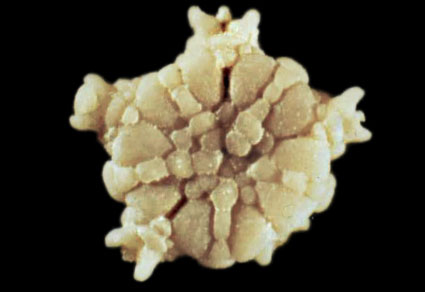
Recent advances in molecular phylogenies have revolutionised our understanding of brittle star systematics and evolutionary history. Although genetic data have provided new grounds for age estimates of phylogenetic divergences, direct fossil evidence is currently the only robust means to determine the minimum age of clades. The present study discusses an exceptional opportunity to robustly pinpoint the minimum age of an extant genus of brittle star. The presumed ophiolepidid brittle star species Ophiolepis? falsa Jagt & Kutscher, in Jagt, 2000, from lower upper Campanian (Upper Cretaceous, c. 79 Ma) deposits in north-east Belgium, is here recorded from coeval strata in the Münsterland Basin (northern Germany) and transferred to the previously monospecific extant hemieuryalid genus Actinozonella Stöhr, 2011. An unusually well-preserved specimen, completely free from mineralised matrix, allows both dorsal and ventral sides of the disc and short arm stumps to be examined. In this way, characters not visible in the holotype of Ophiolepis? falsa could be analysed; these revealed its taxonomic affinity with Actinozonella, dating that genus to at least 79 Ma. The close morphological similarity between Actinozonella and Ophiomisidium Koehler, 1914, and to some species currently assigned to Ophiomastus Lyman, 1878, is discussed.
References
- Christodoulou, M., O’Hara, T.D., Hugall, A.F. & Arbizu, P.M. (2019) Dark Ophiuroid Biodiversity in a Prospective Abyssal Mine Field. Current Biology, 29 (22), 3909–3912.e3. https://doi.org/10.1016/j.cub.2019.09.012
- Fell, H.B. (1952) Echinoderms from Southern New Zealand. Zoology Publications from Victoria University of Wellington, 18, 1–37.
- Gray, J.E. (1840) Room II. In: Synopsis of the contents of the British Museum. Woodfall, London, pp. 57–65.
- Helm, C., Jagt, J.W.M. & Kutscher, M. (1999) Early Campanian ophiuroids from the Hannover area. Berliner geowissenschaftliche Abhandlungen, E30, 161–173, pls. 1–3.
- Huygh, J.J.C., Sinnesael, M., Kaskes, P., Vellekoop, J., Van der Geest, H. & Claeys, P. (2025) Flint formation and astronomical pacing in the Maastrichtian chalk of northwestern Europe. Palaeogeography, Palaeoclimatology, Palaeoecology, 675, 113095. https://doi.org/10.1016/j.palaeo.2025.113095
- Jagt, J.W.M. (1999) Ophiuroid diversity in the type area of the Maastrichtian Stage. Geologie en Mijnbouw, 78 (2), 197–206. https://doi.org/10.1023/A:1003795318464
- Jagt, J.W.M. (2001) Deckersamphiura vitea, a new Late Campanian ophiuroid from southern Limburg (The Netherlands). Bulletin de l’Institut Royal des Sciences Naturelles de Belgique - Bulletin van het Koninklijk Belgisch Instituut voor Natuurwetenschappen, 71, 191–193.
- Jagt, J.W.M. & Neumann, C. (2010) Late Cretaceous ophiuroids in the Binkhorst Collection at the Museum für Naturkunde, Berlin, reassessed. Scripta Geologica. Special Issue, 7, 151–159.
- Jagt, J.W.M. (2000) Late Cretaceous-Early Palaeogene echinoderms and the K/T boundary in the southeast Netherlands and northeast Belgium, Part 3: Ophiuroids, with a chapter on: Early Maastrichtian ophiuroids from Rügen (northeast Germany) and Møn (Denmark) by Manfred Kutscher & John W.M. Jagt. Scripta Geologica, 121, 1–179.
- Jagt, J.W.M. & Girod, P. (2023) Schlangensterne (Ophiuroidea). In: Schneider, C. & Girod, P. (Eds.), Fossilien aus dem Campan von Hannover. Arbeitskreis Paläontologie Hannover, Hannover, pp. 517–524.
- Jagt, J.W.M. & Odin, G.S. (2001) Chapter C7 Campanian-Maastrichtian ophiuroids (Echinodermata) from Tercis les Bains (Landes, France). In: Odin, G.S. (Ed.), Developments in Palaeontology and Stratigraphy. Vol.19. The Campanian-Maastrichtian stage boundary. Characterisation at Tercis les Bains (France) and correlation with Europe and other Continents. Elsevier, Amsterdam, pp. 414–420, pls. I + II. https://doi.org/10.1016/S0920-5446(01)80043-1
- Jagt, J.W.M. & Riegraf, W. (2003) Late cretaceous [sic] ophiuroids from the Münsterland Basin (Germany): preliminary observations. In: Féral, J.-P. & David, B. (Eds.), Echinoderm Research 2001. Swets & Zeitlinger/A.A. Balkema Publishers, Lisse, pp. 61–63.
- Kaever, M. & Kettelhack, C. (1998) Campanian of Baumberge (D 2.5). In: Mutterlose, J., Bornemann, A., Spaeth, C. & Wood, C.J. (Eds.), Key localities of the northwest European Cretaceous. Vol. 48. Bochumer geologische und geotechnische Arbeiten. Institut für Geologie der Ruhr, Universität Bochum, Bochum, pp. 165–168.
- Kaplan, U., Kennedy, W.J. & Hiß, M. (2005) Stratigraphie und Ammonitenfaunen des Campan im nordwestlichen und zentralen Münsterland. Geologie und Paläontologie in Westfalen, 64, 1–171.
- Keutgen, N. (2011) The belemnite zonation of the uppermost Cretaceous in the Maastricht-Aachen-Liège, Brabant-Méhaigne and Mons areas (Belgium, southeast Netherlands). Netherlands Journal of Geosciences, 90 (2–3), 165–178. https://doi.org/10.1017/S0016774600001086
- Keutgen, N. & Jagt, J.W.M. (1998) Late Campanian belemnite faunas from Liège - Limburg (NE Belgium, SE Netherlands). Geological Survey of Belgium, Brussels, 34 pp.
- Koehler, R. (1897) Echinodermes recueillis par “l’Investigator” dans l’Ocean Indien. I. Les Ophiures de mer profonde. Annales des Sciences Naturelles Zoologie, Series 8, 4, 277–372, pls. 5–9.
- Koehler, R. (1901) Note preliminaire sur quelques ophiures nouvelles provenant des campagnes de la Princesse Alice. Bulletin de la Société zoologique de France, 26, 222–231.
- Koehler, R. (1904) Ophiures de l’expédition du Siboga. Ophiures de mer profonde. In: Weber, M. (Ed.), Siboga Expeditie. Vol. 45a. M. E.J. Brill, Leiden, pp. 1–176. https://doi.org/10.5962/bhl.title.11682
- Koehler, R. (1914) A contribution to the study of Ophiurans of the United States National Museum. Bulletin of the United States National Museum, 84, 1–173. https://doi.org/10.5479/si.03629236.84.1
- Ljungman, A.V. (1867) Ophiuroidea viventia huc usque cognita. Öfversigt af Kungliga Vetenskaps-Akademiens Förhandlingar, 23 (9), 303–336. [1866]
- Lochem, H. van, Vis, G.-J. & Jagt, J.W.M. (2025) 8. Late Cretaceous. In: ten Veen, J.H., Vis, G.-J., de Jager, J. & Wong, T.E. (Eds.), Geology of the Netherlands (second edition). Amsterdam University Press B.V., Amsterdam, pp. 252–290. https://doi.org/10.5117/9789463728362_ch08
- Lyman, T. (1878) Ophiuridae and Astrophytidae of the ‘Challenger’ expedition. Part I. Bulletin of the Museum of Comparative Zoology at Harvard, 5 (7), 65–168.
- Lyman, T. (1883) Reports on the results of dredging, under the supervision of Alexander Agassiz, in the Carribbean Sea (1878–79), and on the east coast of the United States, during the summer of 1880, by the U.S. coast survey steamer ‘Blake’, commander J.R. Bartlett, U.S.N., commanding. XX.—Report on the Ophiuroidea. Bulletin of the Museum of Comparative Zoology at Harvard, 10 (6), 227–287.
- Martynov, A.V. (2010) Reassessment of the classification of the Ophiuroidea (Echinodermata), based on morphological characters. I. General character evaluation and delineation of the families Ophiomyxidae and Ophiacanthidae. Zootaxa, 2697 (1), 1–154. https://doi.org/10.11646/zootaxa.2697.1.1
- McKnight, D. (2003) New brittle-stars (Echinodermata: Ophiuroidea) from New Zealand waters. Zootaxa, 352 (1), 1–36. https://doi.org/10.11646/zootaxa.352.1.1
- O’Hara, T.D., Hugall, A.F., Thuy, B., Stöhr, S. & Martynov, A.V. (2017) Restructuring higher taxonomy using broad-scale phylogenomics: The living Ophiuroidea. Molecular Phylogenetics and Evolution, 107, 415–430. https://doi.org/10.1016/j.ympev.2016.12.006
- Riegraf, W. (1990) Baumberger Sandstein und Plattenkalke von Sendenhorst. In: Weidert, W.K. (Ed.), Klassische Fundstellen der Paläontologie. Vol. 2. Goldschneck Verlag, Korb, pp. 175–183.
- Roemer, F.A. (1840–1841) Die Versteinerungen des norddeutschen Kreidegebirges. Hahn’sche Hofbuchhandlung, Hannover, 145 pp., 16 pls. [pp. i–iv + 1–48, pls. 1–7 (1840) & pp. 49–145, pls. 8–16 (1841).
- Sladen, W.P. (1879) On Astrophiura permira, an Echinoderm-Form Intermediate between Ophiuroidea and Asteroidea. Proceedings of the Royal Society of London, 27 (185–189), 456–457. https://doi.org/10.1098/rspl.1878.0083
- Stöhr, S. (2011) New records and new species of Ophiuroidea (Echinodermata) from Lifou, Loyalty Islands, New Caledonia. Zootaxa, 3089, 1–50. https://doi.org/10.11646/zootaxa.3089.1.1
- Štorc, R. (2004a) The ophiuroid Amphiura plana in nearshore settings of the Bohemian Cretaceous Basin (Czech Republic). Geologica Carpathica, 55 (1), 37–41.
- Štorc, R. (2004b) The Late Cretaceous brittle star Ophiosmilax alternatus from Europe and northern Africa. Geobios, 37, 395–401. https://doi.org/10.1016/j.geobios.2003.01.010
- Stuwe, T. (2000) Erstfunde von Ophiuren (Schlangensterne) im Obercampanium des östlichen Münsterland. Geologie und Paläontologie in Westfalen, 56, 67–77.
- Thuy, B. (2013) Temporary expansion to shelf depths rather than an onshore-offshore trend: the shallow-water rise and demise of the modern deep-sea brittle star family Ophiacanthidae (Echinodermata: Ophiuroidea). European Journal of Taxonomy, 48, 1–242. https://doi.org/10.5852/ejt.2013.48
- Thuy, B., Gale, A. & Numberger-Thuy, L. (2019) Brittle stars looking like starfish: the first fossil record of the Astrophiuridae and a remarkable case of convergent evolution. PeerJ, 7, e8008. https://doi.org/10.7717/peerj.8008
- Thuy, B., Knox, L., Numberger-Thuy, L.D., Smith, N.S. & Sumrall, C.D. (2023) Ancient deep ocean as a harbor of biotic innovation revealed by Carboniferous ophiuroid microfossils. Geology, 51 (2), 157–161. https://doi.org/10.1130/G50596.1
- Thuy, B. & Meyer, C.A. (2013) The pitfalls of extrapolating modern depth ranges to fossil assemblages: new insights from Middle Jurassic brittle stars (Echinodermata: Ophiuroidea) from Switzerland. Swiss Journal of Palaeontology, 132 (1), 5–21. https://doi.org/10.1007/s13358-012-0048-5
- Thuy, B. & Stöhr, S. (2011) Lateral arm plate morphology in brittle stars (Echinodermata: Ophiuroidea): new perspectives for ophiuroid micropalaeontology and classification. Zootaxa, 3013 (1), 1–47. https://doi.org/10.11646/zootaxa.3013.1.1
- Vadon, C. (1991) Echinodermata: Ophiuridae profonds de Nouvelle-Calédonie. Formes paedomorphes. Résultats des Campagnes MUSORSTOM. Vol. 8. Mémoires Muséum nationale d’Histoire naturelle, Série A, 151, 335–356.
- Valette, A. (1915) Les ophiures de la craie des environs de Sens. Bulletin de la Société des Sciences d’Histoire naturelle de l’Yonne, 68, 125–150. [for 1914]
- Vellekoop, J., Kaskes, P., Sinnesael, M., Huygh, J., Déhais, T., Jagt, J.W.M., Speijer, R.P. & Claeys, P. (2022) A new age model and chemostratigraphic framework for the Maastrichtian type area (southeastern Netherlands, northeastern Belgium). Newsletters on Stratigraphy, 55 (4), 479–501. https://doi.org/10.1127/nos/2022/0703
- Verrill, A.E. (1899) Report on the Ophiuroidea collected by the Bahama expedition in 1893. Bulletin from the Laboratories of Natural History of the State University of Iowa, 5 (1), 1–86.
- Wienberg Rasmussen, H. (1950) Cretaceous Asteroidea and Ophiuroidea with special reference to the species found in Denmark. Danmarks geologiske Undersøgelse, II. Række, 77, 1–134, pls. 1–18. https://doi.org/10.34194/raekke2.v77.6866
- Wienberg Rasmussen, H. (1952) Cretaceous Ophiuroidea from Germany, Sweden, Spain and New Jersey. Meddelelser fra Dansk geologisk Forening, 12, 47–57. [for 1951]