

Abstract
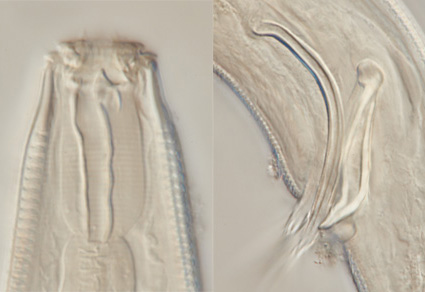
A new species, Rhinema bimorpha sp. nov. is described from the coral reefs in Nha Trang, Vietnam. It is characterized by a coarsely annulated cuticle with 12 longitudinal ridges, of which middorsal and midventral extends only along the anterior part of the body; cephalic sensilla equal to 0.2–0.6 labial region diameters in length; amphideal fovea circular and occupying nearly the entire height of unstriated helmet and 0.4–0.5 of the corresponding body diameter; subventral cuticular ridges in males form bulges about 1.7–2.9 corresponding body diameters anterior to cloaca; spicules arcuate, with poorly developed manubrium and subcylindrical shaft, equal to 1.6–2.1 cloacal body diameters in length; six pairs (one pre-cloacal and five post-cloacal) of posterior setiform copulatory sensilla. The new species differs from R. retrorsum in having relatively larger amphids and shorter helmet (occupying the height of helmet vs. half of the height) and larger number of posterior setiform sensilla in male (one pre-cloacal and 5 post-cloacal pairs vs. 3–4 post-cloacal pairs), and from R. longispicula in having shorter spicules (43–82 µm vs. 120–138 µm) and larger number of posterior setiform sensilla in male (one pre-cloacal and 5 post-cloacal vs. one pre-cloacal and 3 post-cloacal pairs).
References
- Ahmed, M. & Holovachov, O. (2020) Description of a new marine predatory nematode Latronema dyngi sp. nov. (Nematoda, Chromadorida, Selachinematidae) from the west coast of Sweden and an updated phylogeny of Chromadoria. Marine Biodiversity, 50, 113. https://doi.org/10.1007/s12526-020-01129-w
- Cobb, N.A. (1920) One hundred new nemas (type species of 100 new genera). Contributions to a Science of Nematology, 9, 217–343.
- Creer, S., Fonseca, V.G., Porazinska, D.L., Giblin-Davis, R.M., Sung, W., Power, D.M., Packer, M., Carvalho, G.R., Blaxter, M.L., Lambshead, P.J. & Thomas, W.K. (2010) Ultrasequencing of the meiofaunal biosphere: practice, pitfalls and promises. Molecular Ecology, 19 (Supplement 1), 4–20. https://doi.org/10.1111/j.1365-294X.2009.04473.x
- Dana, J.D. (1846) Zoophytes. United States Exploring Expedition during the years 1838–1842, 7, 1–740. https://doi.org/10.5962/bhl.title.70845
- De Coninck, L.A. (1965) Classe des Nématodes - Systématique des Nématodes et sous-classe des Adenophorea. Traité de Zoologie, 4, 586–681.
- De Grisse, A.T. (1969) Redescription ou modification de quelques techniques utilisees dans L’etude des nematodes phytoparasitaries. Mededelingen Rijksfaculteit Landbouwweteschappen, 34, 351–369.
- Esper, E.J.C. (1791) Die Pflanzenthiere in Abbildungen nach der Natur mit Farben erleuchtet nebst Beschreibungen. Raspischen Buchhandlung, Nuremberg, 320 pp. https://doi.org/10.11588/diglit.2885
- Filipjev, I.N. (1934) The classification of the free-living nematodes and their relation to the parasitic nematodes. Smithsonian Miscellaneous Collection, 89, 1–63.
- Gerlach, S.A. (1963) Freilebende Meeresnematoden von den Malediven II. Kieler Meeresforschungen, 19, 67–103.
- Lamarck, J.-B. (1801) Système des animaux sans vertèbres, ou tableau général des classes, des ordres et des genres de ces animaux. Deterville, Paris, 432 pp.
- Lamarck, J.-B. (1816) Histoire naturelle des animaux sans vertèbres. Tome second. Verdière, Paris, 566 pp.
- de Man, J.G. (1889) Espèces et genres nouveaux de Nématodes libres de la mer du Nord et de la Manche. Meìmoires de la Socieìteì zoologique de France, 2, 1–10.
- Raes, M., De Troch, M., Ndaro, S.G.M., Muthumbi, A., Guilini, K. & Vanreusel, A. (2007) The structuring role of microhabitat type in coral degradation zones: a case study with marine nematodes from Kenya and Zanzibar. Coral Reefs, 26, 113–126. https://doi.org/10.1007/s00338-006-0184-8
- Seinhorst, J.V. (1959) A rapid method to the transverse of nematodes from fixative to anhydrous glycerin. Nematologica, 4, 67–69. https://doi.org/10.1163/187529259X00381
- Tchesunov, A.V. (2014) Order Desmodorida De Coninck, 1965. In: Schmidt-Rhaesa A. (Ed.), Handbook of Zoology. Gastrotricha, Cycloneuralia, Gnathifera. Vol. 2. Nematoda. de Gruyter, Berlin, pp. 399–434. https://doi.org/10.1515/9783110274257.399
- Timm, R.W. (1961) The marine nematodes of the Bay of Bengal. Proceedings of the Pakistan Academy of Sciences, 1, 1–88.
- Venekey, V., Fonseca-Genevois, V.G. & Santos, P.J.P. (2010) Biodiversity of free-living marine nematodes on the coast of Brazil: a review. Zootaxa, 2568 (1), 39–66. https://doi.org/10.11646/zootaxa.2568.1.2
- Vincx, M. (1996) Meiofauna in marine and freshwater sediments. In: Hall, G. (Ed.), Methods for the Examination of Organismal Diversity in Soils and Sediments. CABI Publishing, Wallingford, pp. 187–195.
- Yoder, M., De Ley, I.T., King, I.W., Mundo-Ocampo, M., Mann, J., Blaxter, M., Poiras, L. & De Ley, P. (2006) DESS: a versatile solution for preserving morphology and extractable DNA of nematodes. Nematology, 8, 367–376. https://doi.org/10.1163/156854106778493448
- Zhai, H., Huang, M. & Huang, Y. (2020) A new free-living marine nematode species of Rhinema from the South China Sea. Journal of Oceanology and Limnology, 38, 545–549. https://doi.org/10.1007/s00343-019-9169-7