

Abstract
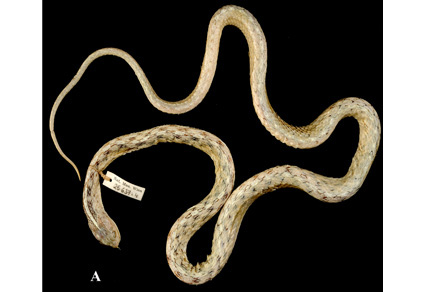
The genus Dryophylax currently comprises 15 widely distributed South American species of snakes. Despite recent efforts to clarify the systematic status of the genus, several species remain taxonomically poorly defined. One example is Dryophylax nattereri (Mikan 1820), regarded first as a junior synonym of Thamnodynastes strigilis (Thunberg 1787), and later as a junior synonym of Thamnodynastes pallidus (Linnaeus 1758). Despite several historical taxonomic studies addressing other congeners, D. nattereri has been often neglected, and no author has attempted to test species boundaries. Recently, several authors referred to this taxon as Dryophylax cf. nattereri, after it was resurrected without a proper taxonomic justification. Here, we demonstrate that D. nattereri is a valid species, based on morphological data gathered from a large series of individuals distributed throughout its known distribution. We designated a neotype for D. nattereri and provide a detailed description of the species diagnostic characters, with additional data on external morphological variation, skull osteology and hemipenial morphology.
References
- Andersson, L.G. (1899) Catalogue of Linnean type-specimens of snakes in the Royal Museum in Stockholm. Bihang Till Koeniger Svenska Vetenskaps-Akademiens Handlingar, 24 (4), 1–35.
- Amaral, A. (1926) Notas de ophiologia. Primeira nota de ophiologia. Sobre a invalidez de um gênero e algumas espécies de ofídios sul-americanos. Revista do Museu Paulista, 14, 17–33.
- Amaral, A. (1929) Contribuição ao conhecimento dos ophidios do Brasil. IV. Lista remissiva dos ophidios do Brasil. Memórias do Instituto Butantan, 4, 102–103.
- Araújo, C.O., Condez, T.H., Bovo, R.P., Centeno, F.C. & Luiz, A.M. (2010) Amphibians and reptiles of the Parque Estadual Turístico do Alto Ribeira (PETAR), SP: an Atlantic Forest remnant of Southeastern Brazil. Biota Neotropica, 10 (4), 257–274. http://doi.org/10.1590/S1676-06032010000400031
- Bailey, J.R., Thomas, R.A. & Silva Jr, N.J. (2005) A revision of the South American genus Thamnodynastes Wagler, 1830 (Serpentes, Colubridae, Tachymenini). I. Two new species of Thamnodynastes from Central Brazil and adjacent areas, with redefinition of and neotype designation for Thamnodynastes pallidus (Linnaeus, 1758). Phyllomedusa, 4, 83–101. http://doi.org/10.11606/issn.2316-9079.v4i2p83-101
- Bailey, J.R. & Thomas, R.A. (2007) A revision of the South American snake genus Thamnodynastes Wagler, 1830 (Serpentes: Colubridae, Tachymenini). II. Three new species from northern South America, with further descriptions of Thamnodynastes gambotensis Pérez-Santos and Moreno and Thamnodynastes ramonriveroi Manzanilla and Sánchez. Memoria de la Fundacion La Salle de Ciencias Naturales, 166, 7–27.
- Bergna, S. & Alvarez, B. (1993) Descripción de una nueva especie de Thamnodynastes (Reptilia: Serpentes, Colubridae) del nordeste argentino. Facena, 10, 5–18.
- Bertoluci, J., Canelas, M.A.S., Eisemberg, C.C., Palmuti C.F.S. & Montingelli G.G. (2009) Herpetofauna of Estação Ambiental de Peti, an Atlantic Rainforest fragment of Minas Gerais State, southeastern Brazil. Biota Neotropica, 9 (1), 1–9. http://doi.org/10.1590/S1676-06032009000100017
- Boulenger, G.A. (1885) A list of reptiles and batrachians from the province Rio Grande do Sul, Brazil, sent to to the Natural History Museum by Dr. H. von Ihering. Annals and Magazine of Natural History, Series 5, 15 (87), 191–196. http://doi.org/10.1080/00222938509459318
- Boulenger, G.A. (1896) Catalogue of the Snakes in the British Museum. Vol. III. Trustees of British Museum, London, 727 pp.
- Brongersma, L.D. (1940) Snakes from the leeward group, Venezuela and Eastern Colombia. In: Hummelinck, P.W (Ed.), Studies on the Fauna of Curacao, Aruba, Bonaire and the Venezuelan Islands. Vol. 2. M. Nijhoff, The Hague, pp. 115–137.
- Cei, J.M., Bergna, S. & Alvarez, B. (1992) Nueva combinación para el gênero Thamnodynastes (Serpentes, Colubridae) de Argentina. Facena, 9, 123–134.
- Centeno, F.C., Sawaya, R.J. & Marques, O.A.V. (2008) Snake assemblage of Ilha de São Sebastião, southeastern Brazil: comparison to mainland. Biota Neotropica, 8 (3), 63–68. http://doi.org/10.1590/S1676-06032008000300005
- Cicchi, P.J.P., De Sena, M.A., Peccinini-Seale, D.M. & Duarte, M.R. (2007) Snakes from coastal islands of State of SaÞo Paulo, Southeastern Brazil. Biota Neotropica, 7 (2), 227–240. http://doi.org/10.1590/S1676-06032007000200026
- Citeli, N., Hamdan, B. & Guedes, T. (2016) Snake richness in urban forest fragments from Niterói and surroundings, state of Rio de Janeiro, southeastern Brazil. Biodiversity Data Journal, 4, 1–41. http://doi.org/10.3897/BDJ.4.e7145
- Dorigo, T.A., Vrcibradic D., Borges-Junior, V.N.T. & Rocha, C.F.D. (2014) New records of anuran predation by snakes of the genus Thamnodynastes Wagler, 1830 (Colubridae: Dipsadinae) in the Atlantic rainforest of southeastern Brazil. Herpetology Notes, 7, 261–264.
- Dowling, H.G. (1951). A proposed method of expressing scale reductions in snakes. Copeia, 1951, 131–134. https://doi.org/10.2307/1437542
- Franco, F.L. & Ferreira, T.G. (2002) Descrição de uma nova espécie de Thamnodynastes Wagler, 1830 (Serpentes, Colubridae) do nordeste brasileiro, com comentários sobre o gênero. Phyllomedusa, 1, 57−74. http://doi.org/10.11606/issn.2316-9079.v1i2p57-74
- Franco, F.L., Ferreira, T.G., Marques, O.A.V. & Sazima, I. (2003) A new species of hood- displaying Thamnodynastes (Serpentes: Colubridae) from the Atlantic forest in southeast Brazil. Zootaxa, 334 (1), 1−7. https://doi.org/10.11646/zootaxa.334.1.1
- Franco, F.L., Trevine, V.C., Montingelli, G.G. & Zaher, H. (2017) A new species of Thamnodynastes from the open areas of central and northeastern Brazil (Serpentes: Dipsadidae: Tachymenini). Salamadra, 53 (3), 339−350.
- Gemel, R., Gassner, G. & Schweiger, S. (2019) Katalog der Typen der Herpetologischen Sammlung des Naturhistorischen Museums Wien. Annalen des Naturhistorischen Museums in Wien. Serie B für Botanik und Zoologie, 121, 33–248.
- Grazziotin, F.G., Monzel, M., Echeverrigaray, S. & Bonatto, S.L. (2006) Phylogeography of the Bothrops jararaca complex (Serpentes: Viperidae): past fragmentation and island colonization in the Brazilian Atlantic Forest. Molecular Ecology, 15, 3969–3982. https://doi.org/10.1111/j.1365-294X.2006.03057.x
- Guedes, T.B., Nogueira, C. & Marques, O.V.A. (2014) Diversity, natural history, and geographic distribution of snakes in the Caatinga, Northeastern Brazil. Zootaxa, 3863 (1), 1–93. http://doi.org/10.11646/zootaxa.3863.1.1
- Guedes, T.B., Entiauspe-Neto, O.M. & Costa, H.C. (2023). Lista de répteis do Brasil: atualização de 2022. Herpetologia Brasileira, 12 (1), 56−161. http://doi.org/10.5281/zenodo.7829013
- Gorzula, S. & Ayarzagüena J. (1996) Dos nuevas especies del genero Thamnodynastes (Serpentes; Colubridae) de los tepuyes de la Guayana Venezuelana. Publicaciones de la Asociación de Amigos de Donana, 6, 1−17.
- Günther, A. (1858) Catalogue of Colubrine snakes of the British Museum. Printed by order of the Trustees, London, xvi + 281 pp.
- Hartmann, P.A., Hartmann, M.T. & Martins, M. (2009) Ecology and natural history of a snake assemblage at Núcleo Santa Virgínia, Parque Estadual da Serra do Mar, southeastern Brazil. Biota Neotropica, 9 (3), 173–184. http://doi.org/10.1590/S1676-06032009000300018
- Harvey, M.B. & Embert, D. (2008) Review of Bolivian Dipsas (Serpentes: Colubridae), with comments on other South American species. Herpetological Monographs, 22 (1), 54–105. http://doi.org/10.1655/07-023.1
- Lönnberg, E. (1896) Linnean Type-specimens of Birds, Reptiles, Batrachians, and Fishes in the Zoological Museum of the Royal University in Upsala. Bihang till Kongliga Svenska Vetenskaps-Akademiens Handlingar, 22 (Afdelning 4, No. 1), 1–45.
- Manzani, P.R. & Abe, A.S. (1998) Sobre dois novos métodos do preparo do hemipênis de serpentes. Memórias do Instituto Butantan, 50, 15−20.
- Manzanilla, J. & Sánchez, D. (2005) Una nueva especie de Thamnodynastes (Serpentes: Colubridae) del macizo del Turimiquire, noroeste de Venezuela. Memoria de la Fundación La Salle de Ciencias Naturales, 161 (162), 61−75.
- Mikan, J.C. (1820) Delectus Florae et Faunae Brasiliensis. Typis Antonii Strauss, Vindobonae [Vienna], 47 pp., 24 pls.
- Moura, M.R., Motta, A.P., Fernandes, V.D. & Feio, R.N. (2012) Herpetofauna from Serra do Brigadeiro, an Atlantic Forest remain in the state of Minas Gerais, Southeastern Brazil. Biota Neotropica, 12 (1), 209−235. http://doi.org/10.1590/S1676-06032012000100017
- Myers, C.W. & Donnelly, M.A. (1996) A new herpetofauna from Cerro Yaví, Venezuela: first results of the Robert G. Goelet American Museum-Terramar expedition to the northwestern Tepuis. American Museum Novitates, 3172, 1−56. http://doi.org/10.1206/0003-0090(2001)261<0001:HOTYCM>2.0.CO;2
- Nogueira, C.C., Argôlo, A.J.S., Arzamendia, V., Azevedo, J.A., Barbo, F.E., Bérnils, R.S., Bolochio, B.E., Borges-Martins, M., Brasil-Godinho, M., Braz, H., Buononato, M.A., Cisneros-Heredia, D.F., Colli, G.R., Costa, H.C., Franco, F.L., Giraudo, A., Gonzalez, R.C., Guedes, T., Hoogmoed, M.S., Marques, O.A.V., Montingelli, G.G., Passos, P., Prudente, A.L.C., Rivas, G.A., Sanchez, P.M., Serrano, F.C., Silva, N.J., Strüssmann, C., Vieira-Alencar, J.P.S., Zaher, H., Sawaya, R.J. & Martins, M. (2019) Atlas of Brazilian Snakes: Verified Point-Locality Maps to Mitigate the Wallacean Shortfall in a Megadiverse Snake Fauna. South American Journal of Herpetology, 14 (sp1), 1−274. https://doi.org/10.2994/SAJH-D-19-00120.1
- Pérez-Santos, C. & Moreno, A G. (1989) Una nueva especie de Thamnodynastes (Serpentes: Colubridae) en el norte de Colombia. Bolletino del Museo Regionale di Scienze Naturali, Torino, 7 (1), 1−9.
- Pesantes, O.S. (1994) A method for preparing the hemipenis of preserved snakes. Journal of Herpetology, 28 (1), 93−95. http://doi.org/10.2307/1564686
- Peters, J.A. (1964) Dictionary of Herpetology. A brief and meaningful definition of words and terms used in herpetology. Hafner Publishing Company, New York, 392 pp.
- Peters, J.A. & Orejas-Miranda, B. (1970) Catalogue of Neotropical Squamata. Part 1. Snakes. Bulletin of the United States National Museum, 297, 1−347. http://doi.org/10.5962/bhl.title.46653
- Pontes, J.A.L., Pontes, R.C. & Rocha, C.F.D. (2009) Snake community of Serra do Mendanha, in Rio de Janeiro State, southeastern Brazil: composition, abundance, richness and diversity in areas with different conservation degrees. Brazilian Journal of Biology, 69 (3), 795−804. http://doi.org/10.1590/S1519-69842009000400006
- Prado, A. (1942) Serpentes do gênero Dryophylax, com a descrição de uma nova espécie. Ciência, 3 (7), 204–205.
- Prado, A. (1943) Notas ofioloìgicas 15. Serpentes do gênero Dryophylax, com a redescriçaÞo de uma nova espeìcie. Memórias do Instituto Butantan, 17, 1–4.
- QGIS Development Team (2024) QGIS Geographic Information System. Open Source Geospatial Foundation Project. Available from: http://qgis.osgeo.org (accessed November 2024)
- Roze, J.A. (1958) Los reptiles de Chimanta Tepui (Estado Bolivar, Venezuela) colectados por la expedición botanica del Chicago Natural History Museum. Acta Biologica Venezuelica, 2, 299−314.
- Sabaj, M.H. (2020). Codes for natural history collections in ichthyology and herpetology. Copeia, 108 (2), 593–669. https://doi.org/10.1643/ASIHCODONS2020
- Sabaj, M.H. (2025) Codes for Natural History Collections in Ichthyology and Herpetology. Online supplement. Version 9.7. 3 March 2025. American Society of Ichthyologists and Herpetologists, Washington, D.C. Available from: https://asih.org (accessed November 2024)
- Santana, D.O., Caldas, F.L.S., Matos, D.S., Machado, C.M.S., Vilanova-Júnior, J.L. & Faria R.G. (2017) Morphometry of hatchlings of Thamnodynastes pallidus (Linnaeus, 1758) (Serpentes: Dipsadidae: Xenodontinae: Tachymenini). Herpetology Notes, 10, 589–591.
- Schmutzer, K. (2007) Der Liebe zur Naturgeschichte halber. Johann Natterers Reisen in Brasilien 1817–1835. Doctoral dissertation, Universität Wien, Wien [Vienna], 293 pp.
- Silva, W.S., Araújo. P.F., França, R.C., Pedrosa, I.M.M.C. & França, F.G.R. (2019) Offspring morphology and early growth of Thamnodynastes pallidus (Linnaeus, 1758) in the Brazilian Atlantic Forest (Serpentes; Thachymenini). Herpetology Notes, 12, 205–209.
- Sousa, B.M., Gomides, S.C., Hudson, A.A., Ribeiro, L.B. & Novelli, I.A. (2012) Reptiles of the municipality of Juiz de Fora, Minas Gerais state, Brazil. Biota Neotropica, 12 (3), 35−49. http://doi.org/10.1590/S1676-06032012000300002
- Trevine, V.C., Caicedo-Portilla, J.R., Hoogmoed, M., Thomas, R.A., Franco, F.L., Montingelli, G.G., Osorno-Muñoz, M. & Zaher, H. (2021) A new species of Thamnodynastes Wagler, 1830 from western Amazonia, with notes on morphology for members of the Thamnodynastes pallidus group (Serpentes, Dipsadidae, Tachymenini). Zootaxa, 4952 (2), 235–256. https://doi.org/10.11646/zootaxa.4952.2.2
- Trevine, V.C., Grazziotin, F.G., Giraudo, A., Sallaberry-Pincheira, N., Vianna, J.A. & Zaher, H. (2022) The systematics of Tachymenini (Serpentes, Dipsadidae): An updated classification based on molecular and morphological evidence. Zoologica Scripta, 51, 643–663. https://doi.org/10.1111/zsc.12565
- Vanzolini, P.E. (1986) Addenda and corrigenda to the Catalogue of the Neotropical Squamata. Smithsonian Herpetological Information Service, 70, 1−26. http://doi.org/10.5479/si.23317515.70.1
- Wagler, J. (1830) Natürliches System der Amphibien, mit voran gehender Classication der Säugthiere und Vögel. J.G. Cotta, Munich, 354 pp. http://doi.org/10.5962/bhl.title.58730
- Wallach, V., Williams, K.L. & Boundy, J. (2014) Snakes of the world: A catalogue of living and extinct species. Taylor & Francis Group, Boca Raton, Florida, 1227 pp. https://doi.org/10.1201/b16901
- Zaher, H. (1999) Hemipenial morphology of the South American xenodontine snakes, with a proposal for a monophyletic Xenodontinae and a reappraisal of colubroid hemipenes. Bulletin of the American Museum of Natural History, 240, 1−168.
- Zaher, H. & Prudente, A.L.C. (2003) Hemipenes of Siphlophis (Serpentes: Xenodontinae) and techniques of hemipenial preparation in snakes: a response to Dowling. Herpetological Review, 34, 295−302.
- Zaher, H., Barbo, F.E., Martínez, P.S., Nogueira, C., Rodrigues, M.T. & Sawaya R.J. (2011) Reptiles from São Paulo State: current knowledge and perspectives. Biota Neotropica, 11 (Supplement 1), 1−15. http://doi.org/10.1590/S1676-06032011000500005