

Abstract
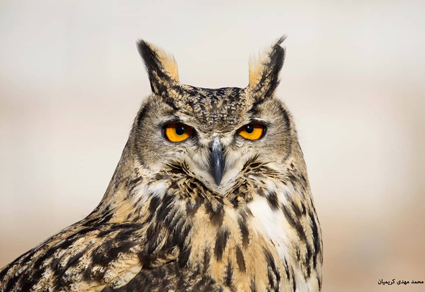
The Eurasian Eagle Owl (Bubo bubo) exhibits complex taxonomic structure with multiple subspecies across its broad geographic range. While much is known about the species in Europe and parts of Asia, the taxonomic status and distribution of B. bubo subspecies in Iran remain poorly understood. Phylogenetic analysis based on partial Cytb sequences of 36 samples across Iran revealed two rather weakly diverged clades: a western Iranian clade clustering with European (mostly German) samples, and an eastern/southern Iranian clade clustering with Chinese samples. Genetic diversity indices for the Iranian population were relatively low, with three identified haplotypes and low nucleotide and haplotype diversity. The findings are consistent with the presence of two subspecies, B. bubo nikolskii and B. bubo interpositus, in Iran, aligning with recent taxonomic assessments, but further investigation with additional genetic markers is needed to clarify the deeper evolutionary relationships among these populations. This study has implications for conservation and future taxonomic revisions of Bubo bubo.
References
- Ahmadzadeh, F., Flecks, M., Carretero, M.A., Mozaffari, O., Böhme, W., Harris, D.J., Freitas, S. & Rödder, D. (2013) Cryptic speciation patterns in Iranian rock lizards uncovered by integrative taxonomy. PLoS One, 8 (12), e80563. https://doi.org/10.1371/journal.pone.0080563
- AviList Core Team (2025) AviList: The Global Avian Checklist. Version 2025. Available from: https://www.avilist.org/checklist/v2025/ (accessed 4 April 2026) https://doi.org/10.2173/avilist.v2025
- Barišić, S., Tutiš, V., Ćiković, D., Kralj, J. & Ružanović, Z. (2016) The Eagle Owl Bubo bubo (Aves: Strigidae) in the Eastern Adriatic (Croatia): the study case of a high-density insular population. Italian Journal of Zoology, 83 (2), 275–281. https://doi.org/10.1080/11250003.2016.1158874
- Clements, J.F., Rasmussen, P.C., Schulenberg, T.S., Iliff, M.J., Fredericks, T.A., Gerbracht, J.A., Lepage, D., Spencer, A., Billerman, S.M., Sullivan, B.L., Smith, M. & Wood, C.L. (2024) The eBird/Clements checklist of Birds of the World. Version 2024. Cornell Lab of Ornithology, Ithaca, New York, Digital Database.
- del Hoyo, J. (2020) All The Birds Of The World. Lynx Edicions, Barcelona, 968 pp.
- del Hoyo, J., Collar, N.J., Christie, D.A., Elliott, A., Fishpool, L., Boesman, P. & Kirwan, G.M. (2014) Illustrated Checklist of the Birds of the World: Non-passerines. Lynx Edicions, Barcelona, 904 pp.
- Dickinson, E. & Remsen Jr., J.V. (2013) The Howard & Moore Complete Checklist of the Birds of the World. Aves Press, Eastbourne, 461 pp.
- Doyle, F.I., Therrien, J.-F., Reid, D.G., Gauthier, G. & Krebs, C.J. (2017) Seasonal movements of female Snowy Owls breeding in the western North American Arctic. Journal of Raptor Research, 51 (4), 428–438. https://doi.org/10.3356/JRR-16-51.1
- Edler, D., Klein, J., Antonelli, A. & Silvestro, D. (2021) raxmlGUI 2.0: a graphical interface and toolkit for phylogenetic analyses using RAxML. Methods in Ecology and Evolution, 12 (2), 373–377. https://doi.org/10.1111/2041-210X.13512
- Excoffier, L., Laval, G. & Schneider, S. (2005) Arlequin (version 3.0): an integrated software package for population genetics data analysis. Evolutionary Bioinformatics, 1, 47–50. https://doi.org/10.1177/117693430500100003
- Felsenstein, J. (1985) Confidence limits on phylogenies: an approach using the bootstrap. Evolution, 39 (4), 783–791. https://doi.org/10.1111/j.1558-5646.1985.tb00420.x
- Fu, Y.-X. (1997) Statistical tests of neutrality of mutations against population growth, hitchhiking and background selection. Genetics, 147 (2), 915–925. https://doi.org/10.1093/genetics/147.2.915
- Geyer, T., Sarradj, E. & Fritzsche, C. (2013) Silent owl flight: comparative acoustic wind tunnel measurements on prepared wings. Acta Acustica, 99 (1), 139–153. https://doi.org/10.3813/AAA.918598
- Gill, F.B. & Wright, M. (2006) Birds of the World: Recommended English names. Princeton University Press, Princeton, New Jersey, ix + 259 pp.
- Gousy-Leblanc, M., Therrien, J.F., Broquet, T., Rioux, D., Curt-Grand-Gaudin, N., Tissot, N., Tissot, S., Szabo, I., Wilson, L. & Evans, J.T. (2023) Long-term population decline of a genetically homogeneous continental‐wide top Arctic predator. Ibis, 165 (4), 1251–1266. https://doi.org/10.1111/ibi.13199
- Gracia, E., Ortego, J., Godoy, J.A., Pérez-García, J.M., Blanco, G., del Mar Delgado, M., Penteriani, V., Almodovar, I., Botella, F. & Sánchez-Zapata, J.A. (2015) Genetic signatures of demographic changes in an avian top predator during the last century: Bottlenecks and expansions of the Eurasian Eagle Owl in the Iberian Peninsula. PLoS One, 10 (7), e0133954. https://doi.org/10.1371/journal.pone.0133954
- Grimmett, R., Inskipp, C. & Inskipp, T. (2011) Birds of the Indian Subcontinent. Christopher Helm, Helm and Oxford University Press, Delhi, 528 pp.
- Hadad, E., Charter, M., Kosicki, J. Z. & Yosef, R. (2022a) Prey-base does not influence breeding success in Eagle Owls (Bubo bubo) in Judea, Israel. Animals, 12 (10), 1280. https://doi.org/10.3390/ani12101280
- Hadad, E., Malkinson, D., Yosef, R., Weil, G. & Charter, M. (2022b) Importance of mesohabitat for nest-site selection in breeding Eagle Owls (Bubo bubo): A multi-scale model. Diversity, 14 (6), 438. https://doi.org/10.3390/d14060438
- Hall, T.A. (1999) BioEdit: a user-friendly biological sequence alignment editor and analysis program for Windows 95/98/NT. In: Nucleic Acids Symposium Series. Vol. 41. Oxford University Press, Oxford, pp. 95–98.
- Harpending, H. (1994) Signature of ancient population growth in a low-resolution mitochondrial DNA mismatch distribution. Human Biology, 591–600.
- Hayashi, Y. (1997) Morphological characters and the source of Eagle Owl Bubo bubo specimens in the Far East. Journal of the Yamashina Institute for Ornithology, 29 (1), 73–79. https://doi.org/10.3312/jyio1952.29.73
- Holt, D.W., Berkley, R., Deppe, C., Enríquez, P.L., Petersen, J.L., Rangel Salazar, J.L., Segars, K.P., Wood, K.L., and Marks, J.S. (2020) Eurasian Eagle-Owl (Bubo bubo). Version 1.0. In: del Hoyo, J., Elliott, A., Sargatal, J., Christie, D.A. & de Juana, E. (Eds.), Birds of the World. Cornell Lab of Ornithology, Ithaca, New York. Available from: https://birdsoftheworld.org/bow/species/eueowl1/1.0/introduction (accessed 4 April 2026) https://doi.org/10.2173/bow.eueowl1.01
- Kim, H.-J., Kim, H., Park, S.-J. & Choi, C.-Y. (2024) Reversed sexual size dimorphism and morphological sex determination of the smallest subspecies of Eurasian Eagle-Owls (Bubo bubo kiautschensis). Journal of Raptor Research, 58 (3), 329–337. https://doi.org/10.3356/jrr2383
- König, C. & Weick, F. (2008) Owls. A Guide to the Owls of the World. Bloomsbury Publishing, London, 528 pp.
- Konishi, M. (1973) How the owl tracks its prey: experiments with trained barn owls reveal how their acute sense of hearing enables them to catch prey in the dark. American Scientist, 61 (4), 414–424.
- Kumar, S., Stecher, G., Suleski, M., Sanderford, M., Sharma, S. & Tamura, K. (2024) MEGA12: Molecular Evolutionary Genetic Analysis version 12 for adaptive and green computing. Molecular Biology and Evolution, 41 (12), msae263. https://doi.org/10.1093/molbev/msae263
- Lanfear, R., Calcott, B., Ho, S.Y. & Guindon, S. (2012) PartitionFinder: combined selection of partitioning schemes and substitution models for phylogenetic analyses. Molecular Biology and Evolution, 29 (6), 1695–1701. https://doi.org/10.1093/molbev/mss020
- Leigh, J.W. & Bryant, D. (2015) POPART: full-feature software for haplotype network construction. Methods in Ecology and Evolution, 6 (9), 1110–1116. https://doi.org/10.1111/2041-210X.12410
- Librado, P. & Rozas, J. (2009) DnaSP v5: a software for comprehensive analysis of DNA polymorphism data. Bioinformatics, 25 (11), 1451–1452. https://doi.org/10.1093/bioinformatics/btp187
- Marks, J.S., Cannings, R.J., Mikkola, H., del Hoyo, J., Elliott, A., Sargatal, J., Christie, D.A. & de Juana, E. (2018) Typical owls (Strigidae). In: del Hoyo, J., Elliott, A., Sargatal, J., Christie, D.A. & de Juana, E. (Eds.), Handbook of the Birds of the World Alive. Lynx Edicions, Barcelona, pp. 152–242.
- Meng, M., Ma, J., Laghari, M.Y. & Ji, J. (2020) Genetic analysis of three wild Eurasian eagle-owl subspecies, B. b. kiautschensis, B. b. ussuriensis, and B. b. tibetanus, in Chinese populations. Mitochondrial DNA, Part B, 5 (3), 3775–3777. https://doi.org/10.1080/23802359.2020.1839363
- Mikkola, H. (2013) Owls of the World: a Photographic Guide. Christopher Helm, London, UK.
- Mueller, J.C., Kuhl, H., Boerno, S., Tella, J.L., Carrete, M. & Kempenaers, B. (2018) Evolution of genomic variation in the Burrowing Owl in response to recent colonization of urban areas. Proceedings of the Royal Society B: Biological Sciences, 285 (1878), 20180206. https://doi.org/10.1098/rspb.2018.0206
- Olsson, U., Alström, P., Ericson, P.G.P. & Sundberg, P. (2005) Non-monophyletic taxa and cryptic species—evidence from a molecular phylogeny of leaf-warblers (Phylloscopus, Aves). Molecular Phylogenetics and Evolution, 36 (2), 261–276. https://doi.org/10.1016/j.ympev.2005.01.012
- Payne, R.S. (1971) Acoustic location of prey by barn owls (Tyto alba). Journal of Experimental Biology, 54 (3), 535–573. https://doi.org/10.1242/jeb.54.3.535
- Pegan, T.M., Kimmitt, A.A., Benz, B.W., Weeks, B.C., Aubry, Y., Burg, T.M., Hudon, J., Jones, A.W., Kirchman, J.J. & Ruegg, K.C. (2025) Long-distance seasonal migration to the tropics promotes genetic diversity but not gene flow in boreal birds. Nature Ecology & Evolution, 9, 957–969. https://doi.org/10.1038/s41559-025-02699-3
- Rajković, D.Z., Vučanović, M., Medenica, I.J., Dimitrijević, V., Koturov, J., Stanković, D. & Skorić, S. (2025) Eurasian Eagle-Owl Bubo bubo (Linnaeus, 1758) (Aves: Strigidae) in eastern Serbia in the 21st century: distribution, population size and density. Kragujevac Journal of Science, 47 (1), 121–138. https://doi.org/10.5937/KgJSci2501121R
- Ramos-Onsins, S.E. & Rozas, J. (2002) Statistical properties of new neutrality tests against population growth. Molecular Biology and Evolution, 19 (12), 2092–2100. https://doi.org/10.1093/oxfordjournals.molbev.a004034
- Rasmussen, P.C. & Anderton, J.C. (2005) Birds of South Asia: the Ripley Guide. 2 Vols. Lynx Edicions, Barcelona, 378 pp. & 683 pp.
- Rexer-Huber, K., Veale, A.J., Catry, P., Cherel, Y., Dutoit, L., Foster, Y., McEwan, J.C., Parker, G.C., Phillips, R.A. & Ryan, P.G. (2019) Genomics detects population structure within and between ocean basins in a circumpolar seabird: the White-chinned Petrel. Molecular Ecology, 28 (20), 4552–4572. https://doi.org/10.1111/mec.15248
- Rezazadeh, E., Aliabadian, M., Darvish, J. & Ahmadzadeh, F. (2020) Diversification and evolutionary history of brush-tailed mice, Calomyscidae (Rodentia), in southwestern Asia. Organisms Diversity & Evolution, 20 (1), 155–170. https://doi.org/10.1007/s13127-019-00426-y
- Ronquist, F. & Huelsenbeck, J.P. (2003) MrBayes 3: Bayesian phylogenetic inference under mixed models. Bioinformatics, 19 (12), 1572–1574. https://doi.org/10.1093/bioinformatics/btg180
- Sarradj, E., Fritzsche, C. & Geyer, T. (2011) Silent owl flight: bird flyover noise measurements. AIAA Journal, 49 (4), 769–779. https://doi.org/10.2514/1.J050703
- Stervander, M., Illera, J.C., Kvist, L., Barbosa, P., Keehnen, N.P., Pruisscher, P., Bensch, S. & Hansson, B. (2015) Disentangling the complex evolutionary history of the Western Palearctic blue tits (Cyanistes spp.)–phylogenomic analyses suggest radiation by multiple colonization events and subsequent isolation. Molecular Ecology, 24 (10), 2477–2494. https://doi.org/10.1111/mec.13145
- Tajima, F. (1989) Statistical method for testing the neutral mutation hypothesis by DNA polymorphism. Genetics, 123 (3), 585–595. https://doi.org/10.1093/genetics/123.3.585
- Thompson, J.D., Higgins, D.G. & Gibson, T.J. (1994) CLUSTAL W: improving the sensitivity of progressive multiple sequence alignment through sequence weighting, position-specific gap penalties and weight matrix choice. Nucleic Acids Research, 22 (22), 4673–4680. https://doi.org/10.1093/nar/22.22.4673
- Weick, F. (2007) Owls (Strigiformes): Annotated and Illustrated Checklist. Springer, Berlin and Heidelberg, 350 pp. [pp. 104–107] https://doi.org/10.1007/978-3-540-39567-6
- Wink, M., El-Sayed, A.-A., Sauer-Gürth, H. & Gonzalez, J. (2009) Molecular phylogeny of owls (Strigiformes) inferred from DNA sequences of the mitochondrial cytochrome b and the nuclear RAG-1 gene. Ardea, 97 (4), 581–591. https://doi.org/10.5253/078.097.0425
- Wink, M. & Heidrich, P. (1999) Molecular evolution and systematics of owls (Strigiformes). In: Owls: A Guide to the Owls of the World. Pica Press, Sussex, pp. 39–57.
- Winker, K. (2010) Subspecies represent geographically partitioned variation, a gold mine of evolutionary biology, and a challenge for conservation. Ornithological Monographs, 67, 6–23. https://doi.org/10.1525/om.2010.67.1.6
- Xia, X. (2013) DAMBE5: a comprehensive software package for data analysis in molecular biology and evolution. Molecular Biology and Evolution, 30 (7), 1720–1728. https://doi.org/10.1093/molbev/mst064