
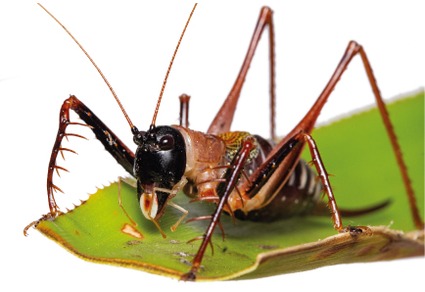

Abstract
Tettigoniidae is one of the most diverse families of Orthoptera, comprising more than 8,000 described species worldwide. Within it, Listroscelidinae is distinctive for its predatory habits, a rare condition among katydids. Members of this subfamily exhibit morphological adaptations associated with active predation, including robust mandibles and spined forelegs. In Brazil, Listroscelidinae are mainly known from the Atlantic Forest, while seasonally dry biomes such as the Caatinga remain poorly studied. Herein, we describe a new genus of predatory katydids from the Caatinga biome of northeastern Brazil based on detailed morphological examination. Draconatus Fianco gen. nov. is diagnosed by a combination of several characters, as the labrum white, short tegmina with yellowish veins contrasting against dark cells, and tibia II bearing a single dorsal spine. Comparative analysis reveals clear morphological differences from other Neotropical genera, including Cerberodon Perty, Listroscelis Serville, Monocerophora Walker, Venatorellus Mendes, Chamorro-Rengifo, Rafael & Carliella Karny particularly in head sculpture and coloration, labral proportions, tegminal condition, tibial armature, and female terminalia. Carliella is also considered as the senior synonym of Isocarliella Mello-Leitão syn. nov. and Macrometopon Bruner syn. nov. The new genus is endemic to the central Caatinga, highlighting the underestimated diversity of predatory katydids in xeric Brazilian biomes.
References
- Bruner, L. (1915) Notes on tropical American Tettigonoidea (Locustodea). Annals of the Carnegie Museum, 9 (3–4), 284–404.
- Castro-Souza, R.A., Tessarolo, G., Stropp, J., Diniz-Filho, J.A., Ladle, R.J., Szinwelski, N., Hortal, J. & Sobral-Souza, T. (2024) Mapping ignorance to uncover shortfalls in the knowledge on global Orthoptera distribution. npj Biodiversity, 3 (1), 1–11. https://doi.org/10.1038/s44185-024-00059-1
- Cigliano, M.M., Braun, H., Eades, D.C. & Otte, D. (2026) Orthoptera Species File. Available from: http://orthoptera.speciesfile.org (accessed 20 February 2026)
- Desutter-Grandcolas, L., Jacquelin, L., Hugel, S., Boistel, R., Garrouste, R., Henrotay, M., Warren, B.H., Chintauan-Marquier, I.C., Nel, P., Grandcolas, P. & Nel, A. (2017) 3-D imaging reveals four extraordinary cases of convergent evolution of acoustic communication in crickets and allies (Insecta). Scientific Reports, 7, 1–8. https://doi.org/10.1038/s41598-017-06840-6
- Emsley, M., Nickle, D.A. & Moss, W. (1967) The value of the stridulatory file and other caracteres in tettigoniid taxonomy (Orthoptera). Notulae Naturae of the Academy of Natural Science, 404, 1–9.
- Fialho, V.S., Chamorro-Rengifo, J., Lopes-Andrade, C. & Yotoko, K.S.C. (2014) Systematics of Spiny Predatory Katydids (Tettigoniidae: Listroscelidinae) from the Brazilian Atlantic Forest Based on Morphology and Molecular Data. In: Hejnol, A. (Ed.), PLoS ONE, 9, e103758. https://doi.org/10.1371/journal.pone.0103758
- Gwynne, D.T. (2001) Katydids and bush-crickets: reproductive behavior and evolution of the Tettigoniidae. Cornell University Press, New York, New York, 327 pp.
- Mello-Leitão, C. (1940) Quatro novos Tetigonioides do Brasil (Orthoptera). Revista de Entomologia, 11, 150–162.
- Mendes, D.M.D.M., Chamorro-Rengifo, J. & Rafael, J.A. (2020) Five new genera of angle-wing katydids (Orthoptera: Tettigoniidae: Phaneropterinae: Microcentrini) from the Amazon Rainforest. Zootaxa, 4828 (1), 1–84. https://doi.org/10.11646/zootaxa.4828.1.1
- MMA (2025) Caatinga. Ministério do Meio Ambiente e Mudança do Clima. Available from: https://www.gov.br/mma/pt-br/assuntos/biodiversidade-e-biomas/biomas-e-ecossistemas/biomas/caatinga (accessed 31 March 2026)
- Queiroz, L.P. de, Rapini, A. & Giulietti, A.M. (2006) Towards Greater Knowledge of the Brazilian Semi-arid Biodiversity. Ministério da Ciência e Tecnologia, Brasília, D.F., 142 pp.
- Rentz, D.C.F. (2010) A Guide to the Katydids of Australia. 1st Edition. CSIRO PUBLISHING, Melbourne, 214 pp. https://doi.org/10.1071/9780643100183
- Snodgrass, R.E. (1935) Principles of insect morphology. McGraw-Hill Book Co., New York, New York, 513 pp.
- Snodgrass, R.E. (1937) The male genitalia of orthopteroid insects. Smithsonian Miscellaneous Collections, 96, 1–107.
- Souza-Dias, P.G.B., Sperber, C.F., Costa, M.K.M. da, Mendes, D.M. de M., Campos, L.D. de, Olivier, R. da S., Silva, D.S.M., Fianco, M., Szinwelski, N., Bolfarini, M.P., Domenico, F.C. de, Chamorro-Rengifo, J. & Jesus, F.M. de (2024) Capítulo 19: Orthoptera Olivier, 1789. In: Insetos do Brasil: Diversidade e Taxonomia. Editora INPA, Manaus, Amazonas, pp. 254–290.