
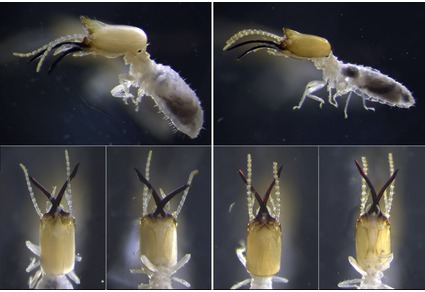

Abstract
Two new species of the genus Termes Linnaeus are described through an integrative approach, combining whole mitogenome sequencing and comparative morphology across all neotropical congeneric species. Our maximum-likelihood phylogenetic reconstruction places the two new species in a clade sister to the T. fatalis species complex. Termes chocoensis sp. nov. was found along the Pacific coast of Colombia, and Termes atlanticus sp. nov. near the Atlantic coast and in Venezuela. Their soldiers differ from those of other Termes species in terms of head, pronotum, and mandible measurements. Workers exhibit a distinctive armature of the enteric valve, which is currently the only diagnostic character separating T. fatalis from T. atlanticus sp. nov. and T. medioculatus from T. chocoensis sp. nov., highlighting the criticality of examining multiple castes when identifying Termes specimens.
References
- Allio, R., Schomaker-Bastos, A., Romiguier, J., Prosdocimi, F., Nabholz, B. & Delsuc, F. (2020) MitoFinder: Efficient automated large-scale extraction of mitogenomic data in target enrichment phylogenomics. Molecular Ecology Resources, 20 (4), 892–905. https://doi.org/10.1111/1755-0998.13160
- Bandeira, A.G. & Cancello, E.M. (1992) Four new species of termites (Isoptera, Termitidae) from the island of Maracá, Roraima, Brasil. Revista Brasileira de Zoologia, 36 (2), 423–435.
- Banks, N. (1918) The termites of Panama and British Guiana. Bulletin of the American Museum of Natural History, 17, 659–667.
- Banks, N. (1919) Antillean Isoptera. Bulletin of the Museum of Comparative Zoology, 62 (10), 475–489.
- Bourguignon, T., Lo, N., Šobotník, J., Ho, S.Y.W., Iqbal, N., Coissac, E., Lee, M., Jendryka, M.M., Sillam-Dussès, D., Křížková, B., Roisin, Y. & Evans, T.A. (2017) Mitochondrial phylogenomics resolves the global spread of higher termites, ecosystem engineers of the tropics. Molecular Biology and Evolution, 34 (3), 589–597. https://doi.org/10.1093/molbev/msw253
- Carrijo, T.F., Pontes-Nogueira, M., Santos, R.G., Morales, A.C., Cancello, E.M. & Scheffrahn, R.H. (2020) New World Heterotermes (Isoptera, Rhinotermitidae): molecular phylogeny, biogeography and description of a new species. Systematic Entomology, 45 (3), 527–539. https://doi.org/10.1111/syen.12412
- Casalla Daza, R. & Korb, J. (2019) Phylogenetic community structure and niche differentiation in termites of the tropical dry forests of Colombia. Insects, 10 (103), 1–26. https://doi.org/10.3390/insects10040103
- Casalla, R. & Korb, J. (2019) Termite diversity in Neotropical dry forests of Colombia and the potential role of rainfall in structuring termite diversity. Biotropica, 51 (2), 165–177. https://doi.org/10.1111/btp.12626
- Castro, D., Carrijo, T.F., Serna, F.J. & Peña-Venegas, C.P. (2021) Can rubber crop systems recover termite diversity in previously degraded pastures in the Colombian Amazon Region? Neotropical Entomology, 50 (6), 899–911. https://doi.org/10.1007/s13744-021-00905-y
- Chen, S., Zhou, Y., Chen, Y. & Gu, J. (2018) fastp: an ultra-fast all-in-one FASTQ preprocessor. Bioinformatics, 34 (17), i884–i890. https://doi.org/10.1093/bioinformatics/bty560
- Emerson, A.E. (1925) The termites of Kartabo Bartica District, British Guiana. Zoologica, 6 (4), 291–459. https://doi.org/10.5962/p.190324
- Emerson, A.E. (1949) Termes medioculatus Emerson n. sp. In: Snyder, T.E. (Ed.), Catalog of the termites (Isoptera) of the world. Smithsonian Miscellaneous Collections, 112 (3953), 183.
- Emerson, A.E. (1960) New genera of termites related to Subulitermes from the Oriental, Malagasy, and Australian regions (Isoptera, Termitidae, Nasutitermitinae). American Museum Novitates, 1986, 1–28.
- Fontaine, N., Hellemans, S., Horáček, N., Křivánek, J., Timmermans, J., Kaczmarek, N., Kaymak, E., Wang, M., Scheffrahn, R.H., Bourguignon, T., Hanus, R., Fournier, D. & Roisin, Y. (2025) Integrative taxonomy unravels the true identity of Linnaeus’ Termes fatalis (Isoptera: Termitidae), the source of termites’ name. Systematic Entomology, 51 (1) (e70016), 1–23. https://doi.org/10.1111/syen.70016
- Godoy, M.C. & Torales, G.J. (1993) Morfología del tubo digestivo de obreras del género Termes (Isoptera: Termitidae) de la región neotropical. Rev. Soc. Entomol. Argent., 52 (1–4), 123–132.
- Hadley, A. (2016) CombineZP. Available from: https://web.archive.org/web/20160525040431/http://hadleyweb.pwp.blueyonder.co.uk/
- Hellemans, S., Bourguignon, T., Kyjaková, P., Hanus, R. & Roisin, Y. (2017) Mitochondrial and chemical profiles reveal a new genus and species of Neotropical termite with snapping soldiers, Palmitermes impostor (Termitidae: Termitinae). Invertebrate Systematics, 31, 394–405. https://doi.org/10.1071/IS16089
- Hellemans, S., Wang, M., Jouault, C., Rocha, M.M., Battilana, J., Carrijo, T.F., Legendre, F., Condamine, F.L., Roisin, Y., Cancello, E.M., Scheffrahn, R.H. & Bourguignon, T. (2026) Termites became the dominant decomposers of the tropics after two diversification pulses. Current Biology, 1–14. https://doi.org/10.1016/j.cub.2026.04.008
- Josens, G., Deligne, J., Harry, M., Roy, V., Akama, P.D., Coulibaly, T., Dosso, K., Goergen, G., Hasson, M., Kasangij A Kasangij, P., Kifukieto, C., Le Ru, B., Loko, L.E.Y., Ndiaye, A.B., Roisin, Y., Sion, N., Šobotník, J., Stiblik, P., Kue Di Kuenda, S., Traoré, S., Viage, M., Wango, S.P., Kaymak, E., Bourguignon, T. & Hellemans, S. (2025) An integrative revision of the genus Isognathotermes (Termitidae: Cubitermitinae) with description of seven new species and four new subspecies. European Journal of Taxonomy, 1024, 1–197. https://doi.org/10.5852/ejt.2025.1024.3099
- Katoh, K. & Standley, D.M. (2013) MAFFT multiple sequence alignment software version 7: Improvements in performance and usability. Molecular Biology and Evolution, 30 (4), 772–780. https://doi.org/10.1093/molbev/mst010
- Krishna, K., Grimaldi, D.A., Krishna, V. & Engel, M.S. (2013a) Treatise on the Isoptera of the world. 1. Introduction. Bulletin of the American Museun of Natural History, 377. https://doi.org/10.1206/377.1
- Krishna, K., Grimaldi, D.A., Krishna, V. & Engel, M.S. (2013b) Treatise on the Isoptera of the world. 6. Termitidae (part three), incertae sedis, taxa excluded from Isoptera. Bulletin of the American Museun of Natural History, 377, 1991–2432. https://doi.org/10.1206/377.6
- Kück, P. & Longo, G.C. (2014) FASconCAT-G: Extensive functions for multiple sequence alignment preparations concerning phylogenetic studies. Frontiers in Zoology, 11 (81), 1–8. https://doi.org/10.1186/s12983-014-0081-x
- Linnaeus, C. (1758) Systema Naturae per Regna Tria Naturae, Secundum Classes, Ordines, Genera, Species, cum Characteribus, Differentiis, Synonymis, Locis. Tomus I. Editio Decima. Laurentius Salvius, Stockholm, 824 pp. [pp. 609–610] https://doi.org/10.5962/bhl.title.542
- Mathews, A.G.A. (1977) Studies on Termites from the Mato Grosso State, Brazil. Academia Brasileira de Ciências, Rio de Janeiro, 276 pp.
- Minh, B.Q., Nguyen, M.A.T. & von Haeseler, A. (2013) Ultrafast approximation for phylogenetic bootstrap. Molecular Biology and Evolution, 30 (5), 1188–1195. https://doi.org/10.1093/molbev/mst024
- Miura, T., Roisin, Y. & Matsumoto, T. (2000) Molecular phylogeny and biogeography of the nasute termite genus Nasutitermes (Isoptera: Termitidae) in the Pacific tropics. Molecular Phylogenetics and Evolution, 17 (1), 1–10. https://doi.org/10.1006/mpev.2000.0790
- Nguyen, L.T., Schmidt, H.A., von Haeseler, A. & Minh, B.Q. (2015) IQ-TREE: A fast and effective stochastic algorithm for estimating maximum-likelihood phylogenies. Molecular Biology and Evolution, 32 (1), 268–274. https://doi.org/10.1093/molbev/msu300
- Nurk, S., Meleshko, D., Korobeynikov, A. & Pevzner, P.A. (2017) metaSPAdes: a new versatile metagenomic assembler. Genome Research, 27 (5), 824–834. https://doi.org/10.1101/GR.213959.116
- Paulino Monteiro, S.R., Carvalho, A., Ferreira, R.R., Figueirêdo, R.E.C.R., Vasconcellos, A. & Koroiva, R. (2025) Efficiency of the cytochrome c oxidase subunit II gene for the delimitation of termite species (Blattodea: Isoptera) in the state of Paraíba, northeastern Brazil. PLoS ONE, 20 (9), 1–17. https://doi.org/10.1371/journal.pone.0328685
- Pinzon Florian, O.P., Carvajal, L.S.B. & Diaz, M.A.B. (2017) Termite (isoptera) diversity in a gallery forest relict in the Colombian eastern plains. Sociobiology, 64 (1), 92–100. https://doi.org/10.13102/sociobiology.v64i1.1184
- Pinzón Florián, O.P., Casalla Daza, R.H., Castro Torres, D. & Vargas Niño, A.P. (2025) Termitas de Colombia. In: Arab, A., Haifig, I. & Carrijo, T.F. (Eds.), Cupins da América do Sul. Editora da UFABC, Santo André, São Paulo, pp. 770–811.
- Pontes-Nogueira, M., Aguilera, S.M., Palma-Onetto, V., Wang, M., Hellemans, S., Scheffrahn, R.H., Cancello, E.M., Bourguignon, T. & Carrijo, T.F. (2026) Phylogeny and biogeography of the termite genus Labiotermes Holmgren, 1912 (Isoptera, Syntermitinae) suggests predominant sympatric speciation. Journal of Biogeography, 53 (1), e70124. https://doi.org/10.1111/jbi.70124
- Rice, P., Longden, I. & Bleasby, A. (2000) EMBOSS (The European Molecular Biology Open Software Suite). Trends in Genetics, 16 (6), 276–277. https://doi.org/10.1016/s0168-9525(00)02024-2
- Roonwal, M.L. (1969) Measurements of termites for taxonomic purposes. Journal of the Zoological Society of India, 21, 9–66.
- Scheffrahn, R.H. (2020) First records of the termite, Termes hispaniolae (Banks, 1918) (Isoptera, Termitidae, Termitinae), from Bolivia and new Caribbean Basin records. Check List, 16 (2), 271–6. https://doi.org/10.15560/16.2.271
- Schneider, C.A., Rasband, W.S. & Eliceiri, K.W. (2012) NIH Image to ImageJ : 25 years of image analysis. Nature Methods, 9 (7), 671–675. https://doi.org/10.1038/nmeth.2089
- Silvestri, F. (1903) Contribuzione alla conoscenza dei termitidi e termitofili dell’ America meridionale. Redia, 1 (1), 1–234, 6 pls. https://doi.org/10.5962/bhl.title.137413
- Simon, C., Frati, F., Beckenbach, A.T., Crespi, B., Hong, L. & Flook, P. (1994) Evolution, weighting and phylogenetic utility of mitochondrial gene sequences and a compilation of conserved polymerase chain reaction primers. Annals of the Entomogical Society of America, 87 (6), 651–701. https://doi.org/10.1093/aesa/87.6.651
- Snyder, T.E. (1923) Three new termites from the Canal Zone, Panama. Proceedings of the Entomological Society of Washington, 25 (5–6), 126–131.
- Snyder, T.E. (1926) Termites collected on the Mulford Biological Exploration to the Amazon Basin, 1921–1922. Proceedings of the United States National Museum, 68 (14), 1–76. https://doi.org/10.5479/si.00963801.68-2615.1
- Suyama, M., Torrents, D. & Bork, P. (2006) PAL2NAL: Robust conversion of protein sequence alignments into the corresponding codon alignments. Nucleic Acids Research, 34 (Web Server issue), W609–W612. https://doi.org/10.1093/nar/gkl315
- Wang, M., Hellemans, S., Buček, A., Kanao, T., Arora, J., Clitheroe, C., Rafanomezantsoa, J.J., Fisher, B.L., Scheffrahn, R., Sillam-Dussès, D., Roisin, Y., Šobotník, J. & Bourguignon, T. (2023) Neoisoptera repeatedly colonised Madagascar after the Middle Miocene climatic optimum. Ecography, 2023 (e06463), 1–12. https://doi.org/10.1111/ecog.06463