

Abstract
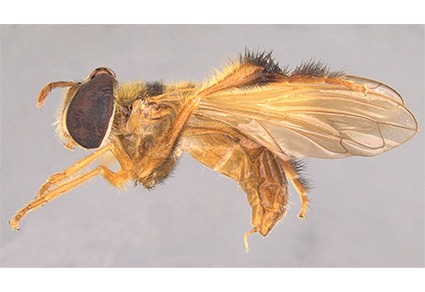
Two new species of flower flies that mimic stingless bees are described, belonging to the genera Carreramyia Doesburg and Hypselosyrphus Hull (Diptera: Syrphidae: Microdontinae) from the Colombian Amazon rainforest. Carreramyia tacita sp. nov. and Hypselosyrphus macagualensis sp. nov. are described and compared with congeneric species, supported by photographs and comparison of diagnostic characters. Modifications to previous keys are provided.
References
- Brèthes, J. (1908) Masarygidae, una nueva familia de dipteros. Anales del Museo Nacional de Historia Natural de Buenos Aires, 10 (3), 439–443.
- Carvalho-Filho, F.S. (2014) Description of new species of Surimyia Reemer and Carreramyia Doesburg (Diptera: Syrphidae) from the Brazilian Amazon. Zootaxa, 3887 (1), 79–87. https://doi.org/10.11646/zootaxa.3887.1.5
- Cheng, X. & Thompson, F.C. (2008) A generic conspectus of the Microdontinae (Diptera: Syrphidae) with the description of two new genera from Africa and China. Zootaxa, 1879, 21–48. https://doi.org/10.11646/zootaxa.1879.1.3
- Cumming, J.M. & Wood, D.M. (2017) Adult morphology and terminology. In: Kirk-Spriggs, A.H. & Sinclair, B.J. (Eds.), Manual of Afrotropical Diptera. Volume 1. Suricata, Pretoria, pp. 89–134.
- Curran, C.H. (1940) Some new Neotropical Syrphidae (Diptera). American Museum Novitates, 1086, 1–14.
- de Souza Amorim, D., Brown, B.V., Boscolo, D., Ale-Rocha, R., Alvarez-Garcia, D.M., Balbi, M.I.P.A., De Marco Barbosa, A., Capellari, R.S., De Carvalho, C.J.B., Couri, M.S., De Vilhena Perez Dios, R., Fachin, D.A., Ferro, G.B., Flores, H.F., Frare, L.M., Gudin, F.M., Hauser, M., Lamas, C.J.E., Lindsay, K.G., Marinho, M.A.T., Marques, D.W., Marshall, S.A., Mello Patiu, C., Menezes, M.A., Morales, M.N., Nihei, S.S., Oliveira, S.S., Pirani, G., Ribeiro, G.C., Riccardi, P.R., De Santis, M.D., Santos, D., Dos Santos, J.R., Silva, V.C., Wood, E.M. & Rafael, J.A. (2022) Vertical stratification of insect abundance and species richness in an Amazonian tropical forest. Scientific Reports, 12, 1734. https://doi.org/10.1038/s41598-022-05677-y
- Doesburg, P.H. (1966) Syrphidae from Suriname. Additional records and descriptions. Studies on the Fauna of Suriname and other Guyanas, 9 (35), 61–107.
- Evenhuis, N.L. & Pape, T. (2025) Family Syrphidae. Systema Dipterorum, Version 6.5. Available from: http://diptera.org/ (accessed 28 September 2025)
- Hull, F.M. (1937) New species of exotic syrphid flies. Psyche, 44, 12–32. https://doi.org/10.1155/1937/46960
- Hull, F.M. (1949) The morphology and inter-relationship of the genera of syrphid flies, recent and fossil. Transactions of the Zoological Society of London, 26, 257–408. https://doi.org/10.1111/j.1096-3642.1949.tb00224.x
- Mittermeier, R.A., Turner, W.R., Larsen, F.W., Brooks, T.M. & Gascon, C. (2011) Global biodiversity conservation: The critical role of hotspots. In: Zachos, F.E. & Habel, J.C. (Eds.), Biodiversity Hotspots: Distribution and Protection of Conservation Priority Areas. Springer, Berlin & Heidelberg, pp. 3–22. https://doi.org/10.1007/978-3-642-20992-5_1
- Miranda, G.F.G. (2014) Ceriomicrodon petiolatus Hull, 1937 (Diptera: Syrphidae: Microdontinae): Redescription and new records. Zootaxa, 3846 (4), 584–590. https://doi.org/10.11646/zootaxa.3846.4.7
- Miranda, G.F.G. (2017) Identification key for the genera of Syrphidae (Diptera) from the Brazilian Amazon and new taxon records. Acta Amazonica, 47 (1), 53–62. https://doi.org/10.1590/1809-4392201601022
- Miranda, G.F.G. & Moran, K. (2017) The female abdomen and genitalia of Syrphidae (Diptera). Insect Systematics & Evolution, 48, 157–201. https://doi.org/10.1163/1876312X-48022153
- Montoya, A.L. & Wolff, M. (2023) Taxonomic revision of the Neotropical genus Argentinomyia Lynch-Arribálzaga, 1891 (Diptera: Syrphidae), with description of 16 new species. Zootaxa, 5234, 1–157. https://doi.org/10.11646/zootaxa.5234.1.1
- Montoya, A.L., Parada-Marín, H.M. & Ramos-Pastrana, Y. (2022) Description of a new flower fly species of the Copestylum vagum group (Diptera: Syrphidae) from pristine Amazonian rainforests of Colombia and Suriname. Zootaxa, 5091 (3), 401–415. https://doi.org/10.11646/zootaxa.5091.3.1
- Montoya, A.L., Parra, J.L. & Wolff, M. (2021) Structure and diversity of hoverflies (Diptera: Syrphidae) in northwestern Colombian Paramos: Towards the identification of bioindicator species in the Tropical Andes. Journal of Insect Conservation, 25 (4), 1–20. https://doi.org/10.1007/s10841-021-00346-3
- Montoya, A.L., Pérez, S.P. & Wolff, M. (2012) The diversity of flower flies (Diptera: Syrphidae) in Colombia and their Neotropical distribution. Neotropical Entomology, 41, 46–56. https://doi.org/10.1007/s13744-012-0018-z
- Parada-Marín, H.M., Montoya, A.L. & Ramos-Pastrana, Y. (2021) New record of Cepa apeca (Diptera, Syrphidae, Eristalinae, Merodontini) in the Andean-Amazonian region of Colombia and expansion of its geographic range. Acta Amazonica, 51 (2), 162–165. https://doi.org/10.1590/1809-4392202003841
- Parada-Marin, H.M., Montoya, A.L., Ramos-Pastrana, Y., Córdoba-Suarez, E. & Mengual, X. (2024) Intraspecific variability of the flower fly Toxomerus flaviplurus (Hall, 1927) (Diptera: Syrphidae), with new distributional records in Colombia and Bolivia. Boletín Científico Museo de Historia Natural Universidad de Caldas, 28 (2), 33–47. https://doi.org/10.17151/bccm.2024.28.2.2
- Parada-Marín, H.M., Montoya, A.L. & Ramos-Pastrana, Y. (2025) Diversity and baits preference of flower flies (Diptera: Syrphidae) collected using Van Someren-Rydon traps in the Colombian Andean-Amazon Piedmont during two rainy seasons. Neotropical Entomology, 54, 52. https://doi.org/10.1007/s13744-025-01260-y
- Rafael, J.A. & Gorayeb, I. (1982) Tabanidae (Diptera) da Amazônia, I – Uma nova armadilha suspensa e primeiros registros de mutucas de copas de árvores. Acta Amazonica, 12, 222–236. https://doi.org/10.1590/1809-43921982121232
- Reemer, M. (2013) Taxonomic exploration of Neotropical Microdontinae (Diptera: Syrphidae) mimicking stingless bees. Zootaxa, 3697 (1), 1–88. https://doi.org/10.11646/zootaxa.3697.1.1
- Reemer, M. (2014) A review of Microdontinae (Diptera: Syrphidae) of Surinam, with a key to the Neotropical genera. Tijdschrift voor Entomologie, 157, 27–57. https://doi.org/10.1163/22119434-00002035
- Reemer, M. & Ståhls, G. (2013) Generic revision and species classification of the Microdontinae (Diptera, Syrphidae). ZooKeys, 288, 1–213. https://doi.org/10.3897/zookeys.288.4095
- Reemer, M. & Mengual, X. (2025) Revision of the Neotropical species of the hoverfly genus Serichlamys Curran, 1925 (Diptera, Syrphidae, Microdontinae). ZooKeys, 1243, 51–106. https://doi.org/10.3897/zookeys.1243.132809
- Reemer, M. & Mengual, X. (2026) Ubristes mirabilissimus sp. nov., a new stingless bee mimicking hoverfly from the Ecuadorian Amazon (Diptera: Syrphidae: Microdontinae). Evolutionary Systematics, 10 (1), 47–54. https://doi.org/10.3897/evolsyst.10.185722
- Sack, P. (1941) Syrphidae (Dipt.). In: Titschack, E. (Ed.), Beiträge zur Fauna Perus. Band 1B. Nach der Ausbeute der Hamburger Südperu-Expedition 1936, anderer Sammlungen, wie auch auf Grund von Literaturangaben. Verlag Conrad Behre, Hamburg, 403 pp.
- Shannon, R.C. (1925) An extraordinary adult myrmecophile from Panama. Proceedings of the National Academy of Sciences, 10, 211–213.
- Shorthouse, D.P. (2010) SimpleMappr, a web-enabled tool to produce publication-quality point maps. Available from: http://www.simplemappr.net (accessed 16 February 2026)
- Schmid, V.S., Morales, M.N., Marinoni, L., Kamke, R., Steiner, J. & Zillikens, A. (2014) Natural history and morphology of the hoverfly Pseudomicrodon biluminiferus and its parasitic relationship with ants nesting in bromeliads. Journal of Insect Science, 14 (38), 1–21. https://doi.org/10.1093/jis/14.1.38
- Thompson, F.C. (1969) A new genus of Microdontine flies (Diptera: Syrphidae) with notes on the placement of the subfamily. Psyche, 76, 74–85. https://doi.org/10.1155/1969/62102
- Thompson, F.C., Vockeroth, J.R. & Sedman, Y.S. (1976) Family Syrphidae. In: Papavero, N. (Ed.), A catalog of the Diptera of the Americas south of the United States. Vol. 46. Universidade de São Paulo, Museu de Zoologia, Departamento de Zoologia, Secretaria da Agricultura do Estado de São Paulo, São Paulo, pp. 1–195.
- van Steenis, J., Miranda, G.F.G., Tot, T., Mengual, X. & Skevington, J.H. (2023) Glossary of morphological terminology of adult Syrphidae (Diptera): an update and extension. Journaal van Syrphidae, 2 (4), 1–99. https://doi.org/10.55710/1.AIMS1978
- Walker, F. (1852) Diptera. Insecta Saundersiana, 1 (3), 157–252.