

Abstract
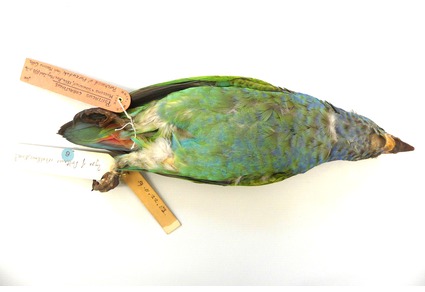
The taxonomy of Pionus menstruus has been relatively settled for at least the last 50 years, although a few recent authorities have split the Atlantic Forest population (P. m. reichenowi) from the other two subspecies (P. m. menstruus over much of Amazonia and P. m. rubrigularis in southern Central America to South America north and west of the Andes). Treated as a synonym of P. m. menstruus since the 1930s, the name Psittacus cobaltinus Massena, 1854, was generally thought to have been based on two specimens, both juveniles, said to be from ‘Colombia’. In our judgement one of these specimens (in the Natural History Museum, Tring) pertains to P. m. reichenowi and the other (at the Academy of Natural Sciences at Drexel University, Philadelphia) to P. m. menstruus. However, a reconsideration of the available evidence indicates that there is no rationale to believe that the Philadelphia specimen is a syntype and that Psittacus cobaltinus was probably based on a single specimen. All of the evidence, some of it previously unpublished, demonstrates that the Tring individual is that specimen. Because Psittacus cobaltinus has been used as a valid name since 1899, it cannot be considered a nomen oblitum under Art. 23.9 (specifically Art. 23.9.1.1 is not met). Given that Pionias Reichenowi Heine, 1884, has been in regular use only c.50 years, we advocate that priority be respected and Massena’s name is used, it being the senior synonym for this population. Available information indicates that the type material (three syntypes, in the Museum Heineanum, Halberstadt, and Museum für Naturkunde, Berlin) pertaining to Pionias Reichenowi was also mixed, although two of the specimens are either lost or destroyed. Nevertheless, to fix the taxonomic identity of this name unequivocally in favour of its long-standing attribution, we precautionarily designate the apparently only surviving syntype, in Halberstadt, as the lectotype of P. m. reichenowi. This designation will permit anyone who wishes to make an application to the ICZN in favour of prevailing usage for reichenowi over cobaltinus to do so from a solid base. Finally, there is evidence that Psittacus menstruus Linnaeus, 1766, was itself based on materials pertaining to more than one parrot species. As a result, a neotype is designated that accords with prevailing usage. The new arrangement for the species group is as follows: Pionus menstruus (Linnaeus, 1766), with subspecies P. m. rubrigularis Cabanis, 1881, and P. m. cobaltinus Massena, 1854 (syn. Pionias Reichenowi Heine, 1884, and P. m. cyanescens O. M. O. Pinto, 1960).
References
- Ahrens, T.G. (1925) The ornithological collection of the Berlin Museum. Auk, 42, 241–245.
- Brabourne, W.W. & Chubb, C. (1912) The birds of South America. Vol. 1. R.H. Porter, London, 504 pp.
- Brisson, M.-J. (1760) Ornithologie, ou, Méthode contenant la division des oiseaux en ordres, sections, genres, espèces & leurs variétés. Tome 4. J.-B. Bauche, Paris, 564 pp. https://doi.org/10.5962/bhl.title.51902
- Cabanis, J. (1881) Bericht über die April-Sitzung. Journal für Ornithologie, 29, 219–222.
- Cassin, J. (1858) United States Exploring Expedition during the years 1838, 1839, 1840, 1841, 1842 under the command of Charles Wilkins, U.S.N. Vol. 8. J.B. Lippincott & Co., Philadelphia, 466 pp.
- Collar, N., del Hoyo, J., Bonan Barfull, A., Kirwan, G.M., Boesman, P.F.D. & Sharpe, C.J. (2022) Blue-headed Parrot (Pionus menstruus), version 1.1. In: Keeney, B.K. (Ed.), Birds of the world. Cornell Lab of Ornithology, Ithaca, New York. https://doi.org/10.2173/bow.blhpar1.01.1
- Cory, C.B. (1918) Catalogue of birds of the Americas and the adjacent islands in Field Museum of Natural History, pt. 2(1). Publications of the Field Museum of Natural History, Zoological Series, 13 (2), 1–315.
- Dickinson, E.C. & Remsen, J.V. (Eds.) (2013) The Howard and Moore complete checklist of the birds of the world. Vol. 1. 4th edition. Aves Press, Eastbourne, 461 pp.
- Edwards, G. (1758) Gleanings of natural history. Part 1. Printed for the author at the Royal College of Physicians, London, 108 pp.
- Edwards, G. (1764) Gleanings of natural history. Part 3. Printed for the author at the Royal College of Physicians, London, 134 pp.
- Finsch, O. (1868) Die Papageien. Band 2(1). E.J. Brill, Leiden, 561 pp.
- Garbino, G.S.T. & Nogueira, M.R. (2017) On the mammals collected by Friedrich Sellow in Brazil and Uruguay (1814–1831), with special reference to the types and their provenance. Zootaxa, 4221 (2), 172–190. https://doi.org/10.11646/zootaxa.4221.2.2
- Giebel, C.G. (1877) Thesaurus ornithologiae: Repertorium der gesammten ornithologischen Literatur und Nomenclator sämmtlicher Gattungen und Arten der Vögel, nebst Synonymen und geographischer Verbreitung: Band 1. F.A. Brockhaus, Leipzig, 212 pp.
- Gouraud, C., Chevrier, L. & Mearns, R. (2016) Charles and Emile Parzudaki: natural history dealers in nineteenth-century Paris. Archives of Natural History, 43, 76–89. https://doi.org/10.3366/anh.2016.0347
- Gray, G.R. (1859) List of the specimens of birds in the collection of the British Museum. Part 3. Trustees of the British Museum (Natural History), London, 110 pp.
- Heine, F. (1884) Zwei anscheinend noch unbeschriebene Papagaien des „Museum Heineanum.“ Journal für Ornithologie, 32, 263–265.
- Heine, F. & Reichenow, A. (1885) Nomenclator Musei Heineani Ornithologici. Verzeichniss der Vogel-Sammlung des Königlichen Oberamtmanns Ferdinand Heine, Lieferung 15, 225–240. R. Friedländer, Berlin.
- del Hoyo, J. & Collar, N.J. (2014) HBW and BirdLife International illustrated checklist of the birds of the world. Vol. 1. Lynx Edicions, Barcelona, 903 pp.
- ICZN [International Commission on Zoological Nomenclature] (1999) International code of zoological nomenclature. 4th Edition. International Trust for Zoological Nomenclature, London, 311 pp. https://doi.org/10.5962/bhl.title.50608
- ICZN [International Commission on Zoological Nomenclature] (2003) Declaration 44. Amendment of Article 74.7.3. Bulletin of Zoological Nomenclature, 60, 263.
- Ingersoll, A.W. & Fisher, C.T. (2006) Type specimens of birds in the Academy of Natural Sciences of Philadelphia. [https://www.ansp.org/~/media/Files/ans/research/sys-ornithology/ANSP_typelist_v1.ashx?la=e]
- Kuhl, H. (1820) Conspectus Psittacorum. Cum specierum definitionibus, novarum discrptionibus, synonymis et circa patriam singularum naturalem adversariis, adjecto indice museorum, ubiearum artificiosae exuviae servantur. Nova Acta Leopoldina, 104 pp. https://doi.org/10.5962/bhl.title.49402
- Linnaeus, C. (1766) Systema naturae per regna tria naturae, secundum classes, ordines, genera, species, cum characteribus, differentiis, synonymis, locis. Tomus 1. 12th edition. Laurentius Salvius, Holmiae, 532 pp.
- Massena, [F.V.] & de Souancé, [C.] (1854) Description de quelques nouvelles espèces d’oiseaux de la famille des Psittacidés. Revue et Magasin de Zoologie pure et appliquée, 6 (2), 71–74.
- Meyer de Schauensee, R. (1944) Notes on Colombian parrots. Notulae Naturae, 140, 1–5.
- Miranda, F.R., Garbino, G.S.T., Machado, F.A., Perini, F.A., Santos, F.R. & Casali, D.M. (2023) Taxonomic revision of maned sloths, subgenus Bradypus (Scaeopus), Pilosa, Bradypodidae, with revalidation of Bradypus crinitus Gray, 1850. Journal of Mammalogy, 104, 86–103. https://doi.org/10.1093/jmammal/gyac059
- O’Brien, C.E. (1968) What is Pionus reichenowi (Heine)? Auk, 85, 694–695. https://doi.org/10.2307/4083390
- Pacheco, J.F., Silveira, L.F., Aleixo, A., Agne, C.E., Bencke, G.A., Bravo, G.A., Brito, G.R.R., Cohn-Haft, M., Mauricio, G.N., Naka, L.N., Olmos, F., Posso, S.R., Lees, A.C., Figueiredo, L.F.A., Carrano, E., Guedes, R.C., Cesari, E., Franz, I., Schunck, F. & Piacentini, V.Q. (2021) Lista comentada das aves do Brasil pelo Comitê Brasileiro de Registros Ornitológicos – segunda edição. Ornithology Research, 29, 94–105.
- Peters, J.L. (1937) Check-list of birds of the world. Vol. 3. Harvard University Press, Cambridge, MA, 345 pp.
- Pinto, O.M.O. (1960) Algumas adendas à avifauna brasileira. Papéis Avulsos do Departamento de Zoologia, Secretaria da Agricultura, São Paulo, 14, 11–15. https://doi.org/10.11606/0031-1049.1960.14.p11-15
- Pinto, O.M.O. (1962) Miscelânea ornitológica: VIII. Nome novo para as populações este-brasileiras de Pionus menstruus Linn (Aves, Psittacidae). Papéis Avulsos do Departamento de Zoologia, Secretaria da Agricultura, São Paulo, 15, 300–301. https://doi.org/10.11606/0031-1049.1962.15.p299-301
- Pinto, O.M.O. (1978) Novo catálogo das aves do Brasil. Primeira parte. Aves não Passeriformes e Passeriformes não Oscines, com exclusão da família Tyrannidae. Conselho Nacional de Desenvolvimento Científico e Tecnológico, São Paulo, 446 pp. https://doi.org/10.5962/bhl.title.109414
- Quaisser, C. & Nicolai, B. (2006) Typusexemplare im Museum Heineanum Halberstadt. Abhandlungen und Berichte aus dem Museum Heineanum 7, Sonderheft 2. Förderkreis Museum Heineanum e.V., Halberstadt, 100 pp.
- Ridgely, R.S., Gwynne, J., Tudor, G. & Argel, M. (2015) Wildlife Conservation Society Birds of Brazil, Vol. 2: The Atlantic Forest of Southeast Brazil, including São Paulo and Rio de Janeiro. Comstock Publishing Associates, Ithaca, NY, 416 pp.
- Salvadori, T. (1891) Catalogue of the birds in the British Museum. Vol. 20. Trustees of the British Museum (Natural History), London, 658 pp.
- de Souancé, C. (1856) Catalogue des perroquets de la collection du prince Masséna d’Essling, duc de Rivoli, et observations sur quelques espèces nouvelles ou peu connues de Psittacidés. Revue et Magasin de Zoologie pure et appliquée, 8 (2), 152–158.
- Sharpe, R.B. (1906) Birds. In: The history of the collections contained in the Natural History Departments of the British Museum. Vol. 2. Trustees of the British Museum (Natural History), London, pp. 79–515. https://doi.org/10.5962/bhl.title.14168
- Stone, W. (1899) A study of the type specimens of birds in the collection of the Academy of Natural Sciences of Philadelphia, with a brief history of the collection. Proceedings of the Academy of Natural Sciences Philadelphia, 51, 5–62. https://doi.org/10.2307/4069478
- Steinheimer, F.D. (2005) The whereabouts of pre-nineteenth century bird specimens. Zoologische Mededelingen Leiden, 79, 45–67.
- Stresemann, E. (1950) Die brasilianischen Vogelsammlungen des Grafen von Hoffmannsegg aus den Jahren 1800–1812. Bonner Zoologische Beiträge, 1, 43–51, 126–143.
- Stresemann, E. (1951) Die Entwicklung der Ornithologie von Aristoteles bis zur Gegenwart. Peters, Berlin, 431 pp.
- Voss, R.S. & Angermann, R. (1997) Revisionary notes on Neotropical porcupines (Rodentia: Erethizontidae). 1. Type material described by Olfers (1818) and Kuhl (1820) in the Berlin Zoological Museum. American Museum Novitates, 3214, 1–44.
- Warren, R.L.M. (1966) Type-specimens of birds in the British Museum (Natural History). Vol. 1. Non-Passerines. British Museum (Natural History), London, 320 pp. https://doi.org/10.5962/bhl.title.8584
- Wiley, J.W. & Kirwan, G.M. (2013) The extinct macaws of the West Indies, with special reference to Cuban Macaw Ara tricolor. Bulletin of the British Ornithologists’ Club, 133, 125–156.