
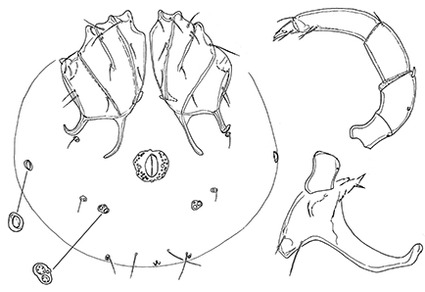

Abstract
Pontarachnidae, the only family of Hydrachnidia inhabiting marine environments, utilize diverse dispersal mechanisms to inhabit broad geographic ranges. Recent molecular studies in semi-enclosed basins, such as the Mediterranean and Red Seas, have challenged the dispersal capabilities of species like Litarachna communis and Pontarachna punctulum, which were previously assumed to be widely distributed. In this study, we employed an integrative taxonomic approach to examine pontarachnid mites from the Indian Ocean. We describe a new species, Litarachna almiri sp. nov., identified from both Mauritius and Thailand. This disjunct distribution, spanning nearly 5,500 km, demonstrates that mites within the Indian Ocean, a fully integrated component of the global ocean system, can achieve significant long-distance dispersal. Additionally, we provide the first molecular confirmations for Litarachna denhami (Kenya), L. triangularis (Thailand), and Pontarachna cf. australis (Kenya). These findings emphasize the necessity of further taxonomic clarification and molecular analysis of type-locality material to resolve the distribution patterns of marine mites accurately.
References
- Bartsch, I. & Gwyther, J. (2004) A non-indigenous halacarid species in Victoria, southeastern Australia, Isobactrus uniscutatus (Rhombognathinae, Halacaridae, Acari). Proceedings of the Royal Society of Victoria, 116 (2), 201–206.
- Bernardes, S.C., von Rintelen, K., von Rintelen, T., Pepato, A.R., Page, T.J. & de Bruyn, M. (2021) Ecological changes have driven biotic exchanges across the Indian Ocean. Scientific Reports, 11, 23357. https://doi.org/10.1038/s41598-021-02799-7
- Boeckner, M.J., Sharma, J. & Proctor, H.C. (2009) Revisiting the meiofauna paradox: dispersal and colonization of nematodes and other meiofaunal organisms in low-and high-energy environments. Hydrobiologia, 624 (1), 91–106. https://doi.org/10.1007/s10750-008-9669-5
- Carlton, J.T. & Geller, J.B. (1993) Ecological roulette: the global transport of nonindigenous marine organisms. Science, 261, 78–82.
- Chatterjee, T., Schizas, N.V. & Pešić, V. (2019) A checklist of Pontarachnidae (Acari: Hydrachnidia) and notes on distributional patterns of the species. Zootaxa, 4619 (3), 527–544. https://doi.org/10.11646/zootaxa.4619.3.6
- Cook, D.R. (1996) A freshwater species of Pontarachna (Acari, Pontarachnidae) from South Africa, with a discussion of genital acetabula in the family. Anales Instituto de Biología Universidad Nacional Autónoma de México, Seria Zoología, 67, 259–264.
- Edgar, R.C. (2004) MUSCLE: Multiple sequence alignment with high accuracy and high throughput. Nucleic Acids Research, 32 (5), 1792–1797. https://doi.org/10.1093/nar/gkh340
- Felsenstein, J. (1985) Confidence limits on phylogenies: An approach using the bootstrap. Evolution, 39, 783–791. https://doi.org/10.1111/j.1558-5646.1985.tb00420.x
- Goldschmidt, T., Zawal, A., Bańkowska, A., Mavrić, B., Melzer, R.L., Smit, H., Rewicz, T., Górecka, E. & Pešić, V. (2026) DNA Barcoding reveals a remarkable genetic diversity of pontarachnid mites (Pontarachnidae, Hydrachnidia) in the Adriatic Sea, including the description of a new species from Slovenia. The European Zoological Journal, 93 (1), 597–618. https://doi.org/10.1080/24750263.2026.2643954
- Kimura, M. (1980) A simple method for estimating evolutionary rate of base substitutions through comparative studies of nucleotide sequences. Journal of Molecular Evolution, 16, 111–120. https://doi.org/10.1007/BF01731581
- Kumar, S., Stecher, G., Li, M., Knyaz, C. & Tamura, K. (2018) MEGA X: Molecular evolutionary genetics analysis across computing platforms. Molecular Biology and Evolution, 35, 1547–1549. https://doi.org/10.1093/molbev/msy096
- Li, H.-T., Smit, H., Zhan, B.-X., Jin, D.-C. & Guo, J.-J. (2025) A comprehensive morphological descriptions of three marine water mites (Acari: Hydrachnidia: Pontarachnidae) from Hainan Island, China. Acarologia, 65 (3), 786–814. https://doi.org/10.24349/jiun-ayx5
- Montes-Ortiz, L., Goldschmidt, T., Vásquez-Yeomans, L. & Elías-Gutiérre, M. (2021) A new species of Litarachna Walter, 1925 (Acari: Hydrachnidia: Pontarachnidae) from Corozal Bay (Belize), described based upon morphology and DNA barcodes. Acarologia, 61 (3), 602–613. https://doi.org/10.24349/r7no-Ludg
- Pešić, V., Chatterjee, T., Chan, B.K.K. & Ingole, B. (2008) Marine water mites (Acari: Hydrachnidia: Pontarachnidae) from Taiwan, Korea and India, with the first description of the male of Pontarachna australis Smit, 2003. Systematic and Applied Acarology, 13, 70–74.
- Pešić, V., Chatterjee, T., Marshall, D. & Pavićević, A. (2011) New records of water mites (Acari: Hydrachnidia) from Brunei Darussalam, Borneo, with descriptions of two new species. Zootaxa, 3018, 50–58. https://doi.org/10.11646/zootaxa.3018.1.5
- Pešić, V., Chatterjee, T., Ingole, B., Velip, D. & Pavićević, A. (2012) A new species of Litarachna Walter, 1925 (Acari: Hydrachnidia) from the West Indian Coast, with a discussion on the diversity of the family Pontarachnidae Koenike, 1910. Cahiers de Biologie Marine, 53, 547–553.
- Pešić, V., Durucan, F. & Zawal, A. (2019) Marine mites (Acari: Hydrachnidia) of the Mediterranean Sea: Descriptions of two new species, key for identification and future prospects. Zootaxa, 4585 (3), 501–516. https://doi.org/10.11646/zootaxa.4585.3.6
- Pešić, V., Batista-Ribeiro, D., Pepato, A. & Smit, H. (2026a) First records of the marine water mite family Pontarachnidae Koenike, 1910 from New Zealand (Acari: Hydrachnidia), with the description of one new species. Acarologia, 66 (1), 134–148. https://doi.org/10.24349/rje7-i3ne
- Pešić, V., Bańkowska, A., Rewicz, T., Górecka, E., Asif, M. & Zawal, A. (2026b) Integrative taxonomy uncovers two new pontarachnid mite species from the eastern Mediterranean and Red Sea (Pontarachnidae, Hydrachnidia, Acari). Zootaxa, 5799 (1), 157–170. https://doi.org/10.11646/zootaxa.5799.1.8
- Ratnasingham, S. & Hebert, P.D.N. (2007) BOLD: The Barcode of Life Data System (http://www.barcodinglife.org). Molecular Ecology Notes, 7, 355–364. https://doi.org/10.1111/j.1471-8286.2007.01678.x
- Smit, H. (2003) Five new species of the water mite family Pontarachnidae from Western Australia (Acari: Hydrachnidia). In: Wells, F.E., Walker, D.I. & Jones, D.S. (Eds.), The Marine Flora and Fauna of Dampier, Western Australia 2. Western Australian Museum, Perth, pp. 547–562.
- Smit, H. (2009) Water mites of the family Pontarachnidae from Singapore, with a description of one new species (Acari: Hydrachnidia). Raffles Bulletin of Zoology, 22, 203–205.
- Srivathsan, A., Lee, L., Katoh, K., Hartop, E., Kutty, S.N., Wong, J., Yeo, D. & Meier, R. (2021) ONTbarcoder and MinION barcodes aid biodiversity discovery and identification by everyone, for everyone. BMC Biology, 19, 217. https://doi.org/10.1186/s12915-021-01141-x
- Srivathsan, A., Feng, V., Suárez, D., Emerson, B. & Meier, R. (2024) ONTbarcoder 2.0: Rapid Species Discovery and Identification With Real-Time Barcoding Facilitated by Oxford Nanopore R10.4. Cladistics, 40 (2), 192–203. https://doi.org/10.1111/cla.12566
- Viets, K.O. (1959) Einige marine Wassermilben (Hydrachnellae, Acari) aus dem Roten Meer. Kieler Meeresforschungen, 15, 109–112.
- Wiles, P.R., Chatterjee, T. & De Troch, M. (2002) Two new and one known marine water mite (Acari: Hydrachnidia: Pontarachnidae) from South-East Africa. Journal of Natural History, 36, 1987–1994. https://doi.org/10.1080/00222930110068583