

Abstract
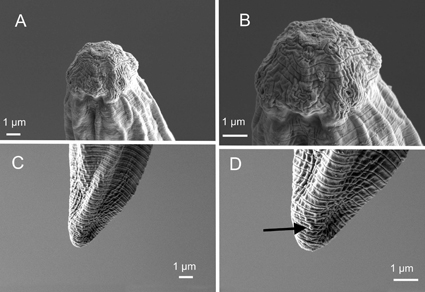
Understanding intraspecific variation in nematodes is essential for accurate taxonomy and ecological interpretation. This study examined morphological and molecular variation in Tylencholaimus mirabilis from geographically distinct populations in South Africa and India using an integrative taxonomic approach. South African populations from Limpopo Province were studied using light microscopy (LM), scanning electron microscopy (SEM), and partial sequencing of 18S and 28S rDNA for morphological characterization and phylogenetic placement. Comparative morphometric analyses were conducted using PCA, PCoA, and UPGMA. South African specimens showed a slender body (768–977 μm), cap-shaped lip region, longer posterior genital branch (4–17 μm), and longer odontostyle (6–9 μm), whereas Indian population had a stouter body with shorter posterior branch (6–9 μm) and odontostyle (6.5–7.5 μm). Multivariate analyses confirmed morphological separation supported by Euclidean distances and cophenetic correlation values. Phylogenetic analyses of 18S and 28S rDNA confirmed species identity and revealed close relationships among populations from South Africa, the Netherlands, and India with strong support (posterior probabilities 0.93–1.00). Combined morphological, statistical, and molecular evidence demonstrated geographic differentiation within T. mirabilis, highlighting the importance of integrative approaches in resolving intraspecific diversity and improving nematode taxonomy.
References
- Ahad, S. & Ahmad, W. (2016) Description of two new and six known species of the genus Tylencholaimus de Man, 1876 (Nematoda: Dorylaimida) with a diagnostic compendium and key to species. Zootaxa, 4107, 451–490. https://doi.org/10.11646/zootaxa.4107.4.1
- Álvarez-Ortega, S. (2025) Advancing the understanding of morphological and molecular diversity of the genus Labronema Thorne, 1939 (Nematoda: Dorylaimida) with new insights into its molecular phylogeny. Zoologischer Anzeiger, 315, 105–123. https://doi.org/10.1016/j.jcz.2025.02.003
- Andrássy, I. (1959) Freilebende Nematoden aus Rumänien. Annales Universitatis Scientiarum Budapestinensis de Rolando Eötvös Nominatae, Sectio Biologica, 2, 3–27.
- Andrássy, I. (1967) Nematoden aus Chile, Argentinien und Brasilien, gesammelt von Prof. Dr. H. Franz. Opuscula Zoologica Budapestinensis, 7, 3–34.
- Andrássy, I. (1991) The free-living nematode fauna of the Bátorliget Nature Reserves. In: The Bátorliget Nature Reserves – After Forty Years. Akadémiai Kiadó, Budapest, pp. 129–197.
- Bastian, H.C. (1865) Monograph on the Anguillulidae, or free nematoids, marine, land, and freshwater; with descriptions of 100 new species. Transactions of the Linnean Society of London, 25, 73–184. https://doi.org/10.1111/j.1096-3642.1865.tb00179.x
- Blaxter, M.L., De Ley, P., Garey, J.R., Liu, L.X., Scheldeman, P., Vierstraete, A., Vanfleteren, J.R., Mackey, L.Y., Dorris, M., Frisse, L.M., Vida, J.T. & Thomas, W.K. (1998) A molecular evolutionary framework for the phylum Nematoda. Nature, 392, 71–75. https://doi.org/10.1038/32160
- Bütschli, O. (1873) Beiträge zur Kenntnis der freilebenden Nematoden. Nova Acta Academiae Caesareae Leopoldino-Carolinae Germanicae Naturae Curiosorum, 36, 1–124.
- Darriba, D., Taboada, G.L., Doallo, R. & Posada, D. (2012) jModelTest 2: more models, new heuristics and parallel computing. Nature Methods, 9, 772. https://doi.org/10.1038/nmeth.2109
- De Grisse, A. (1969) Redescription ou modifications de quelques techniques utilisées dans l’étude des nématodes phytoparasitaires. Mededelingen van de Rijksfaculteit Landbouwwetenschappen Gent, 34, 351–369.
- De Ley, P., Felix, A.M., Frisse, L.M., Nadler, S.A., Sternberg, P.W. & Thomas, W.K. (1999) Molecular and morphological characterization of two reproductively isolated species with mirror-image anatomy (Nematoda: Cephalobidae). Nematology, 1, 591–612. https://doi.org/10.1163/156854199508559
- De Man, J.G. (1876) Onderzoekingen over vrij in de aarde levende Nematoden. Tijdschrift der Nederlandsche Dierkundige Vereeniging, 2, 78–196.
- Ettema, C.H. & Bongers, T. (1993) Characterization of nematode colonization and succession in disturbed soil using the Maturity Index. Biology and Fertility of Soils, 16, 79–85. https://doi.org/10.1007/BF00369407
- Golhasan, B., Heydari, R. & Peña-Santiago, R. (2019) Description of Tylencholaimus discus sp. n. (Nematoda: Dorylaimida: Tylencholaimidae) from Iran. Zootaxa, 4551, 379–384. https://doi.org/10.11646/zootaxa.4551.3.6
- Guindon, S. & Gascuel, O. (2003) A simple, fast and accurate method to estimate large phylogenies by maximum likelihood. Systematic Biology, 52, 696–704. https://doi.org/10.1080/10635150390235520
- Hall, T.A. (1999) BioEdit: a user-friendly biological sequence alignment editor and analysis program for Windows 95/98/NT. Nucleic Acids Symposium Series, 41, 95–98.
- Hammer, Ø., Harper, D.A.T. & Ryan, P.D. (2001) PAST: Paleontological statistics software package for education and data analysis. Palaeontologia Electronica, 4, 9.
- Islam, M.N. & Ahmad, W. (2021) Five new and five known species of the genus Tylencholaimus de Man, 1876 (Nematoda: Dorylaimida: Tylencholaimoidea) from Western Ghats of India. European Journal of Taxonomy, 774, 58–105. https://doi.org/10.5852/ejt.2021.774.1531
- Jairajpuri, M.S. (1965) Three new species of the genus Tylencholaimus de Man, 1876 (Nematoda: Dorylaimoidea) from India. Nematologica, 10, 515–518.
- Jonker, C.Z., Van Ginkel, C. & Olivier, J. (2013) Association between physical and geochemical characteristics of thermal springs and algal diversity in Limpopo Province, South Africa. Water SA, 39, 95–104. https://doi.org/10.4314/wsa.v39i1.10
- Kruger, S.P. (1965) New species of the genera Tylencholaimus and Dorylaimellus from South Africa. Proceedings of the Helminthological Society of Washington, 32, 1–7.
- Loof, P.A.A. & Jairajpuri, M.S. (1968) Taxonomic studies on the genus Tylencholaimus de Man, 1876 with a key to the species. Nematologica, 14, 317–350. https://doi.org/10.1163/187529268X00011
- Loof, P.A.A. (1964) Free-living and plant-parasitic nematodes from Venezuela. Nematologica, 10, 210–300. https://doi.org/10.1163/187529264X00042
- Pearse, A.S. (1942) Introduction to parasitology. Springfield, Illinois, USA.
- Peña-Santiago, R. (2006) Dorylaimida Part I: Superfamilies Belondiroidea, Nygolaimoidea and Tylencholaimoidea. In: Eyualem-Abebe, Andrássy, I. & Traunspurger, W. (Eds.), Freshwater nematodes: ecology and taxonomy. CAB International, Wallingford, pp. 326–391. https://doi.org/10.1079/9780851990095.0326
- Peña-Santiago, R. (2008) The genus Tylencholaimus de Man, 1876 revisited twelve years after. Journal of Nematode Morphology and Systematics, 11, 119–128.
- Peña-Santiago, R. (2020) Morphology and bionomics of dorylaims (Nematoda: Dorylaimida). Brill, Leiden, Netherlands.
- Peña-Santiago, R. & Coomans, A. (1994) Revision of the genus Tylencholaimus de Man, 1876. Prodelphic species: Part II. Nematologica, 40, 186–213. https://doi.org/10.1163/003525994X00139
- Ronquist, F. & Huelsenbeck, J. (2003) MrBayes 3: Bayesian phylogenetic inference under mixed models. Bioinformatics, 19, 1572–1574. https://doi.org/10.1093/bioinformatics/btg180
- Shokoohi, E. (2025) Methods and techniques in nematology. Bentham Science Publishers, Sharjah, UAE. https://doi.org/10.2174/97898153136801250101
- Shokoohi, E., Masoko, P., Malwela, T. & Ahmad, W. (2025) Description of Belondira limpopoensis sp. n. (Nematoda: Dorylaimida: Belondiridae) from South Africa. Biologia, 1–10. https://doi.org/10.1007/s11756-025-01932-5
- Shokoohi, E., Moyo, N. & Gouveia, F. (2023) Relationship of nematodes in natural and disturbed land with physicochemical properties in Magoebaskloof, Limpopo Province, South Africa. Biologia, 78, 3223–3233. https://doi.org/10.1007/s11756-023-01468-6
- Sroczyńska, K., Conde, A., Chainho, P. & Adão, H. (2021) How nematode morphometric attributes integrate with taxonomy-based measures along an estuarine gradient. Ecological Indicators, 124, 107384. https://doi.org/10.1016/j.ecolind.2021.107384
- Steiner, G. (1914) Freilebende Nematoden aus der Schweiz. Archiv für Hydrobiologie und Planktonkunde, 9, 420–438.
- Thompson, J.D., Higgins, D.G. & Gibson, T.J. (1994) CLUSTAL W: improving sensitivity of progressive multiple sequence alignment. Nucleic Acids Research, 22, 4673–4680. https://doi.org/10.1093/nar/22.22.4673
- Thorne, G. (1939) A monograph of the nematodes of the superfamily Dorylaimoidea. Capita Zoologica, 8, 1–261.
- Timm, R.W. (1964) Nematodes of the superfamily Dorylaimoidea from East Pakistan. Proceedings of the Helminthological Society of Washington, 31, 144–153.
- Vinciguerra, M.T. (1986) New and known species of Tylencholaimus de Man, 1876 from Italian beech forests with a key to the species. Nematologia Mediterranea, 14, 107–116.
- Wu, W.J., Xu, C.L., Xie, H. & Wang, D.W. (2019) Three new species, one new genus and subfamily of Dorylaimida and revisions on Tylencholaimellidae and Mydonomidae (Nematoda: Dorylaimida). PeerJ, 7, e7541. https://doi.org/10.7717/peerj.7541
- Wu, W.J., Yu, L., Xie, H., Xu, C.L., Yu, J. & Wang, D.W. (2018) Description and molecular analysis of Tylencholaimus helanensis sp. n. from China. ZooKeys, 792, 1–19. https://doi.org/10.3897/zookeys.792.27255