

Abstract
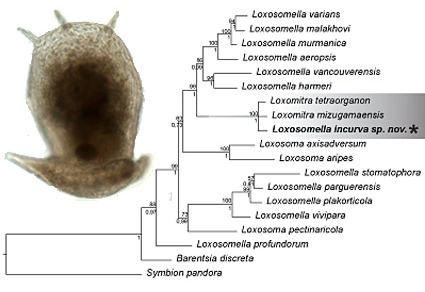
The new species of solitary entoproct, Loxosomella incurva sp. nov., is described from the Cần Giờ Mangrove Forest, located in the south coastal region of Vietnam. This is the first description of a member of the Loxosomatidae from Vietnamese waters and from the mangrove ecosystems. The specimens of Loxosomatidae were found on the polychaete of the family Acoetidae. Loxosomella incurva sp. nov. is a medium-sized species with a characteristically curved body—the calyx is inclined toward the short stalk. The calyx bears seven or eight tentacles. Four (or five) sensory papillae are located along the edge of the calyx. Specimens attach to the host’s body with an elongated narrow platform at the end of the stalk. Buds lack a pedal disc or a creeping foot and instead possess a unique annular bulge. Molecular phylogenetic analyses of partial sequences of two genetic markers, 28S rRNA and 18S rRNA, revealed a close relationship between L. incurva sp. nov. and two species of the subgenus Loxomitra, L. (L.) tetraorganon and L. (L.) mizugamaensis. Loxosomella incurva sp. nov. does not possess the diagnostic morphological features of Loxomitra: its buds lack the wings at the end of the stalk and attach to the maternal specimen by the base of the stalk, rather than by the back of the stalk or calyx as in Loxomitra. A common feature of all three species within this clade is the absence of a foot at the end of the stalk in the bud. The existing system of Loxosomatidae requires revision, since according to molecular genetic data, neither the genus Loxosoma nor the genus Loxosomella are monophyletic. The creeping foot was likely present in the common ancestor of all Loxosomatidae and has been retained in some lineages while modified in others; therefore, its presence cannot serve as a diagnostic generic character.
References
- Altschul, S.F., Gish, W., Miller, W., Myers, E.W. & Lipman, D.J. (1990) Basic local alignment search tool. Journal of Molecular Biology, 215 (3), 403–410. https://doi.org/10.1016/S0022-2836(05)80360-2
- Bharathidasan, V., Borisanova, A.O., Sarathy, P. & Murugesan, P. (2022) New entoproct-polychaete association recorded in the Bay of Bengal, southeastern coast of India. Zootaxa, 5100 (4), 482–500. https://doi.org/10.11646/zootaxa.5100.4.2
- Bobin, G. & Prenant, M. (1953) Deux Loxosomes nouveaux de Roscoff. Archives de Zoologie Expérimentale et Générale, 91, 25–35.
- Borisanova, A.O. (2016) Emschermannia ramificata — a new genus and species of solitary entoproct from the Kara Sea, Russia. Zootaxa, 4084, 135–142. https://doi.org/10.11646/zootaxa.4084.1.7
- Borisanova, A.O. (2018) Entoprocta (Kamptozoa). In: Schmidt-Rhaesa, A. (Ed.), Handbook of Zoology. Miscellaneous Invertebrates. De Gruyter, Berlin and Boston, pp. 111–162. https://doi.org/10.1515/9783110489279-006
- Borisanova, A. & Schepetov, D. (2023) Clarification of the diagnosis of the genus Loxosoma s. l. (Entoprocta; Loxosomatidae) based on morphological and molecular data. Zootaxa, 5325, 342–358. https://doi.org/10.11646/zootaxa.5325.3.2
- Borisanova, A.O., Chernyshev, A.V. & Ekimova, I.A. (2018) Deep-sea Entoprocta from the Sea of Okhotsk and the adjacent open Pacific abyssal area: new species and new taxa of host animals. Deep Sea Research Part II: Topical Studies in Oceanography, 154, 87–98. https://doi.org/10.1016/j.dsr2.2017.11.010
- Borisanova, A.O., Chernyshev, A.V., Neretina, T.V. & Stupnikova, A.N. (2015) Description and phylogenetic position of the first abyssal solitary kamptozoan species from the Kuril-Kamchatka trench area: Loxosomella profundorum sp. nov. (Kamptozoa: Loxosomatidae). Deep-Sea Research Part II: Topical Studies in Oceanography, 111, 351–356. https://doi.org/10.1016/j.dsr2.2014.07.016
- Borisanova, A.O. & Krylova, E.M. (2014) A new species of Loxosomatidae (Entoprocta, Solitaria) from the White Sea: Loxosomella unicornis sp. nov. Zootaxa, 3861, 290–296. https://doi.org/10.11646/zootaxa.3861.3.6
- Claparéde, E. (1867) Miscellanées zoologiques. V. Sur le Loxosoma kefersteinii v. sp., Bryozoaire mou du golfe de Naples. Annales des Sciences Naturelles, ser. 5, 8, 28–30.
- Edgar, R.C. (2004) MUSCLE: multiple sequence alignment with high accuracy and high throughput. Nucleic Acids Research, 32 (5), 1792–1797. https://doi.org/10.1093/nar/gkh340
- Edler, D., Klein, J., Antonelli, A. & Silvestro, D. (2021) RaxmlGUI 2.0: A graphical interface and toolkit for phylogenetic analyses using RAxML. Methods in Ecology and Evolution, 12, 373–377. https://doi.org/10.1111/2041-210X.13512
- Emschermann, P. (1971) Loxomespilon perezi — ein Entoproctenfund im Mittelatlantik. Überlegungen zur Benthosbesiedlung der Großen Meteorbank. Marine Biology, 9 (1), 51–62. https://doi.org/10.1007/BF00348817
- Emschermann, P. (2011) New species, taxonomist’s delight and faunist’s plight. On the variation range in Loxosomella vivipara Nielsen, 1966 (Entoprocta: Loxosomatidae). Zoologische Mededelingen Leiden, 85 (4), 69–77.
- Franzén, Å. (1962) Studies on entoprocta from the west coast of Sweden. Zoologiska Bidrag från Uppsala, 33, 311–326.
- Fuchs, J., Iseto, T., Hirose, M., Sundberg, P. & Obst, M. (2010) The first internal molecular phylogeny of the animal phylum Entoprocta (Kamptozoa). Molecular Phylogenetics and Evolution, 56 (1), 370–379. https://doi.org/10.1016/j.ympev.2010.04.009
- Giribet, G., Carranza, S., Baguñà, J., Riutort, M. & Ribera, C. (1996) First molecular evidence for the existence of a Tardigrada+ Arthropoda clade. Molecular Biology and Evolution, 13 (1), 76–84. https://doi.org/10.1093/oxfordjournals.molbev.a025573
- Giribet, G., Okusu, A., Lindgren, A.R., Huff, S.W., Schrodl, M. & Nishiguchi, M.K. (2006) Evidence for a clade composed of mollusks with serially repeated structures: monoplacophorans are related to chitons. Proceedings of the National Academy of Sciences USA, 103, 7723–7728. https://doi.org/10.1073/pnas.0602578103
- Giribet, G., Sørensen, M.V., Funch, P., Kristensen, R.M. & Sterrer, W. (2004) Investigations into the phylogenetic position of Micrognathozoa using four molecular loci. Cladistics, 20, 1–13. https://doi.org/10.1111/j.1096-0031.2004.00004.x
- Harmer, S.F. (1915) The Polyzoa of the Siboga Expedition. Part I. Entoprocta, Ctenostomata and Cyclostomata. Siboga Expedition Report, 28a, 1–180.
- Hincks, T. (1880) A History of the British Marine Polyzoa. Vol. 1. Van Voorst, London, 602 pp.
- Hyman, L.H. (1951) The invertebrates. Vol. 3. Acanthocephala, Aschelminthes and Entoprocta. The pseudocoelomate Bilateralia. McGraw-Hill, N.Y., London, Toronto, 572 pp.
- Iseto, T. (2002) Loxocorone, a new genus of the family Loxosomatidae (Entoprocta: Solitaria), with descriptions of two new Loxomitra (sensu stricto) and a new Loxocorone from Okinawa, the Ryukyu Archipelago, Japan. Zoological Science, 19, 359–367. https://doi.org/10.2108/zsj.19.359
- Iseto, T. (2003) Four new solitary entoprocts (Entoprocta: Loxosomatidae) from Okinawa Island, the Ryukyu Archipelago, Japan. Proceedings of the Biological Society of Washington, 116, 1007–1020.
- Iseto, T. (2006) Two new non-commensal loxosomatids from Okinawa Island and Sesoko Island, the Ryukyu Archipelago, Japan (Entoprocta: Loxosomatidae). Species Diversity, 11, 33–43. https://doi.org/10.12782/specdiv.11.33
- Iseto, T., Sugiyama, N. & Hirose, E. (2008) A New Sponge-Inhabiting Loxosomella (Entoprocta: Loxosomatidae) from Okinawa Island, Japan, with Special Focus on Foot Structure. Zoological Science, 25, 1171–1178. https://doi.org/10.2108/zsj.25.1171
- Iseto, T. (2017) Review of the Studies of Japanese Entoprocts (Entoprocta). In: Motokawa, M. & Kajihara, H. (Eds.), Species Diversity of Animals in Japan. Springer, Japan, pp. 445–467. https://doi.org/10.1007/978-4-431-56432-4_17
- Kajihara, H., Tomioka, S., Kakui, K. & Iseto, T. (2015) Phylogenetic position of the queer, backwardbent entoproct Loxosoma axisadversum (Entoprocta: Solitaria: Loxosomatidae). Species Diversity, 20, 83–88. https://doi.org/10.12782/sd.20.1.083
- Keferstein, W. (1862) Ueber Loxosoma singulare gen. et sp. nov., den Schmarotzer einer Annelide. Zeitschrift für Wissenschaftliche Zoologie, 12, 131–132.
- Konno, K. (1972) Studies on Japanese Entoprocta. I. On four new species of loxosomatides found at Fukuara, Aomori Prefecture. Science Reports of the Hirosaki University, 19, 64–78.
- Le, H.L., Lecointre, G. & Perasso, R. (1993) A 28S rRNA-based phylogeny of the gnathostomes: first steps in the analysis of conflict and congruence with morphologically based cladograms. Molecular Phylogenetics and Evolution, 2 (1), 31–51. https://doi.org/10.1006/mpev.1993.1005
- Marcus, E. & Marcus, E. (1968) Neue brasilianische Loxosomen. Zoologische Beiträge, 14, 203–212.
- Mortensen, T. (1911) A new species of Entoprocta, Loxosomella antedonis, from Northeast Greenland. Meddelelser om Grønland, 45, 399–406.
- Nielsen, C. (1964) Studies on Danish Entoprocta. Ophelia, 1, 1–76. https://doi.org/10.1080/00785326.1964.10416272
- Nielsen, C. (1966a) On the life-cycle of some Loxosomatidae (Entoprocta). Ophelia, 3, 221–247. https://doi.org/10.1080/00785326.1966.10409644
- Nielsen, C. (1966b) Some Loxosomatidae (Entoprocta) from the Atlantic coast of the United States. Ophelia, 3, 249–275. https://doi.org/10.1080/00785326.1966.10409645
- Nielsen, C. (1996) Three new species of Loxosoma (Entoprocta) from Phuket, Thailand, with a review of the genus. Zoologica Scripta, 25, 61–75. https://doi.org/10.1111/j.1463-6409.1996.tb00152.x
- Nielsen, C. (2010) A review of the taxa of solitary entoprocts (Loxosomatidae). Zootaxa, 2395, 45–56. https://doi.org/10.11646/zootaxa.2395.1.4
- Nilus, G. (1909) Notiz über Loxosoma murmanica und Loxosoma brumpti sp.n. Travaux de la Société Impériale des Naturalistes de St.-Pétersbourg, Comptes Rendus des Séances, 40, 157–169. [Russian, German summary]
- Osterburg, H.H., Allen, J.K. & Finch, C.E. (1975) The use of ammonium acetate in the precipitation of ribonucleic acid. Biochemical Journal, 147 (2), 367–368. https://doi.org/10.1042/bj1470367
- Pattengale, N.D., Alipour, M., Bininda-Emonds, O.R.P., Moret, B.M.E. & Stamatakis, A. (2010) How many bootstrap replicates are necessary? Journal of Computational Biology, 17 (3), 337–354. https://doi.org/10.1089/cmb.2009.0179
- Ronquist, F. & Huelsenbeck, J.P. (2003) MrBayes 3: Bayesian phylogenetic inference under mixed models. Bioinformatics, 19 (12), 1572–1574. https://doi.org/10.1093/bioinformatics/btg180
- Rundell, R.J. & Leander, B.S. (2012) Description and phylogenetic position of the first sand-dwelling entoproct from the western coast of North America: Loxosomella vancouverensis sp. nov. Marine Biology Research, 8, 284–291. https://doi.org/10.1080/17451000.2011.619545
- Rützler, K. (1968) Loxosomella from Tedania ignis, the Caribbean fire sponge. Proceedings of the United States National Museum, 124, 1–11. https://doi.org/10.5479/si.00963801.124-3650.1
- Schultz, E. (1895) Loxosoma harmeri sp. nov. Trudy Imperatorskago S.-Petersbourgskago Obshchestva Estestvoispytatelei, 25, 49–55.
- Whiting, M.F., Carpenter, J.C., Wheeler, Q.D. & Wheeler, W.C. (1997) The Strepsiptera problem: phylogeny of the holometabolous insect orders inferred from 18S and 28S ribosomal DNA sequences and morphology. Systematic Biology, 46 (1), 1–68. https://doi.org/10.1093/sysbio/46.1.1