
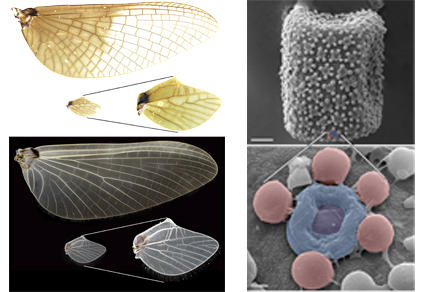

Abstract
Documenting rare species often relies on a limited number of specimens and, despite posing taxonomic challenges, has become increasingly important in the context of the current biodiversity crisis. This is the case for Thraulodes marianoi Silva, Salles & Pinto, 2020, a mayfly endemic to the Atlantic Forest and originally described from a single male collected in the Mananciais da Serra Protected Area, Pico do Marumbi State Park, state of Paraná, Brazil. Here, we expand the knowledge of this species, one of the least known mayflies in Brazil. The male is redescribed, incorporating previously unreported morphological characters, and the female, eggs, and subimagos of both sexes are described for the first time. With the discovery of the female, sexual dimorphism in coloration was identified: abdominal tergites III–V in females are not white as in males, but instead uniformly brown, while the forewings of subimagos of both sexes lack a dark brown basal half. These new data expand the species diagnosis and reduce gaps in the taxonomic and diversity knowledge of Ephemeroptera from the Atlantic Forest. Among the 32 species of Thraulodes reported from Brazil, this is the only one recorded from the state of Paraná.
References
- Araujo, B.R. & Pinto, A.P. (2021) Dragonflies (Insecta: Odonata) from Mananciais da Serra, a Tropical-Araucaria Forest ecotonal remnant in the southern Atlantic Forest, state of Paraná. Zoologia, 38, 1–18. https://doi.org/10.3897/zoologia.38.e55283
- Araujo, B.R., Pinto, A.P. & Padial, A.A. (2022) Influence of landscape homogenization due to river damming on dragonfly (Odonata) community structuring in a subtropical forest in the southern Atlantic Forest. Ecohydrology, 15 (3), e2419. [1–11] https://doi.org/10.1002/eco.2419
- Barber-James, H.M., Salles, F.F. & Sartori, M. (In prep.) Ephemeroptera checklist. Freshwater Animal Diversity Assessment (FADA).
- Coddington, J.A., Agnarsson, I., Miller, J.A., Kuntner, M. & Hormiga, G. (2009) Undersampling bias: the null hypothesis for singleton species in tropical arthropod surveys. Journal of Animal Ecology, 78 (3), 573–584. https://doi.org/10.1111/j.1365-2656.2009.01525.x
- Del Palacio, A., Sarmiento, P.L. & Muzón, J. (2017) A new method using Scanning Electron Microscopy (SEM) for preparation of anisopterous odonates. Microscopy Research and Technique, 80 (10), 1085–1088. https://doi.org/10.1002/jemt.22903
- Diniz-Filho, J.A.F., Jardim, L., Guedes, J.J.M., Meyer, L., Stropp, J., Frateles, L.E.F., Pinto, R.B., Lohmann, L.G., Tessarolo, G., Carvalho, C.J.B., Ladle, R.J. & Hortal, J. (2023) Macroecological links between the Linnean, Wallacean, and Darwinian shortfalls. Frontiers of Biogeography, 15 (2), e59566. [1–11] https://doi.org/10.21425/F5FBG59566
- Domínguez, E., Molineri, C., Pescador, M., Hubbard, M.D. & Nieto, C. (2006) Aquatic Biodiversity in Latin America, Volume 2. Ephemeroptera of South America. Pensoft, Sofia, 646 pp.
- Hortal, J., de Bello, F., Diniz-Filho, J.A.F., Lewinsohn, T.M., Lobo, J.M. & Ladle, R.J. (2015) Seven shortfalls that beset large-scale knowledge of biodiversity. Annual Review of Ecology, Evolution, and Systematics, 46 (1), 523–549. https://doi.org/10.1146/annurev-ecolsys-112414-054400
- Jacobus, L.M., Macadam, C.R. & Santori, M. (2019) Mayflies (Ephemeroptera) and their contributions to ecosystem services. Insects, 10 (6), 170. [1–26] https://doi.org/10.3390/insects10060170
- Kluge, N.J. (2020) Systematic position of Thraulodes Ulmer 1920 (Ephemeroptera: Leptophlebiidae) and descriptions of new and little-known species. Zootaxa, 4756 (1), 1–142. https://doi.org/10.11646/zootaxa.4756.1.1
- Kluge, N.J. (2025) Ephemeroptera of the world: catalogue of literature about all mayfly taxa. Available from: https://insecta.bio.spbu.ru/z/Eph-spp/index.htm (accessed 2 October 2025)
- Koss, R.W. & Edmunds, G.F.Jr. (1974) Ephemeroptera eggs and their contribution to phylogenetic studies of the order. Zoological Journal of the Linnean Society, 55, 267–349, pl. 1–24. https://doi.org/10.1111/j.1096-3642.1974.tb01648.x
- Mariano, R., Lima, L.R.C., Boldrini, R., Alvim, J.B. & Salles, F.F. (2025) Thraulodes. In: Catálogo Taxonômico da Fauna do Brasil. Available from: http://fauna.jbrj.gov.br/fauna/faunadobrasil/14756 (accessed 17 November 2025)
- Orlando, T.Y. & Salles, F.F. (2023) New stage and species description on Brazilian Thraulodes Ulmer, 1920 (Ephemeroptera, Leptophlebiidae). Neotropical Entomology, 52, 1100–1108. https://doi.org/10.1007/s13744-023-01078-6
- Raymundo, T.S., Martins, J.L.A. & Ferreira, D.S. (2021) The morphology of the eggs in the Hermanella complex (Ephemeroptera: Leptophlebiidae). Revista Brasileira de Entomologia, 65 (1), e20200121. [1–5] https://doi.org/10.1590/1806-9665-rbent-2020-0121
- Ribeiro, M.C., Metzger, J.P., Martensen, A.C., Ponzoni, F.J. & Hirota, M.M. (2009) The Brazilian Atlantic Forest: How much is left, and how is the remaining distributed? Biological Conservation, 142 (6), 1141–1153. https://doi.org/10.1016/j.biocon.2009.02.021
- Salles, F.F., Fernandes, O.L., Boldrini, R., Lima, L., Lima, M., Hoehne, L. & Del Ponte, E.M. (2023) EphemBrazil: A curated online database and dashboard to explore the distribution of mayflies (Insecta: Ephemeroptera) from Brazil. Revista Brasileira de Entomologia, 67, e20230064. [1–6] https://doi.org/10.1590/1806-9665-rbent-2023-0064
- Salles, F.F., Fernandes, O.L., Boldrini, R., Lima, L., Lima, M., Hoehne, L. & Del Ponte, E.M. (2025) EphemBrazil. Available from: https://edelponte.shinyapps.io/ephembrazil/ (accessed 10 January 2026)
- Silva, V., Pinto, A.P. & Salles, F.F. (2020) Thraulodes marianoi sp. nov., a remarkable new species of mayfly (Ephemeroptera: Leptophlebiidae) with dark wings from the southern Brazilian Atlantic Forest. Zootaxa, 4860 (1), [1–12]. https://doi.org/10.11646/zootaxa.4860.1.4
- Snodgrass, R.E. (1935) [1993] Principles of insect morphology. Cornell University Press, Ithaca, 768 pp. [reedition with a preface George C. Eickwort]
- Traver, J.R. & Edmunds, G.F.Jr. (1967) A revision of the genus Thraulodes (Ephemeroptera: Leptophlebiidae). Miscellaneous Publications of the Entomological Society of America, 5 (8), 349–395. https://doi.org/10.4182/GFRE2908
- Varella, R.C., Jusviak, K. & Pinto, A.P. (In press) Shedding light on a neglected Plecoptera diversity hotspot in the southern Brazilian Atlantic Forest: Gripopterygidae from the Mananciais da Serra Protected Area and a checklist of stoneflies from the state of Paraná. Aquatic Insects.
- Wells, A., Johanson, K.A. & Dostine, P. (2019) Why are so many species based on a single specimen? Zoosymposia, 14 (1), 32–38. https://doi.org/10.11646/zoosymposia.14.1.5