

Abstract
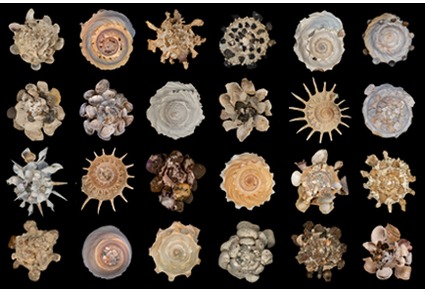
Cryptic speciation is widely documented in marine gastropods, particularly in groups lacking distinct morphological characters. Carrier snails of the family Xenophoridae have long been celebrated by naturalists for their behavior of collecting and affixing foreign objects to their shells. We present the first molecular species delimitation of carrier snails (family: Xenophoridae), using cox1 sequences from 562 specimens encompassing 81% of valid species and all genera in this family. Integrating alpha-taxonomic data, we formalize five new species in descriptions—Xenophora simulans sp. nov., Xenophora brevis sp. nov., Onustus procellosus sp. nov., Collector altissimus gen. nov. et sp. nov., Collector alienus gen. nov. et sp. nov.—and recommend further investigations into other promising clades with potentially undiscovered species, pending corroboration from nuclear loci. This case study highlights the potential of species discovery using single-locus delimitation methods. We established a baseline framework for morphological species delimitation in Xenophoridae, showing that specimens distinguished only by subtle morphological characters often interpreted as intraspecific variation can exhibit species-level genetic divergence.
References
- Adams, H. & Adams, A. (1853–1858) The genera of Recent Mollusca; arranged according to their organization. van Voorst, London, Vol. 1, xl + 484 pp.; Vol. 2, 661 pp.; Vol. 3, 138 pls.
- Adams, M., Raadik, T.A., Burridge, C.P. & Georges, A. (2014) Global biodiversity assessment and hyper-cryptic species complexes: more than one species of elephant in the room? Systematic Biology, 63, 518–533. https://doi.org/10.1093/sysbio/syu017
- Bickford, D., Lohman, D.J., Sodhi, N.S., Ng, P.K., Meier, R., Winker, K., Ingram, K.K. & Das, I. (2007) Cryptic species as a window on diversity and conservation. Trends in Ecology & Evolution, 22, 148–155. https://doi.org/10.1016/j.tree.2006.11.004
- Bravo, G.A., Remsen, J.V. & Brumfield, R.T. (2014) Adaptive processes drive ecomorphological convergent evolution in antwrens (Thamnophilidae). Evolution, 68, 2757–2774. https://doi.org/10.1111/evo.12506
- Bucklin, A., Steinke, D. & Blanco-Bercial, L. (2011) DNA barcoding of marine metazoa. Annual Review of Marine Science, 3, 471–508. https://doi.org/10.1146/annurev-marine-120308-080950
- Callomon, P. (2019) Standard views for imaging mollusk shells. American Malacological Society, 1–19.
- Dasmahapatra, K.K., Elias, M., Hill, R.I., Hoffman, J.I. & Mallet, J. (2010) Mitochondrial DNA barcoding detects some species that are real, and some that are not. Molecular Ecology Resources, 10, 264–273. https://doi.org/10.1111/j.1755-0998.2009.02763.x
- Dupuis, J.R., Roe, A.D. & Sperling, F.A. (2012) Multi‐locus species delimitation in closely related animals and fungi: one marker is not enough. Molecular Ecology, 21, 4422–4436. https://doi.org/10.1111/j.1365-294x.2012.05642.x
- Egea, E., David, B., Choné, T., Laurin, B., Féral, J.P. & Chenuil, A. (2016) Morphological and genetic analyses reveal a cryptic species complex in the echinoid Echinocardium cordatum and rule out a stabilizing selection explanation. Molecular Phylogenetics and Evolution, 94, 207–220. https://doi.org/10.1016/j.ympev.2015.07.023
- Fedosov, A., Achaz, G., Gontchar, A. & Puillandre, N. (2022) MOLD, a novel software to compile accurate and reliable DNA diagnoses for taxonomic descriptions. Molecular Ecology Resources, 22 (5), 2038–2053. https://doi.org/10.1111/1755-0998.13590
- Folmer, R. (1994) DNA primers for amplification of mitochondrial cytochrome c oxidase subunit I from diverse metazoan invertebrates. Molecular Marine Biology and Biotechnology, 3, 294–299.
- Fišer, C., Robinson, C.T. & Malard, F. (2018) Cryptic species as a window into the paradigm shift of the species concept. Molecular Ecology, 27, 613–635. https://doi.org/10.1111/mec.14486
- Gabb, W.M. (1877) Notes on American Cretaceous fossils, with descriptions of some new species. Proceedings of the Academy of Natural Sciences of Philadelphia, 28, 276–324.
- Gómez, A., Serra, M., Carvalho, G.R. & Lunt, D.H. (2002) Speciation in ancient cryptic species complexes: evidence from the molecular phylogeny of Brachionus plicatilis (Rotifera). Evolution, 56, 1431–1444. https://doi.org/10.1111/j.0014-3820.2002.tb01455.x
- Goulding, T.C. & Dayrat, B. (2016) Integrative taxonomy: ten years of practice and looking into the future. In: Аспекты биоразнообразия, pp. 116–133.
- Gray, J.E. (1840) Shells of molluscous animals. In: Synopsis of the contents of the British Museum, Ed. 42. G. Woodfall, London, pp. 105–152.
- Irwin, A.R., Bouchet, P., Crame, J.A., Harper, E.M., Kronenberg, G.C., Strong, E.E. & Williams, S.T. (2024) Molecular phylogenetics of the superfamily Stromboidea (Caenogastropoda): New insights from increased taxon sampling. Zoologica Scripta, 53, 818–838. https://doi.org/10.1111/zsc.12685
- Johnson, S.B., Warén, A. & Vrijenhoek, R.C. (2008) DNA barcoding of Lepetodrilus limpets reveals cryptic species. Journal of Shellfish Research, 27, 43–51. https://doi.org/10.2983/0730-8000(2008)27[43:dbollr]2.0.co;2
- Jörger, K.M. & Schrödl, M. (2013) How to describe a cryptic species? Practical challenges of molecular taxonomy. Frontiers in Zoology, 10, 1–27. https://doi.org/10.1186/1742-9994-10-59
- Kalyaanamoorthy, S., Minh, B.Q., Wong, T.K., Von Haeseler, A. & Jermiin, L.S. (2017) ModelFinder: fast model selection for accurate phylogenetic estimates. Nature methods, 14 (6), 587–589. https://doi.org/10.1038/nmeth.4285
- Kantor, Y., Hallan, A. & Criscione, F. (2022) Integrative taxonomy reveals new Australian species of the deep-water snail genera Comispira and Leucosyrinx. Molluscan Research, 42, 229–247. https://doi.org/10.1080/13235818.2022.2102887
- Kantor, Y.I., Stahlschmidt, P., Aznar-Cormano, L., Bouchet, P. & Puillandre, N. (2017) Too familiar to be questioned? Revisiting the Crassispira cerithina species complex. Journal of Molluscan Studies, 83, 43–55. https://doi.org/10.1093/mollus/eyw036
- Karbstein, K., Kösters, L., Hodač, L., Hofmann, M., Hörandl, E., Tomasello, S. ... & Wäldchen, J. (2024) Species delimitation 4.0: integrative taxonomy meets artificial intelligence. Trends in Ecology & Evolution, 39, 771–784. https://doi.org/10.1016/j.tree.2023.11.002
- Knowlton, N. (1986) Cryptic and sibling species among the decapod Crustacea. Journal of Crustacean Biology, 6, 356–363. https://doi.org/10.2307/1548175
- Kuroda, T., Habe, T. & Oyama, K. (1971) The Sea Shells of Sagami Bay. Collected by His Majesty the Emperor of Japan. Maruzen Co., Ltd., Tokyo, xix + 741 pp. (Japanese text) + 489 pp. (English text) + 51 pp. (index), 121 pls.
- Kreipl, K. & Alf, A. (1999) Recent Xenophoridae. ConchBooks, Hackenheim, 148 pp.
- Kreipl, K. & Lorenz, F. (2023) Carrier shells. Garbage collectors of the oceans. A portrait of the gastropod family Xenophoridae. Molluscan Science 4, 96 pp.
- Kreipl, K., Alf, A. & Kronenberg, G.C. (1999) A new subgenus of the family Xenophoridae Philippi, 1853. Spixiana, 22, 179–180.
- Lamy, D. & Pointier, J.-P. (2018) Marine and freshwater molluscs of the French Caribbean. PLB Editions.
- Lockhart, P.J., Howe, C.J., Bryant, D.A., Beanland, T.J. & Larkum, A.W.D. (1992) Substitutional bias confounds inference of cyanelle origins from sequence data. Journal of Molecular Evolution, 34, 153–162. https://doi.org/10.1007/bf00182392
- Messing, J. & Vieira, J. (1982) A new pair of M13 vectors for selecting either DNA strand of double-digest restriction fragments. Gene, 19, 269–276. https://doi.org/10.1016/0378-1119(82)90016-6
- Meyer, C.P. & Paulay, G. (2005) DNA barcoding: error rates based on comprehensive sampling. PLoS Biology, 3, e422. https://doi.org/10.1371/journal.pbio.0030422
- MolluscaBase eds. (2025) Xenophoridae Troschel, 1852 (1840). Available from: https://www.molluscabase.org/aphia.php?p=taxdetails&id=23144 (accessed 07 Jun. 2025)
- Monnier, E., Tenorio, M.J., Bouchet, P. & Puillandre, N. (2018) The cones (Gastropoda) from Madagascar “Deep South”: composition, endemism and new taxa. Xenophora Taxonomy, 19, 25–75.
- Nappo, A., Bini, G. & Santucci, B. (2022) Taxonomic review of the genus Stellaria Møller, 1832 (Gastropoda: Xenophoridae) including the description of two new genera. Bollettino Malacologico, 58, 47–73. https://doi.org/10.53559/bollmalacol.2022.02
- Nguyen, L.T., Schmidt, H.A., Von Haeseler, A. & Minh, B.Q. (2015) IQ-TREE: a fast and effective stochastic algorithm for estimating maximum-likelihood phylogenies. Molecular Biology and Evolution, 32, 268–274. https://doi.org/10.1093/molbev/msu300
- Pante, E., Schoelinck, C. & Puillandre, N. (2015) From integrative taxonomy to species description: one step beyond. Systematic biology, 64 (1), 152–160. https://doi.org/10.1093/sysbio/syu083
- Paradis, E. & Schliep, K. (2019) ape 5.0: an environment for modern phylogenetics and evolutionary analyses in R. Bioinformatics, 35, 526–528. https://doi.org/10.1093/bioinformatics/bty633
- Páll Gergely, B. & Coltro Junior, J. (2013) The southernmost localities of Xenophora conchyliophora (Born, 1780). Basteria, 77, 83–85.
- Ponder, W.F. & Cooper, J. (1983) A revision of the recent Xenophoridae of the world and of the Australian fossil species (Mollusca: Gastropoda). Australian Museum Memoir, 17, 1–126. https://doi.org/10.3853/j.0067-1967.17.1983.393
- Puillandre, N., Brouillet, S. & Achaz, G. (2021) ASAP: assemble species by automatic partitioning. Molecular Ecology Resources, 21, 609–620. https://doi.org/10.1111/1755-0998.13281
- Puillandre, N., Fedosov, A.E., Zaharias, P., Aznar-Cormano, L. & Kantor, Y.I. (2017) A quest for the lost types of Lophiotoma (Gastropoda: Conoidea: Turridae): integrative taxonomy in a nomenclatural mess. Zoological Journal of the Linnean Society, 181, 243–271. https://doi.org/10.1093/zoolinnean/zlx012
- Puillandre, N., Lambert, A., Brouillet, S. & Achaz, G. (2012) ABGD, Automatic Barcode Gap Discovery for primary species delimitation. Molecular Ecology, 21, 1864–1877. https://doi.org/10.1111/j.1365-294x.2011.05239.x
- R Core Team (2021) R: A language and environment for statistical computing. R Foundation for Statistical Computing, Vienna, Austria. Available from: https://www.R-project.org/ (accessed 2021)
- Reeve, L.A. (1845) Conchologia Iconica: or, illustrations of the shells of molluscous animals. Vol. 1. Monograph of the genus Phorus. Reeve Brothers, London, pls. 1–3.
- Sierwald, P., Bieler, R., Shea, E.K. & Rosenberg, G. (2018) Mobilizing mollusks: Status update on mollusk collections in the USA and Canada. American Malacological Bulletin, 36, 177–214. https://doi.org/10.4003/006.036.0202
- Stayton, C.T. (2006) Testing hypotheses of convergence with multivariate data: morphological and functional convergence among herbivorous lizards. Evolution, 60, 824–841. https://doi.org/10.1111/j.0014-3820.2006.tb01160.x
- Thielsch, A., Knell, A., Mohammadyari, A., Petrusek, A. & Schwenk, K. (2017) Divergent clades or cryptic species? Mito-nuclear discordance in a Daphnia species complex. BMC Evolutionary Biology, 17, 1–9. https://doi.org/10.1186/s12862-017-1070-4
- Xia, X. (2013) DAMBE5: A Comprehensive Software Package for Data Analysis in Molecular Biology and Evolution. Molecular Biology and Evolution, 30 (7), 1720–1728. https://doi.org/10.1093/molbev/mst064
- Xia, X., Xie, Z., Salemi, M., Chen, L. & Wang, Y. (2003) An index of substitution saturation and its application. Molecular Phylogenetics and Evolution, 26 (1), 1–7. https://doi.org/10.1016/s1055-7903(02)00326-3