

Abstract
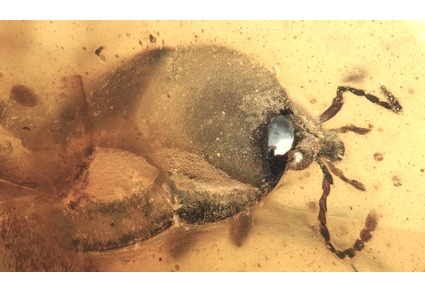
Tetratomidae is a small family of fungivorous beetles, comprising approximately 150 extant species in 13 genera and five subfamilies worldwide. Its fossil record is limited, with only seven named species from the Mesozoic and five from the Cenozoic. In the present study, the third species of the extinct eustrophine genus Allostrophus Hsiao, Ślipiński, Yu, Deng & Pang, 2018, A. tui sp. nov., is described from mid‐Cretaceous (Cenomanian, ca. 99 Ma) Kachin amber, northern Myanmar. The new species closely resembles A. cretaceus Hsiao, Ślipiński, Yu, Deng & Pang, 2018 in general appearance, but can be distinguished by its characteristic antennae, elytra, tibiae and tarsi. The discovery provides further data for completing the generic definition of Allostrophus and underscores the diversification of this small tenebrionoid family at both generic and species levels by the mid‐Cretaceous.
References
- Alekseev, V.I. (2013) The beetles (Insecta: Coleoptera) of Baltic amber: the checklist of described species and preliminary analysis of biodiversity. Zoology and Ecology, 23, 5–12. https://doi.org/10.1080/21658005.2013.769717
- Alekseev, V.I. & Bukejs, A. (2020) A new genus of Hallomeninae (Coleoptera: Tenebrionoidea: Tetratomidae) from Eocene Baltic amber. Baltic Journal of Coleopterology, 20, 189–195.
- Alekseev, V.I. & Bukejs, A. (2022) Eustrophus praecursor sp. nov.: the first Eocene species of Eustrophinae (Coleoptera: Tetratomidae) from Baltic amber. Zootaxa, 5165 (3), 435–442. https://doi.org/10.11646/zootaxa.5165.3.8
- Bonhomme, V., Picq, S., Gaucherel, C. & Claude, J. (2014) Momocs: Outline Analysis Using R. Journal of Statistical Software, 56 (13), 1–24. https://doi.org/10.18637/jss.v056.i13
- Cai, C., Hsiao, Y. & Huang, D. (2016) A new genus and species of polypore fungus beetle in Upper Cretaceous Burmese amber (Coleoptera, Tetratomidae, Eustrophinae). Cretaceous Research, 60, 275–280. https://doi.org/10.1016/j.cretres.2015.12.010
- Cai, C., Tihelka, E., Giacomelli, M., Lawrence, J.F., Ślipiński, A., Kundrata, R., Yamamoto, S., Thayer, M.K., Newton, A.F., Leschen, R.A.B., Gimmel, M.L., Lü, L., Engel, M.S., Bouchard, P., Huang, D., Pisani, D. & Donoghue, P.C.J. (2022) Integrated phylogenomics and fossil data illuminate the evolution of beetles. Royal Society Open Science, 9, 211771. https://doi.org/10.1098/rsos.211771
- Cruickshank, R.D. & Ko, K. (2003) Geology of an amber locality in the Hukawng Valley, northern Myanmar. Journal of Asian Earth Sciences, 21, 441–455. https://doi.org/10.1016/S1367-9120(02)00044-5
- Elias, S.A. (2014) Environmental interpretation of fossil insect assemblages from MIS 5 at Ziegler Reservoir, Snowmass Village, Colorado. Quaternary Research, 82, 592–603. https://doi.org/10.1016/j.yqres.2014.01.005
- Grimaldi, D.A., Engel, M.S. & Nascimbene, P.C. (2002) Fossiliferous Cretaceous amber from Myanmar (Burma): its rediscovery, biotic diversity, and paleontological significance. American Museum Novitates, 3361, 1–72. https://doi.org/10.1206/0003-0082(2002)361<3361:FCAFMB>2.0.CO;2
- Hsiao, Y. (2020) Taxonomic notes on Eustrophinae from the mid-Cretaceous Burmese amber, with description of a new species (Coleoptera, Tetratomidae). PalZ, 94, 263–269. https://doi.org/10.1007/s12542-019-00480-z
- Hsiao, Y. & Otto, R.L. (2024) Contribution to the knowledge of the false click beetles from the mid-Cretaceous Kachin amber (Coleoptera, Eucnemidae), with description of a new species and a paleobiodiversity analysis. PalZ, 98, 407–417. https://doi.org/10.1007/s12542-024-00697-7
- Hsiao, Y. & Tomaszewska, W. (2025) Diversity dynamics of handsome fungus beetles (Coleoptera: Coccinelloidea: Endomychidae) during the Meso-Cenozoic period. PalZ, 99, 139–150. https://doi.org/10.1007/s12542-025-00722-3
- Hsiao, Y., Ślipiński, A., Yu, Y., Deng, C. & Pang, H. (2018) Allostrophus cretaceus gen. et sp. nov.: A new polypore fungus beetle (Coleoptera, Tetratomidae) from the Cretaceous Myanmar amber. Cretaceous Research, 92, 195–200. https://doi.org/10.1016/j.cretres.2018.08.012
- Jiang, R.-X. & Chen, X.-S. (2025) Archistrophus filicornis gen. et sp. nov., a new polypore fungus beetle (Coleoptera, Tetratomidae) from the Cretaceous Kachin amber. Palaeoentomology, 8 (6), 605–608. https://doi.org/10.11646/palaeoentomology.8.6.1
- Kania, I., Wang, B. & Szwedo, J. (2015) Dicranoptycha Osten Sacken, 1860 (Diptera, Limoniidae) from the earliest Upper Cretaceous Burmese amber. Cretaceous Research, 52, 522–530. https://doi.org/10.1016/j.cretres.2014.03.002
- Lawrence, J.F. & Leschen, R.A.B. (2010) 11.5. Tetratomidae Billberg, 1820. In: Leschen, R.A.B., Beutel, R.G. & Lawrence, J.F. (Eds.), Coleoptera, beetles, Handbuch der Zoologie/Handbook of Zoology, vol. 2. Walter de Gruyter Inc, Berlin, pp. 514–520.
- McKenna, D.D., Shin, S., Ahrens, D., Balke, M., Beza-Beza, C., Clarke, D.J., Donath, A., Escalona, H.E., Friedrich, F., Letsch, H., Liu, S., Maddison, D., Mayer, C., Misof, B., Murin, P.J., Niehuis, O., Peters, R.S., Podsiadlowski, L., Pohl, H., Scully, E.D., Yan, E.V., Zhou, X., Ślipiński, A. & Beutel, R.G. (2019) The evolution and genomic basis of beetle diversity. Proceedings of the National Academy of Sciences, 116, 24729–24737. https://doi.org/10.1073/pnas.1909655116
- Nikitsky, N.B. (1998) Generic classification of the beetle family Tetratomidae (Coleoptera, Tenebrionoidea) of the world, with description of new taxa. Pensoft Publishers, Sofia-Moscow.
- Nabozhenko, M.V., Perkovsky, E.E. & Nazarenko, V.Y. (2023) A new tribe, genus and species of the tenebrionid subfamily Lagriinae (Coleoptera: Tenebrionidae) from the Eocene Baltic amber. Zootaxa, 5231 (5), 584–590. https://doi.org/10.11646/zootaxa.5231.5.7
- R Core Team (2025) R: A Language and Environment for Statistical Computing. R Foundation for Statistical Computing, Vienna, Austria. Available from: https://www.R-project.org/ (accessed 15 July 2025)
- RStudio Team (2025) RStudio: integrated development environment for R. Boston, MA. Available from: http://www.rstudio.com/ (accessed 15 July 2025)
- Ross, A.J. (2025) Supplement to the Burmese (Myanmar) amber checklist and bibliography, 2024. Palaeoentomology, 8 (1), 12–28. https://doi.org/10.11646/palaeoentomology.8.1.4
- Ross, A., Mellish, C., York, P. & Crighton, B. (2010) Burmese amber. In: Penney, D. (Ed.), Biodiversity of fossils in amber from the major world deposits. Siri Scientific Press, Manchester, pp. 208–235.
- Schneider, C.A., Rasband, W.S. & Eliceiri, K.W. (2012) NIH Image to ImageJ: 25 years of image analysis. Nature Methods, 9 (7), 671–675. https://doi.org/10.1038/nmeth.2089
- Shi, G., Grimaldi, D.A., Harlow, G.E., Wang, J., Wang, J., Yang, M., Lei, W., Li, Q. & Li, X. (2012) Age constraint on Burmese amber based on U-Pb dating of zircons. Cretaceous Research, 37, 155–163. https://doi.org/10.1016/j.cretres.2012.03.014
- Soriano, C., Pollock, D., Neraudeau, D., Nel, A. & Tafforeau, P. (2014) First fossil record of polypore fungus beetles from Lower Cretaceous amber of France. Acta Palaeontologica Polonica, 59, 941–946. https://doi.org/10.4202/app.2012.0074
- Yu, Y., Hsiao, Y., Ślipiński, A., Jin, J., Ren, D. & Pang, H. (2016) A new Late Cretaceous genus and species of polypore fungus beetles (Coleoptera, Tetratomidae) from northern Myanmar. Cretaceous Research, 68, 34–39. https://doi.org/10.1016/j.cretres.2016.08.006